
A Tour de France-Inspired 45-Minute Indoor Cycling Workout
This 45-minute indoor cycling workout combines four proven pro Tour de France interval patterns—VO₂ max repeats, low-cadence torque, lactate clearance, and sprint lead-outs—into a single session you can execute on a basic exercise bike using only a cadence display and perceived exertion. No power meter or smart trainer required.
- Equipment tier required
- $0-100
- Duration
- 45 min
- Difficulty
- intermediate
- Target area
- legs
You have 45 minutes, a cadence display, a resistance knob, and no useful power number to chase. Good. This Tour de France inspired indoor cycling workout is built for exactly that setup: one hard session that borrows pro interval shapes without pretending your spare room is a WorldTour lab.
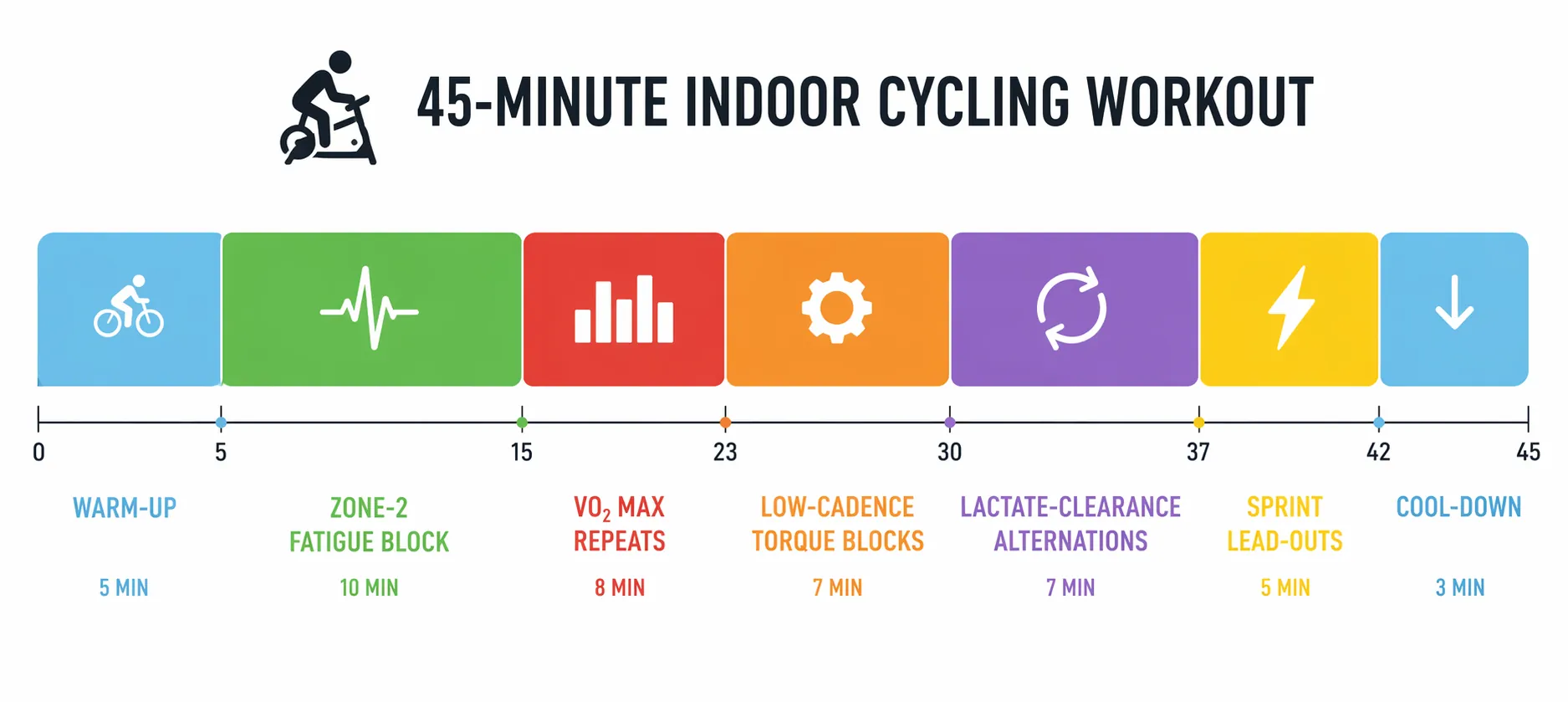
The 45-Minute Tour-Inspired Workout
Set the bike so it is stable, put a towel where you can reach it, and keep the fan on from the start. Use cadence in rpm and RPE on a 1–10 scale: RPE 2–3 is very easy, RPE 5–6 is steady endurance, RPE 7–8 is hard but controlled, and RPE 9–10 is the kind of effort where breathing gets ragged and conversation is gone.
| Time | Block | Cadence | RPE | Resistance cue | What it should feel like |
|---|---|---|---|---|---|
| 0:00–6:00 | Warm-up | 85–95 rpm | 2–5 | Start light, add resistance every 2 minutes | Legs loosen, breathing rises, no strain yet |
| 6:00–18:00 | Steady zone-2 fatigue builder | 85–95 rpm | 5–6 | Moderate resistance you can hold without grinding | Working, warm, controlled; you could speak in short sentences |
| 18:00–26:00 | VO2 max repeats: 4 x 1 minute hard, 1 minute easy | 95–105 rpm hard; 85–95 rpm easy | 9–10 hard; 2–3 easy | Add enough resistance that cadence stays fast but not bouncy | Breathing turns sharp by the final 20 seconds of each hard minute |
| 26:00–32:00 | Low-cadence torque: 3 x 1 minute grind, 1 minute easy | 40–60 rpm hard; 85–95 rpm easy | 8–9 hard; 2–3 easy | Heavy resistance; smooth pressure through the full pedal stroke | Pedals feel sticky, upper body stays quiet, knees track cleanly |
| 32:00–38:00 | Lactate-clearance alternations: 3 rounds of 45 seconds over / 75 seconds under | 90–100 rpm over; 85–95 rpm under | 8 over; 6 under | Nudge resistance up for the over, slightly down for the under | You never fully recover; the under sections teach control |
| 38:00–42:00 | Sprint lead-outs: 4 x 30 seconds all-out, 30 seconds easy | 100+ rpm sprint if safe; 80–90 rpm easy | 10 sprint; 2 easy | Start with resistance already engaged, then accelerate hard | The sprint is over before bargaining starts |
| 42:00–45:00 | Cool-down | 80–90 rpm | 1–2 | Very light | Breathing returns, legs stop buzzing |
Do this as one high-intensity session, not as a daily habit. Pro riders may train 20–30 hours per week, but the useful context is that most of that volume is still easy riding, with only a few high-intensity days layered into the week.[1][6] That makes this workout more legitimate, not less: it is the hard day, not a miniature Tour training plan.
Why This Order Works
The workout starts with 12 minutes of steady zone-2 riding before the fireworks. That is not filler. Dion Smith’s Tour training example places endurance work before high-intensity intervals so the rider has to produce quality efforts under accumulated fatigue; his original session is a pro-level ride of more than 6 hours, so the home version borrows the sequencing principle rather than compressing the whole thing into an evening.[2]
That fatigue-first start changes the rest of the workout. The VO2 repeats arrive when the legs are already warm and slightly dulled. The torque efforts come after your breathing has been disturbed. The above/below-threshold work lands when recovery is incomplete. The sprints are saved for the end, where lead-out power matters because it has to happen with noise already in the legs.
Alex Dowsett’s Tour de Wattbike sessions show how useful strict timing and recovery ratios can be in Tour-themed indoor work, especially when the session is broken into clear blocks instead of one vague instruction to “ride hard.”[3] The point here is not to recreate a specific stage profile. It is to put climb pressure, threshold control, and sprint violence into one repeatable format.
How the Pro Patterns Become a Basic-Bike Session
VO2 max: keep the wattage lesson, ignore the wattage target
Brandon McNulty’s published training examples include 4-minute VO2 max repeats around 500 watts, which is a useful look at the kind of interval pros use and a useless target for most home riders.[1] The home translation is not “try to ride 500 watts.” It is: ride hard enough that one minute becomes a serious oxygen problem.
On a basic bike, set resistance so you can hold roughly 95–105 rpm without spinning out. The first 20 seconds should feel aggressive but possible. By 40 seconds, breathing should be ragged. By the final 10 seconds, you should be counting down. If your cadence collapses below the target, resistance is too high. If you finish the fourth rep feeling tidy, resistance is too low or the effort was not honest.
Torque: the pedals should feel heavy, not chaotic
McNulty’s training examples also include low-cadence torque work at about 40 rpm with heavy resistance, used as a specific strength-on-the-bike pattern rather than random mashing.[1] This is one of the easiest pro ideas to feel on a basic stationary bike because the resistance knob does exactly what the road would do on a steep pitch: it makes the pedals resist you.
For most riders, 40–60 rpm is the usable range. Sit tall, keep the hips quiet, and press smoothly rather than stabbing at the downstroke. The effort is RPE 8–9, not an all-out sprint. If your knees complain, lighten the resistance immediately and ride closer to 60 rpm. Good torque work feels like controlled pressure; bad torque work feels like wrestling the bike.
Lactate clearance: slightly over, slightly under, no full reset
The lactate-clearance block is the most controlled part of the session. It should not feel like four separate attacks. It should feel like a rider lifting over a rise, settling just below threshold, then lifting again before the legs have gone clean.
Use 45 seconds at RPE 8, then 75 seconds at RPE 6. The “under” portion is not recovery in the soft sense; it is still work. This above/below rhythm is where a dumb trainer or basic bike can be better than expected, because you only need two reliable resistance positions: one for pressure, one for control.
Sprint lead-outs: short enough to be honest
The final block uses 30-second all-out sprints with equal easy spins. Bicycling’s Tour-inspired indoor rides use accessible RPE language for hard indoor efforts, and that matters here because sprint work without power has to be judged by commitment and repeatability rather than a number on a screen.[4]
Do not start these from feather-light resistance. Add enough load that the first pedal strokes have something to bite against, then accelerate. If your bike rocks, your feet slip, or your cadence gets silly, back off. A home sprint should be violent in the legs, not sketchy in the room.
Controlling Intensity Without Power
Power is tidy because it gives you one number to obey. Without it, you use three checks: cadence, breathing, and repeatability. Cadence tells you whether the gear is mechanically right. Breathing tells you whether the energy system is being stressed. Repeatability tells you whether the first interval was ego or execution.
| Block | If it feels too easy | If it feels too hard | Correct adjustment |
|---|---|---|---|
| Zone-2 fatigue builder | You can speak normally and forget you are working | You are already dreading the intervals | Add or remove a small amount of resistance while keeping 85–95 rpm |
| VO2 repeats | You finish each hard minute composed | Cadence falls apart before 30 seconds | Tune resistance so the last 20 seconds are ugly but controlled |
| Torque | Cadence floats above 60 rpm | You rock your hips or feel knee strain | Use heavier resistance only if the pedal stroke stays smooth |
| Lactate clearance | The under feels like full recovery | The over feels like a sprint | Keep the change between settings small |
| Sprints | You can save something for later | Bike stability becomes the limiter | Sprint hard within the safest resistance and cadence range your bike allows |
Terrain-to-resistance translations can help if RPE feels too abstract. JLL Fitness frames indoor Tour route recreation through resistance and cadence changes: climbs become heavier, lower-cadence work; flatter fast sections become quicker cadence with less grinding.[5] Use that idea lightly. The VO2 block is a hard surge over open road, the torque block is the steep ramp, the lactate-clearance block is rolling terrain, and the sprint block is the run-in.
The main mistake is making every hard block the same. VO2 is fast and breathless. Torque is slow and heavy. Lactate clearance is controlled discomfort. Sprinting is maximal and brief. If those all feel identical, the resistance knob is being used as decoration.
Where It Fits in a Week
Use this workout once per week when you want a demanding interval day. If you already ride 3–5 times per week, place it after an easy day or rest day, then keep the next ride easy. The pro-volume context cuts both ways: Tour riders train far more hours than normal people, but they still do not make every ride a maximal interval session.[1][6]
If you want stage-type variety rather than one unified interval blueprint, use Tour de France indoor cycling workouts on any bike. If your interest is pacing a steady solo effort, indoor cycling training for time trials on a budget is the cleaner next step.
Small Execution Rules That Matter
- Change resistance before the interval starts, not 20 seconds into it.
- Protect the easy minutes; soft-pedaling properly is what lets the hard work stay sharp.
- Keep torque seated unless your bike is stable enough for standing work.
- End a sprint early if the bike moves, the pedals feel loose, or your form turns reckless.
- Write down the resistance positions you used so the next attempt is comparable.
After the final cool-down, keep the recovery ordinary: easy spinning, fluids, and a normal meal if the session sits near dinner. The carb-timing advice often attached to longer rides matters more when training goes beyond an hour; for this 45-minute workout, the bigger win is not turning the cool-down into extra intervals.
A cadence display and honest RPE are enough here. Match the rpm, choose resistance that creates the right sensation, and let each block do its job. That is the part worth stealing from the Tour.
References
- Pro Cyclist Power Output: Train Like a Tour de France Rider & Get Faster — EVOQ.BIKE
- Tour de France Training Plan — Stages Cycling
- Tour de France Workouts by Alex Dowsett — Wattbike
- Indoor Rides Inspired by the Tour de France — Bicycling
- How to Recreate Tour de France Routes at Home — JLL Fitness
- How Do Tour de France Riders Train? — Bicycling
What a small equipment investment adds
Cable Machine Alternatives That Save Space and Money
Compare the best cable machine alternatives for home gyms – from resistance bands and pulley systems to suspension trainers and compact digital units – and find the right option for your space and budget.
Small Treadmill Buying Guide: 7 Critical Specs to Check Before You Buy
A cross-category spec primer for apartment and small-space dwellers comparing walking pads, ultra-compact folding treadmills, and full-size folding treadmills. Learn the concrete thresholds for motor HP, deck length, noise, warranty, and subscription lock-in so you can compare apples to apples.
How to Practice Basketball at Home Without Noise Complaints
Learn how to run a full basketball workout in a small apartment without noise complaints. This guide covers no-dribble handling drills, wall form shooting, and silent ball options that let you train without disturbing neighbors.
How often should you repeat this?
See our recovery and rest reference for citation-anchored rest-interval guidance.
Spot something off?
Tell us if a movement, tier assumption, or duration didn't match your experience.