
How to Build Muscle Like Travis Hunter With Home Workouts
Adapt Travis Hunter's explosive two-way training for home workouts using bands, dumbbells, and bodyweight. This article breaks down his three-pillar approach into actionable exercises that build lean muscle and durability without a gym.
- Equipment tier required
- none
- Duration
- 45 min
- Difficulty
- beginner
- Target area
- full body
- Space footprint needed
- Small (6-ft hallway)
- Noise level
- Quiet-friendly (avoid jumping)
The useful part of the Travis Hunter muscle-gain story is not that an elite athlete got bigger. It is how the gain reportedly happened: approximately 10–13 pounds of lean mass added during an offseason when running was limited by rehab, with Jaguars head coach Liam Coen publicly saying, “I've been very pleased with Travis and the way he looks, his upper body.”[1] For a home athlete, that flips the usual excuse. If you cannot run much, cannot get to a weight room, or only have a hallway, a band, and one weight, strength work has to carry more of the adaptation.
That does not mean a dumbbell in your apartment becomes the same thing as an NFL facility. Hunter's reported environment includes resisted speed tools, heavy Olympic-style lifts, cables, elite coaching, and a workload most people should not try to imitate. The home version has to be more honest: copy the training qualities, not the equipment or the numbers.
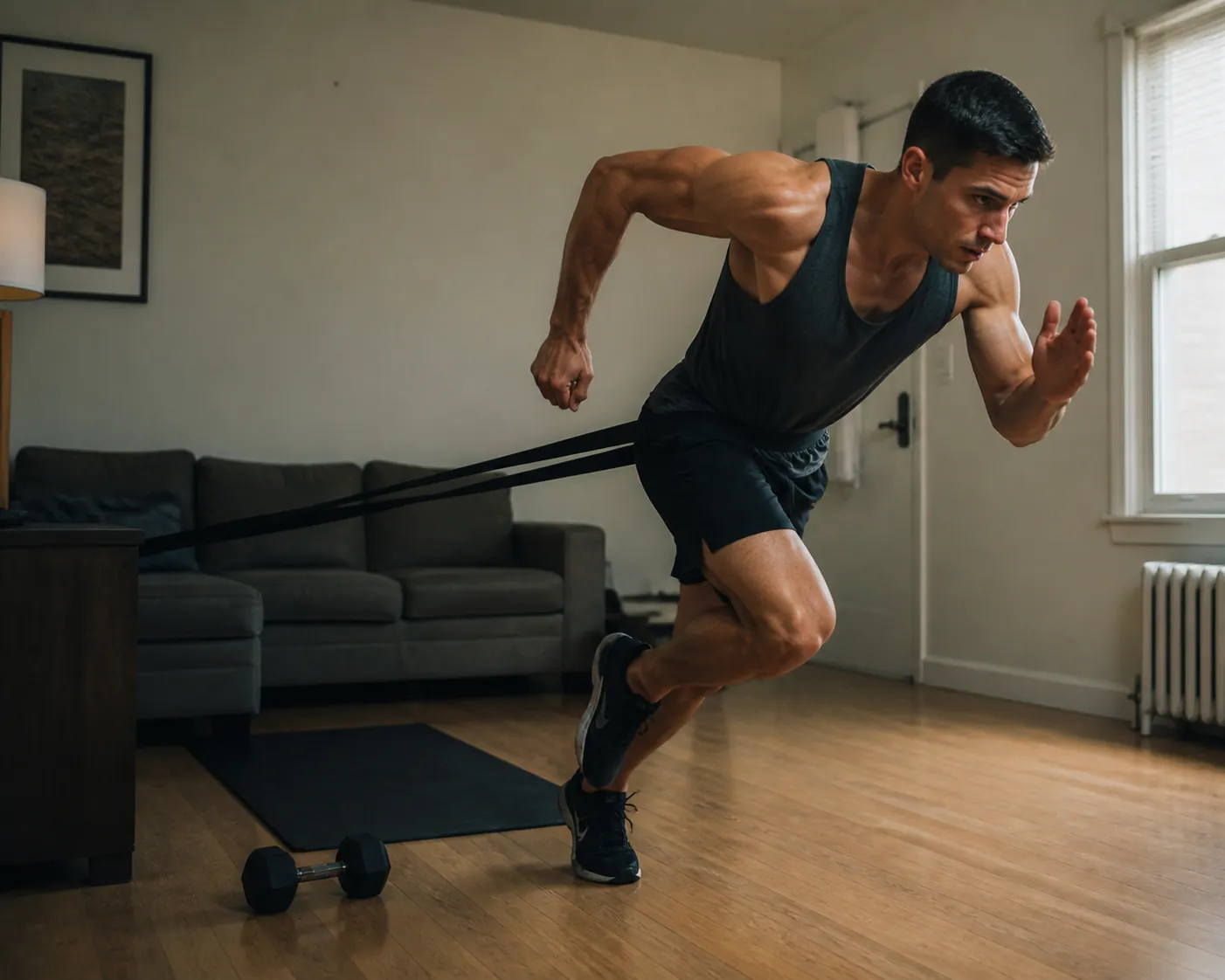
Hunter's body has to solve a strange football problem. In his Heisman season, he produced as a receiver with 92 catches, 1,152 yards, and 14 touchdowns while also playing cornerback with 31 tackles and 4 interceptions. Those numbers matter here because they point to the physical demand: accelerate, brake, jump, absorb contact, recover, then do it again from another position.
The Three Qualities Worth Copying
The cleanest way to turn reported Hunter-style training into home workouts is to organize it around three qualities: resisted acceleration, explosive compound power, and high-volume trunk-and-hip endurance. Those are not bodybuilding categories. They are football categories. They explain why the muscle looks useful instead of just inflated.
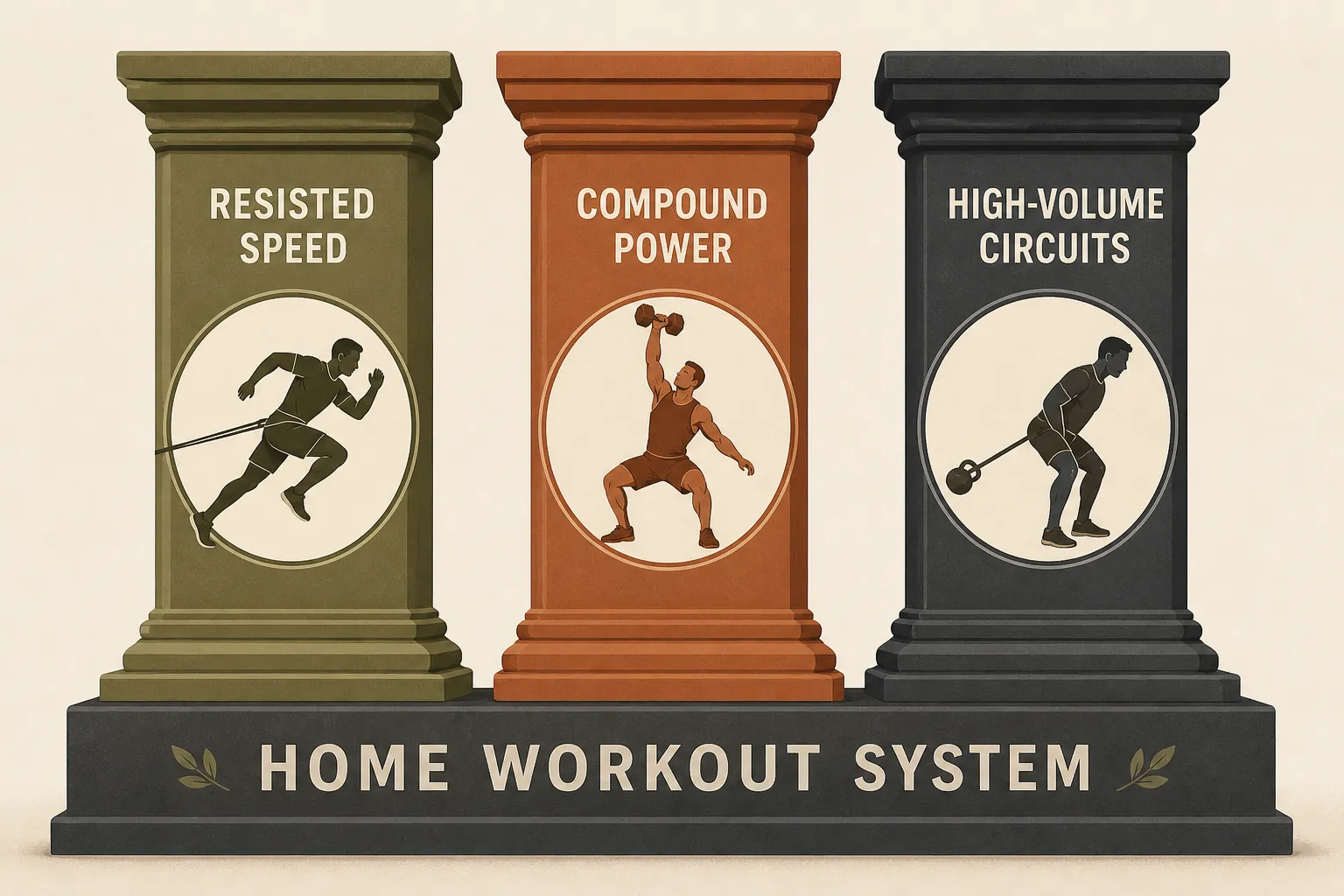
| Training quality | What Hunter's reported work suggests | Home translation |
|---|---|---|
| Resisted speed | Sprints with belts, sleds, and added resistance | Band-resisted starts, backpack hill walks, stair accelerations, short incline sprints |
| Compound power | Heavy clean variations and explosive lifting capacity | One-arm dumbbell snatches, kettlebell swings, goblet squat-to-press, jump squats |
| High-volume stability | Pull-through and push-up fatigue circuits | Band pull-throughs, push-ups, plank variations, lunges, single-leg work |
Start With Resisted Speed, Even If You Only Have Six Steps
Hunter has described using resisted sprint work, including belts, sleds, and added weight, as part of his training approach.[2] The point is not simply to make running harder. Resisted starts teach the body to push the floor away, keep the torso organized, and produce force through the hips before the stride opens up.
At home, the best version depends on what your space can safely handle. If you have a sturdy anchor and enough room, use a resistance band around the hips for short marching drives, wall-drive steps, or 3–5 hard acceleration steps. If anchoring a band to furniture feels even slightly questionable, do not turn your apartment into a physics experiment. Use a loaded backpack, a hill, stairs, or a slow high-tension march instead.
- Quiet apartment option: band-resisted wall drives for 5–8 seconds, then rest.
- Hallway option: 3-step resisted starts, stopping before speed turns into noise.
- Outdoor option: short hill accelerations or stair pushes with full control.
- No-anchor option: backpack-loaded marching drives, focusing on shin angle and hip extension.
Keep these efforts short. This is not conditioning yet. If every rep turns into a sloppy burn, you are training fatigue more than acceleration. A good rep feels like a clean launch: braced ribs, hips pushing through, feet striking under control, and no tugging at a doorframe you do not fully trust.
Power Work Is About Intent, Not Pretending a Dumbbell Is a 335-Pound Clean
Hunter's college training clips became attention magnets because the loads were real. One report described a 335-pound clean at Colorado.[3] Another reported that he moved from a 275-pound hang clean to a 300-plus-pound PR within roughly three months of training.[4] Those lifts show explosive strength expression, not a home-workout prescription.
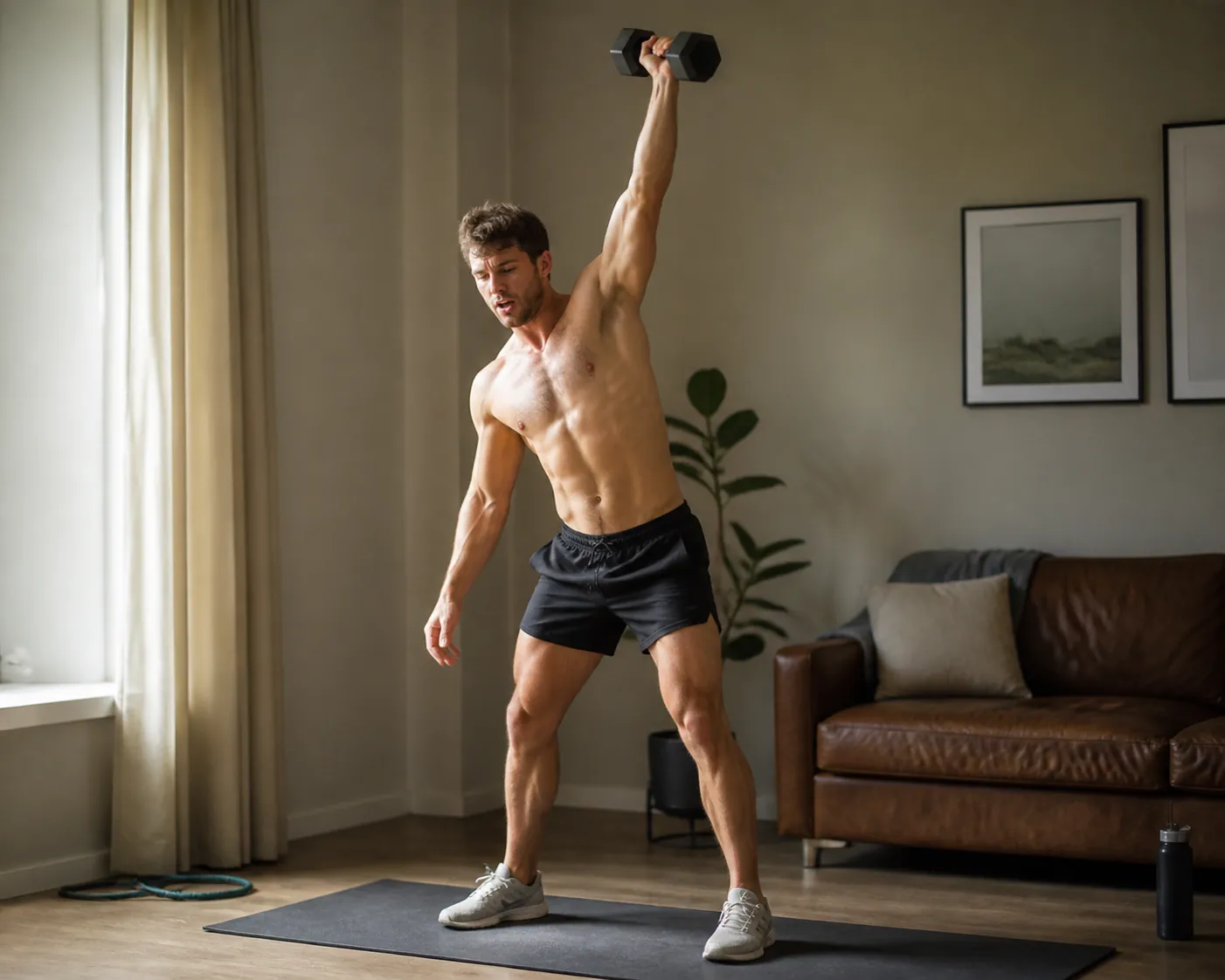
A one-arm dumbbell snatch is not equal to a heavy hang clean. It does, however, train a related pattern at a smaller scale: hips extend fast, the trunk stays stiff, force travels from the floor through the hand, and the weight finishes overhead without turning the rep into a slow shoulder press. That is the level of translation that makes sense in a living room.
| If you have | Use | Main rule |
|---|---|---|
| One dumbbell | One-arm dumbbell snatch | Stop the set when speed drops or the catch gets messy |
| One kettlebell | Hard-style swing or clean | Snap the hips; do not squat every rep |
| No weight | Jump squat or broad-jump stick | Land quietly and own the stop |
| Light weight only | Goblet squat-to-press | Move crisply without turning it into a grind |
For muscle gain, power work needs enough tension to matter, but it should still look athletic. A good home set is usually 3–6 strong reps, not a 25-rep survival test. Save the deep fatigue for the circuit work. In the power block, every rep should look like you could cut, jump, or brace for contact right after it.
Use High-Volume Circuits to Build the Engine Around the Hips and Trunk
The reported pull-through and push-up circuit is the part that feels most useful for the small-space athlete: high-rep hip extension paired with upper-body fatigue. Training footage descriptions have pointed to 100-rep cable pull-through work with push-ups between sets. At home, the honest adaptation is a resistance-band pull-through paired with push-ups, not because it is identical to a cable stack, but because the pattern is close enough to train hip extension, bracing, and repeated effort.
Set the band low, face away from the anchor, and let the hands travel back between the legs as the hips hinge. Then drive the hips through and finish tall. If the lower back starts doing the work, shorten the range, reduce band tension, or switch to bodyweight hip hinges. The goal is not to win a rep-count contest; it is to make the glutes, hamstrings, and trunk keep producing after the fast work is already done.
- Band pull-throughs: 4 sets of 20–25 reps, smooth and repeatable.
- Push-ups: 8–20 reps between pull-through sets, adjusted before form breaks.
- Rest: enough to keep the next set clean, usually 45–90 seconds.
- Regression: incline push-ups and lighter band tension.
- Progression: slower eccentric push-ups, stronger band tension, or fewer breaks across the same total reps.
The Durability Work Is Not Optional
A two-way body has to survive awkward positions. That is where bodyweight work earns its place. Brett Fischer's NFL.com home program for football players includes push-ups, matrix lunges, single-leg squats, and tricep dips, which fit the same durability problem without pretending to be Hunter's personal routine.[5]
Matrix lunges are especially valuable for home workouts because they make the hips and knees handle force from more than one angle. Step forward, diagonal, lateral, and backward. Keep the foot quiet. Keep the knee honest. If the knee dives inward or the torso folds, the rep is too deep or too fast. This is not filler work; it is where a lot of home athletes build the contact balance they claim they want.
Warm Up Like Shoulders and Spine Matter
Hunter's reported prep work includes prone backburns, swimmers, and T-spine rotations.[2] That is a useful clue. Before resisted starts, snatches, push-ups, and lunges, the upper back and shoulders need to move without stealing motion from the lower back.
- Prone backburns: 8–12 slow reps to wake up the shoulder blades.
- Swimmers: 6–10 controlled reps for shoulder range of motion.
- T-spine rotations: 6–8 reps per side, moving through the upper back instead of the hips.
- Low pogo hops or ankle bounces: 15–25 seconds if noise and joints allow.
A Home Workout Template Built From the Same Logic
This session order keeps the fastest, most coordinated work early, then moves into power, then finishes with volume. That matters. If you bury acceleration work after a long circuit, you are not training acceleration anymore; you are practicing tired footwork.
| Block | Exercise | Dose |
|---|---|---|
| Warm-up | Prone backburns, swimmers, T-spine rotations | 1–2 rounds |
| Resisted speed | Band wall drives, 3-step starts, stairs, or hill accelerations | 6–10 short efforts |
| Footwork | Forward/backward shuffle, lateral stick, or low-volume ladder pattern | 4–6 controlled rounds |
| Power | Dumbbell snatch, kettlebell swing, goblet squat-to-press, or jump squat | 3–5 sets of 3–6 reps |
| Strength durability | Matrix lunges, single-leg squat progression, push-ups, tricep dips | 2–4 rounds |
| High-volume finish | Band pull-throughs paired with push-ups | 80–100 total pull-through reps, push-ups scaled to form |
Choose the version that matches your space before you choose the harder version. In a second-floor apartment, quiet stair pushes may beat jump squats. In a narrow hallway, wall drives may beat resisted sprints. If you only own a light dumbbell, make the power work crisp and use lunges, tempo push-ups, and pull-through volume to create the muscle-building stress.
This is not the fastest route to maximum bodybuilding size. A pure hypertrophy split would give more direct volume to individual muscles. But that is not really the Hunter appeal. The target is lean muscle that shows up when you accelerate, change direction, absorb contact, and repeat hard efforts without feeling like every joint is negotiating with you.
A home athlete cannot copy Hunter's loads, staff, or two-way NFL workload. The better standard is simpler: train resisted acceleration, express power through the hips and upper body, then build enough trunk and hip endurance to keep moving well under fatigue. If the workout makes you faster off the first step, stronger through contact positions, and more durable across repeated efforts, it is closer to Hunter's blueprint than a generic muscle split with his name pasted on top.
References
- Jaguars' Travis Hunter bulked up during the offseason, Yahoo Sports, July 2026
- Jacksonville Jaguars Travis Hunter Shares His Plan for Success, Men's Health
- Travis Hunter Shakes Colorado Buffs' Weight Room With Massive 335-Pound Clean Lift, EssentiallySports
- Travis Hunter Jr. Goes From Clark Kent To Superman…, BroBible
- No Gym? No Problem: 5 home exercises for football players, NFL.com
What a small equipment investment adds
We don't have a build tagged to this exact tier yet. Browse all builds.
How often should you repeat this?
See our recovery and rest reference for citation-anchored rest-interval guidance.
Spot something off?
Tell us if a movement, tier assumption, or duration didn't match your experience.