
Travis Kelce's Home Pre-Hab Routine for a Durable Physique
This article adapts Travis Kelce's pre-hab and stabilizer training into a quiet, small-space home workout using just a resistance band, a light dumbbell, and a chair. You'll learn how to train the same injury-prevention patterns that keep an NFL star durable, without needing a commercial gym.
- Equipment tier required
- $0-100
- Duration
- 25 min
- Difficulty
- beginner
- Target area
- full body
- Noise level
- quiet
Search for a Travis Kelce home workout routine for physique and the tempting answer is to copy the loudest parts of football training: sled pushes, jumps, turf drills, loaded carries, racks, and a room built to absorb impact. That is also the part that breaks down fastest in a second-floor apartment.
The more useful home version starts smaller. Kelce’s published offseason work includes wall slides, single-leg box squats, and single-arm snatches, with sets and reps from trainer Alex Skacel: wall slides for 3 sets of 15 per side, single-leg box squats for 3 sets of 10 per side, and single-arm snatches for 3 sets of 6 to 8 per side.[1] Those do not look like the fastest route to a celebrity physique. They look like the kind of training that lets the bigger work keep happening.
That distinction matters. Kelce’s training is not just these three moves, and it should not be sold that way. His broader setup includes professional coaching, position work, and programming that has changed over time. But if the goal is to borrow the piece that survives ordinary constraints, the pre-hab layer is the one worth taking home: one wall, one sturdy chair, one light dumbbell, one resistance band, and enough floor space to stand without clipping a lamp.
The Part of Kelce’s Training That Actually Fits at Home
Skacel’s published in-season approach for Kelce was built around a circuit of core and joint stabilizers followed by hip and glute activation.[1] Tonal later framed this as Kelce “sweating the small stuff,” emphasizing a shift away from making heavy lifts the whole story and toward the stabilizer work that supports durability.[2]
For a home trainee, that is not a downgrade. Most small-space routines fail less often from a lack of intensity than from a shoulder that gets irritated, a knee that drifts under fatigue, a low back that starts doing hip work, or a plan that demands more noise and equipment than the room can tolerate. Stabilizer training is not glamorous, but it solves the problems that usually interrupt consistency.
Kelce’s durability is part of why this layer gets attention. He has missed only 3 regular-season games since 2019, with none of those missed games due to injury.[3] That does not mean wall slides make a renter injury-proof. It does mean the training philosophy is attached to a player whose body has had to stay useful under contact, travel, and long seasons.
There is also a caveat worth stating early: Kelce’s current training is not frozen in the 2021 exercise list. Reporting ahead of the 2025 season described a newer routine with a plyometric emphasis and a three-trainer split involving Skacel, Andrew Spruill, and Laurence Ng.[3] This routine adapts published pre-hab work associated with his training; it does not claim to reproduce his current weekly plan.
What You Need Before You Start
The equipment floor is low, but it is not zero. A useful home version needs a clear wall, a sturdy chair or bench, a light dumbbell, and ideally a resistance band for glute activation. A 10- to 25-pound dumbbell is enough for most home users because the single-arm snatch here is being used for coordination, hip drive, and shoulder control, not a max-effort lift.
| Item | Why it matters | Apartment note |
|---|---|---|
| Clear wall section | Lets you train shoulder control with wall slides | Use a spot without frames, shelves, or baseboard clutter |
| Sturdy chair or bench | Sets the depth for single-leg box squats | Choose something that will not slide, wobble, or fold |
| Light dumbbell | Adds power and coordination to the single-arm snatch | Keep the weight light enough that every rep is quiet |
| Resistance band | Supports glute activation before the squat and snatch work | A mini band or long loop band stores easily |
The room requirement is also modest. You need enough space to stand tall, reach overhead, sit back to a chair, and hinge with one dumbbell between your feet. No jumps. No drops. No sprint starts. If a movement makes the floor shake, it is no longer serving the purpose of this version.
The Small-Space Kelce-Inspired Session
Run this as a controlled pre-hab and stabilizer session, not as a punishment circuit. Rest long enough to keep the reps clean. The published Kelce exercises provide the backbone; the band work prepares the hips so the knees and back do not have to fake stability.
| Order | Exercise | Sets and reps | Main job |
|---|---|---|---|
| 1 | Band glute activation | 2 sets of 10 to 15 controlled reps | Wake up the hips before single-leg work |
| 2 | Wall slides | 3 sets of 15 per side | Train shoulder position and upper-back control |
| 3 | Single-leg box squats | 3 sets of 10 per side | Build quiet knee, hip, and ankle control |
| 4 | Single-arm snatches | 3 sets of 6 to 8 per side | Connect hip drive, trunk stiffness, and shoulder stability |
The sets and reps for wall slides, single-leg box squats, and single-arm snatches come from the published Men’s Health workout.[1] The glute activation slot comes from the same reported structure around hip and glute activation, but the exact home variation can be adjusted based on the band and floor space available.[1]
Start With Glute Activation, Then Get Out of Its Way
A banded glute bridge, lateral band walk, or standing band abduction can fill this opening slot. Keep it simple: controlled reps, no hip swinging, no turning the warm-up into a separate workout. The goal is to make the hips easier to find before the single-leg squats and snatches ask for stability.
If the band work burns so much that your knees shake during the next exercise, it was too much. Pre-hab should raise the quality of the main work, not steal from it.
Wall Slides: Shoulder Control That Deserves Real Attention
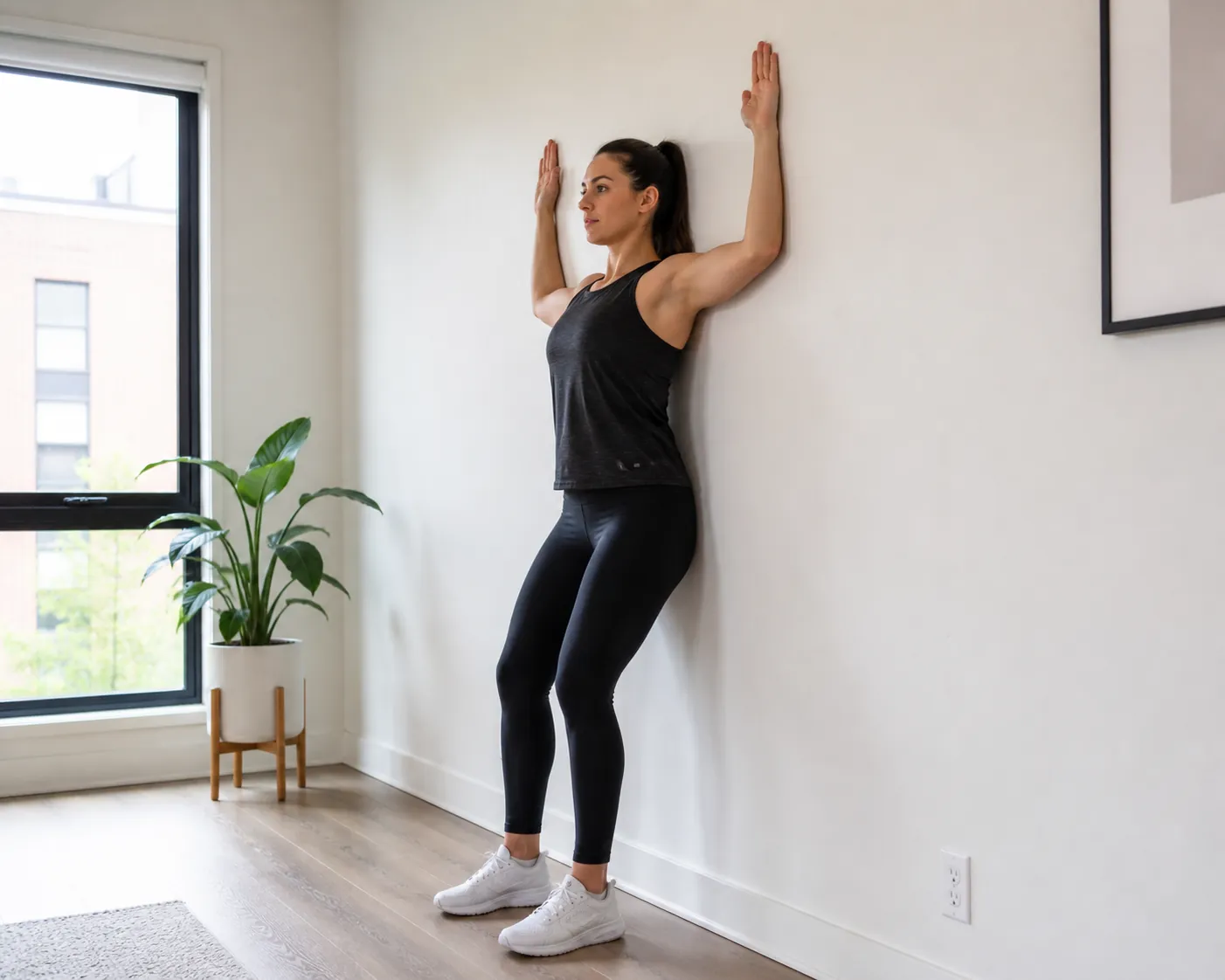
Wall slides are easy to dismiss because they do not make the room look like training is happening. That is usually the point. Stand with your back against a wall, ribs down, and arms moving in a controlled overhead path. The work is in keeping the shoulder blades, ribs, and neck organized while the arms move.
For the home version, use Kelce’s published prescription of 3 sets of 15 per side.[1] Move slowly enough that you can feel whether the shoulder is gliding or whether the low back is arching to fake overhead range. If the ribs flare, reset. If the neck tightens, reduce the range. A clean half-rep teaches more than a full rep held together by compensation.
- Setup: back near the wall, core braced, feet far enough forward to keep the pelvis controlled.
- Purpose: train shoulder blade upward rotation, rib control, and overhead positioning.
- Noise level: silent, which makes it ideal for early mornings or upstairs apartments.
- Common fix: shorten the range before you let the lower back arch.
Single-Leg Box Squats: The Chair Height Decides the Exercise
The single-leg box squat is the most apartment-friendly lower-body move in the group because the chair gives you a target and a brake. It is also the easiest to ruin with ego. If the seat is too low, the working knee caves, the foot twists, and the last few inches become a drop. If the seat is too high, you avoid the range where control is actually needed.
Use the published 3 sets of 10 per side as the target.[1] At home, start with a chair height that lets you sit back softly and stand without pushing off the non-working foot. The knee should track roughly over the middle toes. The pelvis should not dump to one side. The foot should stay quiet on the floor.
The best rep is almost boring: controlled descent, brief contact with the chair, smooth stand. No bounce. No collapse. No theatrical grind. If you live above someone, the sound of the chair should not announce the bottom of the rep.
| If this happens | Change this |
|---|---|
| You fall onto the chair | Raise the seat or slow the descent |
| Your knee dives inward | Use a lighter range and press the foot evenly into the floor |
| Your hip shifts hard to one side | Hold a wall lightly for balance until the pattern improves |
| Your back rounds at the bottom | Shorten the depth and keep the ribs stacked over the pelvis |
Single-Arm Snatches: Keep the Power, Remove the Drama
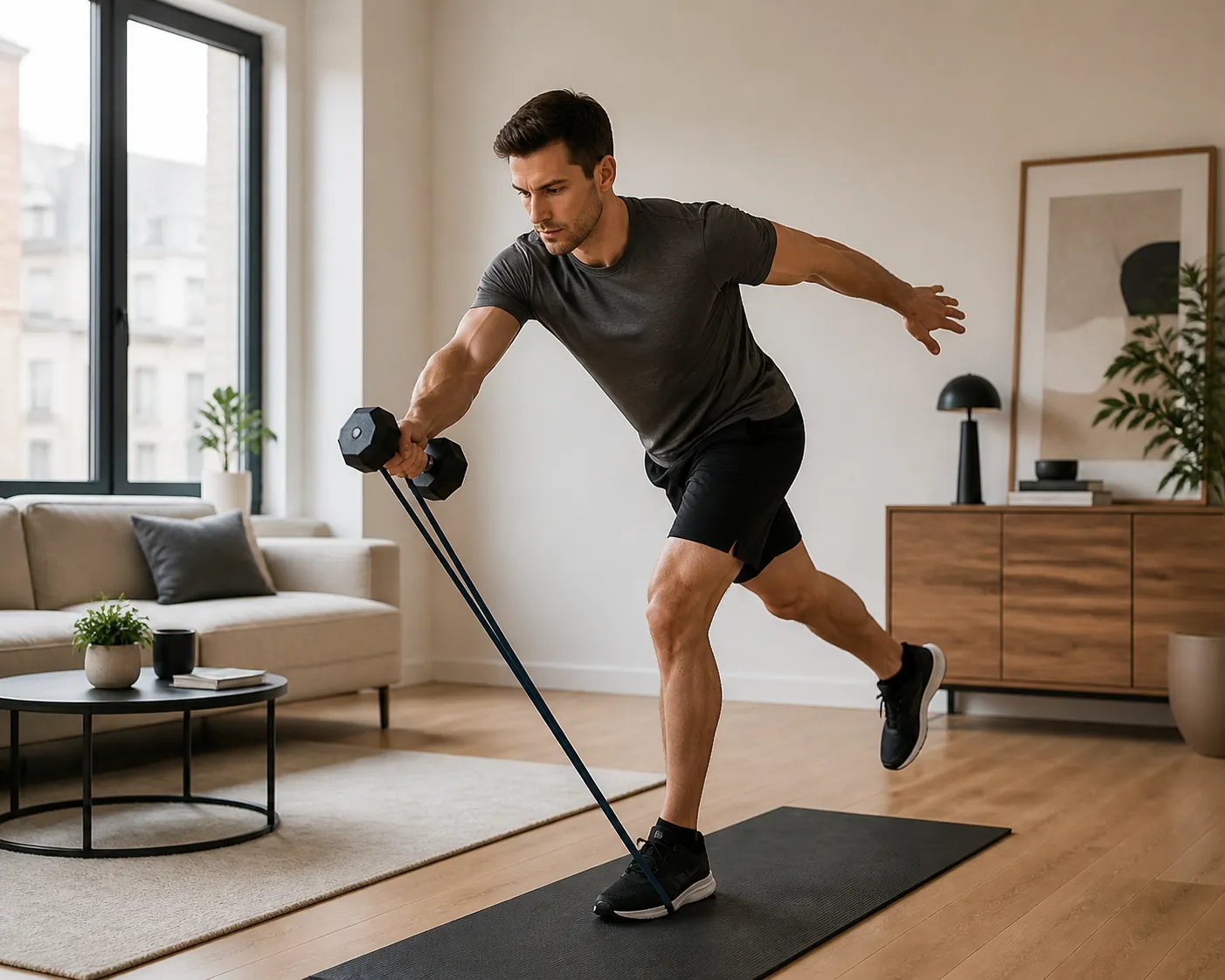
The single-arm snatch is the one move here that deserves the most caution. It can be a good home exercise, but only if the weight stays light and the ceiling, floor, shoulder, and grip all get a vote. Kelce’s published prescription is 3 sets of 6 to 8 per side.[1] For a home trainee, that should feel crisp rather than maximal.
Place the dumbbell between your feet, hinge at the hips, brace the trunk, and drive up so the weight travels close to the body. The arm guides; the hips do the work. At the top, the shoulder should feel stacked, not yanked. Lower the dumbbell with control instead of letting it thud back to the floor.
If overhead movement feels sketchy, substitute a single-arm dumbbell high pull or a single-arm dumbbell clean. Those options keep the hip drive and trunk control without forcing an overhead catch in a small room. That is not a failure of intensity; it is choosing the version that can be repeated without turning the session into a shoulder experiment.
- Use a light dumbbell you can stop at any point in the rep.
- Keep the weight close instead of swinging it away from the body.
- Finish tall, with the ribs down and the shoulder stacked.
- Lower quietly; do not drop the dumbbell between reps.
How Often to Use It
For most home trainees, this routine fits best 2 to 3 times per week. It can stand alone on a recovery-focused day, or it can sit before a short strength session if the reps stay clean. The full session does not need to leave you wrecked. Its job is to improve the positions that make later training possible.
A simple week might place it on Monday and Thursday, with an optional lighter version on Saturday. If you already lift hard, keep the snatches light and treat the wall slides and single-leg box squats as quality work. If this is your main training, add slow tempo and cleaner control before adding load.
| Goal | Best use |
|---|---|
| Shoulder and hip maintenance | Use the full routine 2 times per week |
| Small-space athletic conditioning | Use it 3 times per week with short rests and clean reps |
| Warm-up before strength training | Do 1 to 2 sets of each move before heavier work |
| Skill practice | Keep the snatch variation light and stop before form fades |
What This Routine Will Not Do
This is not Kelce’s whole physique machine. It does not include his full professional training environment, football skill work, heavy sleds, contact preparation, or the more recent plyometric emphasis reported for 2025.[3] It also does not try to reverse-engineer his diet, because this particular home adaptation does not need a calorie spectacle to be useful.
It also will not replace progressive strength training forever. If your only goal is maximum muscle gain, you will eventually need more loading options than one light dumbbell.
The payoff is durability: shoulders that tolerate overhead work better, hips that show up before the low back takes over, knees that learn to track under single-leg demand, and power work that stays controlled enough to repeat. It will not recreate the entire NFL system around Travis Kelce. It gives home users the most realistic part to borrow: quiet stabilizer work that helps an athletic body keep training.
References
What a small equipment investment adds
Cable Machine Alternatives That Save Space and Money
Compare the best cable machine alternatives for home gyms – from resistance bands and pulley systems to suspension trainers and compact digital units – and find the right option for your space and budget.
Small Treadmill Buying Guide: 7 Critical Specs to Check Before You Buy
A cross-category spec primer for apartment and small-space dwellers comparing walking pads, ultra-compact folding treadmills, and full-size folding treadmills. Learn the concrete thresholds for motor HP, deck length, noise, warranty, and subscription lock-in so you can compare apples to apples.
How to Practice Basketball at Home Without Noise Complaints
Learn how to run a full basketball workout in a small apartment without noise complaints. This guide covers no-dribble handling drills, wall form shooting, and silent ball options that let you train without disturbing neighbors.
How often should you repeat this?
See our recovery and rest reference for citation-anchored rest-interval guidance.
Spot something off?
Tell us if a movement, tier assumption, or duration didn't match your experience.