
How to Adapt Travis Kelce's Training Camp Prep for Home
Learn how to replicate Travis Kelce's three-phase training camp prep — speed work, lighter-weight strength, and daily prehab — using just adjustable dumbbells, a resistance band, and a yoga mat's worth of floor space in your apartment.
- Equipment tier required
- $0-100
- Duration
- 30 min
- Difficulty
- beginner
- Target area
- full body
- Space footprint needed
- yoga mat area
- Noise level
- quiet
The useful question is not whether a second-floor apartment can become Chiefs training camp. It cannot. Travis Kelce reported to Chiefs camp on July 29, 2026, walking into a ramp-up built around coaches, fields, timing, recovery staff, and years of pro football tolerance that a home gym cannot fake.[1] The better question is what survives when the field disappears.
For a small-space home workout, the answer is surprisingly clean: keep the order of the work, shrink the distance, and stop pretending the goal is to copy every rep. Kelce’s reported camp prep points toward three portable pillars: speed work broken into phases, lighter-weight strength that exposes stability problems, and daily prehab for the core, hips, glutes, and joint stabilizers.
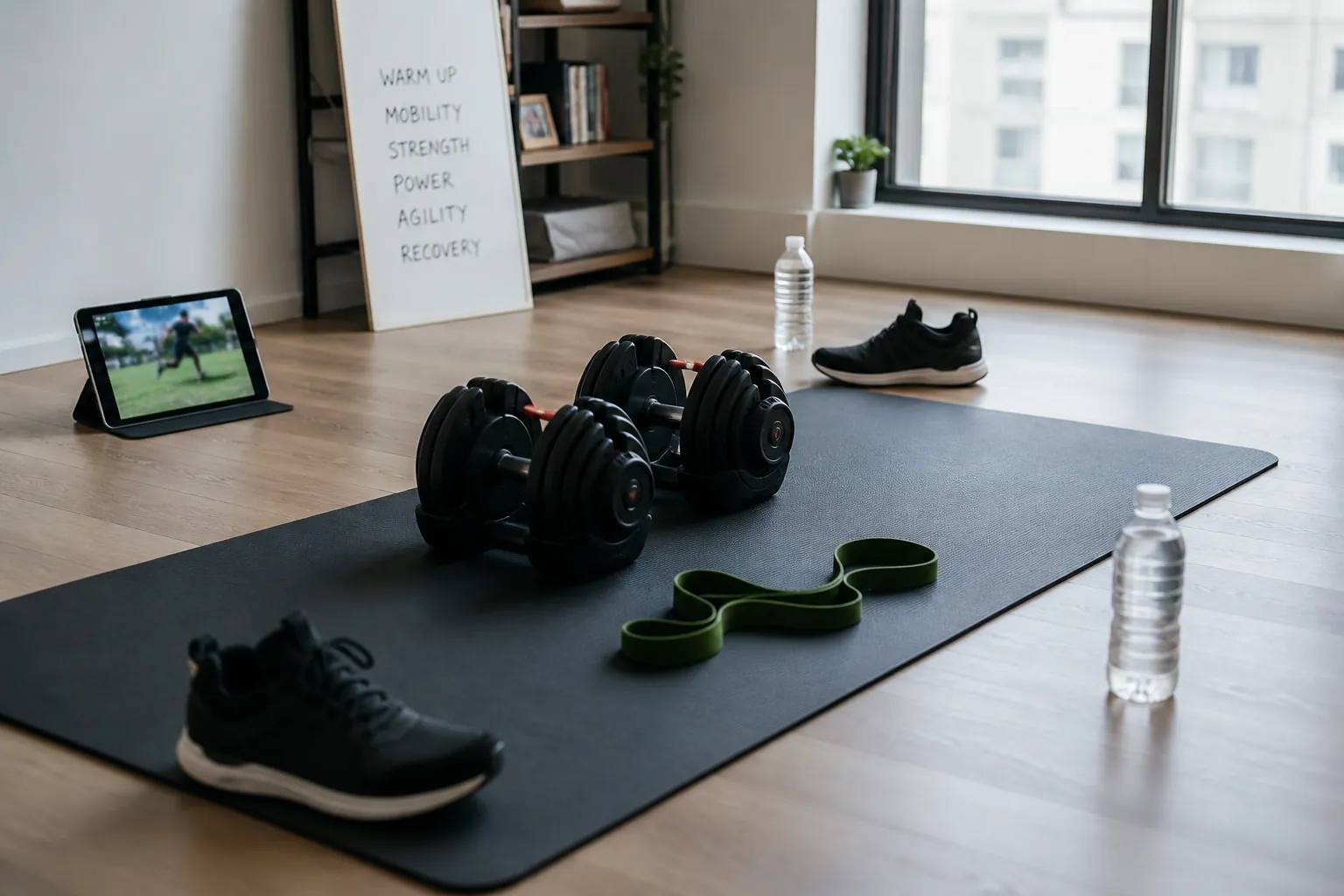
That is the honest version of a Travis Kelce training camp home workout: not a leaked pro session, not a celebrity fantasy plan, and not a promise that skater hops between water bottles turn anyone into an NFL tight end. It is a small-space translation of the categories his camp prep appears to prioritize.
The Home Version Starts With Three Pillars
Alex Skacel, identified in reporting as Kelce’s trainer, has described speed work in three phases: getting off the line, accelerating immediately, and handling stop-and-start agility. The same reporting also points to lighter-load strength work designed so the body does not “rely only on the bigger muscles.”[2] That line matters more than any single exercise name. It is the difference between moving weight and owning the position.
| Kelce camp-prep pillar | Home-gym translation | Main constraint |
|---|---|---|
| Three-phase speed work | Get-off starts, short accelerations, lateral stop-start drills | No field, so distance becomes timing, sharpness, and control |
| Lighter-weight strength | Goblet squats, split squats, lunges, rows, squat-to-press | Use loads light enough to reveal balance and bracing errors |
| Daily prehab | Core, joint stabilizers, hips, glutes, band activations | Treat it as daily practice, not optional warm-up filler |
The equipment list can stay modest: adjustable dumbbells, one resistance band, a yoga mat, and a few household markers such as shoes, books, or water bottles. If the dumbbells are heavy enough to challenge squats, lunges, presses, and rows without forcing ugly reps, they are heavy enough for this adaptation. Exact poundages are a judgment call here, not something the available Kelce sources prescribe.
Pillar One: Shrink Speed Work Without Killing the Point
Speed work gets watered down fastest in home workouts. People hear “agility” and start bouncing around until they are tired. That misses the part that matters. Skacel’s three phases give the session a job: start clean, accelerate now, stop and restart without leaking position.[2]
In an apartment, the get-off phase is not a sprint. It is the first two steps. Set two shoes about one long stride apart. Start in an athletic stance, hips back, ribs down, hands relaxed. On a timer beep or a self-count, drive out for two fast steps and freeze. The freeze is not decoration; it tells you whether the start stayed organized or whether the knees, hips, and trunk scattered as soon as you tried to move fast.
The acceleration phase becomes a short burst rather than a field sprint. Use three markers in a straight line if your space allows it, or stagger them diagonally if it does not. Start at marker one, burst to marker two, then marker three, and walk back. Keep the reps short enough that each one still looks like speed work. Once the drill turns into heavy breathing and sloppy feet, it is conditioning wearing a speed-work costume.
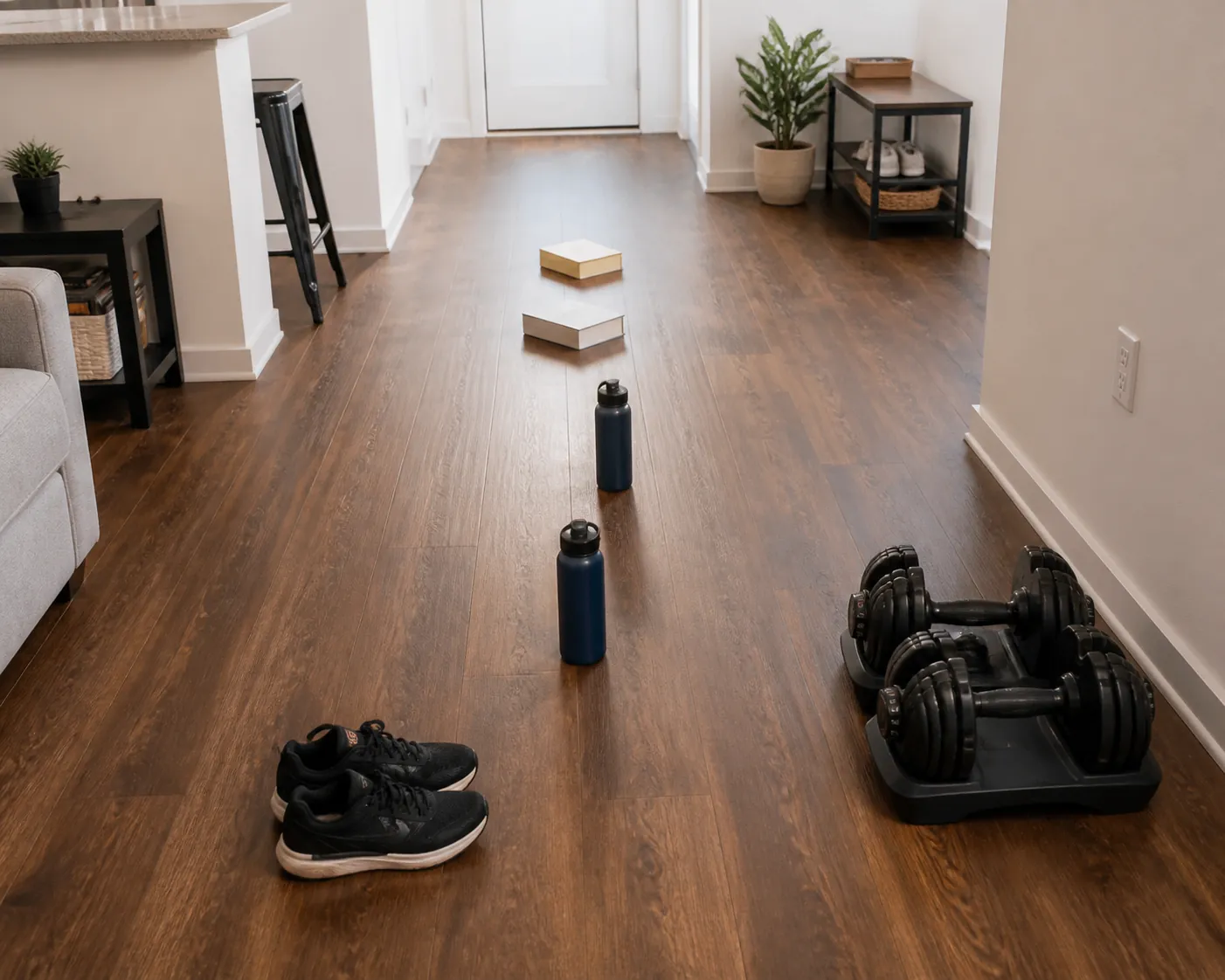
The stop-start phase is where the apartment version can actually teach something. Place two water bottles or books a few feet apart and work lateral shuffles between them. TODAY documented lateral shuffles, squat-to-presses, and skater hops as agility drills that can use household objects as cone substitutes, which makes them a clean fit for this setup.[3] The coaching point is not to cover huge ground. It is to brake without caving, reload the hips, and move again.
- Get-off drill: two-step start to a hard freeze, 4 to 8 crisp reps.
- Short acceleration: burst across two or three markers, then walk back and fully reset.
- Lateral shuffle: move between two markers, touch or hover near the marker, then drive back.
- Skater hop: hop side to side, land quietly, hold the landing before the next rep.
The 2025 reporting around Kelce’s prep also fits here. After a reported weight drop of about 25 pounds, his camp work was described as shifting toward a plyometrics-heavy routine focused on “fast and quick movements,” with CBS Sports citing ESPN reporting.[4] That does not mean an apartment workout needs box jumps over the couch. It means fast intent belongs in the plan, as long as the landing is quiet, the volume is controlled, and the downstairs neighbor is not part of the training stimulus.
A Small-Space Speed Block
| Order | Drill | How to do it at home | Stop the set when |
|---|---|---|---|
| 1 | Two-step get-off | Start from an athletic stance, drive two steps, freeze in balance | The first step gets slow or the freeze gets wobbly |
| 2 | Short acceleration | Burst through two or three markers, then walk back | You need extra steps to slow down safely |
| 3 | Lateral shuffle | Shuffle between shoes, bottles, or books without crossing feet | The knees collapse inward or the torso tips hard |
| 4 | Skater hop | Hop side to side and stick each landing before moving again | Landings get loud or uncontrolled |
For most apartment sessions, this block should feel sharp rather than exhausting. Rest more than a typical circuit class would allow. The point is to practice fast starts and clean brakes while the nervous system still has something to give.
Pillar Two: Use Lighter Strength Work to Find the Leaks
The lighter-load piece is easy to underrate because it does not look like a max-effort football lift. That is exactly why it belongs in a home version. If the goal is to avoid relying only on the big muscles, then the dumbbells should be light enough that the smaller stabilizers have to participate instead of being dragged along behind momentum.[2]
Think squats, lunges, rows, and presses before anything exotic. A goblet squat teaches foot pressure and trunk position. A reverse lunge shows whether one hip owns the bottom position. A one-arm dumbbell row asks the torso not to twist. A squat-to-press, one of the drills documented by TODAY, connects the lower body to the upper body without needing a rack, barbell, or cable station.[3]
- Goblet squat: hold one dumbbell at the chest, lower with control, stand without shifting to one side.
- Reverse lunge: step back, keep the front foot rooted, and drive up without pushing off the rear foot too much.
- One-arm row: hinge or support one hand on a sturdy surface, row without rotating the ribs.
- Squat-to-press: squat with the dumbbells controlled, stand, then press without leaning back.
- Band row or band pull-apart: use the band to add upper-back work on days the dumbbells feel like too much.
This is where a lot of home workouts go wrong. The lifter keeps adding load until the exercise becomes a negotiation with the floor, the knees, and the low back. For this template, leave a little in reserve. If the left lunge looks like a different exercise than the right lunge, the load is already heavy enough.
Pillar Three: Make Prehab Daily, Not Decorative
Kelce’s own description of his prehab routine is the anchor for the home version. In a Tonal interview, he described daily work that starts with core and joint stabilizers, then moves into hip and glute activations.[5] That is not a flashy line, but it is the kind of thing older lifters and apartment athletes should pay attention to. It puts the boring work before the breakdown.
A daily prehab circuit does not need to be long. It needs to be repeatable. Put it before the speed block when you need to wake up the hips and trunk. Put it after lifting when you want to cool the session down without collapsing into random stretching. On an off day, use it by itself.
| Area | Home exercise | What to watch |
|---|---|---|
| Core | Dead bug or plank variation | Ribs stay down; low back does not arch for the rep |
| Lateral core | Side plank | Hips stay stacked instead of rolling open |
| Hips and glutes | Band glute bridge or band lateral walk | Glutes do the work; low back and hip flexors do not take over |
| Joint stabilizers | Band external rotation or controlled shoulder taps | Move slowly enough to feel control, not speed |
| Single-leg control | Bodyweight split-squat hold or single-leg balance | Foot stays planted; knee tracks cleanly |
If the speed block is the fun part, prehab is the part that lets you come back tomorrow. It also protects the spirit of the whole adaptation. A small room punishes lazy landings and sloppy deceleration quickly. The prehab work gives the hips, trunk, shoulders, and ankles a daily vote in how the bigger movements look.
A Realistic Apartment Session
No available source gives a full Kelce home workout with complete sets, reps, rest periods, and loading. This template is a synthesis from the reported pieces: Skacel’s speed phases and lighter-load strength emphasis, Kelce’s daily prehab description, the later reporting on fast plyometric movement, and the apartment-friendly drills documented by TODAY.[2][3][4][5]
| Block | Work | Home setup |
|---|---|---|
| Prehab | Dead bug, side plank, band glute bridge, band lateral walk, band external rotation | Yoga mat and resistance band |
| Speed phase 1 | Two-step get-off starts with a hard freeze | Two shoes or books as markers |
| Speed phase 2 | Short acceleration bursts through two or three markers | Water bottles, shoes, or books |
| Speed phase 3 | Lateral shuffles and skater hops with controlled stops | Two markers and enough room to land quietly |
| Strength | Goblet squat, reverse lunge, one-arm row, squat-to-press | Adjustable dumbbells |
| Reset | Easy breathing, light hip mobility, or a short walk | No extra equipment |
Run the session two or three times per week if you are already training consistently. Use the prehab circuit more often if it helps you move better and recover between harder days. The speed work should stay early in the workout, before heavy fatigue turns sharp reps into survival reps.
The ramp-up also deserves some patience. Donna Kelce said the pre-camp ramp-up takes “months” and described it as “brutal,” which is a useful expectation check for anyone trying to borrow pieces of the process at home.[6] A few weeks of apartment drills can improve the quality of your routine. They do not compress a professional offseason into a weekend.
How to Keep It Honest in a Small Room
The easiest way to ruin this kind of workout is to chase the parts that look athletic while ignoring the parts that make them trainable. Keep the speed reps short. Keep the landings quiet. Use the dumbbells to challenge control, not to prove a point. Do the prehab even when it feels too ordinary to count.
A good home adaptation should leave evidence. Your first step gets cleaner. Your skater-hop landing stops drifting. Your reverse lunge looks the same on both sides. Your shoulders and hips feel prepared before the workout instead of negotiated with after something hurts. Those are small-room results, but they are real results.
That is the lane for this Travis Kelce training camp home workout: borrow the sequence, respect the limits, and train the categories consistently. You are not becoming an NFL tight end in an apartment. You can build a sharper, faster, more durable home routine from the same kinds of work Kelce appears to prioritize before camp.
References
- Travis Kelce Reports to Chiefs Training Camp, PEOPLE, July 2026, link
- Travis Kelce’s Trainer Reveals His Offseason Workout, Page Six, April 2024, link
- Trainer Shares Travis Kelce-Inspired Agility Drills, TODAY, February 2025, link
- Travis Kelce’s Plyometrics-Heavy Routine After Weight Loss, CBS Sports, August 2025, link
- Travis Kelce on Prehab, Core, and Joint Stabilizers, Tonal, March 2022, link
- Donna Kelce Says Travis Kelce’s Training Camp Ramp-Up Takes Months, PEOPLE, May 2026, link
What a small equipment investment adds
Cable Machine Alternatives That Save Space and Money
Compare the best cable machine alternatives for home gyms – from resistance bands and pulley systems to suspension trainers and compact digital units – and find the right option for your space and budget.
Small Treadmill Buying Guide: 7 Critical Specs to Check Before You Buy
A cross-category spec primer for apartment and small-space dwellers comparing walking pads, ultra-compact folding treadmills, and full-size folding treadmills. Learn the concrete thresholds for motor HP, deck length, noise, warranty, and subscription lock-in so you can compare apples to apples.
How to Practice Basketball at Home Without Noise Complaints
Learn how to run a full basketball workout in a small apartment without noise complaints. This guide covers no-dribble handling drills, wall form shooting, and silent ball options that let you train without disturbing neighbors.
How often should you repeat this?
See our recovery and rest reference for citation-anchored rest-interval guidance.
Spot something off?
Tell us if a movement, tier assumption, or duration didn't match your experience.