
How to Train Like a UFC Fighter at Home With Zero Equipment
Multiple UFC fighters have built fight-ready physiques using only bodyweight exercises. This article breaks down their exact methods and gives you a zero-equipment plan to start today.
- Equipment tier required
- none
- Duration
- 25 min
- Difficulty
- beginner
- Target area
- full body
- Space footprint needed
- small space (pushup length)
- Noise level
- quiet (no jumping)
You do not need a rack, a bike, a cable machine, or a subscription screen to start training like a UFC fighter at home in a real room. The harder question is whether "zero equipment" can still mean serious conditioning, not just a few pushups before dinner.
Mike Swick is the cleanest place to start because his example cuts through the shopping list. In a 2012 UFC.com feature, the UFC welterweight described training exclusively with bodyweight work: daily max-rep pushup sets to failure, chin-up sets three times per week, high-rep bodyweight squats twice per week, and neck work with a sandbag. The same feature reported his self-described 4% body fat and connected his routine to a career that included KO-of-the-Night bonuses, though those details came through UFC editorial and were not independently audited.[1]
The useful part is not trying to copy Swick's exact numbers. Most people training beside a bed or coffee table do not need to chase fighter volume on day one. The useful part is the structure: hard sets, repeated often, pushed close enough to failure that bodyweight becomes a real load.
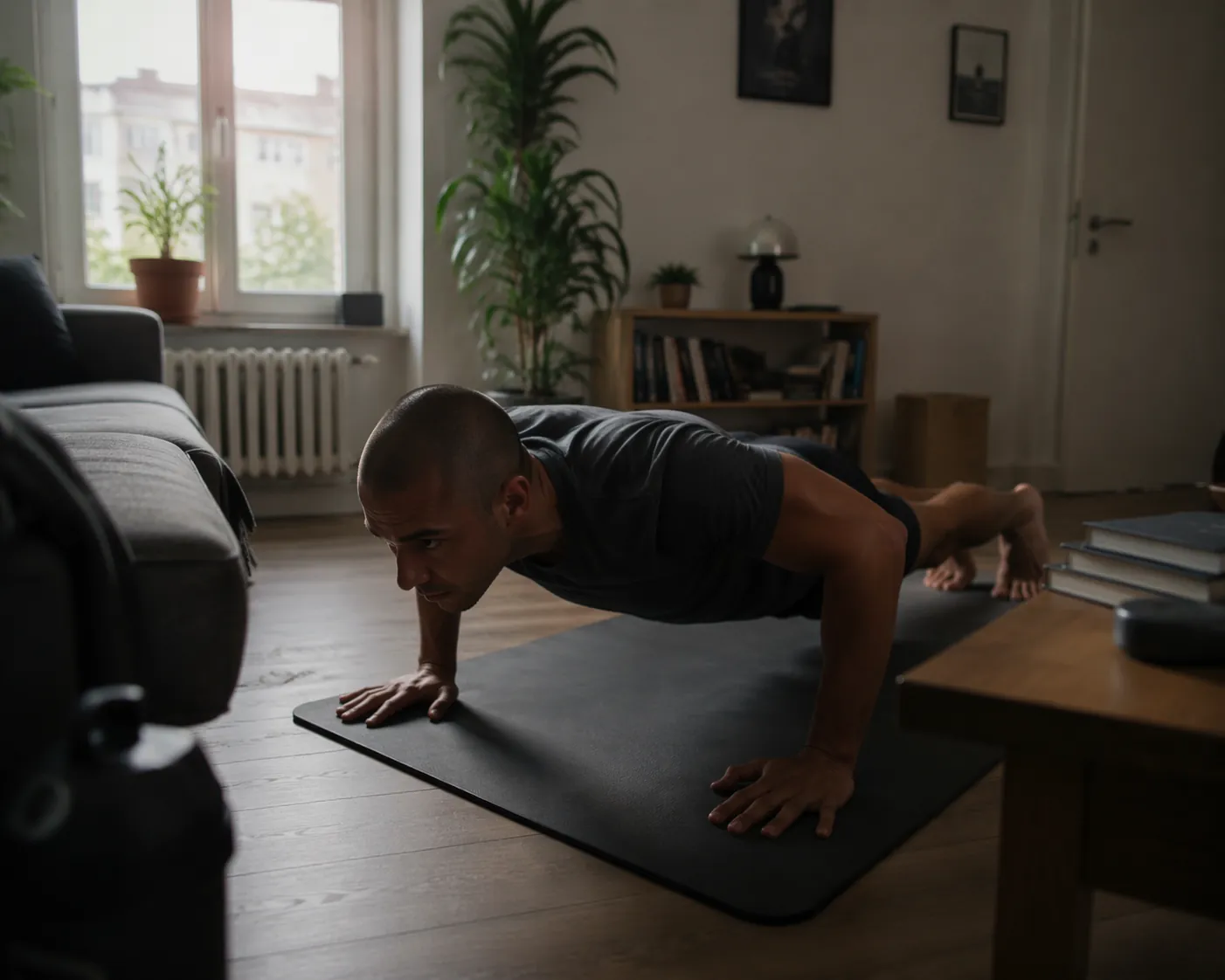
The Fighter Part Is the Structure, Not the Celebrity Name
Bodyweight training works differently from lifting a heavier dumbbell. Since the external load does not change, the pressure has to come from somewhere else: more reps, slower reps, shorter rest, longer rounds, harder variations, or cleaner effort near failure.
That is why the fighter examples are more useful as templates than as posters. Paige Van Zant's hotel-room method, published by Men's Health, used ten favorite bodyweight moves, ten reps each, for ten rounds. That is easy to understand and hard to drift through lazily: the density is the point.[2]
Chris Camozzi's home circuit, shared through Verywell Fit, goes at the same problem from a timing angle: one-minute rounds of pushups, mountain climbers, plank, burpees, and crunches, repeated for three rounds with one-minute rests. Coach Matt Marsden described that round-and-rest setup as a way to mimic the heart-rate variability of an MMA fight.[3]
Then there is the slower, meaner option. UFC Gym coach Andy Hennebelle's 4-2-1 tempo uses four seconds lowering, two seconds holding, and one second rising on bodyweight moves such as pushups, squats, and lunges. That turns familiar exercises into strength work instead of letting them become fast, bouncy rep counting.[4]
| Fighter-style method | What it teaches | Best use at home |
|---|---|---|
| Swick-style max-rep volume | Hard sets near failure can replace external load | Pushups, squats, and core work in repeated sets |
| Van Zant's 10 x 10 x 10 method | Simple density builds fatigue without gear | Hotel-room or apartment circuits |
| Camozzi's timed rounds | Fight-style work needs rest periods, not random chaos | Conditioning circuits with one-minute rounds |
| Hennebelle's 4-2-1 tempo | Slow reps make bodyweight strength-focused | Pushups, squats, lunges, and holds |
A Zero-Equipment UFC-Style Workout You Can Start Today
This plan needs enough floor space for a pushup and enough ceiling clearance to stand. No jumping is required. If you have downstairs neighbors, use the quiet substitutions rather than trying to make burpees polite. They rarely are.
Warm Up for 5 Minutes
- Arm circles for 30 seconds forward and 30 seconds backward.
- Hip circles for 30 seconds each direction.
- Slow bodyweight squats for 60 seconds.
- Walkout to plank, then step back to standing, for 60 seconds.
- Easy mountain climbers or standing knee drives for 60 seconds.
- Two easy pushups, two easy squats, and a 10-second plank repeated until the timer ends.
The warm-up should make the first work round feel available, not impressive. Save the hard breathing for the circuit.
Main Circuit: 3 Fight-Style Rounds
Set a timer for five one-minute stations. Move from one station to the next with as little transition time as your space allows. After all five stations, rest one full minute. Repeat for three total rounds.
| Minute | Exercise | How to do it | Quiet option |
|---|---|---|---|
| 1 | Pushups | Use full pushups, knee pushups, or incline pushups against a sturdy counter. | Same movement, controlled lowering. |
| 2 | Bodyweight squats | Sit hips back, keep heels down, stand tall. | Use 4-2-1 tempo squats. |
| 3 | Mountain climbers | Hold a strong plank and drive knees forward. | Slow climbers or standing knee drives. |
| 4 | Reverse lunges | Step back, lower under control, alternate legs. | Split squats in place. |
| 5 | Plank to shoulder tap | Brace hard and tap opposite shoulder without rocking. | Forearm plank hold. |
This circuit borrows the round logic from Camozzi's timed conditioning work without forcing the noisiest exercise into an apartment. Burpees are useful, but they are also the move most likely to turn a living room workout into a complaint from below.
How Hard Each Round Should Feel
The first round should feel controlled. The second should make you negotiate with the clock. The third should require effort without turning your reps sloppy. If your pushups collapse after 15 seconds, switch immediately to knee or incline pushups and keep working. That is not quitting; that is keeping the round alive.
A good target is to finish each minute with clean movement still possible. Training to failure has a place, as Swick's pushup approach shows, but failure on every station in a beginner circuit turns the session into survival practice. Use max-effort sets later, after you know your baseline.
Optional Finisher: Swick-Style Pushup Sets
After the circuit, rest two minutes. Then do two sets of pushups close to failure. Stop when your next rep would be ugly. Rest 60 to 90 seconds between sets. If you are newer, make this one set. If you are experienced, build toward three to five sets over time rather than trying to borrow a professional fighter's workload immediately.
The Chin-Up Problem in a No-Equipment Workout
Swick's routine included chin-ups, and chin-ups are bodyweight training. They are not, however, zero-equipment training unless you already have a safe place to hang. A bar, a beam, a sturdy table edge, or a towel anchor all change the setup. That matters for renters.
For this plan, the honest zero-equipment replacement is not a fake pull-up. Use prone back extensions, reverse snow angels, and plank variations to train the posterior chain and trunk until you choose to add a pulling option. They will not duplicate a chin-up, but they keep the workout complete enough to start today.
- Prone back extension: lie face down, lift chest slightly, squeeze glutes, lower slowly.
- Reverse snow angel: lie face down and sweep arms from hips to overhead without shrugging.
- Forearm plank: brace ribs down and squeeze legs hard.
- Side plank: hold a straight line from shoulder to ankle, or use knees down.
When you are ready to add a single piece of equipment, pulling is the first gap worth solving. Until then, do not let the lack of a bar delay every other part of training.
Use Tempo When Reps Get Too Easy
Fast bodyweight reps can hide a lot: shallow range, bouncing, loose bracing, and momentum. Tempo removes the hiding places. Hennebelle's 4-2-1 method is simple enough to use without an app: lower for four seconds, pause for two seconds, come up in one second.[4]
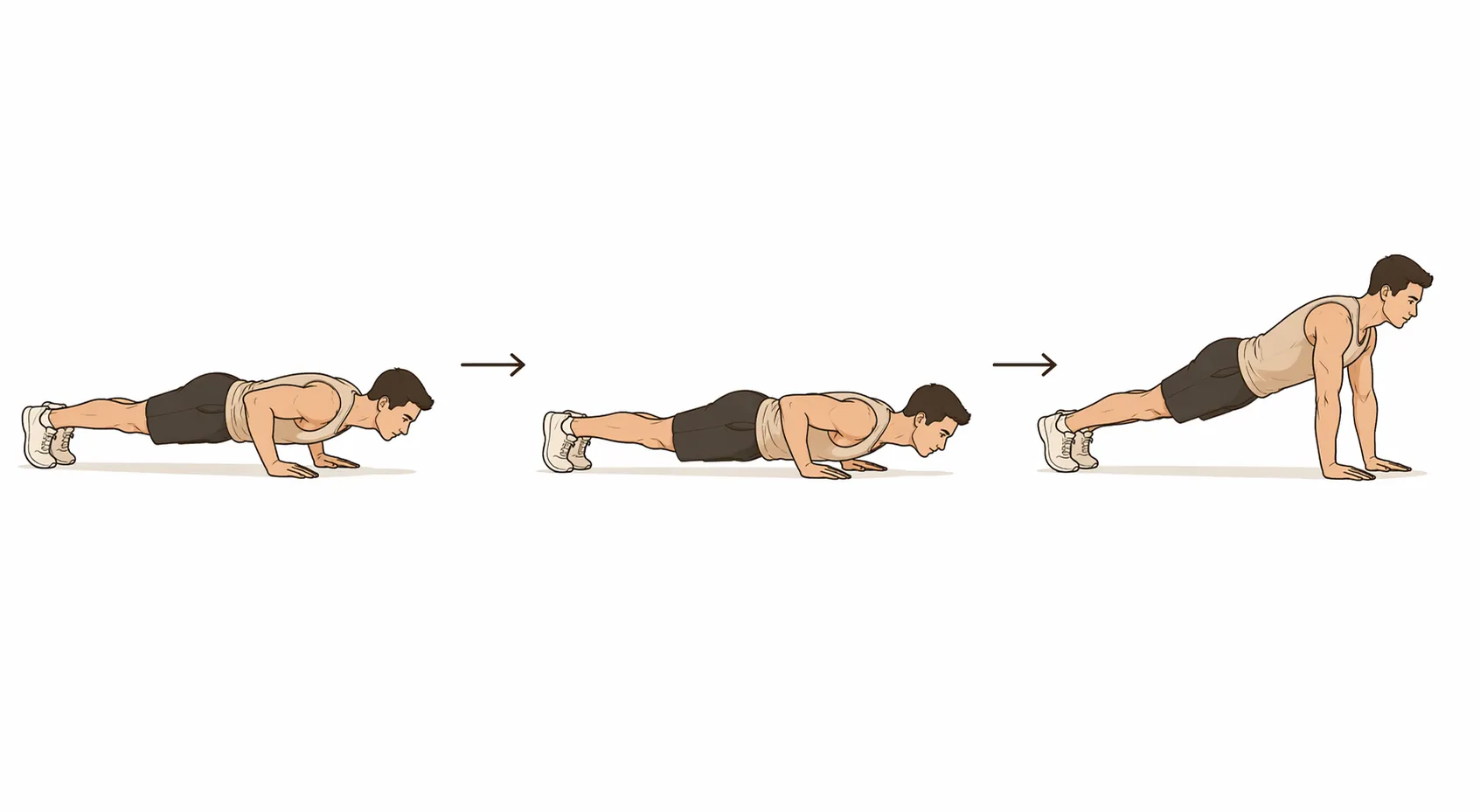
Try it on pushups before adding anything else. A set of 20 rushed pushups may become a set of six controlled reps. That is not a regression. It is a clearer dose of strength work.
| Move | Tempo version | What changes |
|---|---|---|
| Pushup | 4 seconds down, 2-second hold near the floor, 1 second up | More chest, shoulder, triceps, and trunk demand per rep |
| Squat | 4 seconds down, 2-second hold at the bottom, 1 second up | More leg tension without jumping or weights |
| Reverse lunge | 4 seconds down, 2-second hold, 1 second up | More control and balance on each leg |
| Plank | 10-second hard brace, 5-second easy reset, repeat | More useful tension than a long passive hold |
Progress Without Buying Gear
The first week is about learning the circuit and finding honest effort. After that, the workout has to move. Bodyweight training stalls when the plan stays identical while the body adapts.
Do not progress everything at once. Pick one lever for two weeks, then change it when the sessions feel too comfortable.
- Add time: move from three rounds to four, then five.
- Add density: keep three rounds, but complete more clean reps inside each minute.
- Add tempo: use 4-2-1 reps on one or two exercises per round.
- Add holds: pause at the bottom of pushups, squats, and lunges.
- Add harder variations: choose single-limb or uneven versions only when basic reps stay clean.
- Reduce rest carefully: cut a one-minute rest only after your movement quality survives the current setup.
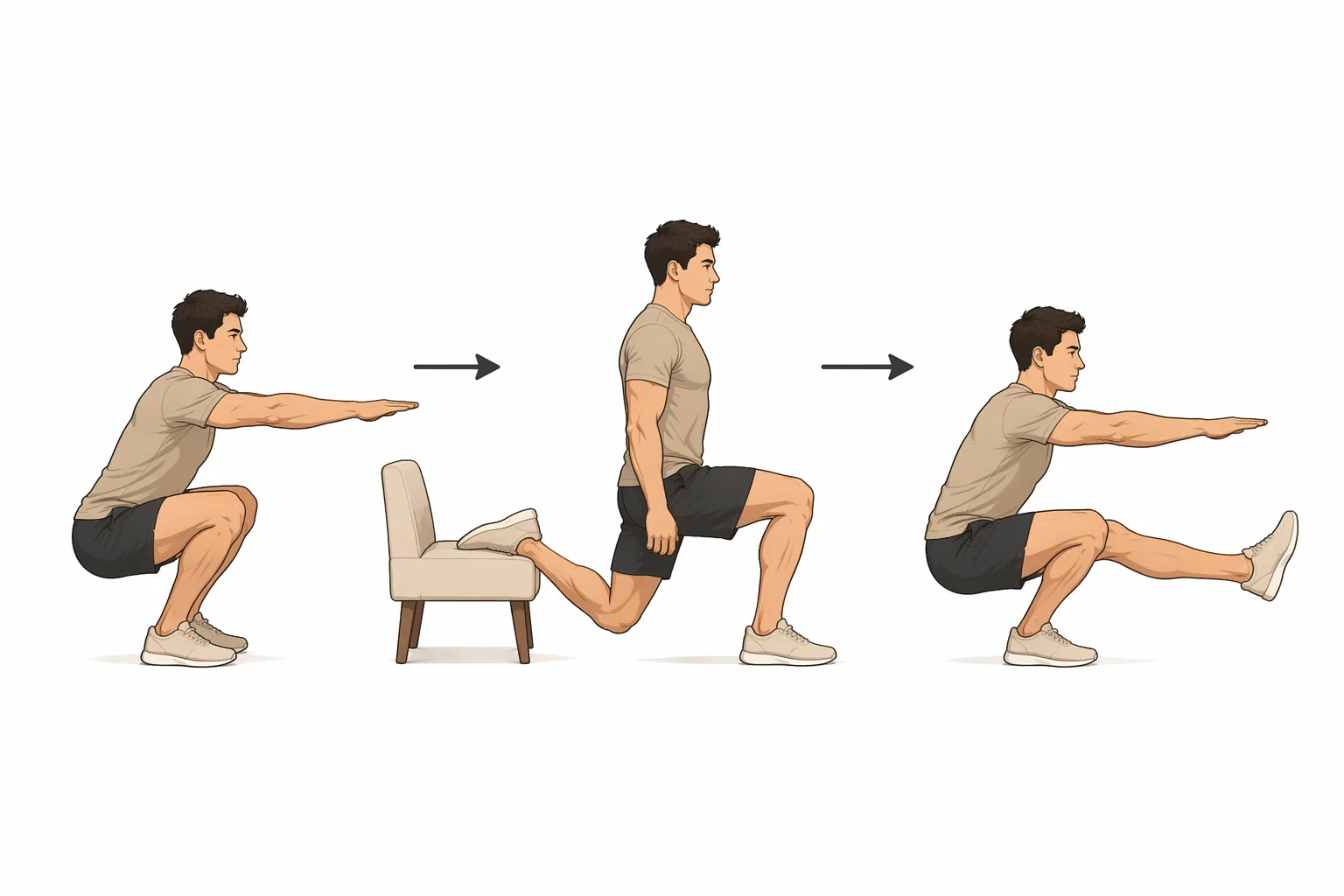
A squat progression might move from regular squats to split squats, then to rear-foot-elevated split squats using a cushion or couch, and eventually to assisted single-leg squats. The boundary is not whether the move looks advanced. The boundary is whether you can control the descent, keep the knee tracking well, and stand up without twisting.
A pushup progression can move from incline pushups to floor pushups, then to tempo pushups, pause pushups, close-grip pushups, and archer-style pushups. If your hips sag or your shoulders shrug toward your ears, the variation is ahead of you. Stay with the version you can own.
A Simple Weekly Layout
Three sessions per week is enough to make the plan repeatable. Four can work if recovery is good. Daily max-effort training, like the Swick example, is not the starting point for most people with regular jobs, hard floors, and no coach watching their joints.
| Day | Session | Focus |
|---|---|---|
| Monday | Main circuit plus optional pushup finisher | Baseline conditioning |
| Wednesday | Main circuit with 4-2-1 tempo on squats and pushups | Strength under control |
| Friday | Main circuit, try to beat Monday's clean-rep totals | Density and repeat effort |
| Weekend | Walk, mobility, or easy shadowboxing without impact | Recovery and movement practice |
Track only what helps you train better next time: rounds completed, pushup variation, squat variation, rest length, and any station where form broke down. You do not need a complicated scorecard. You need enough information to make the next session slightly more deliberate.
What to Avoid in a Small Apartment
Some fighter-style workouts are written as if everyone lives on a gym mat. Most renters do not. The surface, noise, and furniture matter.
- Do not jump if the floor shakes; use squats, lunges, climbers, and tempo work instead.
- Do not use a door, table, or towel anchor for pulling unless it is genuinely stable.
- Do not chase sweat by making every move faster; slow reps can be harder and safer.
- Do not train to failure on every exercise if it makes the next round useless.
- Do not compare your first week to a professional fighter's reported workload.
The promise is grounded, not magical: you can begin fight-style conditioning today with no equipment. The work comes from consistency, hard sets, round structure, tempo, and progression. Gear can be useful later, especially for pulling, but it is not the price of admission.
References
- UFC.com feature article - UFC.com, 2012.
- Blast Fat Like a UFC Fighter With This Equipment-Free Workout - Men's Health.
- The MMA Workout You Can Do at Home - Verywell Fit.
- UFC Gym Training: No Machines, Just Muscle - UFC.com.
What a small equipment investment adds
We don't have a build tagged to this exact tier yet. Browse all builds.
How often should you repeat this?
See our recovery and rest reference for citation-anchored rest-interval guidance.
Spot something off?
Tell us if a movement, tier assumption, or duration didn't match your experience.