
How the USATF Outdoor Championships 2026 Can Motivate You
Learn how the 2026 USATF Outdoor Championships can reignite your home training motivation through observational goal-setting, and how to time your weekend workouts around the broadcast schedule for maximum impact.
- Equipment tier required
- none
- Duration
- 20 min
- Difficulty
- beginner
- Target area
- full body
- Space footprint needed
- small
- Noise level
- low
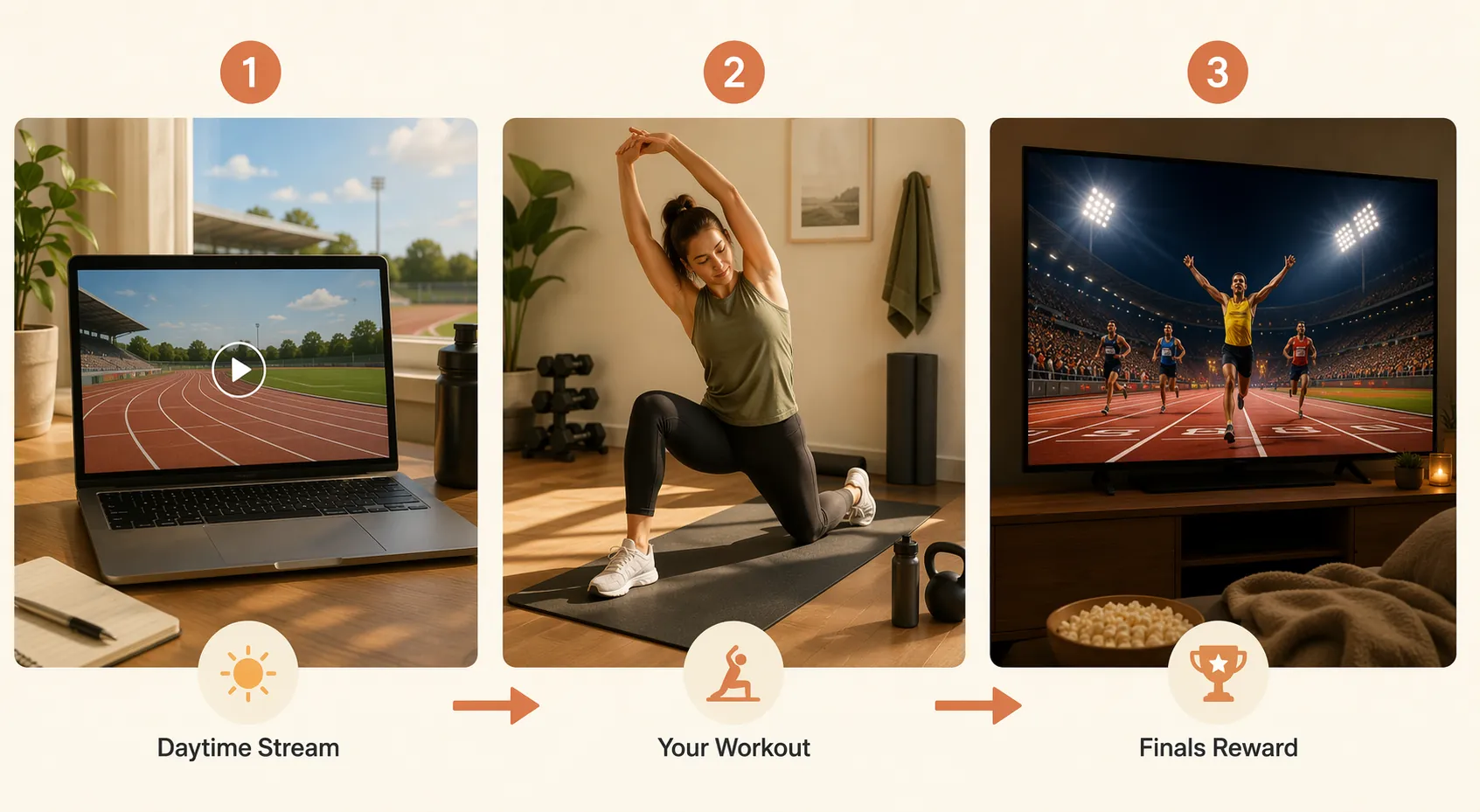
If summer training has started to feel optional, the USATF Outdoor Championships 2026 are useful for a very ordinary reason: they give your weekend a shape. Saturday’s NBC/Peacock window runs from 2–6 p.m. ET, and Sunday’s runs from 4–6 p.m. ET, with daytime sessions streaming on USATF.tv and Peacock before the main broadcast windows.[1] That is enough structure to turn “maybe I’ll work out” into something more specific: watch a little track, do one realistic session, then let the finals be the reward.
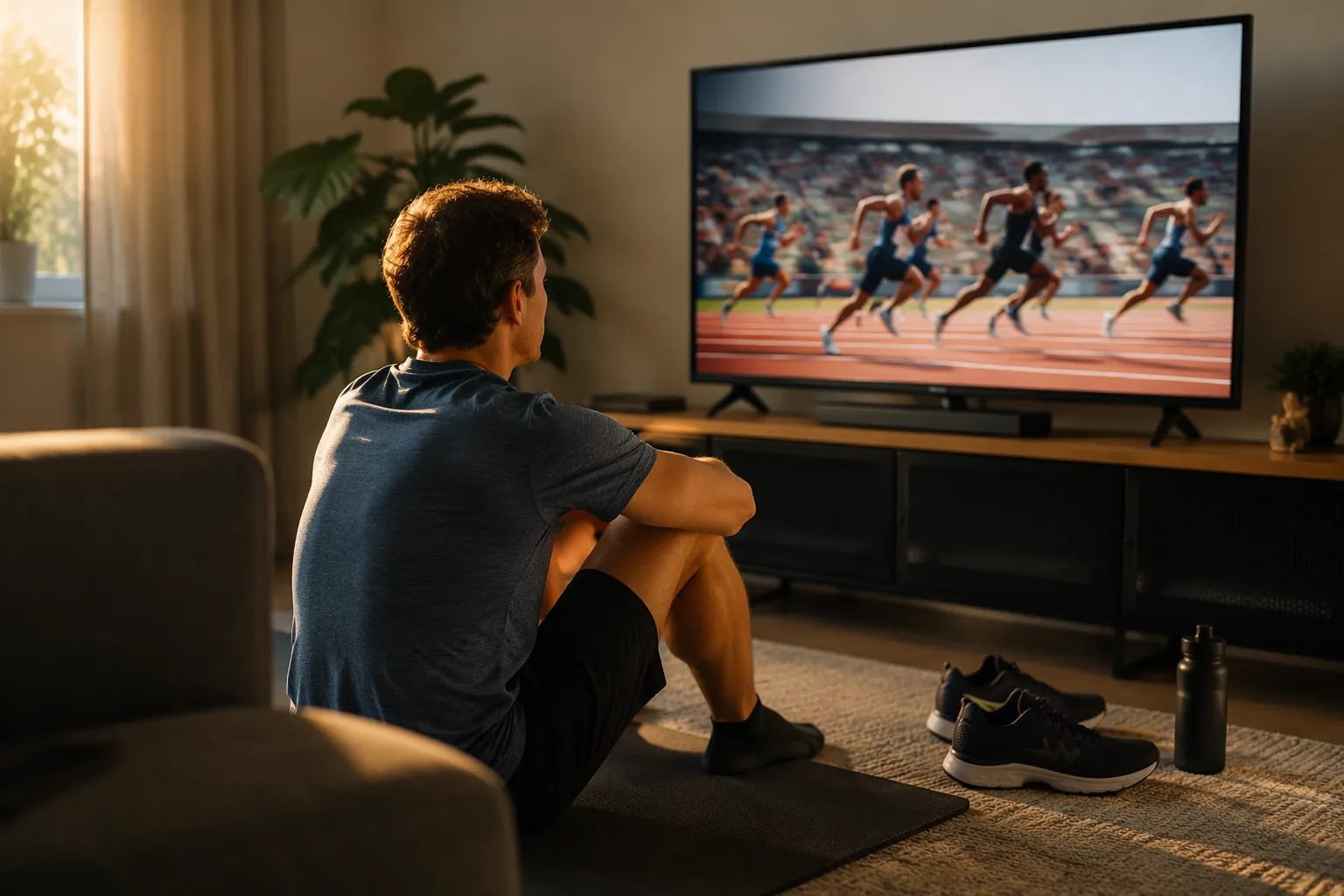
That does not mean watching Sha’Carri Richardson leave the blocks or Noah Lyles come off a curve magically improves your fitness. It means the meet can interrupt the drift. When a runner has no race circled on the calendar, a high-energy competition can supply a temporary external cue: put the shoes by the door, choose the workout before the broadcast starts, and make the day feel like it has a finish line.
This year’s meet has a little extra pull because it is not just another stop on the track calendar. The national championships began in 1876 in the Bronx, and the 2026 edition marks the 150th anniversary while returning to New York for the first time since 1991.[1] It also lands in a year without Olympic or World Championship qualifying pressure attached to the meet, so the emotional center is simpler: national titles, rivalries, pride, rhythm, risk, and the odd jolt of seeing someone make an event feel newly alive.[2]
How to watch without letting the couch win
The online viewing part is straightforward enough to plan around, though the access details still deserve a quick check on the day you watch. NBC carries the main weekend windows over the air, Peacock streams those windows, and daytime sessions are listed for USATF.tv and Peacock.[1] Peacock pricing, any free-trial language through TV bundles, and whether USATF.tv access requires a free registration or member login should be verified directly before relying on them.
| Weekend window | What to do with it | Training use |
|---|---|---|
| Saturday daytime streams | Keep them on as light background while you warm up, stretch, or set out gear | Use the early energy to start, not to delay |
| Saturday 2–6 p.m. ET on NBC/Peacock | Treat the finals window as the reward after your own session | Run, interval, or circuit first; watch after |
| Sunday daytime streams | Pick one technical cue you want to borrow | Choose a short, repeatable intention |
| Sunday 4–6 p.m. ET on NBC/Peacock | Watch with your workout already done or deliberately scheduled after | Close the weekend with consistency instead of guilt |
The key is deciding before the stream starts whether track is going to be fuel or a postponement device. If you are already vulnerable to “I’ll train after this race,” set a rule: no full finals window until the workout is done. If the heat is brutal or your energy is low, make the workout smaller rather than imaginary.
What observational goal-setting actually means
Observational goal-setting is the practical version of a familiar experience: you watch someone move with intent, and your own body starts to remember that movement is available to you too. Sports psychology often discusses this through observational learning, mental rehearsal, and the brain’s tendency to simulate actions we watch. For a home exerciser, the useful part is not the neuroscience label. It is the sequence.
- See a performance cue that is emotionally clear: a start, a finish, a controlled jump approach, a patient middle lap.
- Translate it into one ordinary training intention: relaxed shoulders, quicker cadence, stronger last rep, cleaner landing.
- Do one session that is small enough to complete today.
- Let the broadcast reward the completed action, not replace it.
That transfer has to stay modest. You are not copying an elite sprinter’s training load, hurdle clearance, or long jump takeoff. You are borrowing a cue. A cue is small enough to use without pretending your living room, sidewalk loop, or apartment hallway is a professional track.
For example, if a 100m race makes you notice how still the best sprinters keep their faces under pressure, your home version might be “stay relaxed for the final 10 seconds of each interval.” If an 800m runner waits instead of panicking, your version might be “do not surge in the first half of my run.” If Tara Davis-Woodhall’s long jump rhythm catches your eye, your version might be “make every rep land quietly and under control.” None of those require spikes, blocks, a runway, or a national ranking.
The storylines are fuel, not homework
There is plenty to care about if you follow track casually. Richardson enters with a chance to chase a third national 100m title, a mark that would make her the second woman since 2000 to do it.[2] That is the kind of storyline that can make a short sprint session feel less like punishment and more like participation in the same weekend rhythm.
Cooper Lutkenhaus is a different kind of spark. At 17, he became the youngest track world champion ever in March 2026, and he is now seeking his first outdoor national title in the 800m.[2][3] The useful cue there is not “train like a teenage phenom.” It is the freshness of the event when someone young and fearless changes the temperature of a race. For an ordinary runner, that can translate into one clean middle-distance-inspired workout: controlled, uncomfortable, and over before it becomes a negotiation.
Lyles and Kenny Bednarek bring a more charged kind of attention. Their rivalry carries extra edge after Bednarek shoved Lyles following the 200m in 2025.[2] That is not a model for behavior at the local track, obviously. It is a reminder that sprinting is not only about speed; it is also about composure when adrenaline is high. A home version might be finishing your last interval with form intact instead of flailing through it just to be done.
Davis-Woodhall may be the best cue for people who train in small spaces. She comes in with an 18-meet long jump win streak and is also racing the 100m hurdles.[2] The obvious glamour is the jump. The more transferable lesson is rhythm: approach, takeoff, landing, reset. A no-equipment circuit can borrow that same rhythm without imitating the event.
Turn the meet into one Saturday session
Saturday is the easier day to use because the NBC/Peacock block starts at 2 p.m. ET and lasts four hours.[1] If you wait until after it ends, the workout has to survive dinner, fatigue, weather, and the comforting lie that tomorrow will be easier. Better to finish something before the main window.
A runner can make this simple: warm up for 10 minutes, run 6 to 10 short pickups at a controlled fast pace, walk or jog between them, and cool down before the broadcast. If the heat is oppressive, shorten the pickups and increase the recovery. The point is to touch speed, not to prove toughness to an empty sidewalk.
At home, use the same idea without needing much floor space. Pick four movements: high knees or marching high knees, reverse lunges, plank shoulder taps, and squat-to-calf raises. Move for 30 seconds, rest for 30 seconds, and repeat the circuit three to five times. If jumping bothers your joints or your downstairs neighbor, keep everything quiet and controlled. The sprint feeling can come from posture and intent, not noise.
If you want a fuller template, the natural place to look is FitAtHome’s Routines section, especially running, sprint, cardio, apartment-friendly, and no-equipment workouts. The meet can supply the spark; the routine still needs to match your knees, space, weather, and current fitness.
A Saturday cue menu
| What you notice on screen | What it becomes in your workout |
|---|---|
| Explosive start | Begin each interval with tall posture instead of rushing |
| Relaxed sprint face | Release your jaw and shoulders during hard efforts |
| Late-race patience | Hold back early and finish the final rep cleanly |
| Long jump rhythm | Land quietly on lunges, squats, or step-back movements |
| Competitive composure | Use the same form on the last round as the first |
Choose one cue, not all of them. Watching track can make everything feel possible for about 20 minutes, which is exactly when people overbuild the workout and then avoid it. One cue is enough to give the session a purpose.
Use Sunday as the consistency day
Sunday’s main window is shorter, 4–6 p.m. ET on NBC/Peacock.[1] That makes it a good day for a lighter session, especially if Saturday included speed. Think of Sunday as the day that protects the habit. You do not need another hard workout to make the weekend count.
For runners, that might mean 20 to 40 minutes easy with one intention: stay smooth on hills, keep cadence steady, or finish feeling like you could have done a little more. For home training, it might mean a quiet circuit built around mobility and light strength: glute bridges, dead bugs, side planks, calf raises, and slow split squats. If you trained hard Saturday, Sunday should leave you better for Monday, not wrecked for it.
The Sunday broadcast can also work as a reset if Saturday did not happen. Missed workouts are annoying, but they are also common. Use the shorter window to avoid making the weekend a total loss: do 15 minutes before 4 p.m. ET, then watch. A small completed session beats an elaborate plan that stays theoretical.
A simple weekend plan
Here is the cleanest way to make the USATF Outdoor Championships useful without turning your weekend into a training camp.
- Before Saturday: decide whether your main session is a run, sprint-inspired interval workout, no-equipment cardio circuit, or quiet strength circuit.
- During daytime coverage: watch lightly, and write down one cue you want to borrow.
- Before the NBC/Peacock window: complete the session, even if you have to shorten it.
- During finals: enjoy the racing without pretending you still need to earn it.
- On Sunday: do a lighter consistency session or a short recovery circuit before the 4–6 p.m. ET broadcast.
If the meet gets you excited, let that excitement reduce friction rather than increase pressure. Put the shoes near the door. Fill the bottle. Move the coffee table. Open the stream only after you know what your session is. The athletes on screen are handling national-title pressure; your job is much smaller and still worth doing.
That is why the 2026 championships are a particularly good fit for a summer slump. The meet has history, New York energy, recognizable stars, volatile rivalries, a teenager trying to stretch what an event can feel like, and a broadcast schedule that sits neatly around real weekend workouts. Watch online, borrow one cue, do the session you were avoiding, and let the finals make consistency feel rewarding again.
References
- 2026 Toyota USATF Outdoor Championships — USATF.org
- USATF Outdoor Championships coverage — NBC Sports
- USATF Outdoor Championships coverage — Runner’s World
What a small equipment investment adds
We don't have a build tagged to this exact tier yet. Browse all builds.
How often should you repeat this?
See our recovery and rest reference for citation-anchored rest-interval guidance.
Spot something off?
Tell us if a movement, tier assumption, or duration didn't match your experience.