
Master the Viking Row Challenge in Under 20 Minutes
Learn the exact 125m/250m/500m/1000m Viking Row Challenge protocol, how to pace each distance to avoid burnout, and how to track progress week over week — all in a single 20-minute session.
- Equipment tier required
- $300-800
- Duration
- 20 min
- Difficulty
- intermediate
- Target area
- full body
The monitor is set. The handle is in your hands. The first 125 meters looks almost too small to respect, which is exactly where the Viking Row Challenge starts taking money out of your legs.
The indoor rowing tips that matter most for the Viking Row Challenge are not motivational. They are pacing decisions. The format is short enough to fit into a home-gym session, but the rest rule makes it nastier than it looks: row 125m, rest only as long as that took; row 250m, rest only as long as that took; row 500m, rest only as long as that took; row 1000m, then stop.[1]
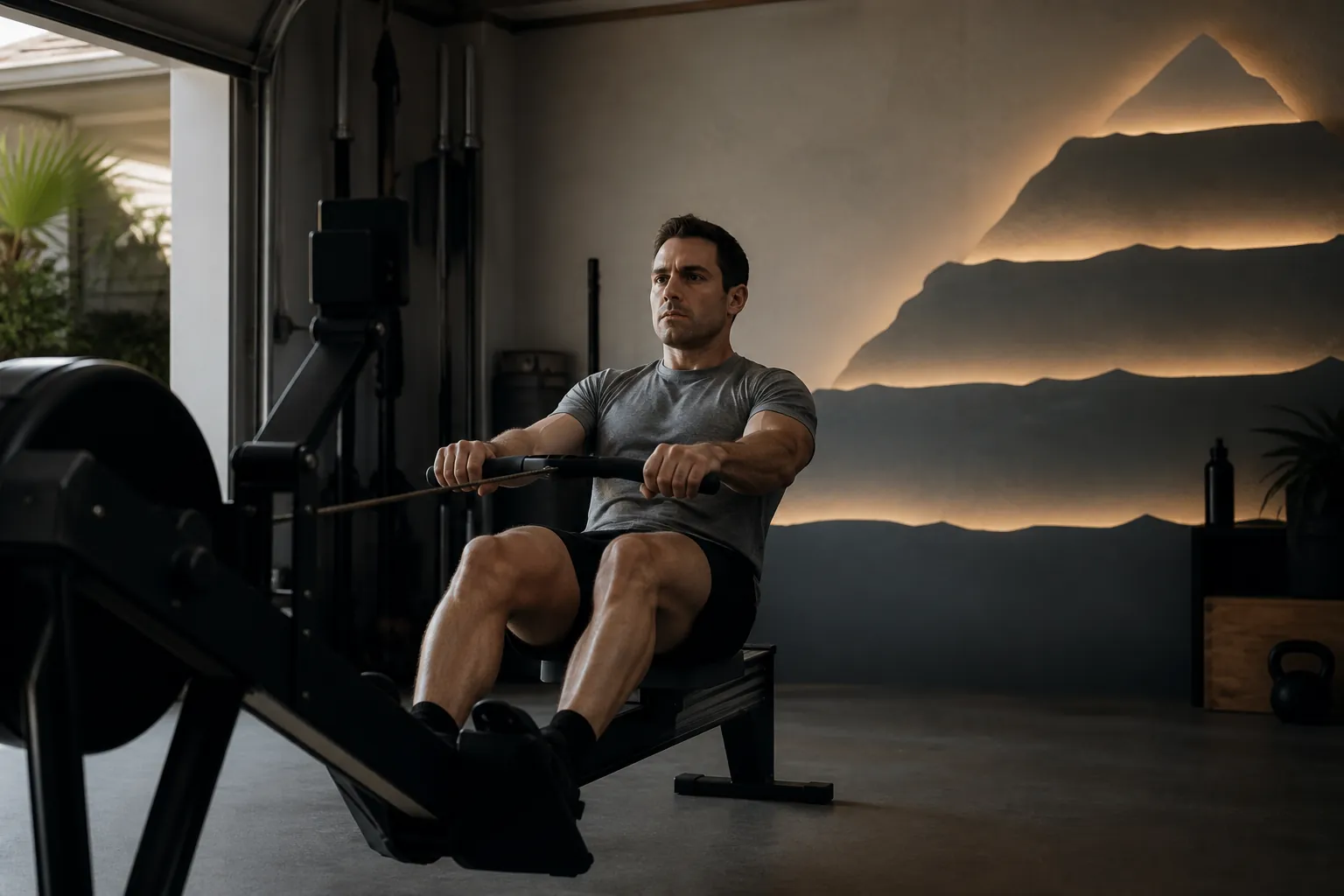
The Viking Row Challenge Protocol
| Round | Work | Rest | Pacing Job |
|---|---|---|---|
| 1 | Row 125m | Rest the same amount of time it took to row 125m | Fast, but not a dare |
| 2 | Row 250m | Rest the same amount of time it took to row 250m | Disciplined pressure |
| 3 | Row 500m | Rest the same amount of time it took to row 500m | Settle into hard rhythm |
| 4 | Row 1000m | Done | Hold form while fatigue is loud |
That is the whole workout. No extra stations, no mystery finisher, no decision tree once you start. The clean structure is part of the appeal, especially if your rower lives in a garage corner, spare room, or apartment setup where the best workout is the one you can run without rearranging your life.
Before you pull the first stroke, set the monitor to distance intervals if your rower allows it. If it does not, watch the distance display and use a timer for the rest periods. The important part is that the rest equals the work time you just completed. A 125m row that takes 30 seconds earns 30 seconds of rest. A 500m row that takes longer earns longer rest, but it also means you are carrying more fatigue into the 1000m.
Why the First 125m Is the Trap
The distances double from 125m to 250m to 500m, then double again to 1000m. Your recovery does not get generous; it only matches the damage you just did. That is the hidden cost in the “under 20 minutes” pitch. The session may be compact, but the debt shows up fast.
A max-effort 125m feels brilliant for about half a minute. You get a sharp split, maybe a little ego reward, and then you sit there during a short rest period with your breathing already ahead of schedule. The 250m becomes less clean. The 500m stops feeling like the middle of the workout and starts feeling like an audit. By the time the 1000m arrives, the question is no longer how fast you can row. It is how much form you can keep while bargaining with the monitor.
Treat the opening round like a controlled acceleration, not a launch. The best first 125m for this challenge may feel almost too easy while you are doing it. That is not wasted speed. It is saved rhythm.

Pace Each Distance Instead of Racing the Whole Workout
Concept2’s stroke-rate guidance gives a useful frame for this challenge: shorter 125m and 250m sprint pieces often sit around 30–36 strokes per minute, while 500m and 1000m pieces are commonly guided closer to 24–28 strokes per minute.[2] Those numbers are calibrated around Concept2 rowing, so expect the feel to shift on magnetic or water-resistance machines. The principle still travels well: quick does not mean frantic, and sustainable does not mean soft.
125m: quick start, quiet ego
Use the 125m to wake the system up, not to prove you can sprint. Take a few strong strokes to get the flywheel moving, then keep the stroke smooth enough that you could repeat the same effort immediately if asked. You should finish knowing you worked, but not needing to slump over the handle.
If you are using stroke rate, the higher range can fit here, but only if the drive stays connected: legs first, body swing, then arms. When the rate climbs by yanking with the upper body, the number on the monitor may improve for a few seconds while the rest of the workout gets worse.
250m: stay disciplined when it still feels fun
The 250m is where many people mistake control for undertraining. It is short enough that you can bully your way through it, but doing so changes the 500m. Keep pressure on the footplates, keep the recovery clean, and resist the little surge that happens when the finish line appears on the monitor.
Your rest after the 250m should feel useful, not desperate. If you spend the entire rest period trying to slow your breathing, the 125m was probably too hot, the 250m was probably too hot, or both.
500m: the challenge starts telling the truth
For the 500m, move from sprint thinking to rhythm thinking. This is where the lower stroke-rate guidance becomes more useful: around 24–28 strokes per minute on a Concept2-style erg is often enough to produce serious pace without turning the stroke into a scramble.[2]
Watch the split, but do not chase every flicker. A better cue is whether you can keep the same stroke shape for the final 150m that you had in the first 150m. If your shoulders creep up, your slide rushes, or the handle starts arriving before the legs have done their job, you are paying interest on the opening rounds.
1000m: hold the line before you empty the tank
The final 1000m is not just a longer sprint. It is the place where all previous choices become visible. Start the first quarter at a pace you believe you can hold. In the middle, keep the rate boring and the pressure honest. If you have something left late, then increase effort rather than spending the first 300m pretending fatigue will negotiate.
This is also the piece where home rowers need to be practical. If your machine shifts on the floor, if the handle path gets sloppy, or if your breathing turns into panic instead of hard work, back off. A repeatable benchmark beats one ugly survival performance.
A Simple Execution Plan
- Warm up until your stroke feels coordinated and your breathing has opened up.
- Set the monitor for the first distance, or prepare to watch the distance display manually.
- Row 125m at controlled speed; rest exactly the time it took.
- Row 250m with discipline; rest exactly the time it took.
- Row 500m at a hard, sustainable rhythm; rest exactly the time it took.
- Row 1000m, building only when you know you can keep form to the end.
- Write down your total session time, including work and rest.
The total session time is the number that matters for comparison. Individual splits are useful clues, but the challenge rewards the person who can manage the whole sequence. If your 125m improves and your 1000m collapses, you did not improve the workout. You just moved the suffering downstream.
How to Track Progress Without Turning It Into Guesswork
Run the Viking Row Challenge as a benchmark, not as a daily punishment. Record the date, machine, resistance or damper setting if relevant, total session time, and any obvious pacing notes. “Blew up on 500m” is not a failure note; it is useful data for next week.
| What to Record | Why It Matters |
|---|---|
| Total session time | The cleanest week-over-week comparison |
| 125m, 250m, 500m, and 1000m times | Shows whether improvement came from pacing or one reckless split |
| Rest times | Confirms you followed the rest-equal-work rule |
| Stroke rate notes | Helps identify whether you rowed efficiently or just rushed |
| Machine and resistance setting | Keeps comparisons fair across different rowers |
Repeat the same setup week over week before you start changing variables. The cleanest win is a lower total time with the same rules, same machine, and better pacing. The next-best win is finishing with less collapse and similar time, because that usually means you are closer to a performance you can build on.
Scaling the Challenge
This is not a good first rowing workout for an absolute beginner. If you cannot row continuously with decent form and controlled breathing, build baseline endurance before trying a high-intensity distance pyramid. The issue is not toughness. It is that poor rowing mechanics get expensive when fatigue arrives.
For less-ready users, halve the distances: 62.5m, 125m, 250m, and 500m, with the same rest-equal-work rule. If your monitor does not make 62.5m practical, use 60m or another easy-to-set approximation and keep it consistent. The goal is to learn the rhythm of the protocol without turning the final piece into a form breakdown.
For advanced users, keep the distances intact and reduce rest gradually. That change is more honest than simply sprinting the first two pieces harder, because it increases density across the whole workout. Make one change at a time: either improve total time under the standard rule or shorten rest, not both in the same test.
If Your Rower Lives in a Small Space
A hard rowing interval is not the same as a gentle 20-minute glide. The machine may shift, the fan or water tank may be louder, and the floor may need protection. If you are still deciding whether a rower belongs in your room at all, compare room shape and machine fit in Exercise Bike vs Rowing Machine: Your Room Shape Decides. For broader equipment trade-offs, Home Gym Cardio Equipment for Small Spaces is the better place to think about footprint, noise, and floor protection.
Cost matters too, especially if this challenge is the workout that finally makes you look at rowing machines seriously. The 3-year ownership picture in Best Home Gym Cardio Equipment: A 3-Year Total Cost Comparison is a better detour than trying to turn this protocol guide into a buying guide.
The Number to Beat Next Time
The Viking Row Challenge works best when it stays brutally simple. Run the four distances. Match each rest period to the work interval that came before it. Keep the first 125m calmer than your ego wants. Keep the 250m honest. Let the 500m and 1000m decide how much speed you actually earned.
When you finish, write down the total session time. That is your target. Next week, beat it by rowing the whole challenge better, not just the first minute louder.
References
- Viking Row Challenge: Get Supremely Shredded, Generation Iron
- Rowing Stroke Rate Explained, Concept2
What a small equipment investment adds
We don't have a build tagged to this exact tier yet. Browse all builds.
How often should you repeat this?
See our recovery and rest reference for citation-anchored rest-interval guidance.
Spot something off?
Tell us if a movement, tier assumption, or duration didn't match your experience.