
3 Wheelchair Home Cardio Workouts by Budget Tier
Wheelchair users new to home cardio can start meeting the 150-minute weekly aerobic target with just bodyweight circuits ($0), add resistance bands and wrist weights for under $30, or invest in a portable pedal exerciser for around $150 — all within small-apartment noise and space constraints.
- Equipment tier required
- none
- Duration
- 10 min
- Difficulty
- beginner
- Target area
- upper body
- Space footprint needed
- one chair-width of space
- Noise level
- low
If you have a wheelchair, a small room, and no idea what to buy, start by choosing the cheapest wheelchair home cardio workout tier you can repeat three to five times this week. Not the most impressive tier. Not the one with the best gadget. The one you can do tomorrow without rearranging furniture, irritating your shoulders, or waiting for a delivery.
| Budget tier | What you use | Best fit | How it gets you into cardio range |
|---|---|---|---|
| $0 | Bodyweight arm patterns, air punches, seated twists, speed intervals | Beginners, tight budgets, very small apartments, quiet workouts | Cadence and interval density raise breathing and heart rate |
| About $30 | Resistance bands and/or wrist weights | People who want more structure, more resistance, or less boredom | Light load plus repeated upper-body movement increases effort without much space |
| About $150 | Adaptive split rope or portable pedal exerciser | People who need rhythm, tracking, grip support, or a repeatable device-based session | Continuous cyclical movement helps sustain moderate intensity |
The weekly target is not different because the workout happens from a chair: the NHS advises wheelchair users to work toward at least 150 minutes of aerobic activity per week, and to start with sessions as short as 10 minutes if that is the realistic entry point.[1] The CDC and ACSM give the same 150-minute weekly benchmark for adults with disabilities and adults generally.[2][3]
Use the talk test before you worry about heart-rate zones. At moderate intensity, you should be able to talk but not sing; if you can sing easily, increase cadence or resistance, and if you cannot get out a sentence, back off.[1] That cue matters at home because two people can do the same seated punching circuit and get completely different training effects depending on shoulder function, trunk control, grip, fatigue, medication, and chair setup.
This is general fitness education, not a medical prescription. If you are dealing with paralysis-specific complications, a recent stroke, unstable blood pressure, autonomic dysreflexia risk, new shoulder pain, pressure-injury concerns, or a condition that changes day to day, use a slower progression and get individualized guidance before treating any plan as routine.
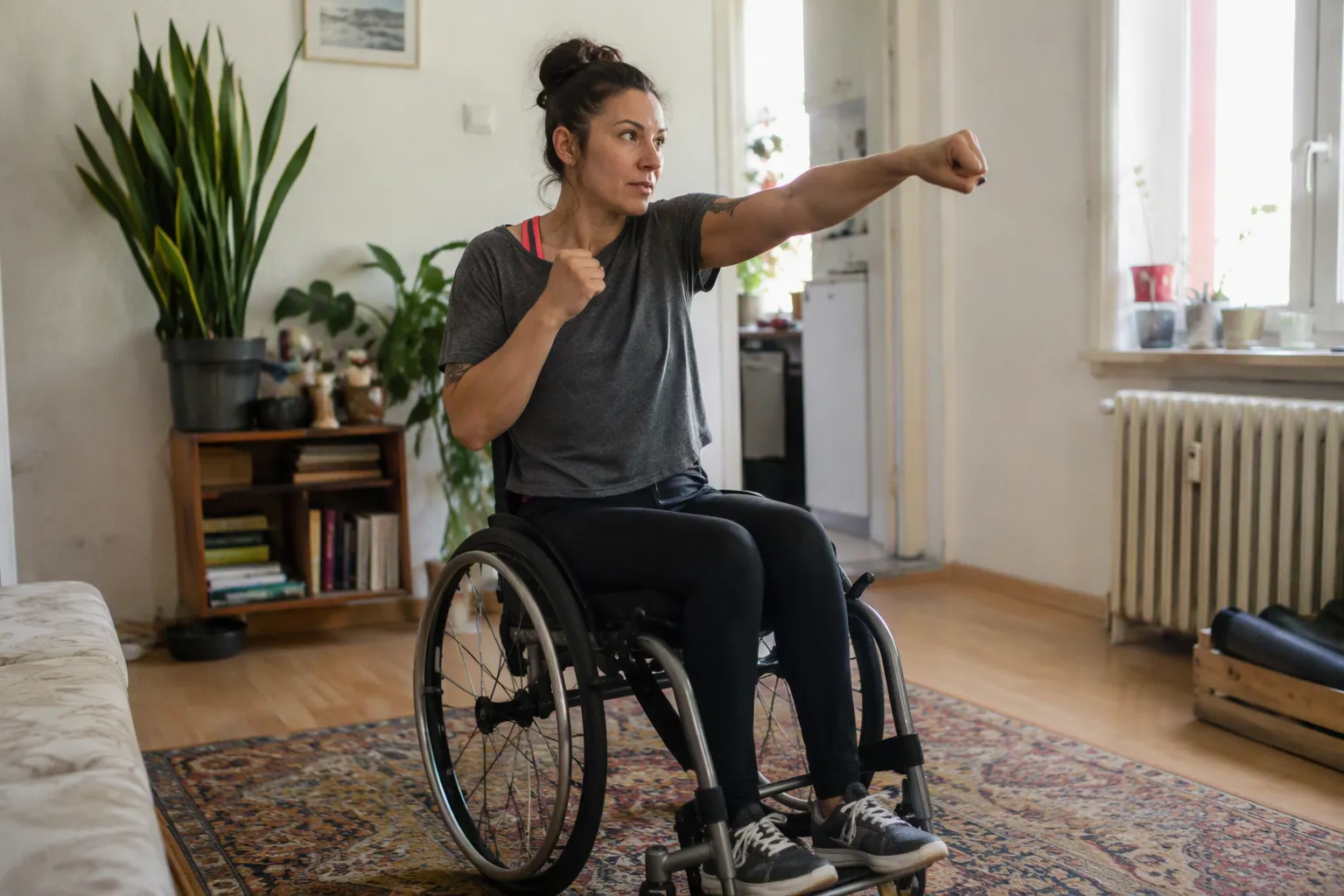
Why the 10-minute start is not a shortcut
Ten minutes is long enough to reveal the parts of home cardio that glossy advice usually skips: whether your brakes hold, whether the rug bunches under your casters, whether repeated forward punches tug at your neck, whether your hands fatigue before your breathing does, and whether the session is quiet enough for downstairs neighbors.
The cardiovascular reason to start is real, but it does not need to be turned into scare copy. British Heart Foundation material cited in wheelchair-health reporting links mobility impairment with a 35% higher risk of cardiovascular events, and a 2024 PLOS ONE meta-analysis cited by New Mobility reported about 1.5 times higher cardiovascular disease risk among people with spinal cord injury.[4] Those figures are a reason to make the first session easier to begin, not a reason to overtrain in week one.
A practical first week could be three 10-minute sessions. If the talk test stays in the moderate zone and your shoulders feel normal later that day and the next morning, add another 10-minute session or extend one session by a few minutes. The target is accumulation. You do not have to produce 150 perfect minutes immediately.
$0 tier: bodyweight cardio that works in one chair-width of space
No-equipment wheelchair cardio is not a consolation prize. It is the cleanest way to learn your usable cadence, your shoulder tolerance, and your recovery pattern before a band, rope, or pedal exerciser adds load. HelpGuide identifies air punching, seated twists, and rapid high-repetition band work as aerobic options for people exercising with limited mobility; the same principle applies here when bodyweight movements are arranged densely enough to raise breathing.[5]
Set up first: lock the brakes if that is safe for your chair and movement style, clear the front casters, move mugs and cords out of reach, and choose a position where your elbows will not hit a wall, table, or wheel. If locking the brakes changes your posture or increases strain, prioritize the setup that keeps you stable.
| Move | How to do it | Easier version | Harder version |
|---|---|---|---|
| Air punches | Punch forward at chest height, alternating arms, returning each hand to guard position | Punch lower and slower, or use one arm at a time | Increase cadence or add cross-body punches |
| Fast arm swings | Drive bent arms forward and back as if sprinting, keeping shoulders down | Shorten the range and keep elbows close | Use 20- to 30-second faster bursts |
| Seated twists | Rotate through the upper body only as far as control allows | Keep hands on thighs and make the twist smaller | Add reaching across the body if it does not pull the shoulder |
| Overhead reaches | Reach one or both arms upward, then return to ribs or lap | Reach to eye level instead of overhead | Alternate reach, punch, reach without pausing |
For a first session, use time rather than rep counting. Rep targets can push people with weaker grip or one-sided involvement into sloppy compensation; timed intervals let you keep the movement honest and stop before the shoulder starts arguing.
- Minute 0-2: easy warm-up with small arm swings, shoulder rolls, and relaxed forward reaches.
- Minute 2-4: alternating air punches at a pace that lets you talk in short sentences.
- Minute 4-5: slower seated twists or side reaches.
- Minute 5-7: fast arm swings, using 20 seconds brisk and 20 seconds easy if continuous speed is too much.
- Minute 7-8: overhead or eye-level reaches, alternating sides.
- Minute 8-10: repeat your best-tolerated move, then slow down gradually.
Quiet-apartment cardio usually comes down to removing impact and controlling chair movement. Bodyweight circuits are good here because there is no rope bead tapping the floor, no pedal base shifting on carpet, and no equipment to drop when grip fades. The sound is mostly breathing, clothing, and wheel contact.
Scale intensity with cadence first. If you are below moderate intensity, make the work intervals slightly faster or reduce the easy breaks. If your shoulders tighten, your neck creeps up, or your hand starts clenching hard to help the movement, reduce range before you add rest. A smaller clean punch repeated steadily is usually more useful than a dramatic punch that turns into shoulder irritation.
When to stay at $0
Stay here if you can reach moderate intensity, recover well, and repeat the sessions across the week. There is no fitness rule that says a band or device must appear before the workout counts. The $0 tier is especially useful for people who are still learning which movements aggravate the shoulder, how heat or fatigue affects output, or what time of day produces the most reliable energy.
The $30 tier: bands and wrist weights add structure without taking over the room
The first useful upgrade is usually not a machine. It is a small amount of resistance that makes familiar movements feel more rhythmic, more measurable, or less boring. In a February 2026 New Mobility community survey of about 80 wheelchair users on Facebook and Instagram, resistance bands, wrist weights, and adaptive split jump ropes appeared among favorite home workout products; the same article listed bands from about $15 and wrist weights from about $20.[6] That is community signal, not proof that these tools work for every body, but it matches what small-space training tends to reward: cheap, light, storable, adjustable resistance.
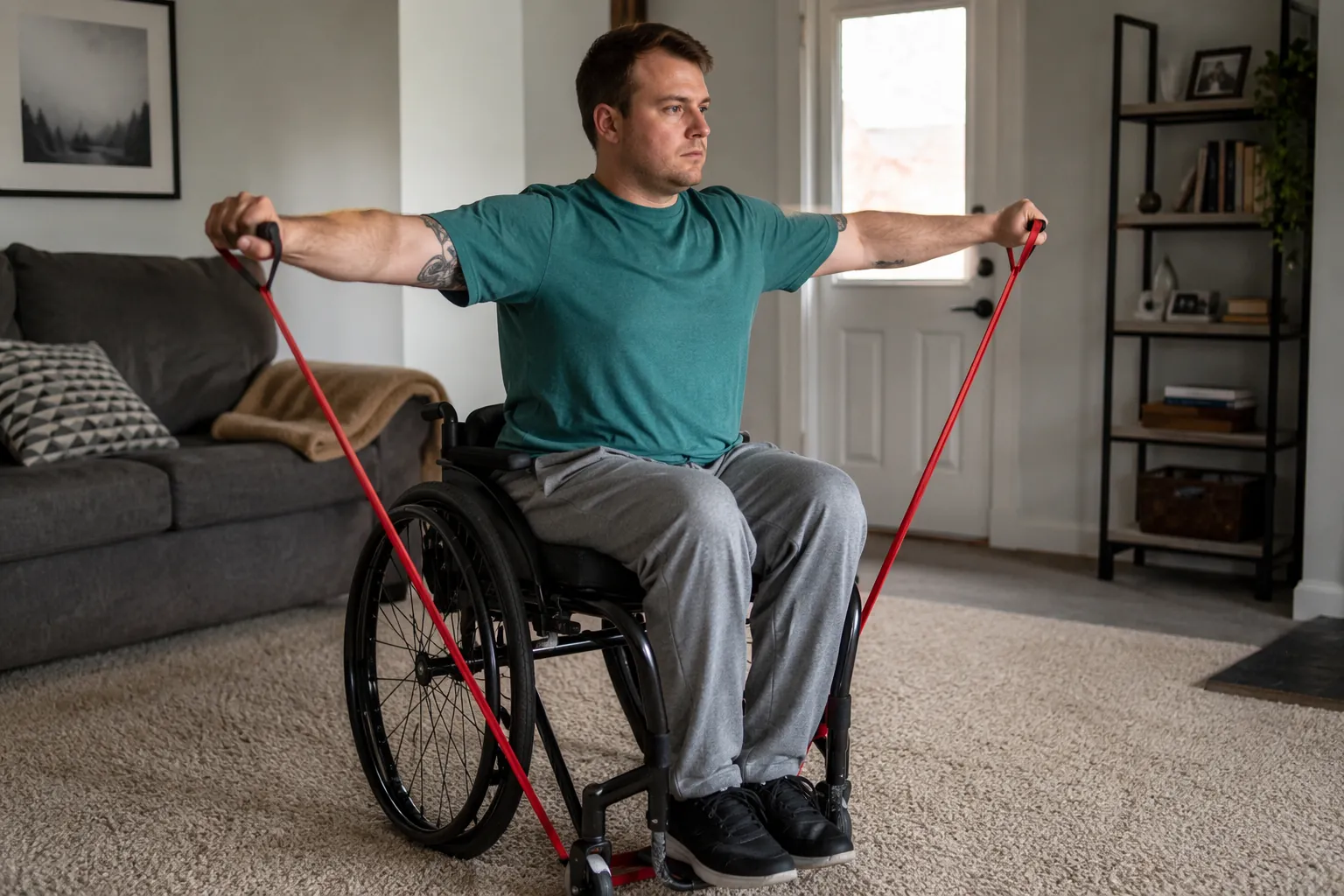
Bands are useful because they do not require a large arc of movement. You can press forward, row back, pull apart, or move diagonally with only the space around your chair. They also let you change effort quickly: choke up to increase tension, move farther from the anchor if your setup allows, or switch to a lighter band when form starts to change.
Anchoring deserves more attention than most product roundups give it. A band under a wheel, under a footplate, behind the back, or around a stable door anchor changes the line of pull. A line that feels fine for one person can drag another person forward in the chair or demand more grip than the cardio system can sustain. Start with the lowest-tension band and a short test set before using it in intervals.
| Band or weight option | Cardio use | Grip-aware adjustment |
|---|---|---|
| Band chest press | Press forward repeatedly at a steady tempo | Loop the band around the palm or use handles if gripping the rubber is the limiting factor |
| Band row | Pull elbows back, release with control, repeat for time | Use lighter tension if the wrist bends or the shoulders hike |
| Band pull-apart | Open arms from the front of the body and return slowly | Keep the range small and stop before shoulder pinch |
| Wrist-weight punches | Add light load to air punches or arm swings | Use very light weights and remove them if they change joint position |
A simple $30 cardio session can keep the same 10-minute frame as the bodyweight circuit, with only two loaded sections. Warm up with unloaded movement, do two minutes of band presses, recover with easy twists, do two minutes of rows or pull-aparts, then finish with unloaded air punches. The point is not to turn cardio into strength training. The point is to add just enough resistance that moderate intensity arrives at a controlled cadence.
- Choose a band tension you can move smoothly for 30-60 seconds, not the heaviest band you can move once.
- Keep one unloaded movement in the circuit so your hands and shoulders get a break while breathing stays elevated.
- Use wrist weights only if they do not pull the wrist, elbow, or shoulder out of a comfortable line.
- Stop loaded intervals early if grip fatigue changes posture; do not wait for pain to make the decision.
This is also where experienced adaptive trainers can be helpful. Ben Clark of Adapt to Perform, a C7 quadriplegic personal trainer, publishes seated HIIT and strength sessions that many wheelchair users reference as practical home guidance.[7] Treat that kind of programming as experienced coaching input, not a diagnosis-specific prescription; copy the pacing idea before copying every exercise.
When the $30 tier earns its place
Move from $0 to bands or wrist weights when bodyweight intervals no longer raise your breathing without frantic speed, when repetition boredom is stopping consistency, or when a small amount of resistance helps you feel the rhythm of the session. Do not move up if the extra load mainly makes your hands, neck, or shoulders work harder than your cardiovascular system.
The $150 tier: buy one device only if it removes a barrier
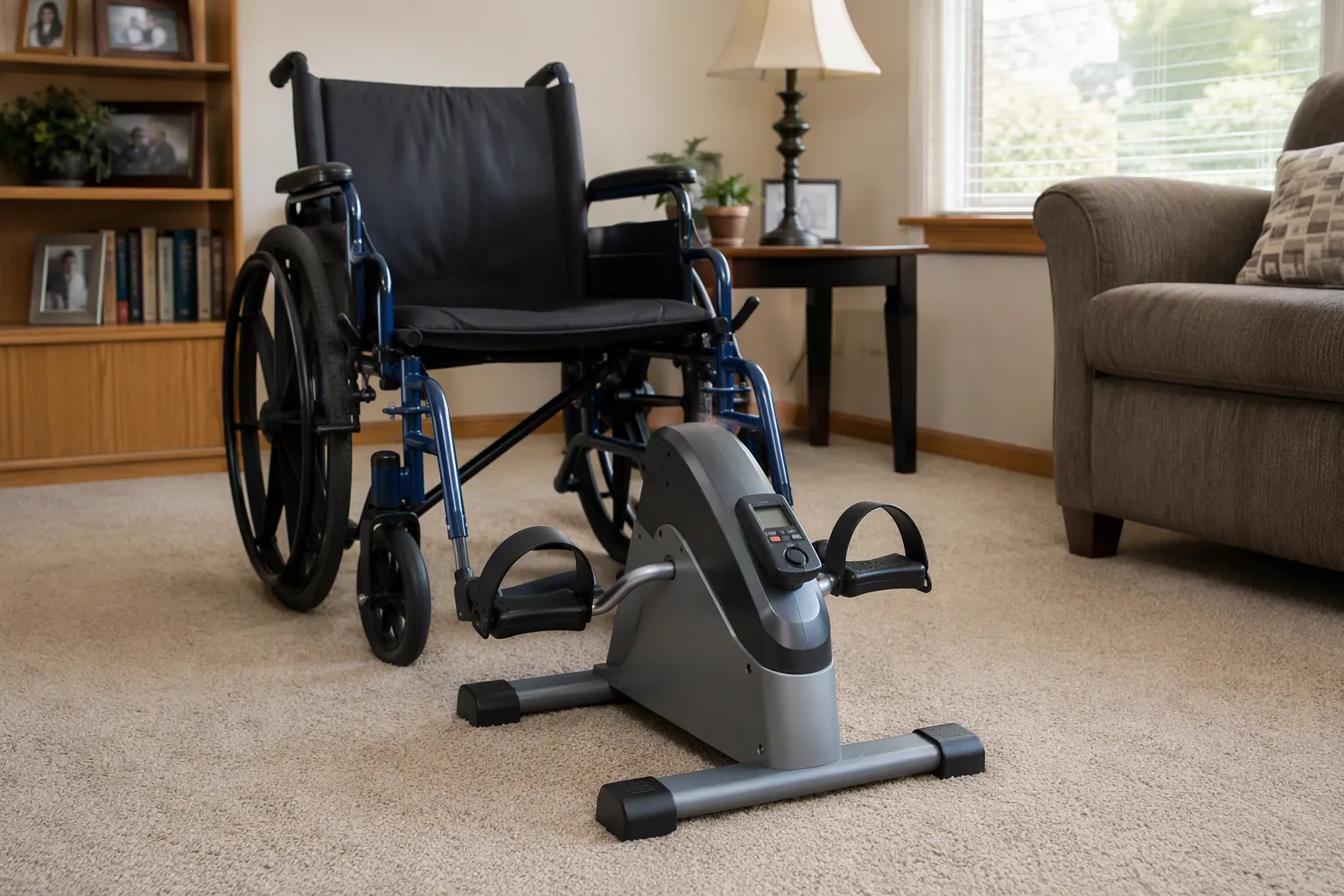
At around $150, the best purchase is not the most versatile piece of equipment. It is the one that solves the reason you are missing sessions. For some wheelchair users, that may be an adaptive split rope because it gives a clear cadence without needing floor clearance for a full rope. New Mobility listed adaptive jump ropes in a roughly $99-$165 range in early 2026.[6] For others, it may be a portable pedal exerciser because continuous cyclical movement is easier to sustain than inventing another interval circuit.
A split rope can work well when you have enough shoulder tolerance for repeated circular arm motion and enough grip or cuff support to hold the handles. It is less useful if the circling pattern irritates the shoulder, if timing demands create more frustration than flow, or if the rope heads strike nearby furniture. Test the motion first with empty hands for one minute. If that already feels awkward or sharp, the product is unlikely to become magic after purchase.
A portable pedal exerciser asks different questions. Can you position close enough without sliding? Does the base stay put on your floor surface? Can your feet or hands stay secured without excessive gripping? Is the resistance low enough for a warm-up and high enough to reach the talk-test zone? Does the unit store somewhere you can actually retrieve it, or will it become a heavy object behind a chair?
A device-based 10-minute session can be very plain: two minutes easy, six minutes at talk-test moderate intensity, two minutes easy. If concentration, spasticity, grip, or positioning makes continuous work unrealistic, use intervals instead: 30 seconds steady, 30 seconds easy, repeated for the middle block. The device earns its keep when it reduces decision fatigue and helps you collect minutes across the week.
One WashU Medicine NIH-funded study led by Kerri Morgan uses 150 minutes per week and three sessions per week as protocol parameters for wheelchair exercise research with 110 participants.[8] That is useful as an example of how researchers may structure weekly volume, but it should not be read as completed proof that one home device or one format is best.
How to build the first month
Start with the tier that gives you the fewest excuses and the cleanest recovery. If that is $0, good. If a band makes the session easier to follow, use the band. If a pedal exerciser is already in the room and it gets you moving, use it. The budget tier is a starting structure, not a moral ranking.
| Week | Target | What to watch |
|---|---|---|
| Week 1 | Three 10-minute sessions | Talk-test intensity, shoulder response later that day, hand fatigue |
| Week 2 | Three or four 10- to 15-minute sessions | Whether cadence stays smooth without pain or breathlessness beyond moderate effort |
| Week 3 | Add minutes before adding equipment | Whether boredom, grip, or setup is the true limiting factor |
| Week 4 | Keep accumulating toward 150 minutes per week | Whether the current tier is repeatable without creating a recovery problem |
Higher-intensity interval formats can be useful later, and SpinalCord.com describes wheelchair fat-burning workouts using HIIT formats several times per week.[9] For a new home-cardio habit, though, intensity should serve consistency. If hard intervals leave your shoulders sore enough to skip the next two sessions, they are not moving you closer to the weekly aerobic target.
The simplest rule is to add only one stressor at a time. Add minutes, or add cadence, or add resistance, or add a device. Do not add all four in the same week. The body part that complains first may not be your heart and lungs; for many wheelchair users, the limiter is shoulder tissue, hand grip, trunk fatigue, heat, or positioning.
Small-apartment checks before you spend money
- Space: Can you move both arms through the planned range without hitting wheels, walls, furniture, or medical equipment?
- Noise: Will the session stay quiet if a band snaps back, a rope handle rotates, or a pedal base shifts?
- Floor contact: Does the chair or device slide on carpet, wood, tile, or a rug?
- Grip: Can you hold, loop, cuff, or release the equipment safely when tired?
- Storage: Can you reach the item independently at the time you usually train?
If a purchase fails one of those checks, it is not a small-space solution yet. It is just another object in the room. For home cardio, the winning setup is the one that lets you begin quickly, stay near moderate intensity, and stop before a useful session turns into a shoulder or grip setback.
Begin with 10-minute sessions. Use the talk test. Accumulate minutes toward 150 per week. Upgrade only when the next tier removes a real barrier to repeating the work.
References
- Fitness advice for wheelchair users, NHS, https://www.nhs.uk/live-well/exercise/wheelchair-users-fitness-advice/
- Increasing Physical Activity among Adults with Disabilities, CDC, https://www.cdc.gov/physical-activity/features/disabilities.html
- Physical Activity Guidelines, ACSM, https://www.acsm.org/education-resources/trending-topics-resources/physical-activity-guidelines
- Heart Health for Wheelchair Users, New Mobility, Aug. 2025, https://newmobility.com/heart-health-for-wheelchair-users/
- How to Exercise with Limited Mobility, HelpGuide.org, https://www.helpguide.org/wellness/fitness/how-to-exercise-with-limited-mobility
- Wheelchair Users' Favorite Home Workout Products, New Mobility, Feb. 2026, https://newmobility.com/wheelchair-users-favorite-home-workout-products/
- Adapt to Perform, Adapt to Perform, https://www.adapttoperform.co.uk/
- Study promotes exercise for wheelchair users, WashU Medicine, https://medicine.washu.edu/news/study-promotes-exercise-for-wheelchair-users/
- Wheelchair Fat-Burning Workouts, SpinalCord.com, https://www.spinalcord.com/blog/wheelchair-fat-burning-workouts
What a small equipment investment adds
We don't have a build tagged to this exact tier yet. Browse all builds.
How often should you repeat this?
See our recovery and rest reference for citation-anchored rest-interval guidance.
Spot something off?
Tell us if a movement, tier assumption, or duration didn't match your experience.