
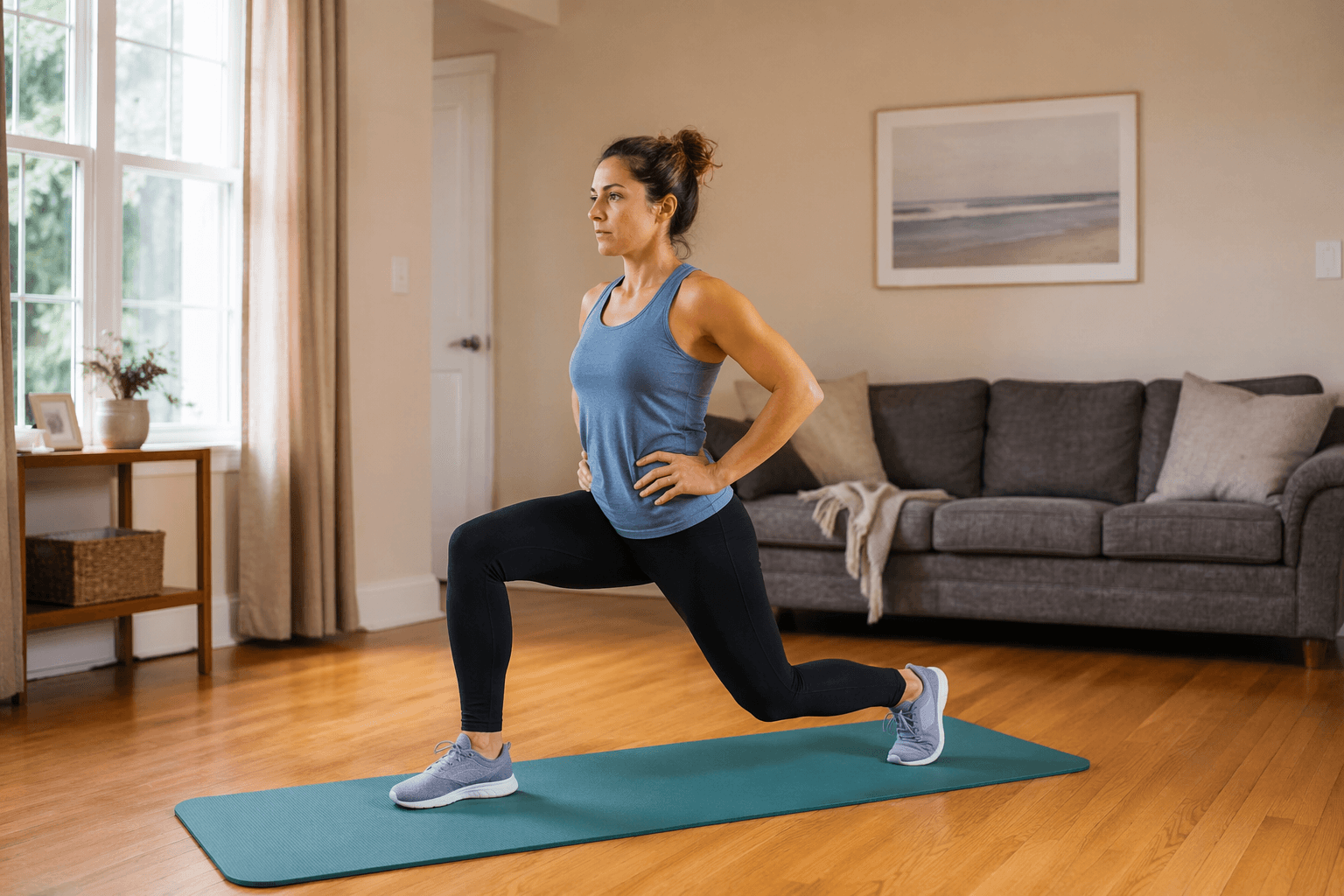
Why Most Beginners Quit Home Cardio (And How This Plan Fixes It)
If you've ever searched for "cardio at home" and landed on a list of 20 exercises with no instructions on which to do first or how to combine them, you're not alone. That format is the default across most fitness content, and it has a predictable outcome: you try a few moves, feel unsure about whether you're doing enough, skip a day, and eventually stop. The problem isn't that you lack motivation or exercise knowledge. The problem is that a flat list of moves is not a program.
This 4-week plan is built on a different premise. Instead of throwing every possible exercise at you, it introduces movements in phases, each with a specific intensity target, a clear schedule, and a checkpoint that tells you when you're ready to advance. The progression moves from low-impact walking-based moves in Week 1 to controlled interval circuits by Week 4, all designed for a small apartment with no equipment and no jumping. By the end of the four weeks, you'll have built a foundation of cardiovascular endurance that you can maintain, repeat, or build upon — not because you memorized 20 exercises, but because you followed a system.
Before You Start: What You Need and What to Know
This plan requires no equipment. You need enough clear floor space to extend your arms out to the sides and step forward and backward without hitting furniture. A yoga mat or towel on hardwood helps with grip and cushioning. Wear non-skid shoes — bare feet or socks on a slippery floor can lead to falls, especially during lateral movements.
Before starting any new exercise program, consult a healthcare provider, especially if you have any pre-existing conditions or risk factors for heart disease.
Understanding Intensity: RPE and the Talk Test
Throughout this plan, you'll see RPE targets. RPE stands for Rate of Perceived Exertion, a simple 1-to-10 scale where 1 is sitting on the couch and 10 is an all-out sprint you can't sustain for more than a few seconds. For this plan, you'll work in the RPE 3 to 7 range:
- Moderate intensity (RPE 3–4): You can hold a conversation comfortably. Your heart rate is elevated but you're not breathing hard. This corresponds to roughly 65–75% of your maximum heart rate.
- Vigorous intensity (RPE 5–7): You can speak a few words but not a full sentence. Breathing is noticeably heavier. This corresponds to roughly 76–96% of your maximum heart rate.
The talk test is a reliable alternative if you don't have a heart rate monitor. If you can sing, you're below moderate intensity. If you can talk comfortably, you're in the moderate zone. If you can only manage a word or two between breaths, you're in the vigorous zone.
Phase 1 (Week 1–2): Low-Impact Foundation
The first two weeks are about building a baseline. You'll use simple, standing movements that elevate your heart rate without requiring coordination or impact. The goal is to establish the habit of moving consistently and to learn how your body responds to sustained effort.
The Moves
- Walking in place / Marching: Lift your knees to hip height or lower. Keep your arms swinging naturally. This is your primary movement for building duration.
- Arm circles: Extend your arms out to the sides and make small forward circles, then backward. This adds an upper-body component without requiring leg coordination.
- Standing oblique crunch: Stand with feet hip-width apart. Lift your right knee toward your right elbow, then lower. Alternate sides. This engages your core while keeping both feet on the ground between reps.
- Toe taps: Place a small marker (a towel or a water bottle) on the floor in front of you. Tap your right foot to the marker, return to center, then tap your left foot. This is a low-impact alternative to high knees.
Weekly Schedule
| Day | Session | Duration | RPE Target |
|---|---|---|---|
| Day 1 | Marching + arm circles + standing oblique crunches | 10 minutes | 3–4 |
| Day 2 | Rest or light walking | — | — |
| Day 3 | Marching + toe taps + standing oblique crunches | 12 minutes | 3–4 |
| Day 4 | Rest | — | — |
| Day 5 | All Phase 1 moves in sequence | 15 minutes | 3–4 |
| Day 6 | Rest or light walking | — | — |
| Day 7 | Rest | — | — |
Form Cues for Apartment Dwellers
- Keep your knees soft — never locked — during standing moves.
- Land quietly. If you hear a thud with each step, you're landing too hard. Aim for a soft, controlled foot placement.
- Keep your movements controlled rather than fast. Speed will come later.
Advancement Checkpoint
You are ready for Phase 2 when you can complete a 15-minute session without stopping and maintain an RPE of 4 without feeling breathless. If you need more time, repeat Week 2 before moving on.
Phase 2 (Week 3): Adding Controlled Bodyweight Moves
In Week 3, you introduce larger-range-of-motion movements that recruit more muscle mass and push your heart rate higher. These moves are still low-impact — both feet rarely leave the ground — but they require more control and stability.
The Moves
- Air squats: Stand with feet shoulder-width apart. Sit back as if lowering into a chair, keeping your chest up and knees tracking over your toes. Drive through your heels to stand.
- Standing hamstring curls: Stand tall. Bend your right knee, bringing your heel toward your glutes. Lower with control. Alternate legs. This targets the back of your legs without requiring balance on one foot for long periods.
- Butt kicks (standing): From a standing position, quickly bring your right heel toward your glutes, then your left. Keep the motion small and controlled. This is a dynamic warm-up move that also works as a light cardio accelerator.
- Lateral shuffles: Take two steps to the right, then two steps to the left. Keep your feet wide and your hips low. This move builds lateral stability and raises your heart rate without vertical impact.
Sample Session Structure
Each session in Week 3 follows a warm-up → main set → cool-down structure. This teaches you to prepare your body before pushing intensity and to bring your heart rate back down afterward.
| Phase | Duration | Activity |
|---|---|---|
| Warm-up | 3 minutes | Marching in place + arm circles |
| Main set | 12–15 minutes | Alternate 1 minute of air squats, 1 minute of standing hamstring curls, 1 minute of butt kicks, 1 minute of lateral shuffles. Repeat the circuit 3–4 times. |
| Cool-down | 2 minutes | Slow marching + deep breathing |
Quiet Modifications
- Replace butt kicks with standing hamstring curls if the kicking motion feels too bouncy for your floor.
- For lateral shuffles, place a towel under each foot on hardwood floors and slide instead of stepping. This is nearly silent and adds a stability challenge.
- Lower slowly during air squats — a 3-second descent reduces noise and increases time under tension.
Advancement Checkpoint
You are ready for Phase 3 when you can complete a 20-minute session at RPE 5 and feel that the effort is manageable — not easy, but sustainable. If you're still struggling to finish the main set without a break, repeat Week 3 before moving on.
Phase 3 (Week 4, First Half): Low-Impact HIIT Introduction
In the first half of Week 4, you'll experience your first timed intervals. The work-to-rest ratio is 20 seconds of effort followed by 40 seconds of recovery — a forgiving ratio that lets you push harder during the work interval because you know a full recovery is coming.
All moves remain no-jumping. The intensity comes from speed and range of motion, not from impact.
The Moves
- Squat with toe taps: Perform a squat. As you stand, tap your right toe forward, then return to the squat position. Alternate sides.
- Standing hamstring curls (fast tempo): Same move as Phase 2, but performed at a quicker pace during the 20-second work interval.
- Sumo squat and reach: Stand with feet wider than shoulder-width, toes pointed slightly out. Lower into a sumo squat. As you stand, reach both arms overhead and slightly to one side. Alternate sides.
- Lateral shuffles (fast tempo): Same as Phase 2, but performed at a quicker pace.
- Reverse lunges: Step backward with your right foot, lowering both knees to 90 degrees. Drive through your left heel to return to standing. Alternate legs.
Sample Interval Circuit
| Exercise | Work | Rest | Rounds |
|---|---|---|---|
| Squat with toe taps | 20 seconds | 40 seconds | 1 |
| Standing hamstring curls (fast) | 20 seconds | 40 seconds | 1 |
| Sumo squat and reach | 20 seconds | 40 seconds | 1 |
| Lateral shuffles (fast) | 20 seconds | 40 seconds | 1 |
| Reverse lunges | 20 seconds | 40 seconds | 1 |
Intensity Check
During the 20-second work interval, you should be breathing hard enough that you can only say a word or two. During the 40-second rest, your breathing should return to a point where you can speak a short sentence. If you can sing during the work interval, you're not pushing hard enough. If you can't catch your breath during the rest, dial back the speed or range of motion.
Advancement Checkpoint
You are ready for Phase 4 when you can complete 3 circuits of the 20/40 interval without excessive fatigue — meaning you feel tired but not wiped out, and you could repeat the session the next day if needed.
Phase 4 (Week 4, Second Half): Building Intensity
In the second half of Week 4, the work-to-rest ratio shifts to 30 seconds of effort and 30 seconds of recovery. This is a significant jump in density — you're working longer and resting less. You'll also introduce a few new moves that approach the vigorous-intensity zone (RPE 6–7) while remaining apartment-friendly.
The Moves
- Controlled squat jumps (quiet modification): Instead of jumping, rise onto your toes at the top of the squat and lower back down with control. This mimics the explosive upward phase without leaving the ground.
- Forearm plank: Hold a plank on your forearms. Keep your body in a straight line from your head to your heels. This is an isometric core exercise that also elevates your heart rate when held for 30 seconds.
- Plank shoulder taps: From a high plank position (hands under shoulders), lift your right hand to tap your left shoulder, then alternate. Keep your hips as still as possible. This adds an upper-body and stability challenge to the plank.
- Step-in burpees (no jump): From standing, step your feet back one at a time into a plank position. Step them forward one at a time to return to standing. No jump, no push-up. This is a full-body move that can be surprisingly intense when performed at a steady pace.
Sample Interval Circuit
| Exercise | Work | Rest | Rounds |
|---|---|---|---|
| Controlled squat jumps | 30 seconds | 30 seconds | 1 |
| Forearm plank | 30 seconds | 30 seconds | 1 |
| Step-in burpees (no jump) | 30 seconds | 30 seconds | 1 |
| Plank shoulder taps | 30 seconds | 30 seconds | 1 |
Form Cues for Higher Intensity
- During plank variations, if your hips sag or rise, drop to your knees to maintain a straight line. Quality matters more than duration.
- For step-in burpees, keep your hands planted and your core braced. Don't let your back arch when your feet are in plank position.
- If the 30/30 ratio feels too intense, revert to 20/40 for one more week before attempting Phase 4 again.
Advancement Checkpoint
Completing Phase 4 means you have built a foundation of cardiovascular endurance that meets or approaches the CDC's recommended 150 minutes of moderate-intensity activity per week. From here, you can repeat Phase 4 with longer intervals (40/20), add more rounds, or explore other beginner programs on this site.
Putting It All Together: Your 4-Week Weekly Schedule
The table below shows the entire 4-week progression at a glance. Use it as a printable reference to track your progress.
| Week | Phase | Session Length | Frequency | RPE Target | Key Exercises |
|---|---|---|---|---|---|
| Week 1 | Phase 1: Low-Impact Foundation | 10–15 min | 3x/week | 3–4 | Marching, arm circles, standing oblique crunches, toe taps |
| Week 2 | Phase 1: Low-Impact Foundation | 10–15 min | 3x/week | 3–4 | Same as Week 1 — focus on completing full duration |
| Week 3 | Phase 2: Controlled Bodyweight | 15–20 min | 3x/week | 4–5 | Air squats, standing hamstring curls, butt kicks, lateral shuffles |
| Week 4 (first half) | Phase 3: Low-Impact HIIT (20/40) | 15–20 min | 3x/week | 5–6 | Squat with toe taps, sumo squat and reach, reverse lunges, fast lateral shuffles |
| Week 4 (second half) | Phase 4: Building Intensity (30/30) | 15–20 min | 3x/week | 6–7 | Controlled squat jumps, forearm plank, plank shoulder taps, step-in burpees |
Apartment-Friendly Modifications at a Glance
One of the biggest barriers to doing cardio at home is the fear of disturbing neighbors. The modifications in this plan are designed to maintain intensity while reducing noise. Here's a quick-reference table matching each potentially noisy move to its quiet alternative.
| High-Impact Move | Quiet Alternative | Noise Reduction Strategy |
|---|---|---|
| Jumping jacks | Step-out jacks (step one foot out at a time) | Eliminates the landing impact entirely |
| Squat jumps | Controlled squat jumps (rise onto toes) | No foot leaves the ground |
| Burpees (with jump) | Step-in burpees (no jump, no push-up) | Replaces the jump with a controlled step |
| High knees | Toe taps to a marker | Keeps one foot on the ground at all times |
| Mountain climbers | Sliding mountain climbers (towels on hard floor) | Sliding is quieter than tapping feet |
| Butt kicks | Standing hamstring curls | Eliminates the bouncing motion |
| Lateral shuffles | Sliding lateral shuffles (towels on hard floor) | Sliding is quieter than stepping |
What Comes After Week 4?
Finishing this 4-week plan is a real achievement. You've built a habit, learned how your body responds to different intensities, and proven that effective cardio can happen in a small space with no equipment. Now you have several options for continuing your progress:
- Repeat Phase 4 with longer intervals: Try 40 seconds of work with 20 seconds of rest. This shifts the ratio toward higher density and pushes your cardiovascular endurance further.
- Add more rounds: If you're doing 3 circuits, aim for 4 or 5. This extends your session duration without changing the exercises.
- Explore other beginner programs: Check out our beginner bodyweight routines for strength-focused sessions, or our 4-week training plans for a more structured approach that combines cardio and strength.
- Focus on recovery: As your training volume increases, recovery becomes more important. Our recovery guides cover active rest, mobility work, and how to use HRV data from your fitness tracker to gauge readiness.
The research is clear: home workouts are as effective as gym training when the programming is consistent and challenging. A 2026 review published by Health.com concluded that effectiveness depends on consistency, not location. You've just proven that to yourself over four weeks. Keep going.
Comments
Join the discussion with an anonymous comment.