
The Home Gym That Becomes a Clothes Rack
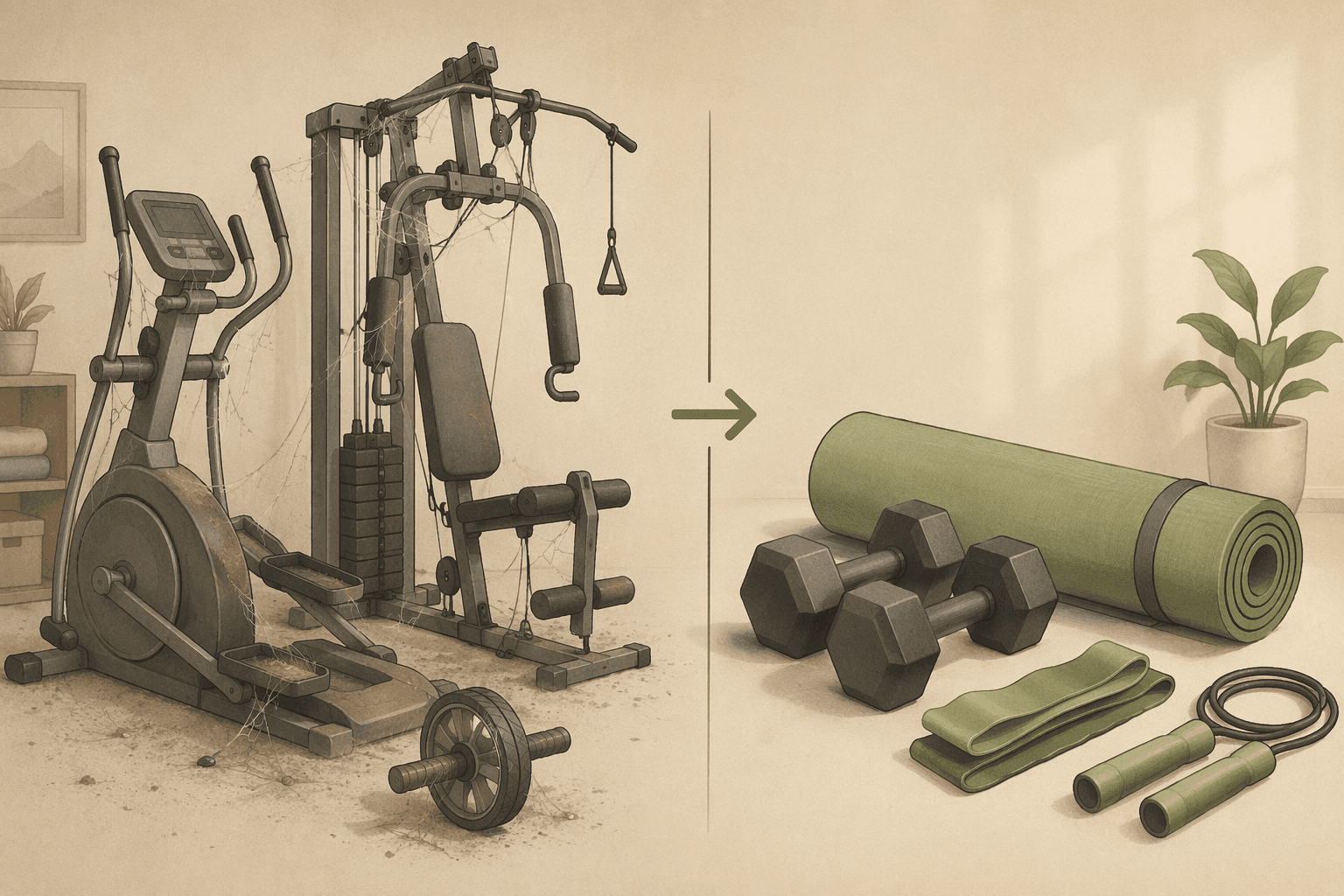
You know the scene. A friend buys an elliptical, a multitrainer, or a set of kettlebells in sizes they will never use. Three months later the machine holds laundry or holds nothing.
Exercise physiologist Chris Mohr put it plainly: “People tend to buy big and complex equipment for the home that ends up collecting dust.” I’ve seen this happen to friends who spent $800 on a machine they used for two weeks. The problem isn’t motivation — it’s that the gear didn’t fit their space or their habits.
A study in the American Journal of Health Promotion found that the strongest predictor of physical activity among home gym owners wasn’t how much equipment they owned — it was whether they genuinely enjoyed the exercises the equipment allowed. Ownership alone didn’t translate to use. That should change how you decide what to buy. If enjoyment predicts usage and usage predicts results, then buying gear that fits your space and feels good to use matters more than buying gear that covers every possible movement pattern.
Three Items, 90% — But the Real Question Is Use
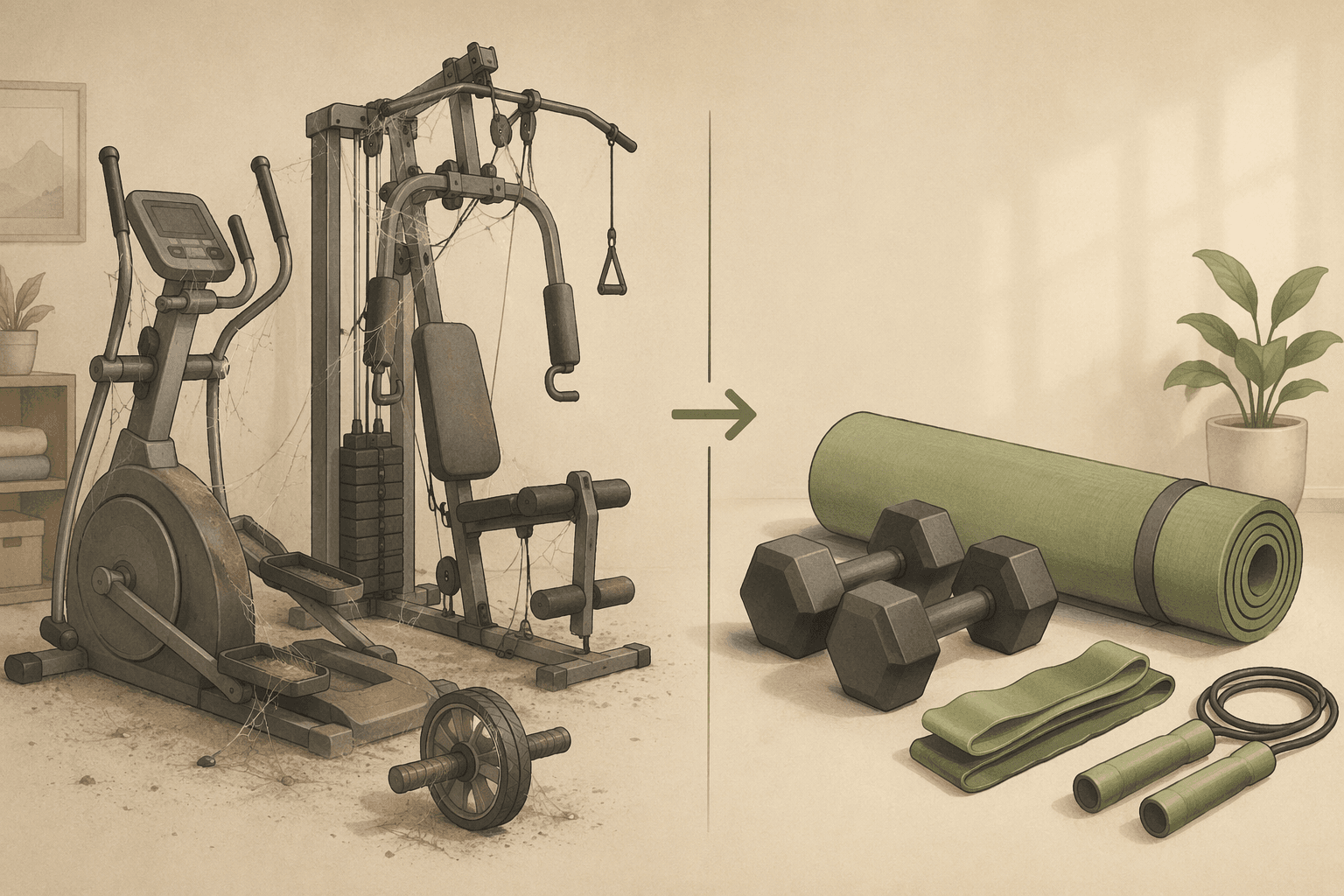
So what does a starter setup that people actually stick with look like? Trainer Jacob Siwicki’s guide puts a number on it: a yoga mat, resistance bands, and one pair of dumbbells — total cost between $200 and $300. His estimate: “A mat, a set of bands, and some dumbbells will get you 90% of the way there for effective home training.”
That’s not a marketing number. It’s a practical observation about exercise selection: with those three items you can perform squats, lunges, rows, presses, curls, extensions, glute bridges, planks, bird dogs, and countless banded variations. You won’t do heavy deadlifts or bench presses, but you will cover the compound and isolation movements that build a foundation.
But I don’t treat the 90% claim as a guarantee of success. It’s about what exercises are possible — not about whether you’ll actually do them three weeks in. The AJHP study makes clear: buying equipment and enjoying the exercises are two different actions. If the mat feels thin on hardwood and makes your knees complain, or the bands snap back and sting your wrists, the equipment gets abandoned.
That’s why the graduated investment rule exists: you earn the right to buy the next piece by consistently using the first one.
Earn the Next Piece — The Graduated Investment Rule
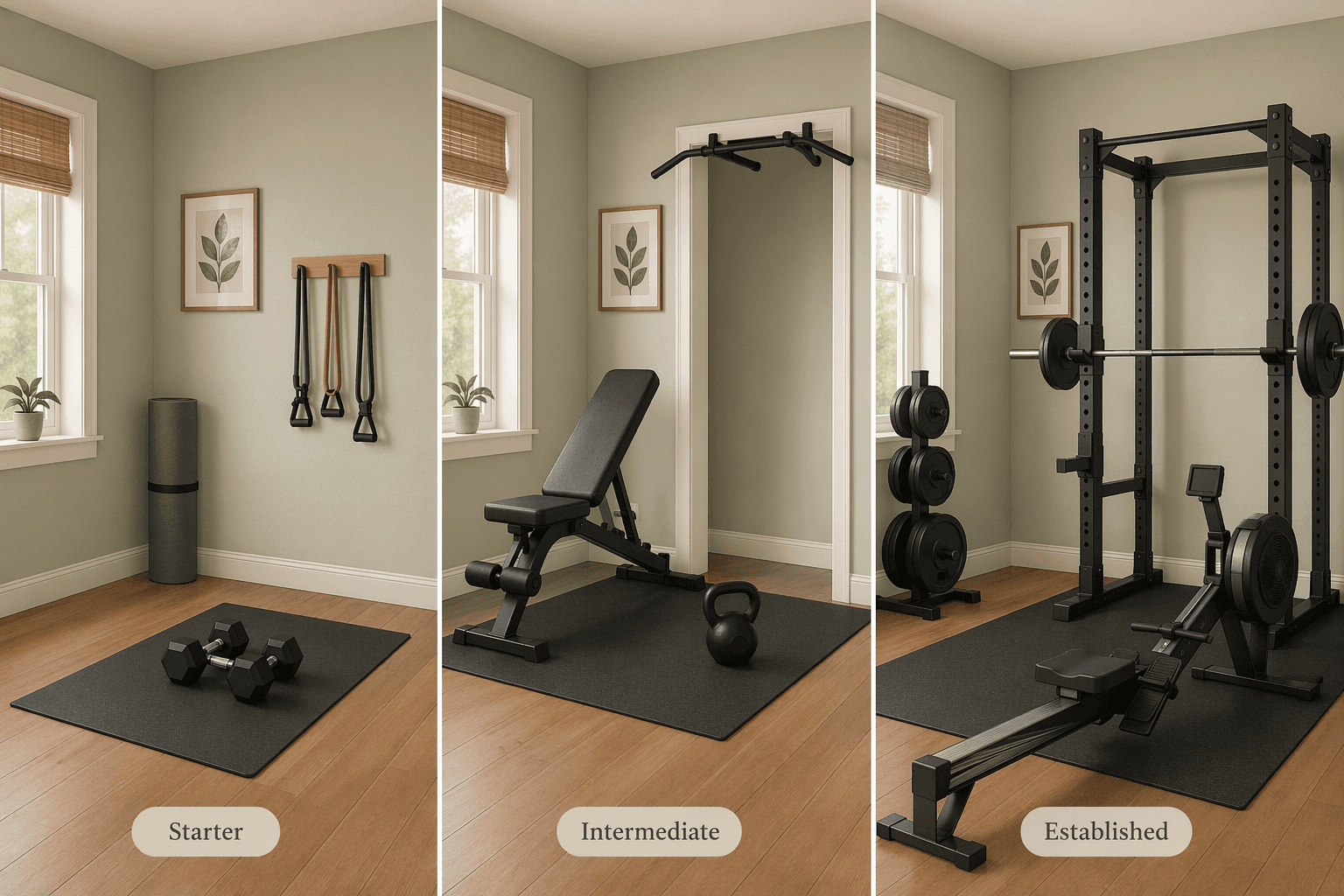
Instead of buying everything upfront, follow a three‑tier timeline:
- Immediate essentials (Tier 1) – buy the first day. Cost: $200–$300.
- Additions at 4+ weeks (Tier 2) – only add what you actually miss during workouts. Cost: $470–$600 total if you opt for higher‑quality dumbbells and a bench.
- Long‑term investments at 3+ months (Tier 3) – a rack, barbell, or cardio machine. Only buy if your training consistently demands it.
The logic is simple: a beginner who trains three times a week for a month with just a mat, bands, and a single dumbbell pair will know exactly which movement they miss — a chest press that requires a bench, a row that needs a heavier load, a stretch that a band can’t replicate. Those gaps are genuine needs, not marketing suggestions.
Your First $300: What Actually Belongs
Here are the specific items that form the core of a durable starter setup. Each is chosen not just for covering exercises but for making the experience something you want to repeat. A cheap mat on a hard floor wears you out faster than a better one — I’ve seen people quit because of that alone.
| Item | Recommended Pick | Price | Why It’s Worth It |
|---|---|---|---|
| Yoga mat | Manduka PRO | $144 (Siwicki) | Thick, grippy, non‑toxic. A cheap mat on hard floors makes floor work uncomfortable; this one keeps you coming back. |
| Resistance bands | Vergali Mini Bands (4‑pack) | $19.79 | Variety of tensions for glutes, hips, and upper body. Compact and nearly indestructible. |
| Dumbbells (one pair) | CAP Barbell Rubber Coated (start with a medium weight, e.g., 15 lb for women, 25 lb for men) | $139.99 (set) or $1.10/lb (hex dumbbells) | The single most versatile weight. A rubber coating protects floors; hex shape prevents rolling. |
| Jump rope (optional) | WOD Nation Double Under Speed Rope | $18.99 | Five minutes of jumping equals a short run, and it takes negligible space. |
Total for the four items above: roughly $320. That’s slightly above the $300 ballpark, but the jump rope is a nice‑to‑have. Without it you land under $300. Either way, you have a setup that covers squats, lunges, rows, presses, curls, planks, glute bridges, and banded mobility work — easily 30 to 40 different exercises.
What to Add (or Not) After a Month
After a month of consistent training, ask yourself: what movement do I want to do but can’t? Common missing pieces:
- Adjustable bench ($100–$200) – needed if you want to do dumbbell chest presses, incline rows, or seated shoulder presses at a supported angle.
- Pull‑up bar ($30–$50 over‑door) – if you miss vertical pulling or want to do dead hangs for shoulder health. Over‑door bars are space‑efficient.
- Kettlebell (single, 15–25 lb, $30–$60) – good for swings, goblet squats, and Turkish get‑ups. A nice variety piece.
- Adjustable dumbbells (like REP QuickDraw, $416) – replaces up to 12 fixed dumbbells. Honest trade‑off: switching weights is slower than picking up a new pair, and the price is not a budget option. But for apartment dwellers it’s the single best space‑compromise pick.
Notice the pattern: each addition solves a specific, self‑identified gap. If you never miss a chest press, you don’t buy a bench.
The Skip List Matters More Than the Buy List
Most beginner purchasing mistakes aren't about what they forget – they're about what they buy that ends up unused. Chris Mohr again: “big and complex equipment ends up collecting dust.” The biggest offenders:
- Single‑use cardio machines (ellipticals, stationary bikes, treadmills) – expensive, space‑hungry, and unless you already love that specific activity, you won’t use it enough to justify the cost.
- Cheap all‑in‑one home gyms – flimsy cables, limited range of motion, and often the machine makes the exercise harder than the resistance. You’re better off with bands and dumbbells.
- Ab gadgets (roll wheels, sit‑up benches, electric stimulators) – you can do a plank, bicycle crunch, or leg raise on the mat you already own.
- Overly specific gear (balance boards, stepping platforms, grip trainers) – unless you have a specific rehab or performance goal, they add variety but rarely replace a basic movement.
Start Minimal, Add What You Miss
Buy the starter kit – mat, bands, one pair of dumbbells. Use it for four weeks. If you find yourself wishing for something, then consider adding it. If you don’t, you already own everything you need.
Your home gym is a process of subtraction, not accumulation. The gear that stays in use is the gear you chose because you actually needed it – not because a list told you should have it.
Comments
Join the discussion with an anonymous comment.