
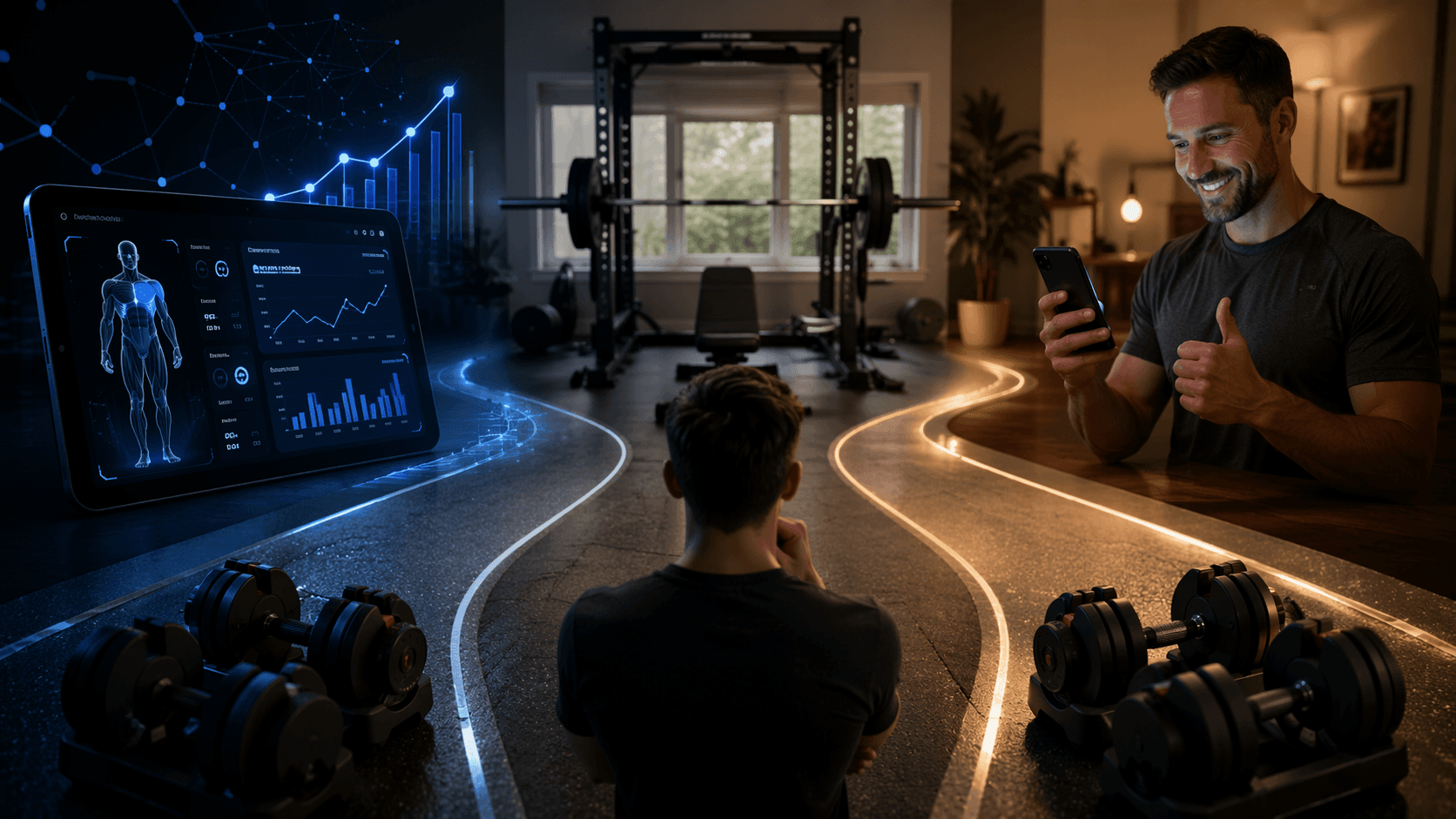
For a home gym lifter in 2026, the “best strength training app” question usually becomes a pricing and accountability question before it becomes a feature question. One path costs roughly $10–20 per month and gives you automated programming that adjusts around your lifts, equipment, and readiness. The other costs about $199 per month and buys access to an actual coach who checks in, reviews video, and notices when your training log has gone quiet.
That gap is large enough to make the decision feel obvious until you remember what usually ruins home training. It is not always a bad spreadsheet. Sometimes it is a deadlift that keeps drifting out of position. Sometimes it is three missed sessions in a busy month. Sometimes it is not knowing whether to push, repeat, or back off after sleep has been terrible and warmups feel heavier than they should.
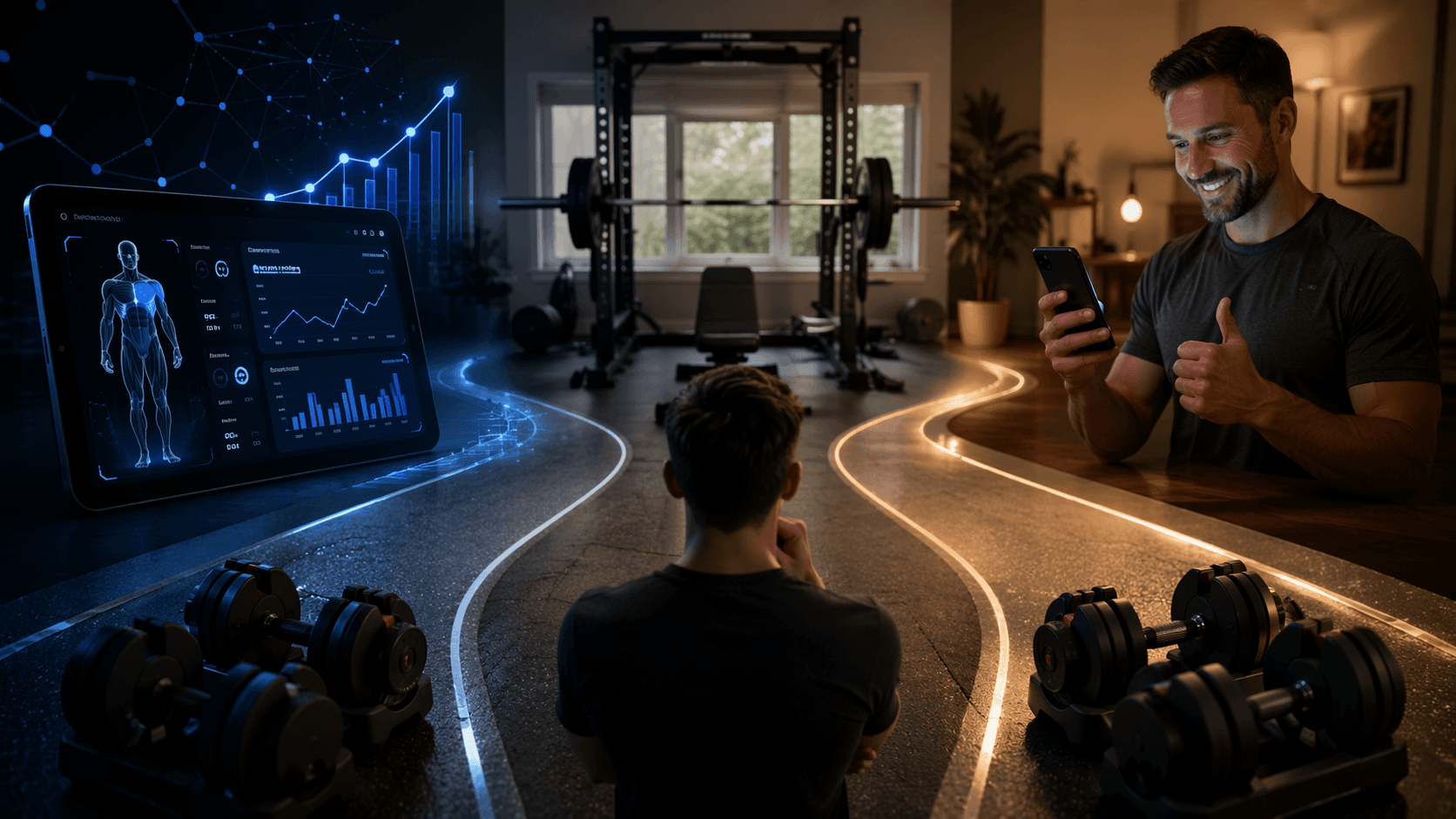
So the useful comparison is not “AI versus humans” in the abstract. It is whether your current bottleneck is programming consistency, external accountability, form feedback, equipment fit, or budget. Those are different problems, and the same app will not solve them equally well.
| Training model | Typical 2026 cost | What you are really buying | Where it is strongest | Where it is weakest |
|---|---|---|---|---|
| AI strength programming apps | About $10–20/month | Automated progression, readiness-based adjustments, equipment-aware workout generation | Cost, consistency, load progression, home-gym adaptability | Accountability and real-time form judgment |
| Human-coached remote platforms | About $199/month | A coach who checks in, reviews video, adjusts plans, and responds to context | Adherence, form review, nuanced decisions, confidence during stalls | Price |
| Hybrid group-coaching options | About $19/month for Caliber Pro | Structured programming plus coach-led group accountability | A middle tier when pure automation is too easy to ignore | Less individual attention than 1:1 coaching |
If you want the pricing argument in more detail, the site’s analysis of which strength training app delivers the most value per dollar is the better place to look at cost-per-value comparisons. Here, the more important question is what the money changes inside your week.
What AI programming gets right
The strongest case for AI strength apps is not that they are futuristic. It is that they remove a lot of small programming decisions that intermediate lifters can overthink or avoid: how much to load today, when to increase volume, when to pull back, and how to keep training moving when the exact equipment in your garage does not match a generic program.
JuggernautAI is the cleanest example because its adjustment process is visible enough to judge. Garage Gym Reviews tester Amanda Capritto used JuggernautAI for more than a year while training for triathlon and described it as “insanely smart and impressive.” Before sessions, the app asks about motivation, sleep, calorie intake, and soreness, then uses that readiness information to adjust loads automatically.[1]
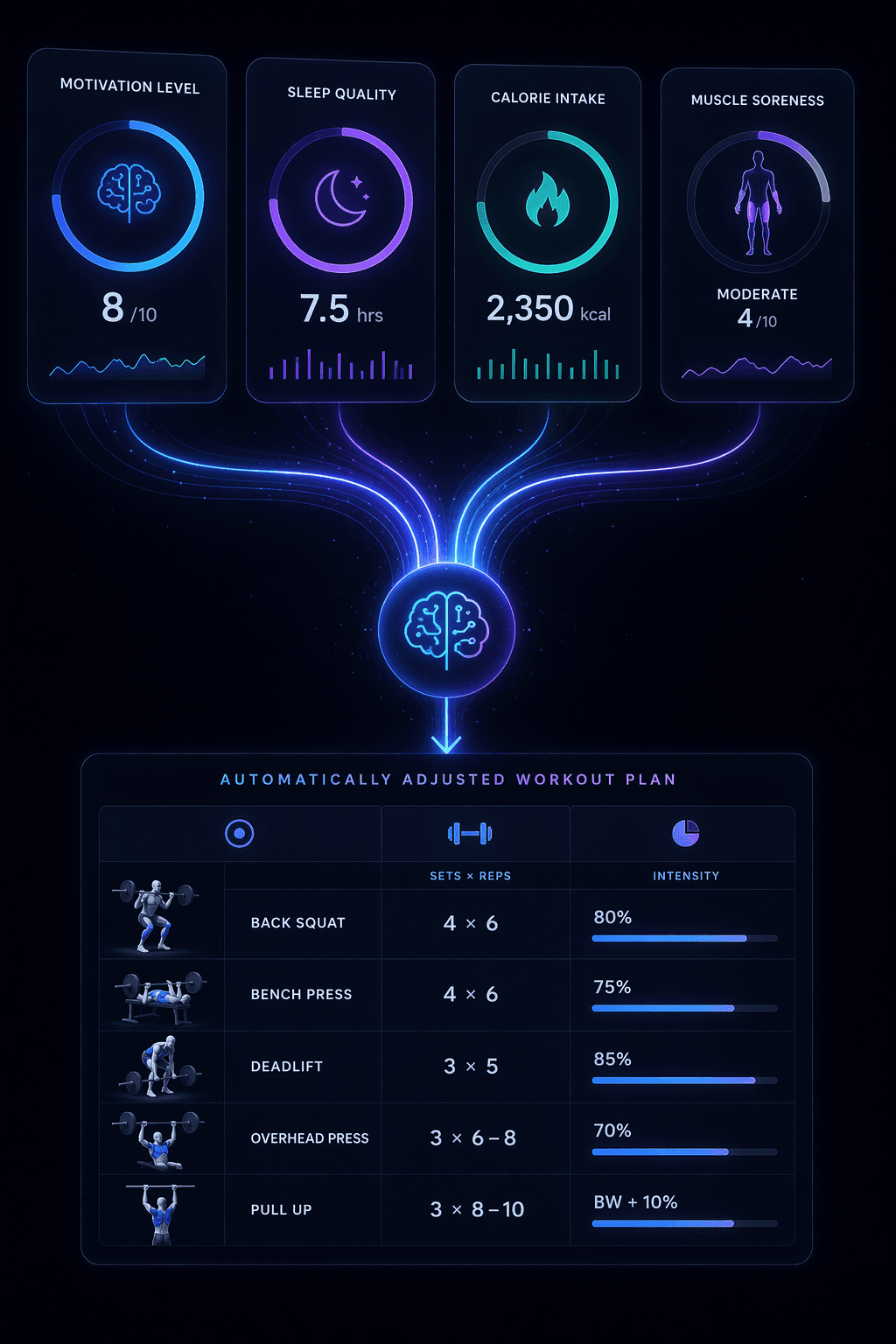
That matters because a decent home lifter already knows the difference between “I am being lazy” and “this is not the day to force a top set” is not always obvious in the moment. A readiness questionnaire will not see your bar path, but it can make you pause long enough to report the conditions that should affect loading. When the app then adjusts the day’s work, the decision feels less like improvisation and more like a planned response.
Fitbod and similar AI-driven apps occupy the same broad lane: generate strength workouts around your available equipment, training history, and recovery signals. For a home gym with a squat rack, adjustable dumbbells, bands, a bench, and maybe no cable stack, that equipment adaptability is not a minor feature. It is the difference between following the plan and spending five minutes before every session rewriting movements. For a deeper home-gym-specific look at that issue, see the guide to strength training apps for home gym users.
The price reinforces the appeal. Strength-focused AI apps tend to cluster around $10–20 per month, which is meaningfully different from a broad workout-app average that includes larger boutique ecosystems such as Peloton and iFIT. Garage Gym Reviews has cited an average workout-app price around $34 per month, but that broader figure should not be treated as the going rate for AI strength programming specifically.[1]
The low-risk AI entry point
TR[Ai]NER by Element 26 changes the trial math because it offers three complete programs for free before moving to a $14.99 monthly subscription. Fortune rated it 4.5 out of 5 and named it its best option for weightlifting, which makes it a practical first test for someone curious about AI programming but not ready to add another permanent subscription.[2]
That kind of trial is especially useful if you are not sure whether automated programming will feel helpful or disposable. After a few full programs, you can judge whether the app’s progression logic fits your training style, whether substitutions make sense for your equipment, and whether you actually follow the sessions when nobody is waiting for a reply.
Where AI still feels thin: accountability and form
The common weakness in AI strength apps is not intelligence in the narrow programming sense. It is consequence. If you skip Wednesday’s lower-body session, the app can reschedule, modify, or remind you. It cannot be disappointed in a way that matters. It cannot ask whether the missed session was a one-off work conflict or the start of another three-week drift.
Across app testing summaries, AI programming options tend to score low on accountability, often around 1–2 out of 5, while human-coached options can reach 5 out of 5.[1] That does not mean AI apps are bad. It means they are better at changing the plan than changing your behavior.
Form review is the bigger dividing line. A training app can store videos, estimate exertion, or ask how a set felt. But the useful correction is often more specific: your hips rose early, the bar drifted forward, your brace disappeared on rep four, your squat depth changed when the load got heavy. If no one is watching the video with a trained eye, those details stay in the garage with you.

This is where human-coached platforms justify a price that looks jarring next to a $15 app. Future and Caliber Premium both sit around $199 per month for 1:1 remote coaching with daily check-ins and video form review.[3][4] That is expensive compared with AI programming, but it is still below the roughly $300–600 per month range cited for in-person training by the Michigan Fitness Association.[5]
What the $199 coaching tier actually buys
“More personal” is too vague to explain the difference. The better way to think about Future or Caliber Premium is that the coach becomes part of the training system. They do not just write a better plan on day one. They watch whether the plan survives your actual life.
A human coach can notice that your reported effort keeps climbing even though the weights are flat. They can see that a lift looks worse than the log suggests. They can ask why you stopped training on Fridays. They can tell you to repeat a week without making it feel like failure, or push you when you are hiding behind “recovery” because the next set looks uncomfortable.
That does not guarantee better results. A disengaged coach is not automatically more useful than a well-built algorithm. But the structure of 1:1 coaching is better suited to problems that involve avoidance, uncertainty, and interpretation. If your issue is that you keep changing programs every time progress slows, paying for a coach may be less about exercise selection and more about staying inside the process long enough for it to work.
The price is still the hard part. At about $199 per month, a human-coached app can cost 10–20 times as much as an AI strength app. That makes sloppy comparisons annoying. You are not deciding whether one app has a nicer interface than another. You are deciding whether missed workouts, unclear technique, and second-guessing are costing you more than the subscription difference.
The hybrid wrinkle: Caliber Pro
The market is not a clean two-box choice. Caliber Pro sits in the middle at $19 per month, using group coaching rather than full 1:1 coaching. Garage Gym Reviews rated Caliber 4.6 out of 5 overall, with 5 out of 5 scores for both accountability and instruction.[4]
That makes it interesting for the home lifter who does not need a coach rewriting every week but does need more social pressure than an automated reminder. A group-coaching model will not give the same individualized attention as Caliber Premium, yet it can add enough friction to keep training from becoming invisible. For many intermediate lifters, that may be the actual missing piece.
How to choose based on your real constraint
Start with the problem you have repeated, not the feature list that looks most advanced.
- Choose an AI strength app if you already lift with decent technique, train consistently, log honestly, and mainly want smarter progression without paying coaching prices.
- Choose 1:1 human coaching if your main failures are missed sessions, recurring form doubts, stalled lifts you cannot interpret, or a tendency to disappear when training gets inconvenient.
- Consider a hybrid group-coaching tier if $199 per month is too much but a fully automated plan is too easy to ignore.
- Start with a free or low-cost option if you are still figuring out whether app-based training fits your routine at all.
Cost-sensitive lifters should also separate “I need coaching” from “I need structure.” If all you need is a plan to follow for a training block, the site’s guide to free workout apps for home may be enough to avoid paying for support you will not use.
If money is the limiting factor, AI programming is the obvious first stop. If form feedback is the limiting factor, human coaching has the clearer advantage. If accountability is the limiting factor, be honest about whether a notification has ever changed your behavior. If equipment adaptability is the limiting factor, AI apps can be excellent, but only if their substitutions match how your home gym is actually set up.
The app that looks best on paper is not always the one that keeps you training six months from now. A $15 AI app is a bargain if you use it consistently and trust its adjustments. A $199 coach is reasonable if that human attention prevents the stalls, skipped sessions, and technique problems that keep repeating. The right model is the one that addresses the constraint that is already showing up in your log.
References
- JuggernautAI App Review, Garage Gym Reviews
- Best Weightlifting Apps, Fortune
- Future App Review, Garage Gym Reviews
- Caliber App Review, Garage Gym Reviews
- Personal Training Cost, Michigan Fitness Association
Comments
Join the discussion with an anonymous comment.