
The Best Free Workout Apps for Your Specific Fitness Goal
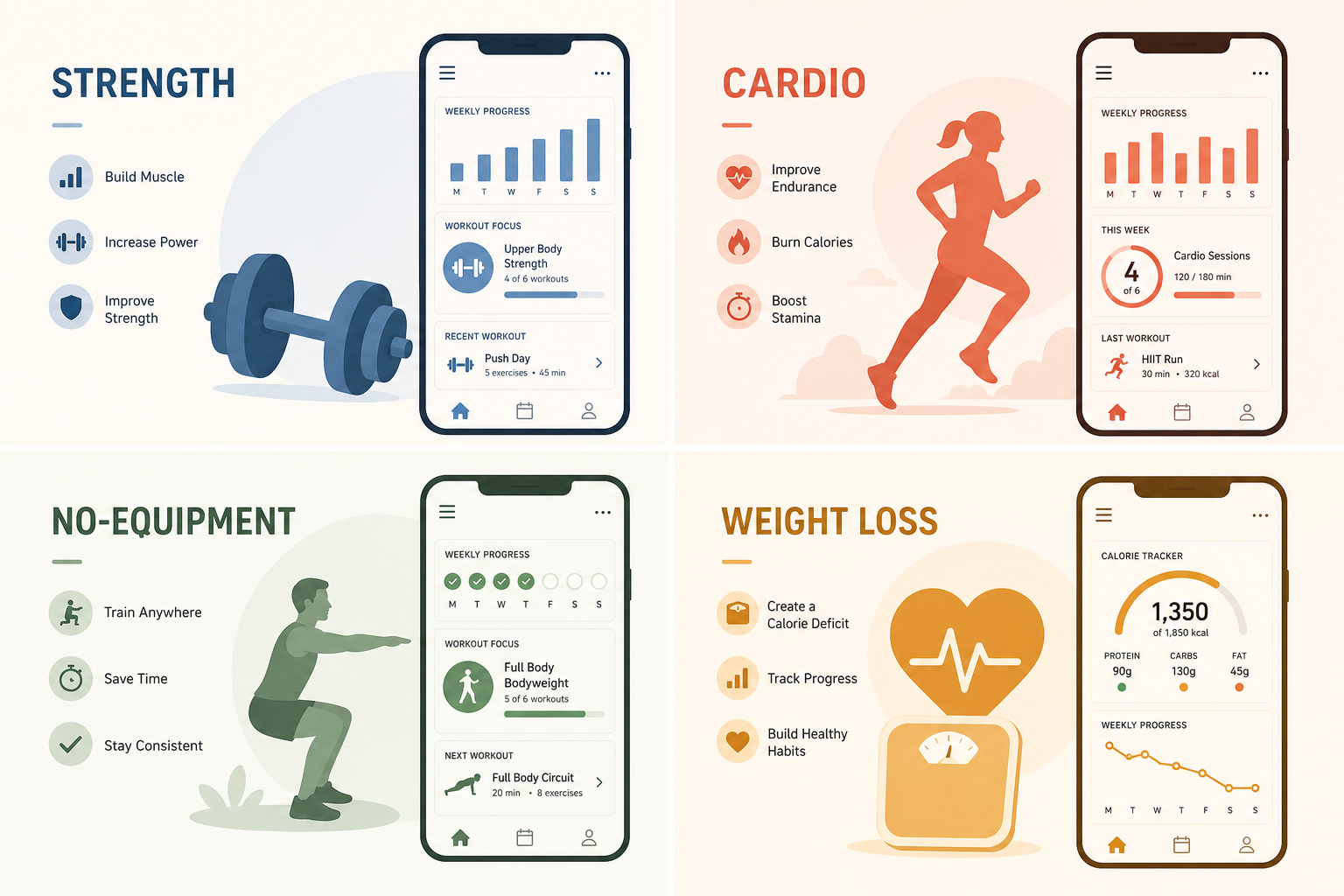
Most free workout app roundups rank apps by overall quality — but the right app depends entirely on what you're training for. This guide matches the strongest free-tier options to four specific goals: strength and progressive overload, no-equipment home workouts, cardio and endurance, and weight loss.
Why Your Goal Should Pick Your App (Not a Ranked List)
Most free workout app roundups work the same way: they test a handful of apps, assign scores, and hand you a numbered list. The problem is that a #1 ranking means almost nothing if the app is optimized for cardio and you're trying to build strength.
The apps that dominate those lists — Nike Training Club, FitOn, Boostcamp — are all genuinely good. But they're built around different use cases. Boostcamp is designed for progressive overload strength programming. Nike Training Club is a broad guided-workout library. FitOn leans toward variety and accessibility. Picking one without knowing your goal is like choosing a tool before you know the job.
This guide organizes recommendations by training goal — not by overall quality score. If you want a broader look at what's free versus paywalled across the app landscape, the Best Free Fitness Apps for Home Workouts guide covers that ground. What this article adds is a goal-first framework so you can skip straight to the app that actually matches how you train.
Identify Your Primary Training Goal First
Before scanning any app, narrow down which of these four goals describes your primary focus. Most people have a mix, but one goal usually drives their training decisions. Pick the one that matters most right now.
- Strength and progressive overload — You want to follow a structured lifting program, track weights and reps over time, and see measurable progress. You may have dumbbells, a barbell, or a home gym setup. Ask yourself: Do I care more about following a proven program or just logging what I did?
- No-equipment and beginner workouts — You want guided sessions you can do anywhere with no gear, or you're new enough that you need structure and instruction before worrying about equipment. Ask yourself: Am I starting from scratch, or do I just prefer bodyweight training?
- Cardio and endurance — You want to improve cardiovascular fitness through HIIT, cycling, dance cardio, or mixed-format sessions. You may also mix cardio with other training styles. Ask yourself: Is cardio my main focus, or is it supplementary?
- Weight loss — Fat loss is primarily driven by a calorie deficit, which means your app strategy needs to cover both exercise and nutrition. A workout app alone won't close that gap. Ask yourself: Am I tracking what I eat, or just what I do in workouts?
Free-Tier Feature Comparison at a Glance
The table below maps each app to its strongest goal match, what the free tier actually includes, and what requires a paid upgrade. Use this as your reference before reading the goal-specific sections.
| App | Primary Goal Match | Key Free Features | Behind the Paywall | Platform |
|---|---|---|---|---|
| Boostcamp | Strength & Progressive Overload | 11,000+ programs, 130+ coach-designed routines, auto-progression, plate calculator, RPE tracking, AI program builder | 20+ exclusive coach programs, advanced analytics, premium tools | iOS, Android |
| Hevy | Strength logging | Unlimited workout tracking, up to 4 stored routines, exercise history, community features | Additional routine slots, advanced analytics | iOS, Android |
| Strong | Strength logging | Clean workout logger, progress visualization, up to 3 custom routines | Unlimited routines, advanced stats | iOS, Android |
| FitOn | No-Equipment & Beginners | Unlimited guided workout access, no-equipment sessions, variety of formats (HIIT, yoga, pilates, strength), challenges, community | Offline downloads, nutrition/meal plans, personalized programs | iOS, Android |
| Fitloop | No-Equipment & Beginners | 100% free core, 28-day beginner calisthenics program, progression paths, rest timers, workout history, Apple Health sync | No paywall on core features | iOS |
| Nike Training Club | Cardio & Endurance (and all-around) | 300+ workouts across strength, cardio, yoga, mobility — entirely free, no paywall | Nothing — fully free | iOS, Android |
| MyFitnessPal | Weight Loss (nutrition tracking) | Calorie tracking, large food database, macro logging, exercise logging | Premium meal plans, advanced analytics, ad-free experience | iOS, Android |
Strength and Progressive Overload: Boostcamp, Hevy, and Strong
If building strength is your goal, you need an app that does more than log sets. You need one that tells you what to lift next — or at minimum gives you a structured program with progression logic built in. Three apps serve this goal well on a free tier, but they operate differently.
Boostcamp: The Standout Free Pick for Strength Programming
Boostcamp is the strongest free option for home gym users who want a proven strength program without paying for it. The free tier includes over 11,000 programs in total, with 130+ coach-designed routines built by certified coaches — programs like 5/3/1, nSuns, and various powerbuilding splits, all with progressive overload logic coded in. The app tells you what weights to use next session based on your previous performance.
What makes Boostcamp genuinely different from a basic logger is that the progression happens automatically. You don't have to calculate your next working weight — the app handles it. The free tier also includes a plate calculator, RPE (rate of perceived exertion) tracking, exercise demonstration videos, and an AI program builder. With over 1.2 million users and 120 million workouts logged, it's not a niche tool.
The paid tier (Boostcamp Pro) adds 20+ exclusive coach programs, advanced analytics, and premium tools — but most home gym users will find the free tier more than sufficient. The core programming and tracking features are all free.
Hevy: The Logging-First Companion
Hevy takes a different approach. It's primarily a workout logger rather than a program-delivery platform. The free tier allows unlimited workout tracking — every set, rep, and weight you log is saved without restriction. You can store up to four routines, which covers most users who follow a simple split.
Where Hevy shines is in visualizing your progress over time. It shows you strength trends through charts and graphs, which helps self-directed lifters see whether they're actually progressing. It doesn't algorithmically prescribe your next session the way Boostcamp does — you decide your own programming — but it gives you the data to make that decision well.
Hevy works well as a companion to Boostcamp: follow a Boostcamp program for structure, log the details in Hevy if you prefer its interface. It also works as a standalone tool for intermediate lifters who already know their program and just need a clean, reliable tracker.
Strong: Clean Logger, Limited Free Routines
Strong is a well-designed workout logger with a clean interface and clear progress visualization. The free tier is genuinely usable — you can log unlimited sessions and see your progress over time. The constraint is that the free version limits you to three custom routines.
For users following a simple three-day split (push/pull/legs, for example), three routines is enough. But if you run a more complex program or rotate between multiple templates, you'll hit the cap quickly. Strong doesn't manage progression for you the way Boostcamp does — it's a logging tool, not a programming tool.
Between Hevy and Strong, Hevy's free tier is more generous: four stored routines versus three, with the same unlimited tracking. Both are solid loggers, but Hevy edges out Strong on the free tier for most home gym users.
No-Equipment and Beginner Workouts: FitOn and Fitloop
If you want guided workouts that require no gear — or you're new to structured training and need instruction before worrying about equipment — two apps stand out on the free tier. Nike Training Club (covered in the next section) also applies here, but FitOn and Fitloop are the more purpose-built options for this goal.
FitOn: Unlimited Guided Workouts, No Equipment Required
FitOn gives free users unlimited access to its full workout library — no session limits, no daily caps. The library spans cardio, HIIT, yoga, pilates, strength, and toning, with most sessions requiring no equipment. Sessions run 10 to 30 minutes, which makes them realistic for people fitting workouts into a busy schedule.
With over 15 million members and 400,000+ five-star reviews, FitOn has a large, active community. The social and challenge features are included on the free tier. What the free tier doesn't include: offline downloads (you need a connection to stream), nutrition and meal planning features, and personalized program recommendations. If you're training at home with reliable Wi-Fi, the offline restriction rarely matters.
FitOn is particularly well-suited to beginners who want variety without commitment to a single format. The breadth of the library means you can sample different styles — yoga one day, HIIT the next — before settling into a routine.
Fitloop: 100% Free Calisthenics with Built-In Progression
Fitloop is smaller and less well-known than FitOn, but it earns its place here because its core is completely free — no paywall on primary features. The app is built specifically for bodyweight and calisthenics training, with a 28-day beginner program included. Progression paths, rest timers, workout history, and Apple Health sync are all available at no cost.
Where Fitloop differs from FitOn is in structure. Rather than a large library of varied sessions, Fitloop gives you a linear progression path — it tells you what to do today and how to advance. For beginners who find a large library overwhelming, that structure is an advantage.
Cardio and Endurance: Nike Training Club as the Only Truly Free Option
For cardio-focused users, the free app landscape is thinner than it looks. Most apps with strong cardio libraries use a freemium model where the interesting content is paywalled. Nike Training Club is the clear exception.
Nike Training Club has no paywall at all. Every workout in its library — over 300 sessions spanning strength, cardio, HIIT, yoga, and mobility — is free to every user, with no premium tier. You can browse by fitness goal, target muscle group, or equipment level. Structured programs are included. Forbes Health rated it the #1 free fitness app, and its breadth makes it the default recommendation for users who mix cardio with other training types.
This also makes Nike Training Club the safest default for users who are unsure of their primary goal. If you're not certain whether you want to focus on strength, cardio, or flexibility, start here. You can sample every format without hitting a paywall.
For users who mix indoor home cardio with outdoor running or cycling, Strava is a useful secondary option. Its free tier covers GPS tracking, basic performance data, and social features. It doesn't replace a guided workout app, but it handles the outdoor cardio side well.
Weight Loss: Why One App Isn't Enough
Weight loss is driven primarily by a calorie deficit. Exercise supports fat loss and improves body composition, but if you're not tracking what you eat, you're missing the variable that matters most. No workout app — free or paid — solves this on its own.
The most practical free-tier strategy for weight loss is a two-app pairing: a workout app for exercise structure and MyFitnessPal for calorie and nutrition tracking. This combination covers both sides of the energy equation without requiring a paid subscription on either app.
- FitOn (workout side) — Unlimited guided workouts, variety of formats, no equipment required. Short sessions (10–30 minutes) make it realistic to stay consistent.
- MyFitnessPal (nutrition side) — Large food database, calorie and macro tracking, exercise logging. The free tier covers the core calorie-tracking functionality that drives fat loss results.
MyFitnessPal's premium tier adds advanced analytics, ad removal, and additional meal planning features — but the free tier's calorie database and macro tracking are sufficient for most users managing a deficit. The combination of FitOn workouts and MyFitnessPal nutrition tracking addresses the two variables that actually determine weight loss outcomes.
Can Two Free Apps Work Better Than One? Multi-App Strategies
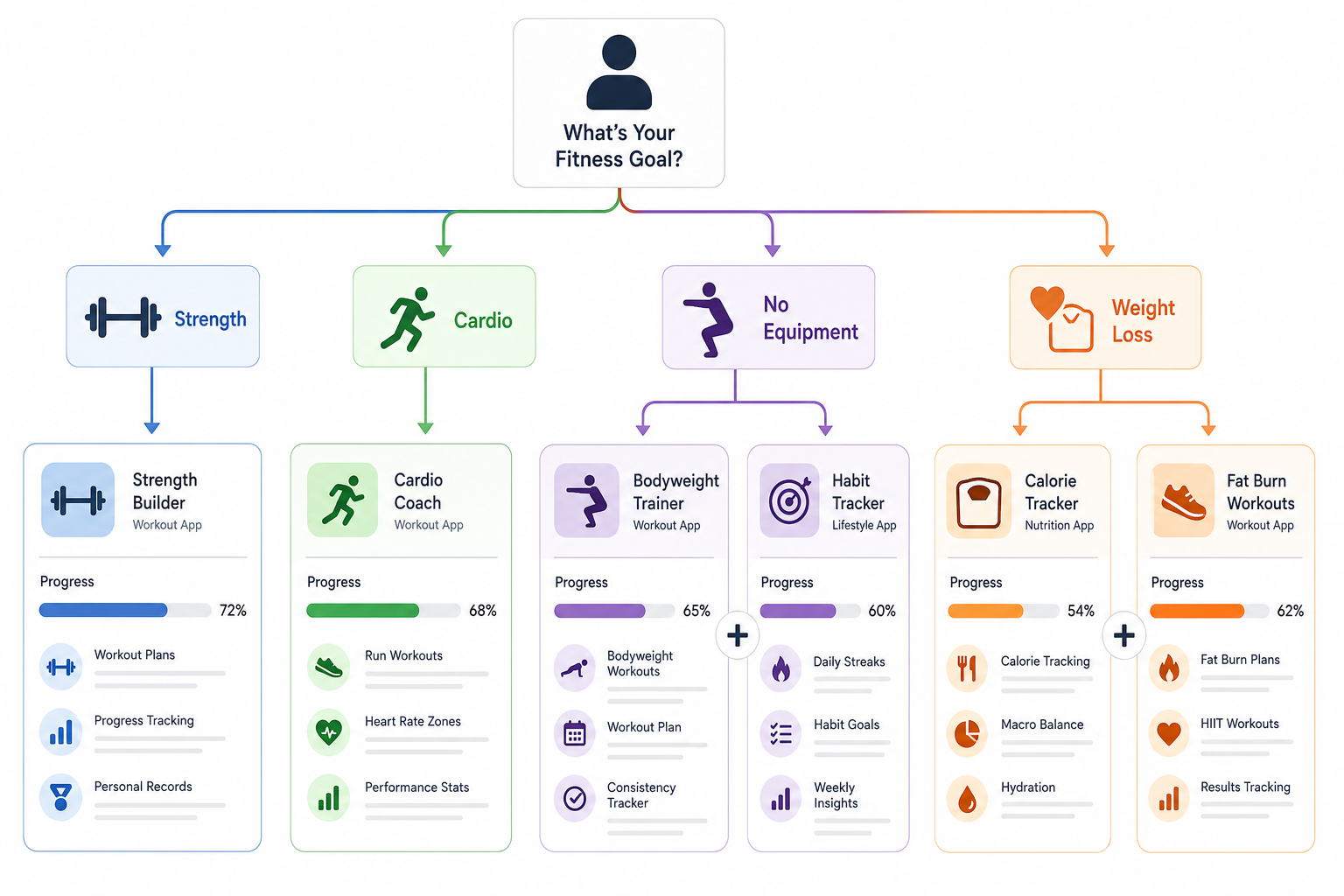
The assumption that you need one app to do everything is worth questioning. Most free apps are built around a specific strength — structured programming, guided video sessions, nutrition tracking, or cardio logging. Pairing two apps that each do one thing well often produces a better result than finding a single app that does everything adequately.
Here are three pairings that work well in practice:
- Boostcamp + Nike Training Club (strength + cardio) — Use Boostcamp for your lifting sessions with auto-progression, and Nike Training Club for cardio days, yoga, or active recovery. Both are free. This pairing covers a full-week training schedule without any paywall.
- FitOn + MyFitnessPal (workouts + nutrition) — FitOn handles the exercise side with unlimited guided sessions; MyFitnessPal handles calorie and macro tracking. Best pairing for weight loss goals where both training and nutrition need to be managed.
- Boostcamp + Hevy (programming + detailed logging) — Follow a Boostcamp program for structured progression, and log session details in Hevy if you prefer its visualization and tracking interface. Useful for strength-focused users who want richer analytics than Boostcamp's free tier provides.
The main limitation of multi-app strategies is that data doesn't automatically sync between most free apps. You'll be logging in two places, which adds a small friction cost. For most users, that tradeoff is worth the capability gap it closes.
Quick Decision Guide: Match Your Goal to an App
| Your Primary Goal | Primary App | Backup / Companion |
|---|---|---|
| Strength and progressive overload | Boostcamp (free — auto-progression, 130+ coach programs) | Hevy (free — unlimited logging, 4 routines) |
| No-equipment and beginner workouts | FitOn (free — unlimited guided sessions, no gear needed) | Fitloop (free — structured 28-day calisthenics program) |
| Cardio and endurance | Nike Training Club (fully free — 300+ workouts, no paywall) | Strava (free tier — outdoor cardio tracking) |
| Weight loss | FitOn + MyFitnessPal (free pairing — workouts + calorie tracking) | Nike Training Club + MyFitnessPal (alternative pairing) |
| Mixed goals / unsure | Nike Training Club (broadest free library, no paywall) | Add Boostcamp if you add strength training |
Frequently Asked Questions
Are free apps actually useful for serious strength training, or do you need to pay?
Yes — Boostcamp's free tier is genuinely capable for serious strength training. It includes established programs like 5/3/1 and nSuns with progression logic built in, a plate calculator, RPE tracking, and an AI program builder. The paid tier adds exclusive coach programs and advanced analytics, but the free tier covers everything most home gym users need to run a structured strength program with real progressive overload.
Will Boostcamp's free tier stay free?
Boostcamp's official site confirms that the full program library and core training features are free, with the paid tier (Boostcamp Pro) covering exclusive programs and advanced analytics. As with any app, free-tier scope can change — it's worth checking the current feature split on the App Store or official site if you're making a long-term decision based on the free tier.
Does Nike Training Club work without any equipment?
Yes. Nike Training Club lets you filter workouts by equipment level, including minimal-equipment and no-equipment options. The library covers bodyweight strength, cardio, yoga, and mobility sessions that require nothing beyond a clear floor space. It's one of the reasons it works as a default pick for users who are unsure of their goal or don't yet have equipment.
Can two free apps sync data with each other?
Direct sync between most free workout apps is limited. Some apps (including Fitloop) sync with Apple Health, which can serve as a shared data layer on iOS. MyFitnessPal connects with Apple Health and Google Fit, which allows some workout data from compatible apps to appear in its exercise log. But for most free-tier pairings — Boostcamp + Hevy, for example — you'll be logging in both apps separately. It adds minor friction but is manageable for most users.
Is there a single free app that tracks both workouts and nutrition?
Most apps that attempt to cover both workouts and nutrition in one place put the nutrition features behind a paywall. MyFitnessPal's free tier covers calorie and macro tracking well, but its workout guidance is minimal. FitOn's free tier covers workouts well, but nutrition planning is a premium feature. The most practical free solution for users who need both is the FitOn + MyFitnessPal pairing — two apps, each doing one thing well, both free at the core tier.
This result comes from one real apartment under the stated conditions — it is a strong signal, not a guarantee your space will measure identically.
Builds this evidence supports
No build currently links to this specific test. Browse all builds with a matching tag.
Spot something off?
If this result didn't match your own space, let us know — floor-damage and noise claims carry real deposit-risk consequences if we get them wrong.