
Stop Looking for One Perfect App: Why Pairing Two Specialized Trackers Beats Any All-in-One
No single exercise tracker app excels at strength logging, GPS running, and guided home workouts. This guide helps intermediate exercisers match apps to their primary training mode and explains why pairing two specialized apps — like Hevy for strength and Strava for cardio — delivers better results than forcing one app to do everything.
Why One App Can't Do It All
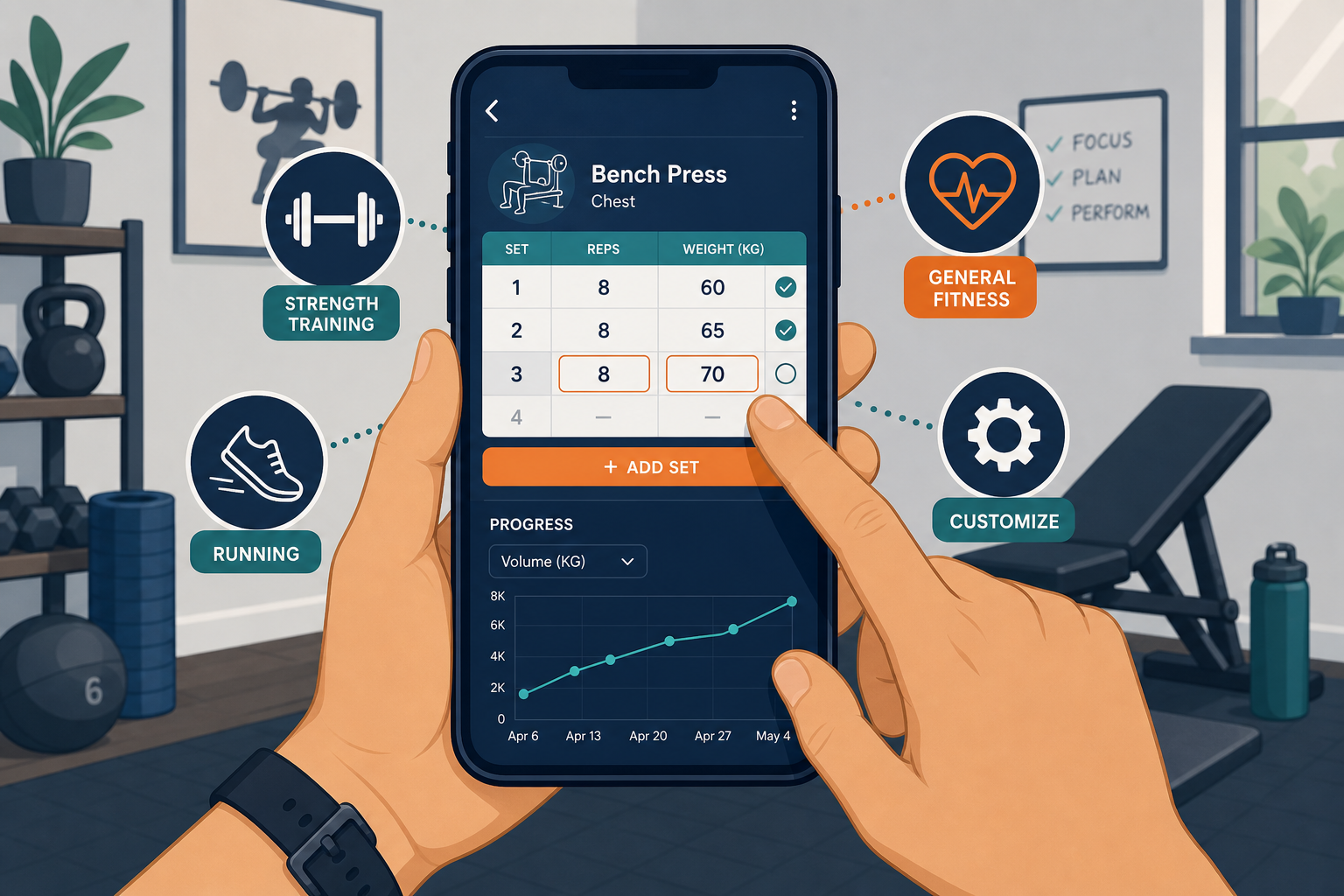
The fitness app market is crowded with platforms that promise to handle everything — strength logging, GPS running, guided home workouts, nutrition tracking, and recovery monitoring all under one roof. The problem is that all-in-one apps trade depth for breadth. A single interface that tries to serve every training style inevitably compromises on the features that matter most for each specific mode.
For intermediate exercisers who already know their training style, the smarter approach is to match an app's core strength to your primary activity. If you lift weights, you need an app built for rapid set logging and progressive overload tracking. If you run or cycle, you need accurate GPS mapping and route discovery. If you train at home with bodyweight or dumbbells, you need guided video instruction with clear form cues.
This guide takes a different approach from the typical "best app" ranking. Instead of asking which single app is best, we'll look at which apps excel in their specific domain — and why the most effective setups often involve pairing two specialized apps rather than forcing one to do everything. As Hevy's own team puts it: "Lift weights, but also want to do the occasional cardio workout? Pair Hevy with Strava." That pairing logic is the core thesis here.
Strength Training: Hevy, Jefit, and Strong Compared
Strength training apps live or die on logging speed, exercise library depth, and progressive overload features. The three dominant players — Hevy, Jefit, and Strong — each take a different approach to these core requirements.
Hevy: Best Free Logging and Social Features
Hevy has earned a 4.9 rating on both the App Store and Google Play with over 500,000 ratings, making it one of the most consistently well-reviewed fitness apps available. Its free tier is unusually generous: unlimited workout logging, three months of workout history, social features including a feed for sharing workouts and following other lifters, and integration with Strava and Apple Health.
The paid version costs $2.99 per month, $23.99 per year, or a $74.99 lifetime purchase. It unlocks Hevy Trainer (AI-driven workout planning), unlimited routines, and full data history. For most intermediate lifters, the free tier is sufficient — the paid upgrade mainly benefits users who want AI programming or need to reference workouts from more than three months ago.
Hevy's social layer is its strongest differentiator. The community feed lets you see what others are lifting, share your own sessions, and compare progress. This turns logging from a solo data-entry task into a source of motivation and accountability.
Jefit: Most Complete Exercise Library and AI Programming
Jefit positions itself as the data-complete option for serious strength trainees. Its exercise library contains over 1,400 exercises with HD video demonstrations, muscle activation maps, and form instructions. If you need to look up an unfamiliar movement or verify proper technique mid-session, Jefit's library is the most comprehensive of the three.
The free tier includes full workout logging and access to community-created routines. The Elite subscription ($12.99 per month or $69.99 per year) adds an AI-driven progressive overload algorithm that monitors each session and tells you exactly when to increase weight or reps. It also introduces the North Star Progress Index (NSPI), a weekly score that reflects volume across muscles, movement balance, strength gains, and consistency.
Jefit's AI programming is its main advantage over Hevy and Strong. If you want an app that actively guides your progression rather than just recording what you did, Jefit's Elite tier delivers that. The trade-off is a higher subscription cost and a more complex interface that can feel overwhelming for casual lifters.
Strong: Fastest Logging Experience
Strong is built around one core principle: get you in and out of the logging interface as quickly as possible. Its tap-to-complete workflow lets you log sets with minimal friction, and the Apple Watch app is widely considered the best wearable companion for strength training.
The free tier is limited to three routines, which is restrictive for anyone who rotates through multiple training splits. Paid plans run approximately $5 per month or $29.99 per year, with some sources reporting $3.99 per month and others $9.99 per month — pricing has shifted across sources, so check the current rate before subscribing.
Strong's exercise library includes over 200 movements with detailed instructions and videos. That's enough for most lifters, but significantly smaller than Jefit's 1,400+ database. If you frequently use niche or specialized exercises, you may find gaps in Strong's library.
| Feature | Hevy | Jefit | Strong |
|---|---|---|---|
| App Store / Google Play Rating | 4.9 (500,000+ ratings) | 4.5–4.7 (42,000+ five-star ratings) | 4.6–4.7 |
| Free Tier Logging | Unlimited workouts, 3-month history | Full workout logging, community routines | Limited to 3 routines |
| Exercise Library | Solid, regularly updated | 1,400+ exercises with HD demos | 200+ exercises with instructions |
| AI / Smart Features | Hevy Trainer (paid) | Progressive overload algorithm, NSPI (paid) | None |
| Paid Pricing | $2.99/mo, $23.99/yr, $74.99 lifetime | $12.99/mo, $69.99/yr | ~$5/mo, $29.99/yr |
| Best For | Social lifters, free-tier users | Data-driven lifters, bodybuilders | Speed-focused lifters, Apple Watch users |
Running and Cycling: Strava, Runna, and Runkeeper
For endurance athletes, the primary requirements are accurate GPS tracking, route discovery, and community features that turn solo training into a shared experience. Strength logging apps simply can't compete in this domain — their GPS implementations are basic at best.
Strava: The Dominant Social Fitness Platform
Strava remains the default choice for runners and cyclists who want GPS tracking combined with social features. The free tier includes GPS route tracking, activity logging, route heatmaps for discovering popular local paths, and segment leaderboards that let you compete against other users on specific stretches of road or trail.
Strava's free version tracks 30 different sports and integrates with Garmin, Polar, Wahoo, and Fitbit devices. Paid plans start at $7.99 per month or $49.99 per year, with some sources listing $11.99 per month depending on the plan tier. The paid version adds features like live beacon tracking for safety, personalized coaching, and deeper performance analytics.
Garage Gym Reviews rates Strava 4.5 out of 5 and calls it the "Best Free Workout App for Cyclists." The community aspect is genuine — Strava's segment leaderboards and kudos system create a social feedback loop that keeps runners and cyclists coming back.
Runna: Structured Race Training
Runna targets runners who want structured training plans rather than just activity logging. It generates personalized race training programs based on your current fitness level, target race distance, and available training days. For runners training for a specific event — 5K, 10K, half marathon, or marathon — Runna provides the periodized programming that Strava's free tier lacks.
Runna is a paid app, and its value depends entirely on whether you actually follow a structured plan. Casual runners who just want to log miles and see where they ran will find Strava's free tier more than adequate.
Runkeeper: Best for Running Beginners
Runkeeper is the most beginner-friendly option for runners. Its interface is simpler than Strava's, with flexible goal setting and a clean activity log that doesn't overwhelm new runners with data. The free tier covers basic GPS tracking and goal setting, while the paid version ($9.99 per month) adds personalized training plans and audio coaching.
Zapier lists Runkeeper as the "best fitness app for running beginners", and that assessment holds. If you're new to running and find Strava's social features or segment leaderboards intimidating, Runkeeper offers a less competitive, more encouraging environment.
| Feature | Strava | Runna | Runkeeper |
|---|---|---|---|
| Primary Strength | GPS tracking + social community | Structured race training plans | Beginner-friendly simplicity |
| Free Tier | GPS tracking, 30 sports, segments | Limited free trial | Basic GPS tracking, goal setting |
| Paid Pricing | $7.99–$11.99/mo, $49.99/yr | Subscription-based | $9.99/mo |
| Device Integration | Garmin, Polar, Wahoo, Fitbit | Apple Watch, Garmin | Apple Watch, Android Wear |
| Best For | Runners and cyclists who want community | Runners training for a specific race | New runners who want simplicity |
Home Workouts and Bodyweight Training: Nike Training Club, FitOn, and SmartWOD
Home workout apps serve a fundamentally different need from strength logging or GPS tracking apps. Here, the primary value is guided video instruction — you need to see the movement, hear the coach's cues, and follow along without having to think about what comes next.
Nike Training Club: Completely Free, No Catch
Nike Training Club (NTC) is the standout in this category because it is completely free with no premium tier. Forbes Health ranks it as the "Best Free Fitness App" with a score of 5.0, and Garage Gym Reviews notes it has "10+ workout categories and periodized programs led by certified instructors." The library includes hundreds of guided workouts across strength, HIIT, yoga, mobility, and pilates.
The trade-off is that NTC has no detailed weight or rep logging. You follow the video, you finish the session, and the app records that you completed it. If you want to track exactly how much weight you used on each set or see your progress over time, NTC won't give you that data. It's a guided workout platform, not a logging tool.
FitOn: Class Variety and Social Features
FitOn offers a similar guided workout experience with a broader class variety — dance cardio, barre, boxing, and meditation in addition to the standard strength and HIIT categories. All workout videos are accessible on the free tier, with a premium subscription at approximately $30 per year that adds personalized meal plans and advanced tracking.
Garage Gym Reviews rates FitOn 4 out of 5 and calls it the "Best Free Workout App for Beginners." Like NTC, it prioritizes guided instruction over detailed logging. If you enjoy variety and don't need to track specific weights, FitOn's class library is one of the most diverse available.
SmartWOD: CrossFit-Style Programming
SmartWOD serves a niche but dedicated audience: CrossFit athletes and anyone who follows constantly varied functional fitness programming. Its workout generator creates random WODs (Workouts of the Day) based on the equipment you have available. The timer function is free, while the full generator costs a $54.99 lifetime purchase.
Garage Gym Reviews rates SmartWOD 4.1 out of 5 and calls it the "Best Free Workout App for CrossFit." If you follow a CrossFit affiliate's programming or create your own WODs, SmartWOD's timer and generator are useful tools. But like NTC and FitOn, it doesn't provide detailed strength logging — you'll need a separate app for that.
Hybrid Training: Why Pairing Hevy and Strava Works Best
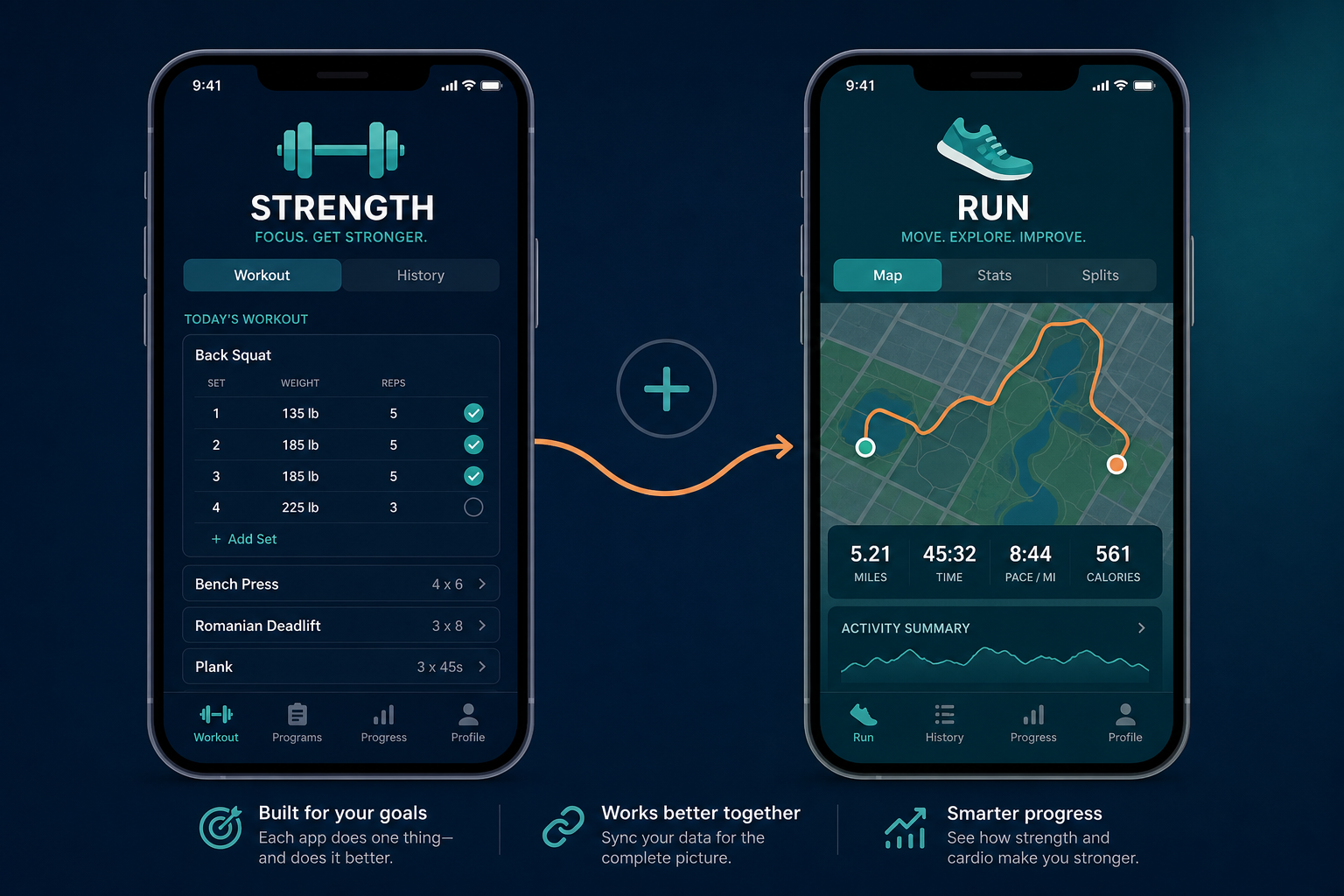
If you do both strength training and cardio — and most intermediate exercisers do — the most effective setup is to pair a dedicated strength logging app with a dedicated GPS/cardio app. The combination of Hevy for strength and Strava for cardio is the most commonly recommended pairing, and for good reason.
Here's how the data flows: You log your strength workouts in Hevy, which records every set, rep, and weight with the speed and detail that a strength-specific app provides. You record your runs and rides in Strava, which captures GPS routes, elevation, pace, and segment times with the accuracy that a dedicated GPS platform delivers. Both apps sync to Apple Health, so your overall activity data — steps, heart rate, active calories — is aggregated in one place without either app needing to compromise on its core function.
What you don't get with this pairing is a single dashboard that shows your squat progress alongside your 5K time. That's the trade-off. But what you gain is significant: Hevy's strength logging is faster and more detailed than Strava's, and Strava's GPS tracking and community features are far beyond what Hevy offers for cardio. Each app handles its specialty without compromise.
The pairing strategy is explicitly recommended by Hevy's own team, and it's the approach used by many experienced hybrid athletes. It acknowledges that no single app can serve both strength and cardio at a high level — and that trying to force one app to do everything leads to frustration and abandoned logging habits.
Quick-Reference Decision Table: Match Your Training Style to the Right App
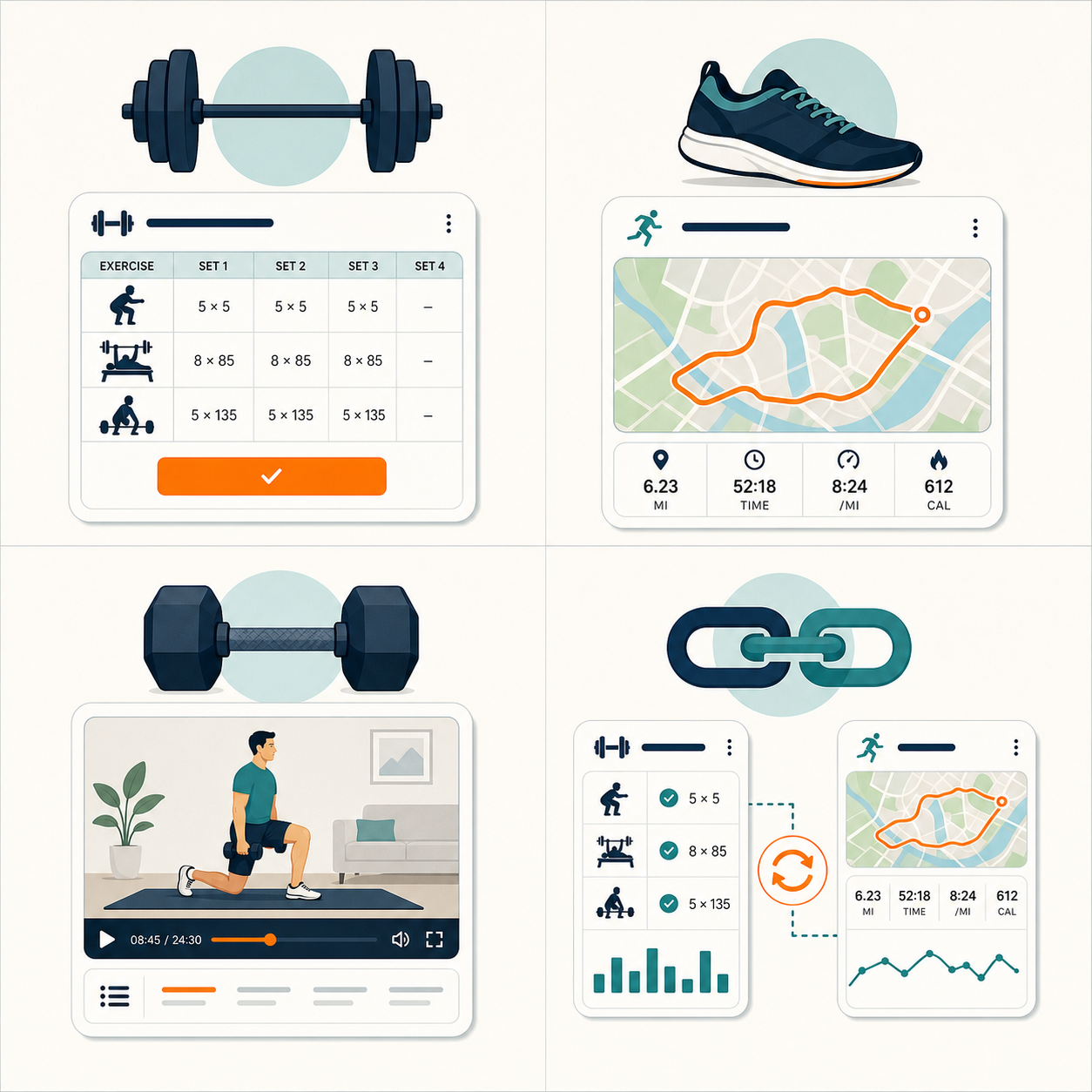
The table below maps training styles to recommended primary apps and optional pairing apps, with pricing tiers and key differentiators. Use it as a starting point for your decision.
| Training Style | Primary App | Pairing App (Optional) | Pricing | Key Differentiator |
|---|---|---|---|---|
| Strength (gym or home gym) | Hevy | None needed | Free / $2.99/mo or $23.99/yr or $74.99 lifetime | Best free tier, strong social features, 4.9 rating |
| Strength (data-driven, bodybuilding) | Jefit | None needed | Free / $12.99/mo or $69.99/yr | 1,400+ exercise library, AI progressive overload, NSPI scoring |
| Strength (speed-focused, Apple Watch) | Strong | None needed | Free (limited) / ~$5/mo or $29.99/yr | Fastest logging interface, best Apple Watch support |
| Running (community-focused) | Strava | Hevy (if also strength training) | Free / $7.99–$11.99/mo or $49.99/yr | GPS tracking, segment leaderboards, 30 sports |
| Running (race training) | Runna | Strava (for community) | Subscription-based | Personalized race training plans |
| Running (beginner) | Runkeeper | None needed | Free / $9.99/mo | Simplest interface, flexible goal setting |
| Home workouts / bodyweight | Nike Training Club | Hevy (if also lifting) | Completely free | Hundreds of guided video workouts, no premium tier |
| Home workouts (class variety) | FitOn | Hevy (if also lifting) | Free / ~$30/yr | Diverse class types: dance, barre, boxing, meditation |
| CrossFit / functional fitness | SmartWOD | Hevy (for detailed logging) | Free timer / $54.99 lifetime for generator | WOD generator based on available equipment |
| Hybrid (strength + cardio) | Hevy + Strava | N/A — this is the pairing | Hevy free + Strava free (or paid upgrades) | Best strength logging + best GPS tracking, synced via Apple Health |
Frequently Asked Questions About Combining Apps and Ecosystem Fit
Can you sync data between Hevy and Strava?
Yes. Hevy integrates directly with Strava, so your completed strength workouts can be shared to Strava as an activity. This gives your Strava followers visibility into your lifting sessions without requiring you to log them twice. Both apps also sync with Apple Health, which means your overall activity data — steps, heart rate, active calories — is aggregated regardless of which app you used for a given session.
What about Apple Watch vs. Wear OS vs. Garmin compatibility?
Ecosystem compatibility is a real constraint. Strong has the best Apple Watch support among strength logging apps, with a native watch app that lets you log sets directly from your wrist. Hevy also has an Apple Watch app, though it's less feature-rich than Strong's. On the Android side, Hevy and Jefit both have solid Wear OS apps. For Garmin users, Strava integrates natively with Garmin Connect, making it the natural choice for cardio tracking. If you're an Apple user deciding between iOS apps, our Best Fitness Apps for iPhone in 2026 guide provides a deeper dive into ecosystem-specific considerations.
Should beginners use the same pairing strategy?
Not necessarily. The pairing strategy — using two specialized apps instead of one all-in-one — works best for intermediate exercisers who already have established training habits and know what they need from each app. Beginners are better served by starting with a single app that covers their primary activity, whether that's Nike Training Club for guided home workouts or Runkeeper for running. Once you've built consistency and know that you want to track both strength and cardio in detail, the pairing approach becomes valuable. Our beginner app guide covers the best starting points for new exercisers.
What about apps that offer both strength logging and GPS tracking?
Several apps try to do both — Hevy has basic GPS tracking, and Strava has a basic strength logging feature. But in both cases, the secondary feature is significantly less capable than the primary feature of a dedicated app. Hevy's GPS tracking is fine for recording a quick run's distance and time, but it lacks route discovery, segment leaderboards, and the social features that make Strava valuable for runners. Strava's strength logging is cumbersome compared to Hevy's tap-to-complete workflow. This is the "trade depth for breadth" problem in practice: the hybrid features are usable but not excellent.
This result comes from one real apartment under the stated conditions — it is a strong signal, not a guarantee your space will measure identically.
Builds this evidence supports
No build currently links to this specific test. Browse all builds with a matching tag.
Spot something off?
If this result didn't match your own space, let us know — floor-damage and noise claims carry real deposit-risk consequences if we get them wrong.