
Best Free Workout Apps for Strength Training: Which Ones Actually Support Progressive Overload Without a Paywall?
Most free workout apps cripple core strength-tracking features after a short trial. This article compares the free tiers of Boostcamp, Hevy, Jefit, and Strong to find which ones genuinely let you track sets, reps, and progressive overload without forcing a subscription.
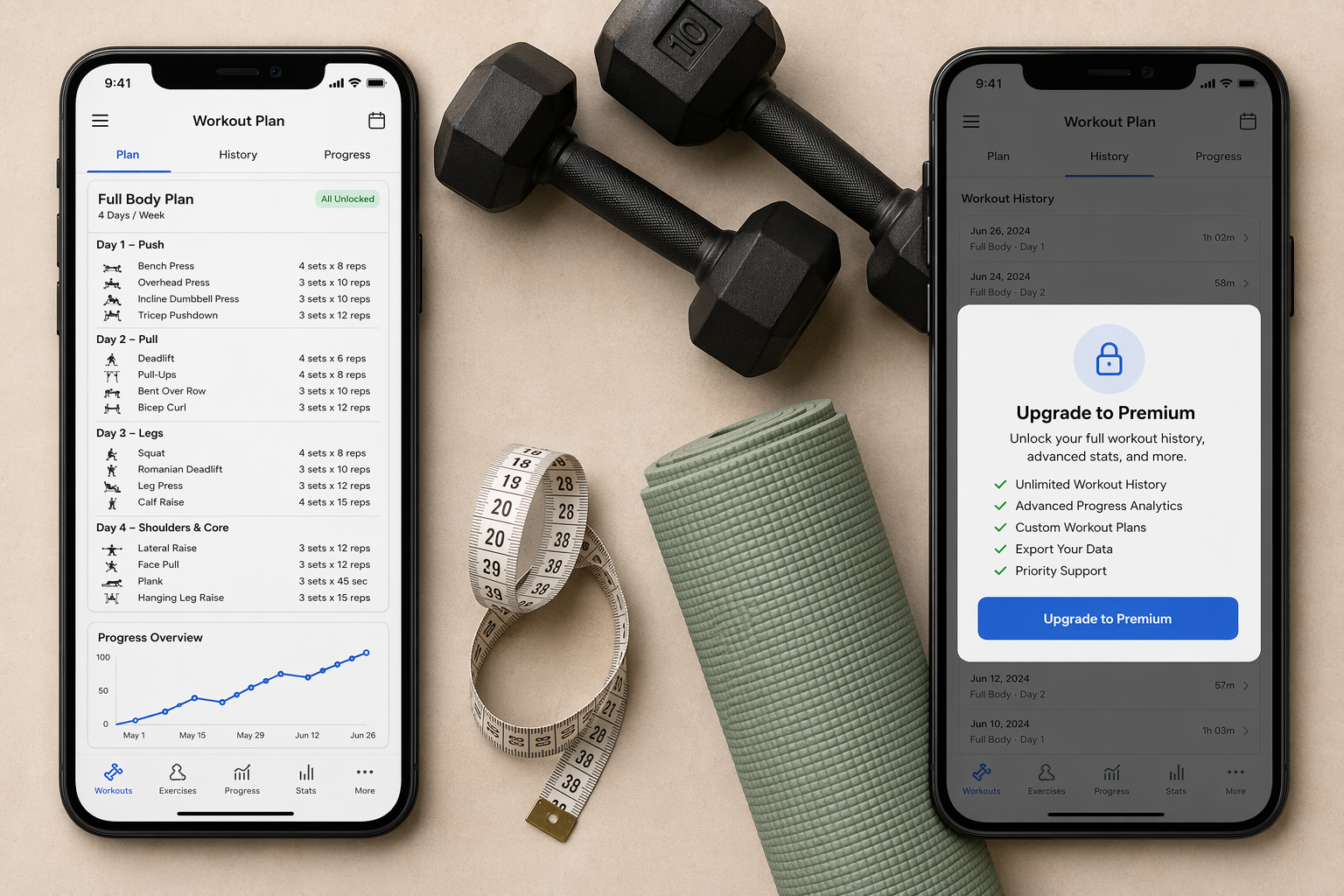
Why Most 'Free' Workout Apps Are Actually Freemium Traps
The fitness app market hit $12.91 billion in 2025 and is projected to grow at a 13.5% CAGR through 2034, according to Polaris Market Research. With that kind of money on the table, app developers have strong incentives to design free tiers that look generous on the surface but quietly lock the features serious lifters actually need behind a paywall. The result is a marketplace flooded with apps that let you log a single workout for free but charge you to see your history, create more than a handful of custom routines, or track whether you're actually getting stronger.
Industry data from Business of Apps shows that fitness apps generated $3.4 billion in revenue in 2025, a 24.5% increase year-over-year, and were downloaded 888 million times. Yet the average 30-day retention rate for health and fitness apps sits at just 27.2%, meaning nearly three out of four users who download a free app abandon it within a month. Part of that churn is motivational, but a significant portion comes from users hitting a feature wall — they realize the app can't do what they need without a subscription, so they move on.
This article cuts through the marketing. We tested the free tiers of four strength-focused apps — Boostcamp, Hevy, Jefit, and Strong — against a single question: can you track progressive overload without paying a dime? The answers are specific, measurable, and often surprising.
What Progressive Overload Actually Requires From a Tracker
Progressive overload is the principle of gradually increasing the stress placed on your muscles to drive adaptation and growth. In practical terms, that means adding weight to the bar, adding reps to your sets, or reducing rest between sets over time. A free app that claims to support strength training must handle at least the following five capabilities without a paywall:
- Unlimited set, rep, and weight logging. If the app limits how many exercises or sets you can log per workout, it's not a strength tracker — it's a demo.
- Custom routine creation. You need to build your own program or follow a structured template. A cap of three or five saved routines is a dealbreaker for anyone running a multi-week program.
- Workout history depth. You must be able to see what you lifted last session, last week, and last month. Without history, you're guessing at overload.
- Personal record (PR) detection. The app should automatically flag when you hit a new rep max, volume PR, or estimated one-rep max. Manual tracking defeats the purpose.
- Auto-progression or calculated weight increases. For program-based lifters, the app should suggest the next weight based on your last logged performance. This is the feature most commonly locked behind premium.
If an app's free tier fails on any of these five points, it cannot genuinely support progressive overload. The comparison below uses these criteria as the benchmark.
The 4 Apps That Truly Work (and Where They Fall Short)
After reviewing testing from Garage Gym Reviews (updated June 2, 2026), Forbes Health, CNET (updated June 5, 2026), and Digihealth, four apps consistently appear as the strongest free-tier contenders for strength training. Each has a different philosophy about what the free version should include.
- Boostcamp: Built around proven strength programs. The free tier provides access to over 1,000 workout plans including 5/3/1, nSuns, GZCLP, and the Reddit PPL, all with auto-calculated weights. Garage Gym Reviews named it the best free app for strength training. The catch: after a trial period, some features require a subscription ($14.99/month or $59.99/year per Jefit's review, or $79.99/year per Garage Gym Reviews). The core program-following experience, however, remains functional on the free plan.
- Hevy: The most generous free tier among the four. Unlimited workout logging, unlimited custom routines, a social feed for sharing workouts, and PR detection are all included at no cost. Hevy's Pro tier ($2.99/month) adds analytics and data export, but the free version is genuinely usable long-term. Garage Gym Reviews and Jefit's own review both highlight Hevy as the best option for social accountability and flexible logging.
- Jefit: Boasts the largest exercise library at 1,400+ movements, each with video demos. The free tier includes workout logging and basic progress tracking. However, Jefit locks its AI-driven progressive overload algorithm and NSPI (Neural Strength Performance Index) analytics behind the Elite subscription ($12.99/month or $69.99/year). For lifters who want auto-progression, the free tier is a teaser.
- Strong: Praised for its minimalist, fast logging interface. Forbes Health and CNET both list it as a top strength tracker. The free version, however, limits users to three saved custom routines. For anyone running a program with multiple training blocks (e.g., an upper/lower split with different phases), that cap is reached almost immediately. Premium is $4.99/month or $29.99/year.
Free-Tier Feature Comparison: Boostcamp vs Hevy vs Jefit vs Strong
The table below maps each app's free tier against the five progressive overload requirements. This is the side-by-side audit that most roundups skip.
| Feature | Boostcamp (Free) | Hevy (Free) | Jefit (Free) | Strong (Free) |
|---|---|---|---|---|
| Custom routine limit | Unlimited (program-based) | Unlimited | Unlimited | 3 routines |
| Workout history depth | Full (per program) | Full (unlimited) | Full (unlimited) | Full (unlimited) |
| PR detection | Yes (auto) | Yes (auto) | Yes (basic) | Yes (basic) |
| Auto-progression | Yes (program-calculated weights) | No (manual only) | Locked behind Elite ($12.99/mo) | No (manual only) |
| Exercise library | Program-specific | Community-created | 1,400+ with demos | Built-in + custom |
| Social / community | Limited | Full social feed | Groups and challenges | None |
| Offline mode | Yes | Yes | Yes | Yes |
The table reveals a clear pattern: Hevy and Boostcamp offer the most complete free experience, but they achieve it differently. Hevy gives you unlimited logging and lets you build your own structure. Boostcamp gives you unlimited access to pre-built programs that handle the progression math for you. Jefit and Strong offer solid logging foundations but gate the features that make progressive overload automatic.
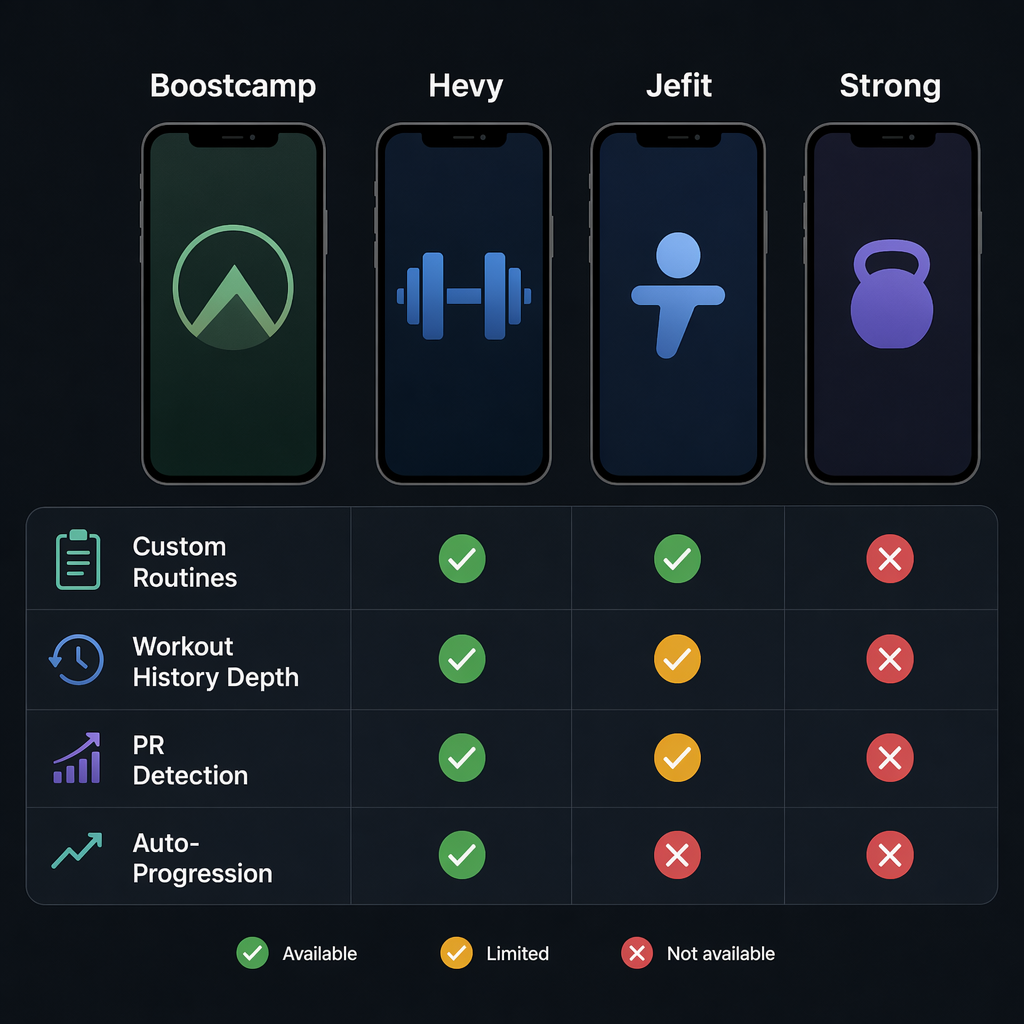
How Each App Handles PR Detection and Auto-Progression
PR detection and auto-progression are the two features that separate a passive logbook from an active training partner. Here is how each app handles them on the free tier.
Boostcamp: Program-Driven Auto-Progression
Boostcamp's core value proposition is that you don't need to think about progression at all. When you select a program like 5/3/1 or nSuns, the app calculates your training maxes and auto-generates the weights for each session based on your last logged performance. PR detection is built into the program structure — if you hit the prescribed reps on your top set, the app knows you've made progress and adjusts the next cycle accordingly. This is the most hands-off approach to progressive overload available on a free tier.
Hevy: Flexible Logging, Manual Progression
Hevy does not auto-calculate your next weight. Instead, it excels at surfacing your history so you can make informed decisions. When you open an exercise, Hevy shows your last logged weight and reps for that movement. PR detection is automatic — the app flags any new rep max, volume PR, or estimated one-rep max in your workout summary. You decide whether to increase the weight next time, but the data to make that call is always one tap away. For lifters who prefer to manage their own progression, this is a feature, not a limitation.
Jefit: AI Progression Locked Behind Elite
Jefit's free tier includes a basic progress tracker and a massive exercise library, but its most compelling feature — the AI progressive overload algorithm — is exclusive to the Elite subscription. The algorithm analyzes your logged workouts and suggests weight increases, deload weeks, and exercise substitutions based on your performance trends. Without it, you are left with manual logging and a simple history view. For $12.99/month, the AI layer is powerful, but the free tier feels incomplete for anyone serious about systematic progression.
Strong: Minimalist Logging, No Auto-Progression
Strong's free tier is the most stripped-down. It logs sets, reps, and weights cleanly, and it shows basic progress charts. But there is no auto-progression, no PR detection beyond a simple comparison to your last session, and the three-routine cap means you cannot maintain separate templates for different training phases. Forbes Health notes that the warm-up calculator, plate calculator, and body measurement recording are also locked behind premium. Strong works well as a simple logbook, but it does not actively support progressive overload — it expects you to manage that entirely on your own.
Which App Fits Your Strength Goal?
The best app depends on how you train. The table below maps each app to a primary strength goal based on its free-tier strengths.
| Your Primary Goal | Best Free App | Why |
|---|---|---|
| Powerlifting / strength program following | Boostcamp | Access to 1,000+ proven programs with auto-calculated weights. No need to plan progression manually. |
| Bodybuilding / flexible hypertrophy training | Hevy | Unlimited custom routines, full history, social accountability, and automatic PR detection. You control the programming. |
| General strength / large exercise library | Jefit (free tier) | 1,400+ exercises with demos. Good for exploring new movements, but auto-progression requires the Elite upgrade. |
| Minimalist logging / simple tracking | Strong (free tier) | Fast, clean interface. Acceptable if you only need three routines and manage progression yourself. |
If your goal is powerlifting or following a structured program like 5/3/1 or GZCLP, Boostcamp is the clear winner — it removes the mental load of calculating weights and lets you focus on execution. If you prefer to design your own workouts and want a social component to stay motivated, Hevy's free tier is unmatched. Jefit is best for lifters who value exercise variety and are willing to pay for AI-driven progression later. Strong is a fallback for those who want the simplest possible log and can work around the three-routine limit.
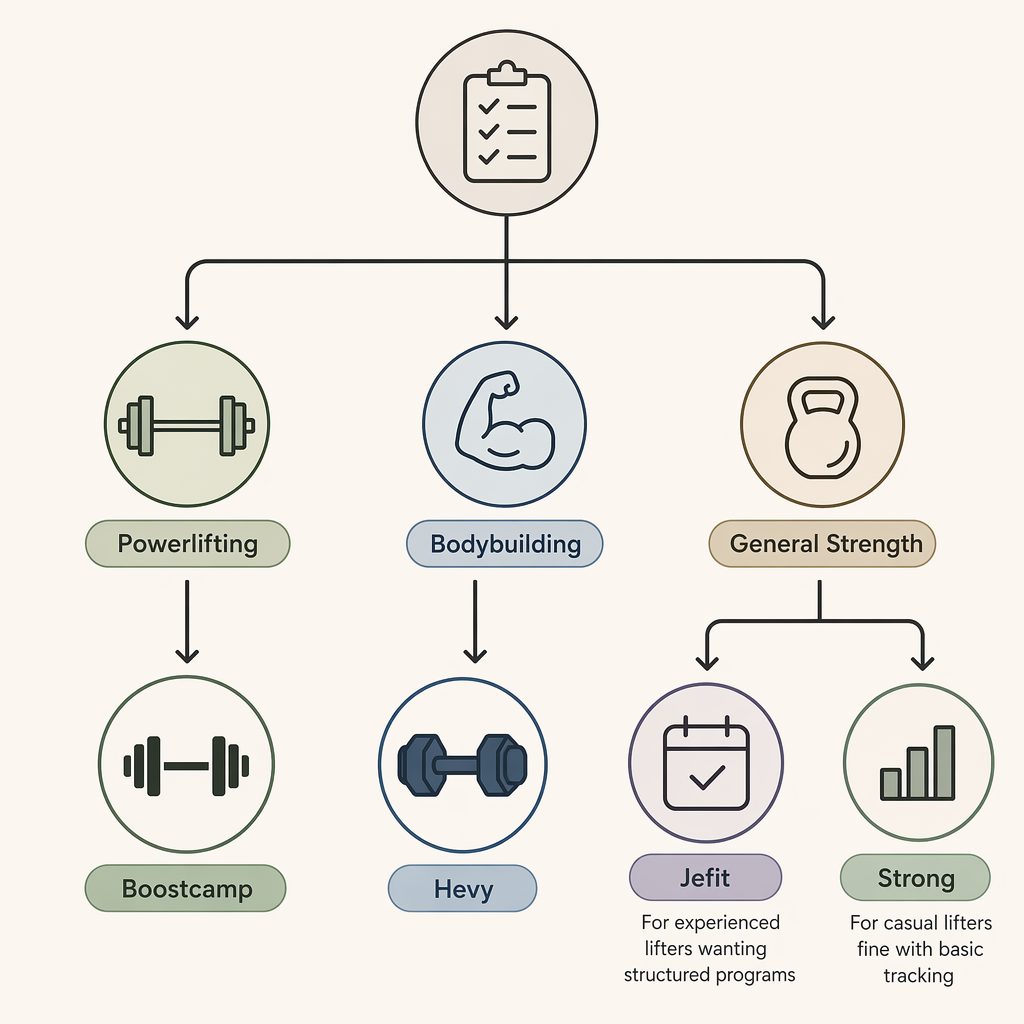
Verdict: A Decision Flow by Experience Level
The right choice also depends on how much experience you have managing your own training. Here is a practical decision flow based on experience level and specific needs.
- If you want to follow a proven program without thinking about weight calculations → Boostcamp. The free tier gives you access to 5/3/1, nSuns, GZCLP, and the Reddit PPL with auto-calculated weights. You don't need to plan progression — the program does it for you.
- If you want unlimited logging and a social community to stay accountable → Hevy. It has the most generous free tier, with no caps on routines or history, and the social feed adds a layer of motivation that other apps lack.
- If you want the largest exercise library and are willing to pay for AI features later → Jefit. The free tier is a solid logging tool with 1,400+ exercises, but the AI progression algorithm that makes it truly powerful costs $12.99/month.
- If you only need a simple log and can work around the 3-routine limit → Strong. The interface is fast and clean, but the free tier is intentionally restrictive. It works for lifters who run one program at a time and don't need auto-progression.
No free app is perfect. Every developer needs to make money, and the free tier is always a marketing tool for the paid version. But for intermediate home gym lifters who know what they're doing, Boostcamp and Hevy prove that you can track progressive overload seriously without paying a cent. The key is knowing which features you can live without — and which ones are dealbreakers.
This result comes from one real apartment under the stated conditions — it is a strong signal, not a guarantee your space will measure identically.
Builds this evidence supports
No build currently links to this specific test. Browse all builds with a matching tag.
Spot something off?
If this result didn't match your own space, let us know — floor-damage and noise claims carry real deposit-risk consequences if we get them wrong.