
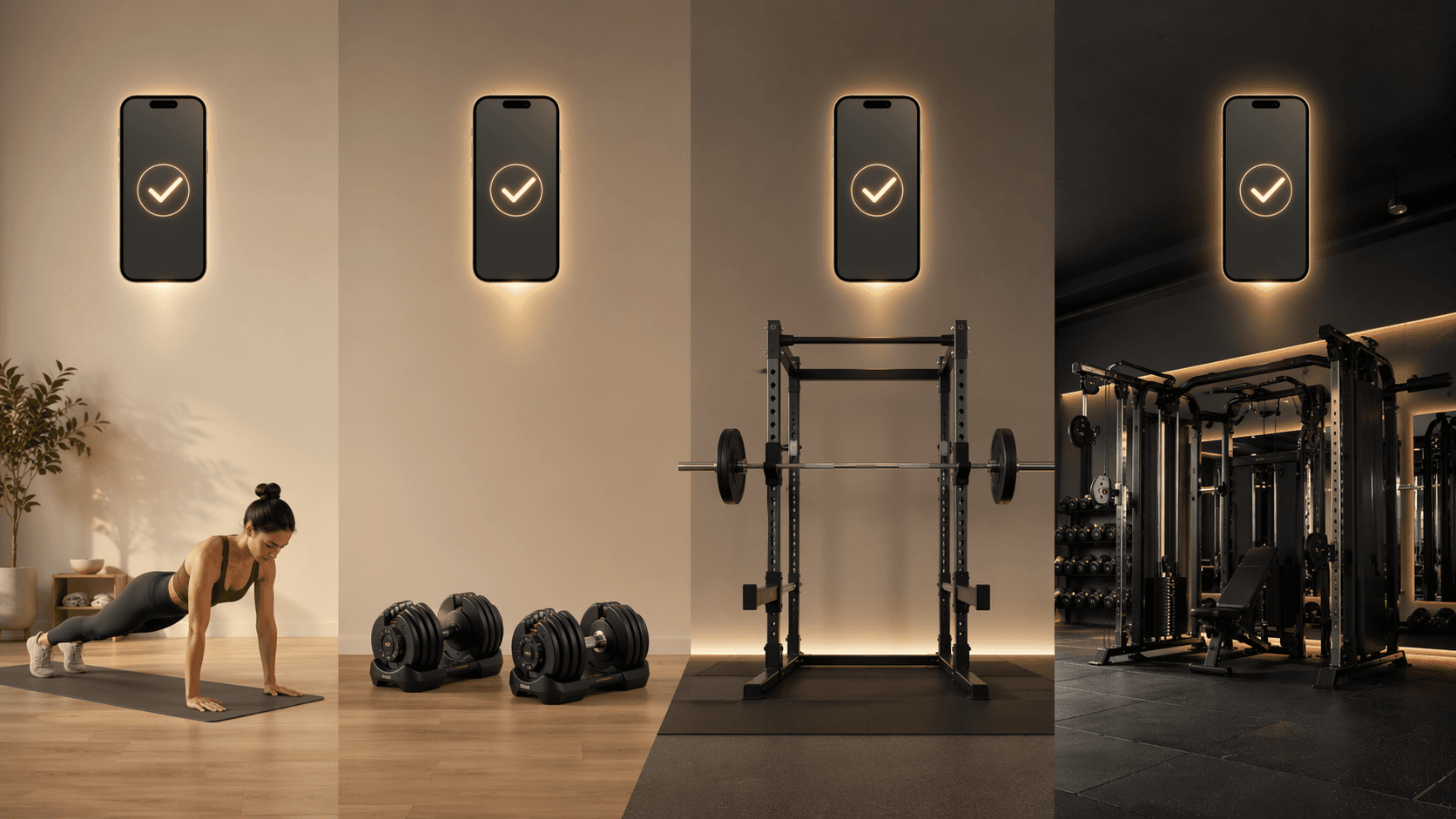
The fastest way to pick the best strength training app is to ignore the app store ranking for a minute and start with the room you train in. If an app asks for a leg press, five dumbbell jumps, a cable station, and a seated hamstring curl before you have finished the first week, it does not matter how polished the interface is. It is a commercial-gym program wearing a home-workout label.
A useful app lets you enter the equipment you actually own and still gives you a complete program. That means bodyweight-only users should not be handed a few leftover circuits, dumbbell users should not be treated as temporarily gym-less, and barbell lifters should not pay for high-touch coaching when a simple progressive plan would do.
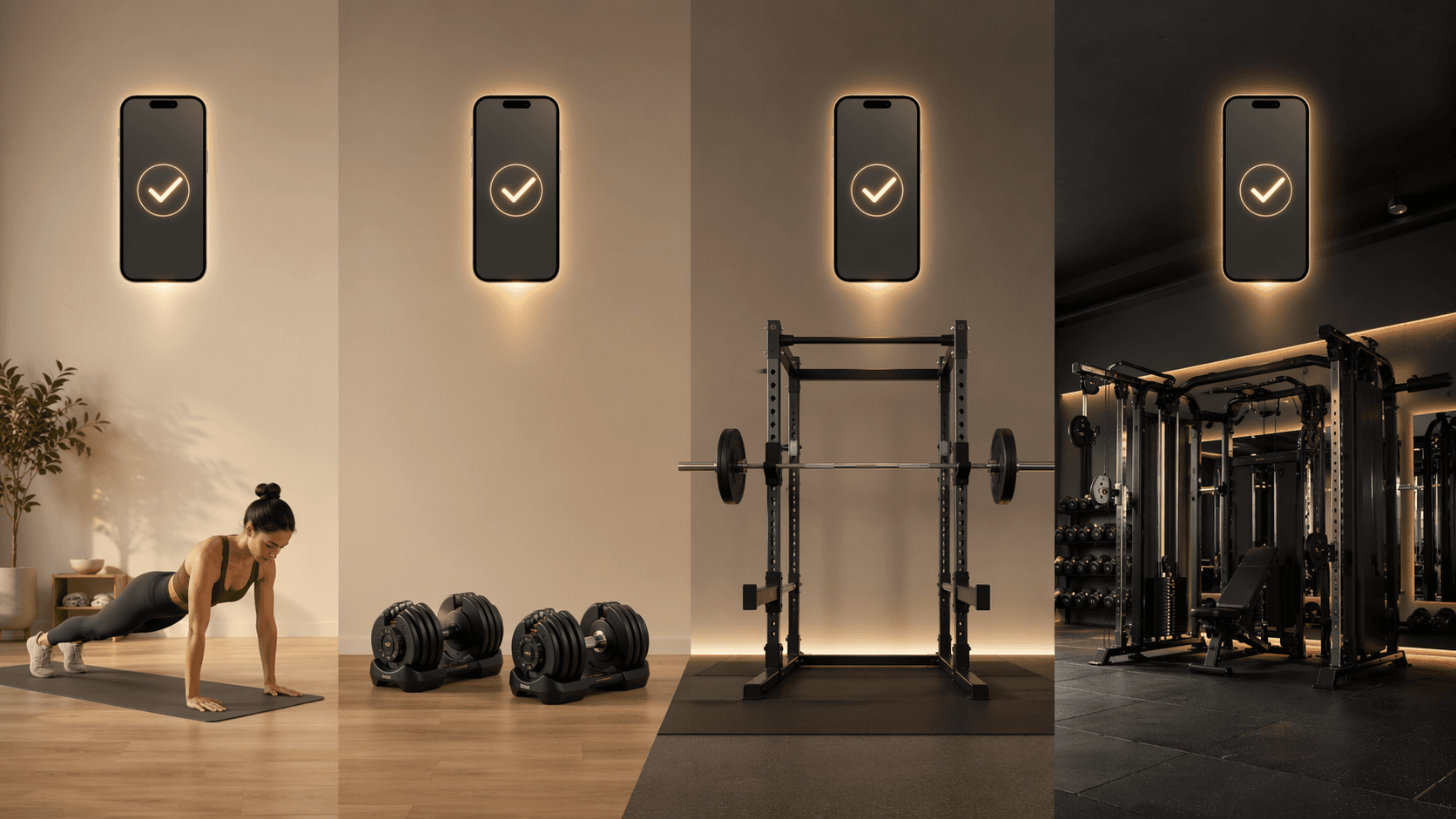
For this guide, the sorting rule is simple: choose by equipment setup first, then by price, coaching style, and training personality. Garage Gym Reviews’ 2026 testing is especially useful here because it scores apps on equipment demands using a 1-to-5 rating system, and the differences are not subtle: Fitbod and Caliber receive 5/5 for equipment flexibility, while JuggernautAI lands at 4/5 because it requires at least a barbell, squat rack, and bench setup. [1]
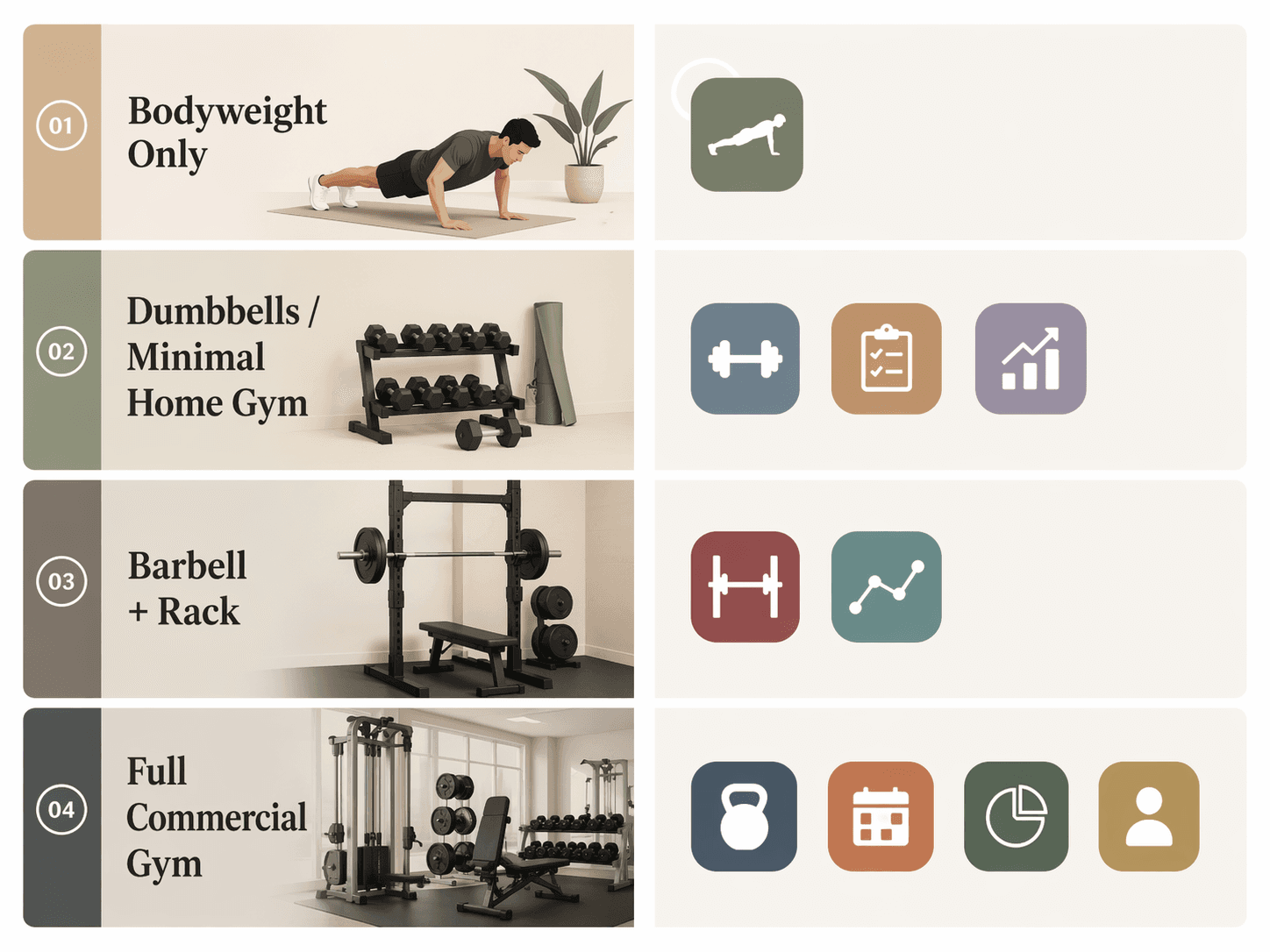
| Equipment you own | Best first look | Also consider | Be careful with |
|---|---|---|---|
| Bodyweight only | Caliber | Nike Training Club | Apps whose bodyweight content is only a small slice of the library |
| Dumbbells / minimal home gym | Fitbod or Caliber | TR[Ai]NER | Boostcamp, unless its smaller dumbbell-only and at-home libraries match your goals |
| Barbell + rack | StrongLifts 5x5 for beginners; JuggernautAI for advanced strength work | Boostcamp, Fitbod, Caliber | JuggernautAI if you do not have a true barbell setup |
| Full commercial gym | Fitbod, Boostcamp, Caliber, JuggernautAI | Future if you want human coaching | Overpaying for coaching you will not use |
Pricing matters, but only after the app survives the equipment test. As of June 2026, Fitbod is listed at $12.99 per month, JuggernautAI at $35 per month, TR[Ai]NER at $8.33 per month on an annual plan, and Future at $199 per month; Caliber and Nike Training Club both stand out because their most relevant entry points are free. [1]
Bodyweight only: start with Caliber, not the biggest free library
Bodyweight-only training is where weak app recommendations get exposed fastest. Many apps technically include bodyweight workouts. Fewer can turn push-ups, split squats, hinges, planks, tempo work, range-of-motion changes, and progression options into something that feels like training instead of filler.
Caliber is the best free starting point here because its exercise system is built with bodyweight, dumbbell, and barbell progressions inside movements rather than treating bodyweight as a separate beginner corner. GGR gives Caliber a 5/5 equipment flexibility score, which is the important part for someone who does not want an app to keep nudging them toward gear they do not own. [1]
Nike Training Club is still worth mentioning because it is 100% free and does allow bodyweight-only filtering. The catch is depth. GGR testers found that bodyweight workouts are “a small fragment” of the overall library and that most workouts require some equipment. [1]
That distinction matters. A free app with a few good no-equipment sessions can be useful for travel weeks, conditioning days, or someone easing back into training. It is not automatically the better strength app for months of progressive training. If you have no equipment and want the app to behave like that is a legitimate setup, Caliber is the safer first download.
Dumbbells and minimal home gyms: this is where the real sorting happens
The adjustable-dumbbell home gym is the awkward middle that many apps claim to support and then quietly disappoint. You have enough load to train seriously, but not enough stations to follow a full-gym bodybuilding plan unchanged. The best apps in this tier do more than remove unavailable exercises. They replace them with movements that keep the session balanced.
Fitbod: strongest paid option for variety with limited gear
Fitbod is the paid app I would look at first for a dumbbell-based home gym. Its advantage is not just that it has a large exercise database. It lets users select specific equipment, ranging from bodyweight-only setups to full gyms, and then builds workouts from a database of more than 900 movements. GGR gives it a 5/5 equipment-demand score. [1]
That makes Fitbod especially useful if your equipment list is oddly specific: adjustable dumbbells, a bench, bands, maybe a pull-up bar, no rack. Instead of forcing a program designed around machines, it can generate sessions around what is available and keep rotating substitutions as you train. At $12.99 per month, it is not the cheapest option, but the value is easier to justify when your gear list changes what every workout can include. [1]
Caliber: best free base if you want structure before novelty
Caliber is less about endless novelty and more about making the main movement patterns work across equipment levels. That is a good match for the lifter who wants to train consistently with dumbbells and does not need the app to reinvent every session.
Its free tier is the reason it stays near the top of this guide. With 5/5 equipment flexibility from GGR and progressions that cover bodyweight, dumbbell, and barbell versions of movements, Caliber gives limited-equipment users a real path without making payment the first gate. [1]
TR[Ai]NER: useful if your dumbbells are the plan, not a workaround
TR[Ai]NER belongs in the dumbbell conversation because it offers dumbbell-only program modules rather than simply asking users to improvise substitutions. GGR notes that users can access up to three free programs, potentially amounting to six months free, before moving into paid use; its annual pricing is listed at $8.33 per month. [1]
That makes it a practical mid-tier option for someone who knows they will be training with dumbbells for the foreseeable future. It is less of a broad cross-equipment answer than Fitbod or Caliber, but the dumbbell-only modules are exactly the kind of specificity that matters in a spare-room gym.
Boostcamp: good filters, thinner limited-equipment depth
Boostcamp is the app that looks compatible on paper and needs a caveat in practice. It has four equipment filters: Full Gym, Garage Gym, Dumbbell Only, and At Home. That is a real feature. The issue is that GGR found the Dumbbell Only and At Home libraries notably thinner than the Full Gym library. [1]
For a lifter with a complete setup, Boostcamp’s coach-written programs can be a strength. For a dumbbell-only user, the question is narrower: does the smaller slice of programs fit your goal right now? If yes, it can work. If you want the app to adapt around limited equipment as its main job, Fitbod and Caliber are safer bets.
Barbell plus rack: now the strength-specific apps make more sense
Once you have a barbell, plates, a rack, and a bench, the app landscape changes. Programs that were useless in an apartment suddenly become appropriate, and the decision shifts from “Can I do this workout?” to “Is this the right progression for my training age?”
StrongLifts 5x5 for true barbell beginners
StrongLifts 5x5 is best understood as a beginner barbell app, not a general home-gym app. It requires a barbell, rack, and bench, and its appeal is the simplicity of linear progression. [2]
That simplicity has a shelf life. A likely 3-to-6-month usefulness window before linear progression stalls for many users is not a flaw if you use it for what it is: a clean introduction to barbell training before moving to a more flexible program. [2]
JuggernautAI for advanced lifters with the actual setup
JuggernautAI should not be recommended to someone with a pair of dumbbells and optimism. GGR rates it 4/5 for equipment demands because it requires, at minimum, a barbell, squat rack, and weight bench, and also uses dumbbells, kettlebells, or bands for accessory work. [1]
For the right user, that requirement is not a problem. A garage-gym lifter chasing serious strength work may prefer JuggernautAI’s specificity over a general workout generator. At $35 per month, though, it should be a deliberate choice for someone who has both the equipment and the training need. [1]
Boostcamp, Fitbod, and Caliber still belong here
Barbell access makes Boostcamp much easier to recommend because its stronger libraries sit closer to full-gym and garage-gym use. If you want coach-written programs and already have the equipment those programs expect, Boostcamp’s earlier limitation becomes less important. [1]
Fitbod and Caliber remain strong because they do not stop being useful when you add equipment. Fitbod is still the better fit if you want AI-driven variety and automatic exercise selection. Caliber is still the cleaner free entry point if you want a structured progression system before paying. [1]
Full commercial gym: equipment stops being the bottleneck
With full commercial-gym access, most of the apps in this guide become more usable. Machines, cables, benches, racks, dumbbell runs, and specialty attachments remove the substitution problem. At that point, the best strength training app is less about access and more about the kind of programming you want to follow.
- Choose Fitbod if you want AI-generated sessions, broad movement variety, and equipment-aware substitutions.
- Choose Boostcamp if you prefer coach-written programs and have the equipment to run them as intended.
- Choose Caliber if you want a strong free starting point and a progression structure that can scale with your gym access.
- Choose JuggernautAI if you are an experienced strength athlete with barbell goals and the equipment to match.
Future also becomes more attractive if accountability is the missing piece. It pairs users with a human coach who can tailor programming to specific home or gym equipment, and GGR gives it 5/5 for accountability. The reason it is not central here is cost: at $199 per month, it is a special-case recommendation for people who specifically want human coaching and can pay for it. [1]
The apps that look compatible but get thin
Equipment filters are not all the same. One app may ask what gear you have and then rebuild the workout around it. Another may simply show the small part of its library that happens not to need a machine. Both can truthfully claim to support home workouts, but they do not give the user the same training experience.
Fitbod and Caliber are the strongest cross-tier answers because equipment flexibility is built into how they generate or structure training. Fitbod lets users select specific equipment and draws from a large movement database; Caliber builds bodyweight, dumbbell, and barbell progressions into movement patterns. Both receive 5/5 equipment flexibility from GGR. [1]
Boostcamp, Nike Training Club, and TR[Ai]NER need more specific placement. Boostcamp has meaningful filters, but its at-home and dumbbell-only libraries are thinner than its full-gym options. Nike Training Club is free and useful, but its bodyweight-only content is only a small fragment of the overall library. TR[Ai]NER has dumbbell-only modules, which makes it more credible for that middle tier, though it is not the same kind of all-equipment platform as Fitbod or Caliber. [1]
That is the difference between “contains workouts you can do” and “can train you well with what you own.” For a one-off session, the first may be enough. For a strength plan, the second is the standard.
Final shortlist by equipment tier
- Bodyweight only: Caliber first; Nike Training Club if you want free supplemental workouts and accept a thinner bodyweight library.
- Dumbbells or minimal home gym: Fitbod if you want paid AI-driven variety; Caliber if you want the strongest free entry point; TR[Ai]NER if dumbbell-only modules match your goals.
- Barbell plus rack: StrongLifts 5x5 for new barbell lifters; JuggernautAI for advanced strength-focused users; Boostcamp if you want coach-written programs and have the setup to run them.
- Full commercial gym: Fitbod, Boostcamp, Caliber, and JuggernautAI all become more viable; choose by programming style, experience level, and price.
- High-accountability coaching: Future can tailor around your equipment, but its $199-per-month price makes it a premium exception rather than a default pick.
If budget is the next deciding factor, compare free and paid workout apps before subscribing. If you are still unsure whether you need a tracker, AI-generated workouts, or a human coach, narrow the app model after you narrow the equipment tier. The best strength training app is the one whose programming survives contact with your actual floor space, rack situation, dumbbells, and budget.
References
- Expert-Tested: The Best Workout Apps (2026), Garage Gym Reviews
- Expert-Tested: Best Weightlifting Apps (2026), Garage Gym Reviews
Comments
Join the discussion with an anonymous comment.