
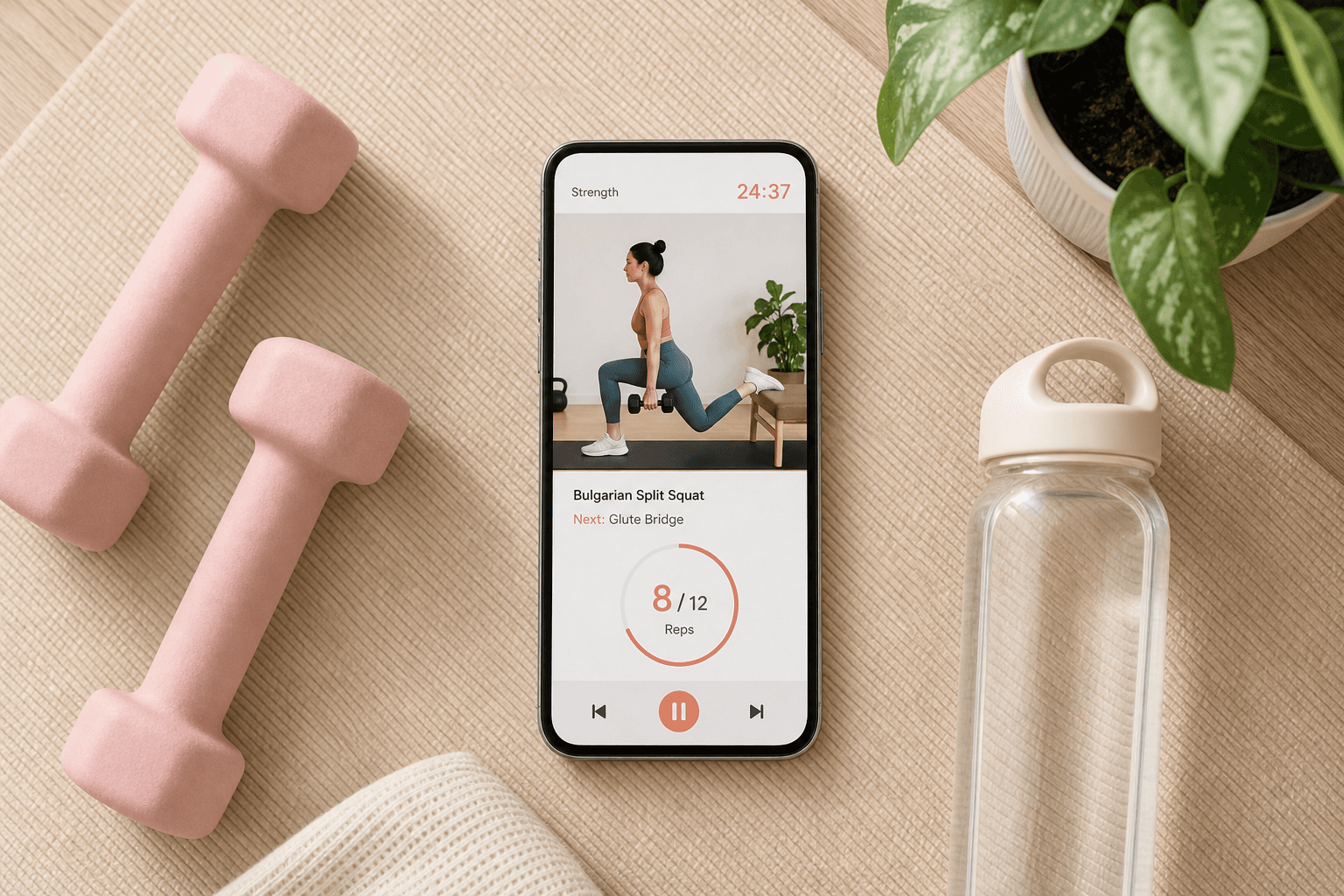
You are 44, your energy is unpredictable, your joints ache after a run that used to feel easy, and you are pretty sure the hot flashes are not just the weather. You open the App Store looking for a workout app. The top results are full of generic "for women" roundups — the same ones that were there when you were 30. They talk about calorie burn, shredding, and sculpting. They do not mention perimenopause. They do not mention bone density. They certainly do not mention that your cycle, if you still have one, might be irregular enough that a calendar-based plan is useless.
A new wave of apps — Reverse Health, Obé Fitness, Menovation, 28, and Fit Over 40 now claim to fill that gap. They talk about cycle-syncing, low-impact strength, bone-density programming, and hormone-conscious training. This sounds exactly like what you need. But after a decade of wellness marketing, you are also wise enough to wonder: how much of this is real, and how much is a premium subscription dressed up in estrogen-related buzzwords?
I have covered women's fitness long enough to see cycle-syncing go from fringe to trend without solid evidence. This article walks through what the new apps actually offer, what the science says (and does not say) about tailoring workouts to your cycle, and how to decide where your money is actually worth spending.
Why generic apps fail after 40
Perimenopause and menopause change the physiological ground rules for exercise. Estrogen decline affects metabolism, joint stability, and bone density. A December 2025 narrative review in Frontiers in Endocrinology confirmed estrogen's role in cardiopulmonary function during exercise — when estrogen drops, the cardiovascular system does not respond the same way.
Generic workout apps treat every user as a 25-year-old with predictable recovery. They prioritize high-impact moves, progressive overload that assumes joints can handle it, and a one-size-fits-all intensity curve. They do not adjust for the higher risk of osteopenia or the morning stiffness that comes with peri-menopausal joint laxity.
The Harvard Apple Women's Health Study (May 2025 update) found that women who exercise regularly show lower all-cause mortality than male counterparts at equivalent activity levels. That finding matters here: the strongest argument for any fitness app after 40 is that it keeps you moving consistently — not that it periodizes perfectly.
The workout apps for women market is worth $5.64 billion in 2026, growing at 17% CAGR. The exercise and weight-loss segment holds 29.5% of that share. Subscriptions account for 62.2%. North America leads with 39.9% of global revenue, and Asia Pacific is the fastest-growing region. General fitness app usage is also climbing: 540 million users in 2025 and $3.4 billion in revenue, up 24.5% year-over-year. The over-40 demographic is the fastest-growing user segment, but mainstream roundups still ignore it. The apps profiled here exist precisely because of this gap — they are responding to demand, not demonstrating proven efficacy.
What the new apps claim — and what they actually do
Below is a comparison of the key apps positioning themselves for perimenopause and menopause. Note that some — Reverse Health, Menovation, 28, Fit Over 40 — currently have limited independent verification; their descriptions are based on public app store listings and marketing materials, not on editorial testing. I would not take a feature list as proof.
| App | Price per month | Key features | Hormone-conscious? | Best for |
|---|---|---|---|---|
| Reverse Health | From $15/mo | Wall Pilates, Chair Yoga, weight loss programming designed for menopause | Claims menopause-specific, but no cycle-syncing | Women in menopause wanting gentle movement and weight management |
| Obé Fitness | $27/mo ($199/yr) | 17,000+ on-demand classes, cycle-syncing workouts, perimenopause support | Yes – explicit cycle-syncing and perimenopause section | Women who want variety + cycle awareness |
| Menovation | Around $20/mo (est.) | Perimenopause-specific strength training, educational content | Yes – hormone stage education, no cycle-syncing | Women seeking targeted strength for perimenopause |
| 28 | $12/mo (approx.) | Cycle-based fitness plans, four phases | Yes – core feature is cycle-syncing | Women with regular cycles who want periodized plans |
| Future | $199/mo | 1:1 coaching, daily program adjustments, video feedback | Not explicitly, but coach adapts to daily energy | Women who want real-time, personalized adjustments |
| Evlo Fitness | $59.99/mo | Gentle consistency, strength classes by physical therapists | No, but joint-friendly approach aligns with perimenopause needs | Women seeking joint-safe, progressive strength |
| LES MILLS+ | $20/mo (approx.) | Cycle-syncing workouts, group training style | Yes – offers cycle-syncing | Women who like structured group fitness and cycle awareness |
| Fit Over 40 | Free / in-app purchases | Wall Pilates, Chair Yoga, targeted over-40 workouts | Not explicitly, but audience-focused | Budget-conscious women over 40 |
Obé is the most comprehensive mainstream app in this space. It added perimenopause support and cycle-syncing workouts in 2024-2025, and its library of 17,000+ classes covers almost any format. But cycle-syncing is a premium feature — you need the $199/year plan. Future's $199/month buys you a real human coach who can adapt today's workout based on how you feel. That adaptive approach may actually be more practical for women with irregular cycles than any calendar-based algorithm.
Also note what "hormone-conscious" actually means for each app. Obé and 28 adjust workout intensity based on cycle phase. Menovation provides educational content about hormone stages but does not sync workouts. Evlo does not market itself as hormone-conscious, yet its joint-friendly, gentle-consistency approach happens to serve perimenopausal women well. The label is not a substitute for what the app actually does.
The cycle-syncing science: what we know and do not know
This is the section that matters most, and I am going to spend the most space on it because the marketing is ahead of the evidence.
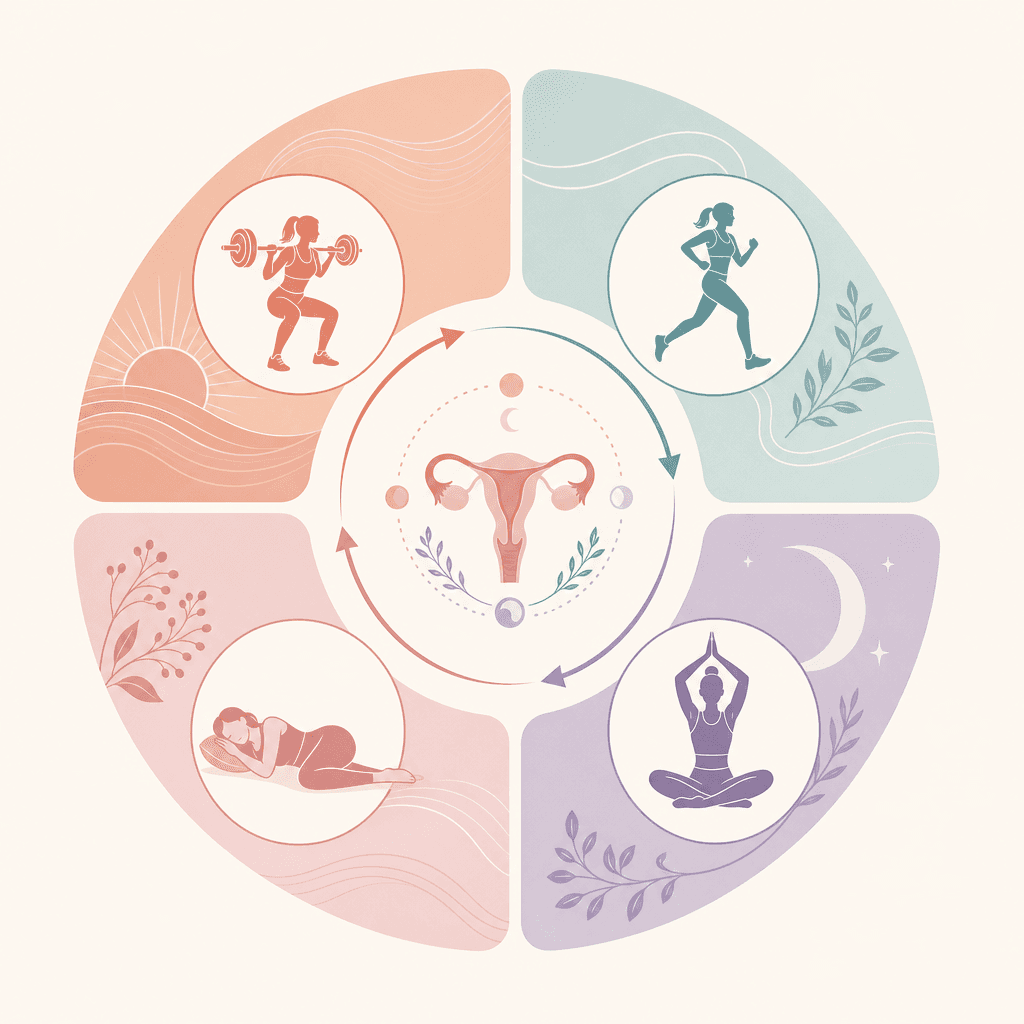
The idea behind cycle-syncing is straightforward: align your training intensity with your menstrual cycle phases. High-intensity during the follicular phase (when estrogen is rising), moderate in the luteal phase, and rest during menstruation. It sounds logical. The research, however, is mixed.
A 2022 randomized controlled trial by Kissow et al. in Sports Medicine found that follicular-phase resistance training produced greater gains in muscle strength and volume than luteal-phase training. That is evidence in favor of the concept.
But a 2023 McMaster University umbrella review in Frontiers in Sports and Active Living found no consistent influence of cycle phase on acute strength performance. The Karolinska Institutet is running a rigorous trial testing whether cycle-based periodization improves aerobic performance in trained women — results are expected in 2026.
A January 2026 FENDURA project in the European Journal of Sport Science found modest differences in ventilation, heart rate, and perceived exertion between phases but concluded that session demands were not substantially altered by cycle phase alone. In plain language: do not overhaul your entire training schedule based on which week you are in.
A February 2025 qualitative study in the same journal found that recreational women reported the highest energy and motivation around ovulation. But reported energy is not the same as objective performance, and it definitely is not a prescription.
A March 2025 review in Sports Health also reminded us that the relationship between cycle phase and ACL injury risk is real but complex: neuromuscular coordination matters more than timing alone. So even the injury-prevention argument for cycle-syncing is not as simple as "don't do plyometrics in the luteal phase."
The takeaway: cycle-syncing has some support for strength periodization in women with regular cycles, but it is far from settled science. For women over 40, the strongest conclusion remains the one from the Harvard Apple Women's Health Study: consistency beats perfect periodization. An app that gets you moving three to four times a week, regardless of cycle phase, will do more for your health than an app that optimizes the wrong week.
What to look for instead
When you strip away the cycle-syncing marketing, here is what truly matters for a woman in perimenopause or menopause:
| Priority | Why it matters | Apps that deliver |
|---|---|---|
| Bone density work | Prevents osteoporosis; estrogen decline accelerates bone loss. | Future (1:1 coaching), Evlo (PT-designed strength), Obé (strength collections) |
| Joint-friendly instruction | Reduces injury risk; perimenopausal joints need controlled loading. | Evlo, Fit Over 40 (chair yoga, wall Pilates), Obé (low-impact categories) |
| Real-time adaptability | Caters to daily energy fluctuations; no calendar guesswork. | Future (coach adjusts daily), Evlo (scalable options) |
| Transparent pricing | Avoids surprise subscription costs; shows full annual commitment. | All listed apps: Obé ($199/yr), Future ($2,388/yr), Evlo ($719/yr), etc. |
Verdict: better, but do not overpay for marketing
The new wave of menopause-focused apps — Reverse Health, Obé, Menovation — genuinely fill a gap that generic fitness apps leave wide open. They address bone density, low-impact strength, and energy fluctuations. That is real value. If you are over 40 and looking for a fitness app, these are the only candidates I would consider.
But do not pay a premium for cycle-syncing unless you have a regular cycle and understand that the science is still evolving. For most women in perimenopause, an app that keeps you moving consistently — whether through a live coach, a large library of joint-safe classes, or a free trial — will outperform any periodization scheme. The single best investment you can make is showing up, not syncing.
Comments
Join the discussion with an anonymous comment.