
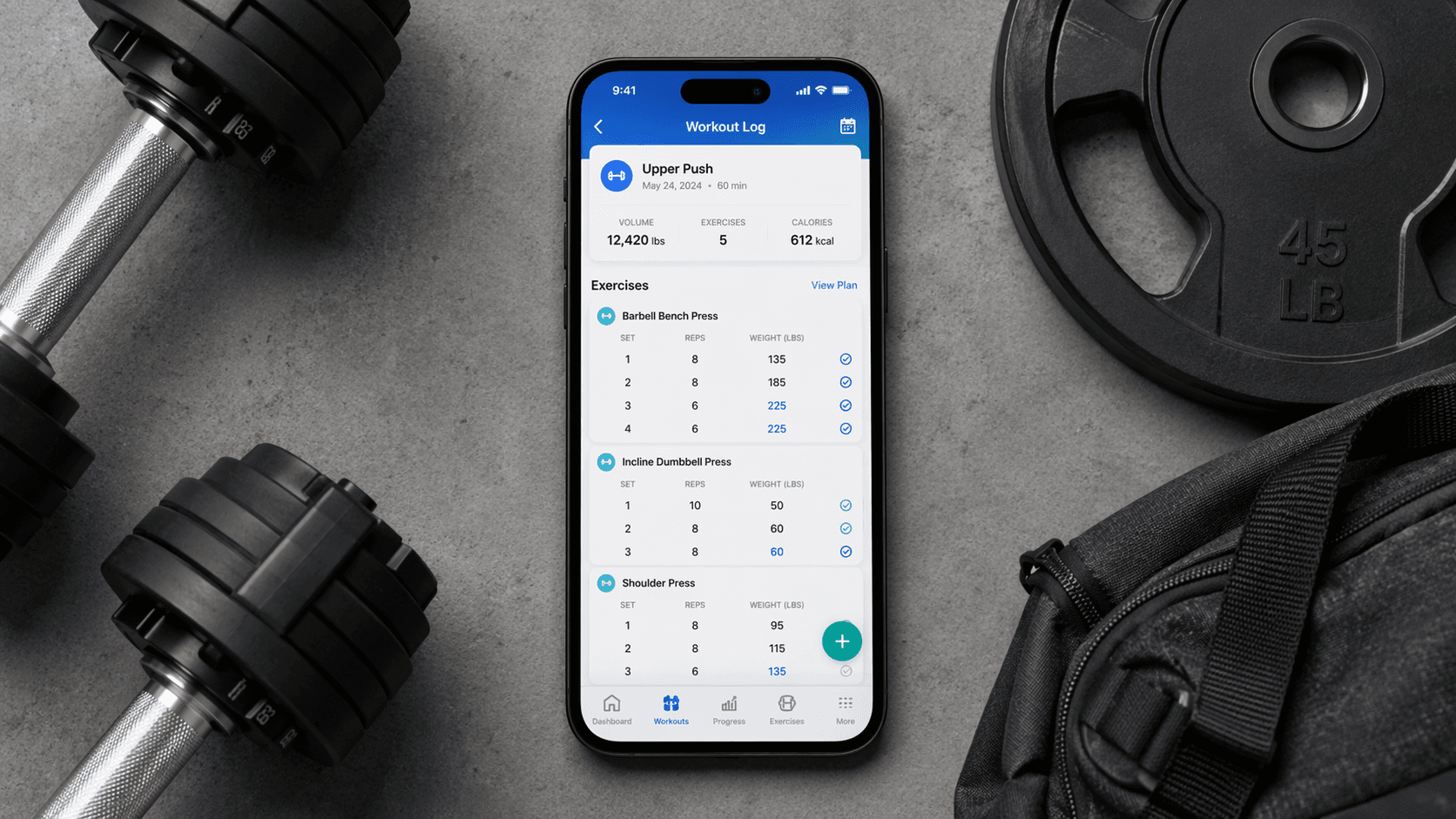
How can an app with five exercises outperform an app with over 1,400? That question cut through the noise the first time I heard it. The contrast comes from Garage Gym Reviews, which tested more than 50 platforms and found that StrongLifts — a program built around just five exercises — is highly effective for beginners. Meanwhile, JEFIT, a library of over 1,400 exercises, offers no progression logic at all. If exercise count alone predicted training quality, the math would be simple. It doesn't. That contradiction is where any honest evaluation of a strength training app has to start.
The app store is full of lists: best workout apps, most exercises, prettiest interface. None of that tells you whether the app will make you stronger. After cycling through several apps myself, I learned that the real differentiators are invisible in screenshots. They live in the programming logic — how the app decides what weight to load next, whether it adjusts when you're fatigued, how well it flexes with the equipment you actually own.
Progressive Overload: The Engine That Makes Strength Happen
Progressive overload is the single most important principle in strength training. Edge's review of the best apps puts it plainly. The body adapts to stress, and if you don't increase that stress over time — by adding weight, volume, or difficulty — you stop adapting. A strength training app that doesn't manage this progression is just a digital logbook.
I break progression into three types: linear, periodized, and autoregulated. Each maps to a different kind of app — and knowing which one you need changes everything.
| Progression type | How it works | Example apps | Best for |
|---|---|---|---|
| Linear | Add weight each session, same reps/sets | StrongLifts 5x5 | Beginners, quick adaptation |
| Periodized | Plan blocks of volume and intensity over weeks | RP Hypertrophy | Intermediate, long-term gains |
| Autoregulated | Adjust based on daily feedback (RPE, performance) | JuggernautAI, Fitbod, Edge | Advanced, variable recovery |
Recovery Adaptation: When the App Knows You're Tired
Recovery adaptation means the app changes your workout based on how you're feeling. Concretely: if you logged poor sleep or high soreness, a smart app might lower the prescribed weight, reduce volume for a fatigued muscle group, or swap a heavy leg day for an accessory session. Only a small handful of apps do this well. JuggernautAI uses a daily readiness questionnaire — you rate your energy and soreness on a simple scale — and it adjusts the session accordingly. Edge claims to do the same. Most apps, though, ignore recovery entirely. They assume you're always ready to hit your top sets. That assumption will eventually stall your progress.
If you're going to use autoregulation, you need to log your RPE — rate of perceived exertion on a 1–10 scale where 10 is a maximal effort. That feedback tells the app whether the prescribed weight was too easy or too hard. Without honest RPE entries, the app's adjustments are based on garbage. It's a simple tool, but most people skip it.
Equipment Flexibility: What If You Only Have Dumbbells?
The third dimension is how well the app adapts to the equipment you actually have. Fitbod lets you tap an exercise and swap it for another that targets the same muscles — that's incredibly useful if your gym is missing a barbell or you're training at home. JuggernautAI, by contrast, assumes you have a barbell, rack, and plates. If you don't, the program falls apart. For anyone without a full barbell setup, equipment flexibility is the most undervalued differentiator.
These three dimensions — overload, recovery, equipment — are what separate a coach from a logbook. The apps that excel in all three produce measurably better outcomes. The rest have large libraries and pretty interfaces, but they won't make you stronger. Know the difference.
Comments
Join the discussion with an anonymous comment.