
Home Gym Builds / $0-100 / apartment
Can You Hydrate With Just Water During Home Workouts?
Most home workouts under an hour in normal temperatures don't require sports drinks or electrolyte supplements — plain water and normal meals are enough. Learn when you actually need something more and how to hydrate properly during your home gym sessions.
- Budget tier
- $0-100
- Space type
- apartment
- Floor footprint
- 0
By Editorial Team
Itemized build and cost breakdown
- Total cost estimate
- $0
- Included equipment
- dumbbells, resistance bands, yoga mat
Prices and specs on this build are rechecked periodically — if something looks stale, flag it below.
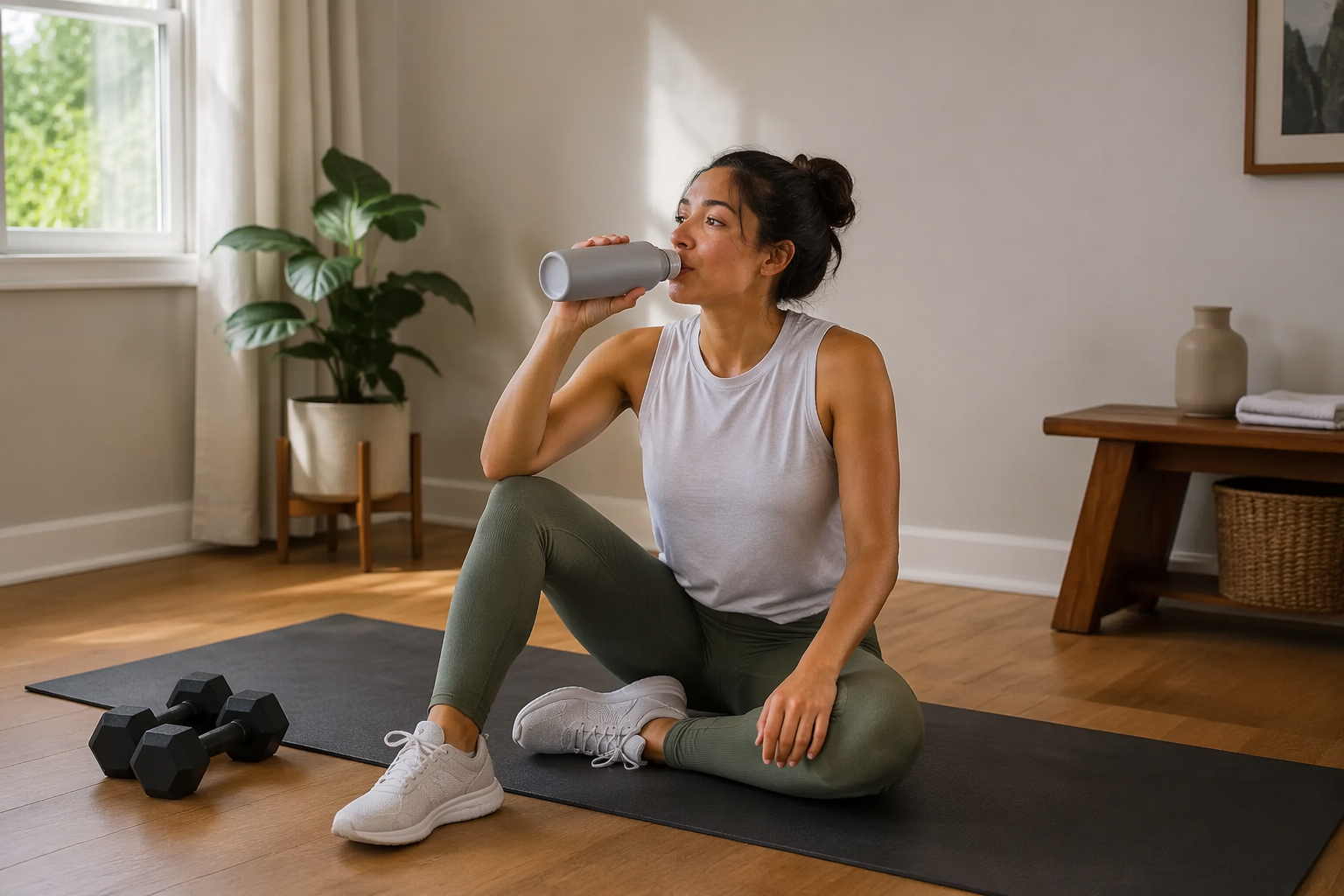
For most 20- to 45-minute home workouts, you can hydrate with plain water. If you are doing strength work beside the sofa, a mobility session on a mat, or a short cardio block in a normal indoor room, regular meals plus water are usually enough. The American College of Sports Medicine says most exercisers training under 60 to 90 minutes in normal weather conditions are unlikely to become dehydrated or depleted of electrolytes, and Harvard’s Nutrition Source says plain water is the best choice for lower-intensity workouts under one hour.[1][2]
That answer matters because electrolyte marketing has a way of making an ordinary Tuesday workout feel underprepared. A tub on the counter, a packet in the gym bag, a “performance hydration” ritual before a half-hour dumbbell circuit — it can all start to feel like another task standing between you and the workout. For the usual home session, the more useful question is not “Which drink mix should I buy?” It is “Will I actually drink water before I wander into the warm spare room and start exercising?”
The plain-water baseline
Electrolytes are minerals such as sodium, potassium, calcium, and magnesium that help with fluid balance, muscle contraction, and nerve function. You lose some through sweat. That does not mean every sweaty workout empties the tank. Duration, heat, and sweat loss matter more than the fact that you exercised at all.
The practical cutoff is fairly generous for home exercisers. ACSM’s under-60-to-90-minute guidance gives plenty of room for a normal home strength session, a beginner cardio workout, or a yoga-and-core routine, as long as the room is not unusually hot.[1] Harvard draws a similar line: for lower-intensity exercise lasting less than an hour, plain water is best.[2]
Other clinical guidance points the same way. Houston Methodist’s Dr. Megan Arthur distinguishes between workouts under one hour, where plain water is typically enough, and longer workouts, where electrolytes can become more relevant.[3] In a BBC News article on electrolyte drinks, Professor Graeme Close put the everyday version even more bluntly: “Just sip water, keep your hard-earned money for other things.”[4]
That does not make electrolyte products fake or useless. It puts them back in their lane. A short home workout in a normal room is not the same hydration problem as a long run, a team practice in heat, or a summer garage session with no air conditioning.
Make water harder to forget
The most common home-workout hydration mistake is not choosing the wrong electrolyte ratio. It is starting a workout with no bottle nearby because the kitchen sink is technically only a room away. Ultima Replenisher’s blog makes that behavioral observation directly: home exercisers may be less likely to bring water because they assume there is water “somewhere around here.”[5] That is painfully believable if you have ever finished a circuit, looked at the water bottle across the room, and decided to rest instead of getting up.
Mass General Brigham gives a simple rhythm that works better than vague advice to “drink more”: during moderate exercise, Dr. Sarah Eby recommends 4 to 8 ounces of water every 15 to 20 minutes.[6] For a short home session, that can be as plain as filling a bottle before you start and taking a few swallows between sets, rounds, or mobility blocks.
| Workout situation | Simple hydration move |
|---|---|
| 20-minute mobility or core session | Drink normally beforehand; keep water nearby if you want it. |
| 30- to 45-minute strength or cardio session | Start with a filled bottle and sip during natural breaks. |
| Moderate session with several work blocks | Use the 4- to 8-ounce every 15- to 20-minute range as a loose guide. |
| Longer or hotter session | Plan fluids before starting; consider electrolytes if sweat loss is high. |
The bottle does not need to be fancy. It needs to be close enough that drinking is easier than ignoring it. Put it beside the dumbbells, next to the mat, or on the chair where you set your phone timer. If your workout plan already has rest periods, use those as hydration cues instead of adding another app or ritual.
When water alone may not be enough
The “water is enough” answer has two important boundaries: workouts that run long, and workouts done in hot rooms. ACSM’s baseline is tied to normal weather conditions, which is not the same thing as a garage in July or a spare room with a fan pushing warm air around.[1]
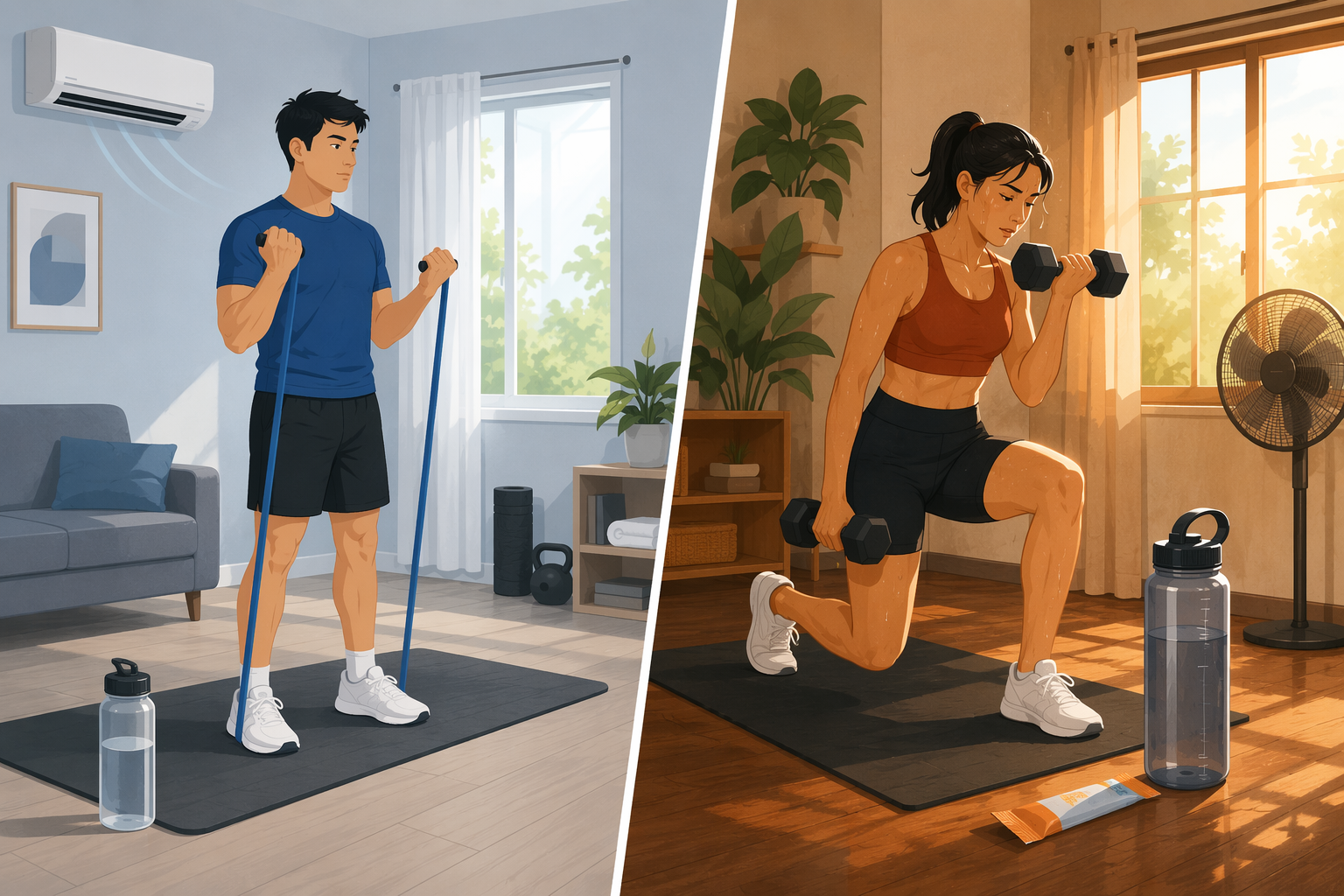
Once a session pushes past an hour, especially if it is continuous, sweaty, or higher intensity, electrolyte support becomes more reasonable. That does not automatically mean you need a branded drink for every long workout, but it does mean the problem changes. You are no longer just replacing a few sips between sets. You are managing a longer period of fluid loss and, depending on sweat rate and conditions, sodium loss too.
Heat changes the calculation even if the workout is not heroic. A renter doing resistance bands in a room without AC, or someone lifting in a garage that stays hot after sunset, may sweat far more than they would during the same routine in a cool room. In that case, hydration is only part of the fix. Cooling the space, shortening the session, moving the workout to a cooler time, and watching for heat stress matter too. If the room itself is the problem, start with practical cooling changes like five cooling fixes under $50 for home workouts without AC and more detailed guidance on how to exercise safely in a hot home gym.
A useful self-check is to classify the session before you start, not after you are already overheated. Short and normal-room? Water nearby. Long, hot, or unusually sweaty? Bring more fluid, consider electrolytes, and make the room safer instead of treating the drink mix as the whole solution.
What about sports drinks, powders, and milk?
Commercial electrolyte drinks can be useful when the workout actually calls for them: longer duration, heavier sweating, heat, or a setting where normal food and water are not enough. For the short home sessions most people are trying to keep consistent, they are usually optional at best.
If you do buy them, read the label like you would read any other packaged food. Some products include sugars, non-sugar sweeteners, colors, flavors, or other additives. That is not automatically a dealbreaker, but it is a reason not to turn them into a daily habit without need, especially if you know certain ingredients bother your stomach. If additives are the sticking point, this deeper look at which artificial sweeteners may affect gut health and recovery is the more relevant rabbit hole than comparing every electrolyte packet on the shelf.
There is also an interesting ACSM-cited study in which whole and skim milk rehydrated better than water or sports drinks.[1] That is worth noting, but it should stay in proportion. A single study finding does not mean you need to drink milk during a workout, and it certainly does not make milk the new default for a 30-minute home circuit. It is more useful as a reminder that recovery nutrition and ordinary meals can contribute to hydration after exercise.
A simple way to decide before each workout
- If the workout is under one hour and the room feels normal, use plain water and eat normal meals.
- If the workout is 60 minutes or longer, plan your fluids instead of relying on a bottle you might forget.
- If the room is hot or not air-conditioned, treat heat as part of the workout load.
- If you sweat heavily, train long, or feel poorly in heat, electrolyte support may be reasonable.
- If you are only adding a drink because marketing made your short workout feel incomplete, skip it.
This keeps hydration attached to the actual session. A 25-minute resistance-band workout beside the couch does not need the same setup as a long conditioning day in a hot garage. A short beginner routine from a home gym workout plan that grows with your equipment can stay simple. Put the bottle where you train, drink during breaks, and let meals do their normal job.
For recovery, the bigger win is consistency: water you actually drink, meals you actually eat, and workouts you can repeat without turning every session into a product routine. If that is the part you are trying to build, start with three simple daily eating habits for home workout recovery.
References
- 9 Facts About Hydration & Electrolytes, American College of Sports Medicine.
- Do I need electrolyte drinks?, Harvard T.H. Chan School of Public Health.
- Can You Drink Too Much Water During Exercise?, Houston Methodist, November 2024.
- Just sip water, keep your hard-earned money for other things, BBC News.
- Ultima Replenisher hydration blog, Ultima Replenisher.
- Tips for Staying Hydrated, Mass General Brigham.
Best for
Before you buy
Verify an item, or start using this build
Spot a stale price or spec?
Prices and stock change. If something in this build no longer matches what you found at checkout, let us know so we can recheck it.