
Home Gym Builds / $0-100 / apartment
When to Drink Water During Your Home Workout Routine
Most home exercisers forget to hydrate properly because there is no coach or water fountain to cue them. This guide provides a simple, evidence-based schedule for before, during, and after exercise, tailored to common home routine types.
- Budget tier
- $0-100
- Space type
- apartment
- Floor footprint
- 0 sq ft
By Editorial Team
Itemized build and cost breakdown
- Total cost estimate
- $0
- Included equipment
- dumbbells, yoga mat, water bottle
Prices and specs on this build are rechecked periodically — if something looks stale, flag it below.
Home workouts remove a few obvious water cues. There is no coach calling a break, no fountain on the way back from the squat rack, and no bottle automatically packed in a gym bag. It is very easy to start a timer beside the couch, get three rounds into a circuit, and realize the water is in another room.
The hydration timing itself does not need a different rulebook for HIIT, strength circuits, yoga, or stretching. What changes is where the drink fits into the routine. For most moderate home workouts under about an hour, the useful answer is simple: drink before the workout starts, sip during existing breaks, and replace noticeable fluid loss afterward. ACSM notes that most fitness exercisers training less than 60 to 90 minutes per day in normal conditions are unlikely to become dehydrated, which is a good reason not to turn a living-room workout into a fluid-management project.[1]
The Simple Home Workout Hydration Schedule
If you only want the working schedule, use this. The amounts are ranges on purpose; for an ordinary 30- to 45-minute session, the difference between tiny ounce counts matters less than whether the bottle is actually within reach.
| When | What to do | Why it matters at home |
|---|---|---|
| 2 to 3 hours before | Drink about 17 to 20 oz of water. | This is the step people miss because the workout has not mentally started yet. |
| During warmup | Top off with a smaller drink, roughly 8 oz if you have not had water recently. | It gives you a reset before the timer, video, or circuit takes over. |
| During exercise | Sip about 4 to 8 oz every 15 to 20 minutes. | Use rest intervals, round changes, or pose transitions instead of stopping at random. |
| After exercise | Drink to thirst for short, moderate sessions; use a more deliberate replacement plan if you lost meaningful fluid. | Most home workouts do not require a weigh-in ritual, but heavy sweat changes the plan. |
Mass General Brigham gives the practical during-exercise range of 4 to 8 ounces every 15 to 20 minutes, and also makes the useful point that thirst is a late cue rather than a perfect starting signal.[2] The Korey Stringer Institute gives a similar during-exercise guide in metric terms, about 200 to 300 ml every 15 minutes.[3] Those are close enough for home use: small, regular sips beat waiting until the whole workout feels dry.
The pre-workout drink is the least glamorous part and probably the most useful. During a home workout, “I’ll drink when I need it” often means “I’ll remember when I’m already annoyed.” Brand-published home-workout guides from Ultima Replenisher and PRx Performance both point to the same behavioral issue: people training at home are less likely to prep a bottle the way they would before leaving for a gym, and the fix is often as plain as parking water beside the workout space.[4][5] That is not controlled research, but it matches the failure point: the bottle was never staged.
Place the Breaks Where the Workout Already Has Edges
A hydration break during a home workout routine should not feel like an extra chore taped onto the side. It should sit in the pauses the routine already gives you. That is the real difference between workout types.
HIIT: Sip During Rest, Not After You Are Already Behind
HIIT is where people miss water most easily because the rests are short and the clock feels bossy. If the bottle is across the room, a 20- or 30-second rest disappears before you even unscrew the cap. Then the next interval starts, and drinking becomes something you will do “after this round,” which somehow becomes after the workout.
Set the bottle before the warmup, close enough that you can reach it without leaving the mat. Take the pre-workout top-off before the first working interval. Then use rest intervals for a few swallows, not a full water-chugging pause. Waterboy’s HIIT guidance suggests sipping 2 to 3 ounces during rest intervals, which fits the same practical idea: keep the sip small enough that you can restart cleanly.[6]
For a 20-minute apartment HIIT session, that may mean a drink before the timer starts and one or two quick sips during longer rests. For a 45-minute interval session, the 15- to 20-minute rhythm matters more. You do not need a special HIIT hydration formula; you need the bottle inside the rest interval instead of outside the room. If your routine is low-impact HIIT in a small space, the same timing works; the jump-free format changes impact, not the basic water schedule. For workout structure ideas, FitAtHome’s no-jumping HIIT guide is a natural place to pair the habit with the routine.
Strength Circuits: Drink Between Rounds or Blocks
Strength circuits are easier. They already have natural edges: after a round, after a superset, after changing dumbbells, or before moving from lower body to upper body. Put the water break there.
For a short bodyweight or dumbbell circuit, drink before you start, then sip after every one or two rounds depending on the length of the workout. If the session is closer to 45 or 60 minutes, use the 15- to 20-minute guide more deliberately. A practical setup looks like this: warmup, sip; first two rounds, sip; next two rounds, sip; cooldown, drink as needed. Nothing about that needs to interrupt the actual set.
The one small warning with strength work is not to treat water as a reward you earn after the hard block. If you are already thirsty before the final circuit, you waited too long. Keep it boring and regular.
Yoga and Stretching: Pre-Load, Then Keep Water Nearby
Yoga, mobility, and stretching usually do not need frequent interruption unless the room is hot, the class is long, or you sweat heavily. The better move is to drink ahead of time, take a small top-off before you begin, and keep the bottle where you can reach it during natural transitions.
Do not force a sip into every pose sequence. If you are moving through a calm 20-minute stretch, the water break may simply happen before and after. If the session is vigorous, heated, or longer, use the same 15- to 20-minute check-in you would use elsewhere.
Plain Water Is Usually Enough, Until the Conditions Change
For moderate-intensity workouts lasting 60 minutes or less, plain water is usually adequate. Abbott’s exercise hydration guidance says water is enough for moderate workouts up to 60 minutes, which fits the typical home routine: bodyweight circuits, bands, light dumbbells, yoga, mobility, and short HIIT sessions.[7]
The exceptions are not mysterious. A hot room, poor airflow, unusually heavy sweating, salty sweat, long sessions, repeated sessions in one day, or clinical concerns can move you out of the simple lane. The Kansas Health System notes salty sweaters may notice salt on clothing or taste salt in sweat, and that is one situation where electrolyte replacement can become relevant.[8]
Heat deserves special respect in a home setup because apartments, garages, and spare rooms can trap warmth fast. If the workout space is hot or has no AC, solve the room problem instead of trying to compensate with a fancier bottle. FitAtHome has separate guides to hot-home-gym safety and cooling fixes under $50 for that reason.
Sports drinks are not automatically bad; they are just often unnecessary for the workout most people are doing at home. If the session is short and normal-temperature, water gets the job done. If the session is long, hot, or sweat-heavy, electrolytes are a tool, not a badge of seriousness.
Use Urine Color as a Quick Starting Check
The easiest pre-workout self-check is urine color. The Korey Stringer Institute’s urine color chart treats pale yellow as a better hydration sign and colors 4 or higher as a dehydration warning sign.[3] That does not make the bathroom a diagnostic lab, and supplements or some foods can affect color. It is still a useful low-cost check before you press play.
If your urine is consistently dark before workouts, do not solve that only with during-workout sips. Start earlier. The pre-load window exists because catching up after the warmup has started is clumsy, especially when the video is moving faster than you are.
There is also a performance reason not to wait for obvious thirst. ACSM identifies a 2% body-weight fluid loss as a point where performance can be impaired.[1] For a home exerciser, the point is not to calculate that number every Tuesday. It is to avoid building the habit around the last possible cue.
After the Workout, Replace What You Actually Lost
Most short home workouts do not need a scale before and after. If you did a 25-minute strength session in a normal room, drank beforehand, and feel fine, drink to thirst afterward and move on with your meal or recovery routine.
If the workout was long, hot, or sweat-heavy enough that fluid loss seems meaningful, weighing before and after can make rehydration more concrete. The Kansas Health System recommends replacing 20 to 24 ounces of fluid for each pound lost during exercise.[8] That formula is useful after the sessions that actually justify it, not as homework after every mat workout.
Post-workout hydration also fits into the broader recovery picture: food, fluids, and sleep all carry part of the load. If you want the less obsessive version of that full routine, FitAtHome’s guide to daily eating habits for home workout recovery keeps hydration in proportion.
Make the Bottle Part of the Setup
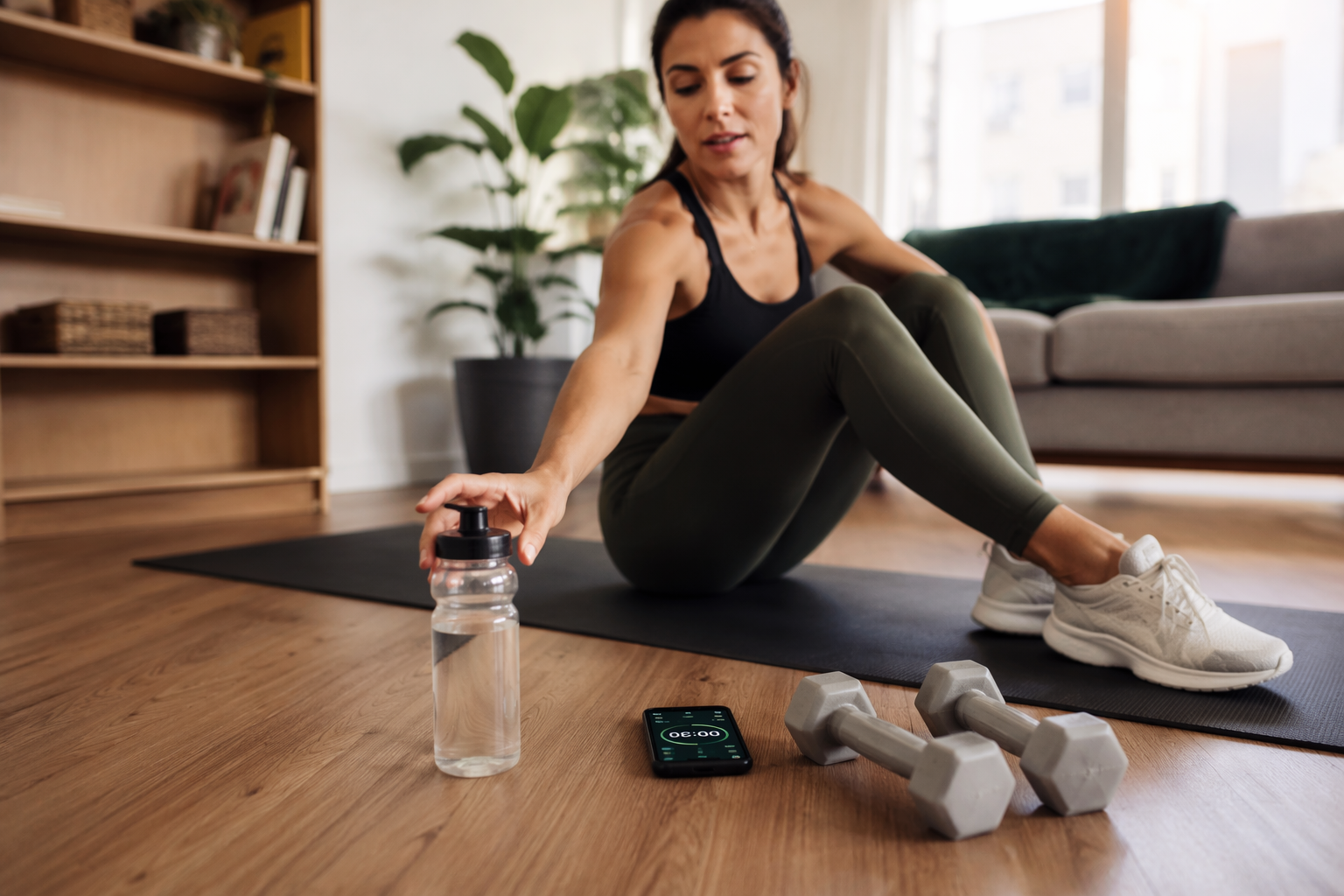
The habit is mostly environmental. Put the bottle where the workout happens before you start the warmup. If your home gym is just a mat, two dumbbells, and a phone, the bottle belongs in that same triangle. If you are still building the space, FitAtHome’s small-apartment home gym setup guide can help make the station less improvised.
- Before the workout: drink ahead of time, then take a small top-off during warmup.
- During HIIT: sip during rest intervals, with the bottle already open or easy to grab.
- During strength circuits: drink between rounds, supersets, or equipment changes.
- During yoga or stretching: pre-load first, then sip only at natural transitions unless the session is hot or long.
- Afterward: drink to thirst for ordinary short sessions; replace measurable sweat loss more deliberately when the conditions justify it.
That is enough structure for most home routines: bottle in place, water before the timer starts, small sips on existing breaks, and no electrolyte upgrade unless the workout length, heat, sweat rate, or health context actually calls for one.
References
- 9 Facts About Hydration & Electrolytes, ACSM.
- Tips for Staying Hydrated, Mass General Brigham.
- Hydration, Korey Stringer Institute.
- 4 Tips for Hydrating During At-Home Workouts, Ultima Replenisher.
- Keep Hydrated at Home, PRx Performance.
- Exercise and Dehydration, Waterboy.
- Hydration Tips Before, During and After Exercise, Abbott, 2024.
- Hydration for Sports Performance, The University of Kansas Health System.
Best for
Before you buy
Verify an item, or start using this build
Spot a stale price or spec?
Prices and stock change. If something in this build no longer matches what you found at checkout, let us know so we can recheck it.