
How morning coffee timing improves heart health and exercise
Learn why drinking coffee in the morning is linked to lower cardiovascular risk and how this timing fits naturally into a pre-workout routine, with evidence from recent studies.
The practical coffee question is rarely asked at the moment it actually matters: you are half-awake, the water bottle is filling, the walking pad or dumbbells are waiting, and the first cup is already in your hand. At that point, “one to three cups is fine” is not very useful. The better question is whether coffee belongs in this part of the day, before training and before the house or workday takes over, or whether the habit has drifted into a cup-by-cup pattern that follows you into the afternoon.
For heart health and exercise, the strongest current timing signal points toward a simple pattern: keep coffee in the morning, especially if it helps you train, and be much more cautious with the cup that appears later because energy is fading.

The heart-health signal is about timing, not just cup count
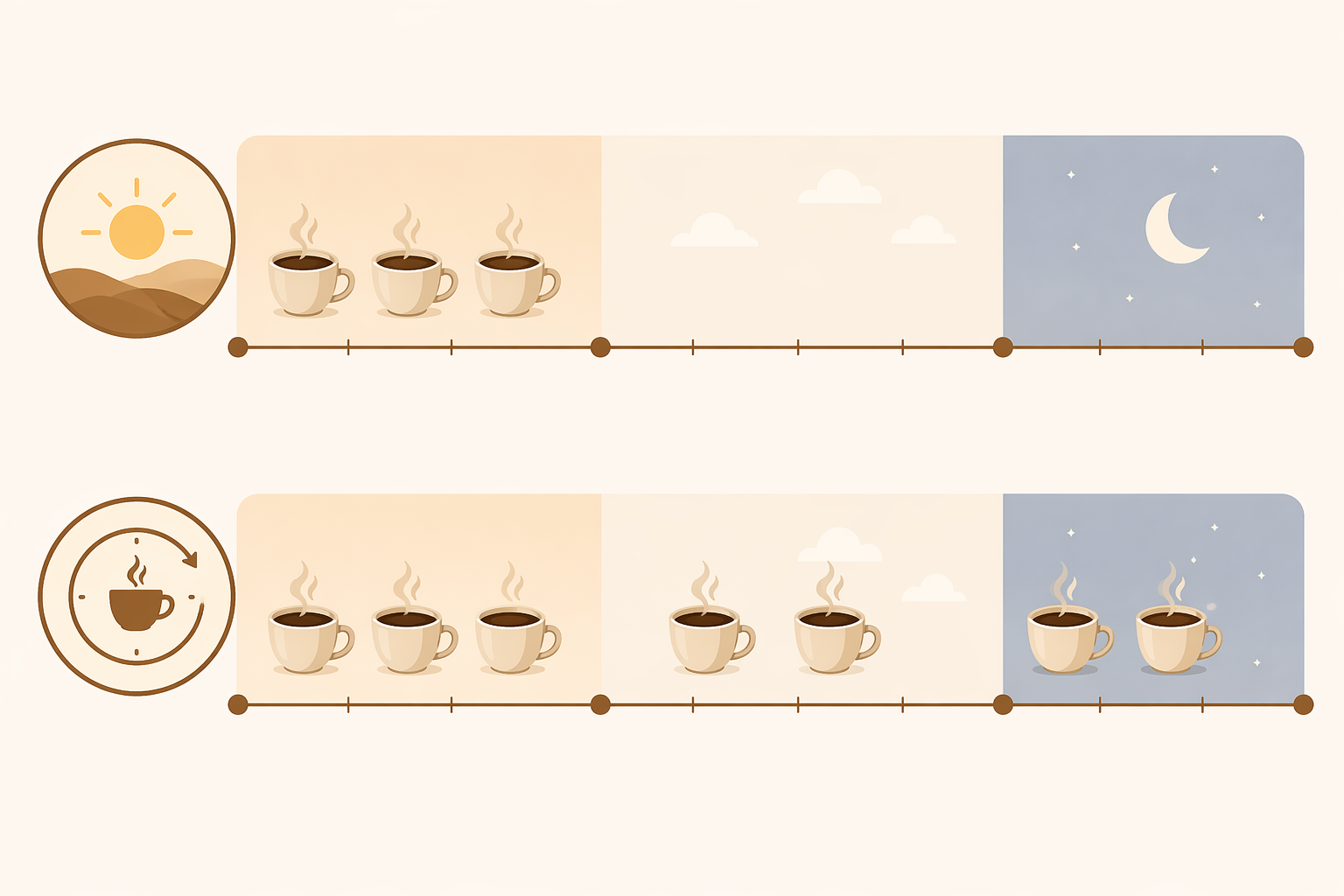
A 2025 European Heart Journal study led by Wang and colleagues looked at National Health and Nutrition Examination Survey data from 40,725 adults and separated coffee drinkers by timing pattern. Compared with non-drinkers, morning coffee drinkers had a 31% lower risk of cardiovascular mortality, with a hazard ratio of 0.69 and a 95% confidence interval of 0.55 to 0.87. They also had a 16% lower risk of all-cause mortality, with a hazard ratio of 0.84 and a 95% confidence interval of 0.74 to 0.95. All-day coffee drinkers did not show a significant reduction in risk in the same comparison.[1]
That last sentence is the part that changes the morning routine. The study does not simply say that coffee drinkers did better. It suggests that people who concentrated coffee earlier in the day looked different from people who kept drinking it across the day.
The dose detail also matters. In the same study, moderate morning drinkers, defined as 2 to 3 cups, and heavier morning drinkers, defined as more than 3 cups, showed benefit, while light morning drinkers, defined as 1 cup or less, had a smaller reduction in risk.[1] That does not mean more coffee is automatically better. It does mean the study’s most useful distinction is not a perfect daily number; it is whether the coffee stays in the morning or spreads through the day.
This was observational research. It can show that a morning coffee pattern was associated with lower cardiovascular and all-cause mortality; it cannot prove that moving your second or third cup before noon directly prevents cardiovascular death. People who drink coffee only in the morning may differ from all-day drinkers in sleep, work schedules, stress, diet, health status, or other behaviors that are hard to fully separate.
Still, the timing explanation is plausible enough to act on carefully. Afternoon and evening caffeine can interfere with the body’s wind-down period by suppressing melatonin and increasing sympathetic nervous system activity when recovery should be taking over.[1] For someone training at home several days a week, that is not a small side issue. Sleep is when the next workout is being prepared.
Why morning coffee fits exercise better than all-day sipping
Morning coffee has a practical advantage that does not require turning breakfast into a lab project: it can be the same caffeine you would have used before exercise anyway. If you train early, coffee sits naturally before a walking pad session, a bike ride, a dumbbell circuit, or a short HIIT workout. You get the alertness effect when you need to start moving, not when your body is trying to slow down.
The exercise evidence should be kept in its lane. A 2021 randomized controlled trial by Sampaio-Jorge and colleagues, published in Scientific Reports, tested 6 mg/kg of caffeine during intense cycling and reported what the authors described as a cardioprotective effect through increased vagal tone.[2] That is relevant for intense cardio contexts, especially for people who already tolerate caffeine, but it is not proof that every cup of coffee improves every home workout.
The useful takeaway is narrower and more dependable: if caffeine helps you begin or sustain morning training, using it earlier in the day fits both the workout window and the heart-health timing signal better than saving caffeine for an afternoon rescue.
| Coffee pattern | What it tends to do to the routine | How to judge it |
|---|---|---|
| Morning-only | Supports wake-up and can double as pre-workout caffeine | Best aligned with the current heart-health timing signal |
| Morning plus afternoon | May start as a productivity habit but can crowd sleep later | Watch the last-cup time and next-morning energy |
| All-day sipping | Keeps caffeine active deep into the recovery window | Hardest to reconcile with sleep and the Wang timing findings |
The tradeoff shows up in sleep
The CRAVE trial is a useful reality check because it does not treat coffee as only good or only bad. In an American Heart Association report on the randomized trial, coffee was linked with increased physical activity but reduced sleep.[3] That is exactly the tradeoff many active people feel without measuring it: coffee can make movement more likely today, while poorly timed coffee can make tomorrow’s training harder.
That is why morning-only timing is such a clean compromise. It keeps the part of coffee many exercisers value — alertness, readiness, a ritual that gets the workout started — while removing the most questionable part of the habit: caffeine late enough to interfere with recovery.
If sleep is already fragile, the problem may not be the first cup. It may be the cup that feels harmless because it is “just coffee” and arrives after lunch, during the work slump, or after a bad night that was partly caused by yesterday’s late caffeine. That loop is common enough to feel normal, but it is still a recovery problem.
What about recovery after harder sessions?
For higher-volume exercisers, there is one more nuance: coffee around morning training does not automatically conflict with recovery if post-workout nutrition is handled well. In a 2021 crossover randomized controlled trial in Nutrients, Loureiro and colleagues studied 11 endurance-trained men after exhaustive cycling. Coffee plus milk after exercise produced 153% greater glycogen resynthesis than milk alone, with values of 102.56 versus 40.54 mmol·kg dw⁻¹ and a p value of 0.01.[4]
That is interesting, not universal. The sample was small, the participants were endurance-trained men, and the exercise model was exhaustive cycling. It should not be stretched into a claim that coffee improves recovery for every lifter, walker, or mixed-modality home trainee. The safer lesson is that morning coffee is not automatically at odds with recovery when carbohydrates and overall nutrition are in place.
How to apply this without chasing a perfect cup number
For most active home exercisers who tolerate caffeine, the most evidence-aligned pattern is straightforward: drink coffee in the morning, preferably before midday, and let it serve the workout if you train early. The goal is not to force a specific dose. It is to stop the habit from leaking into the part of the day where it can compete with sleep.
- If your coffee is already morning-only and your sleep is steady, there may be nothing to fix.
- If your last cup has moved into the afternoon, move it earlier before adjusting anything more complicated.
- If coffee helps you start morning workouts, keep that benefit in the morning rather than replacing it with all-day sipping.
- If you wake tired and need more caffeine each day, treat sleep timing and caffeine timing as the same problem.
Individual tolerance still matters. People vary in how quickly they metabolize caffeine, and the same cup that is harmless for one person can cause anxiety, palpitations, reflux, or a restless night for another. Anyone with cardiovascular conditions, arrhythmias, pregnancy, medication interactions, anxiety disorders, or unusual caffeine sensitivity should ask a clinician for individualized guidance rather than using population-level coffee findings as personal medical advice.
The cleanest routine is not dramatic: coffee early, training when it fits, food after the session if needed, and no casual caffeine drift into the recovery window. Keep the cup that helps the morning happen. Be more suspicious of the one that borrows from tonight’s sleep.
References
- Morning coffee may protect the heart better than all-day coffee drinking, European Society of Cardiology.
- Caffeine and cardiovascular responses during exercise, Scientific Reports, 2021.
- Coffee boosts physical activity, cuts sleep, affects heartbeat, study suggests, American Heart Association, November 15, 2021.
- Coffee Increases Post-Exercise Muscle Glycogen Recovery in Endurance Athletes: A Randomized Clinical Trial, Nutrients, 2021.
Have a question about this guidance?
This is a question and correction channel, not an open discussion thread — recovery topics sit close to a medical-advice boundary, so we review submissions rather than publishing them instantly.