
The Three-Block Training System That Badwater 135 Finishers Follow
Learn the three-block training system used by Badwater 135 finishers: sustained high mileage, a structured heat acclimation protocol, and a deliberate taper. This article reveals the specific weekly numbers, sauna schedules, and nutrition strategies that produce the race's high finish rate.
- Citation source
- Arthur Webb
- Evidence level
- general guideline
Badwater 135 has the kind of reputation that makes people expect carnage: 135 miles from Death Valley to Mount Whitney, daytime heat, long exposed roads, and enough mythology to make ordinary training talk sound too small. Then the finish rate complicates the story. In recent discussions of the race, Jason Koop notes that roughly 85–90% of starters finish, a rate higher than many marquee 100-milers that runners casually call more approachable.[1]
That number does not mean Badwater is secretly easy. It means the comparison is rigged if we treat Badwater like an open-entry survival contest. The race is curated and invitation-only, with a small field, so the start line is already filtered for runners who have done hard things and can show they understand the assignment.[1] The useful question is not whether Badwater demands toughness. It does. The better question is what “prepared” looks like before anyone gets to Furnace Creek.

The most useful Badwater 135 finisher training regimen is not built around one heroic peak week or one confidence-building monster long run. It is a stacking problem: sustained mileage that does not bury the runner, heat exposure that is treated as real training stress, and a final taper that makes the athlete more specific instead of merely more rested.
| Block | What It Emphasizes | Why It Matters |
|---|---|---|
| Base volume | About 90–120 miles per week for roughly three months in Arthur Webb’s published approach, with long runs capped near 15 miles | Durability comes from repeatable accumulation, not a single proof-of-fitness run [2] |
| Heat acclimation | A 4–8 week block using sauna or hot-water immersion, with sessions hard enough to drive meaningful thermal strain | Heat work competes for recovery capacity instead of sitting harmlessly on top of mileage [3][4][5] |
| Taper and execution | Mileage reduction, power walking, caffeine withdrawal, liquid calories, ice water, electrolytes, and crew logistics | The system continues into race management; fitness alone does not solve heat, stomach, or pacing errors [2][6] |
Arthur Webb’s Training Looks Boring in the Best Possible Way
Arthur Webb’s Badwater record is hard to ignore because it is not a theory from someone adjacent to the race. He finished Badwater 15 times and described a final-three-month pattern that moves from about 120 miles per week down to about 90 miles per week, with no long run longer than 15 miles.[2] He also set an age-group course record using this kind of preparation.[2]
The 15-mile cap is the detail that matters. Plenty of runners facing 135 miles would be tempted to stage a giant rehearsal, partly for fitness and partly for emotional reassurance. Webb’s approach goes the other direction. He keeps the individual run contained so he can come back tomorrow, and the day after that, and the week after that. The stress is not concentrated into a dramatic workout. It is distributed across a long block.
That distribution changes the meaning of high mileage. A 120-mile week can be reckless or controlled depending on what surrounds it: sleep, fueling, soreness decisions, surface choice, pace discipline, and whether the athlete can absorb the next session. Webb’s numbers are impressive, but the restraint inside the numbers is more instructive than the total itself.
For a runner trying to understand the Badwater pattern, the lesson is not “run 120 miles per week.” Webb was a veteran finisher whose baseline was already unusually high. The lesson is that the base block has to be repeatable enough to make tomorrow’s training possible. A runner who needs three days to recover from a theatrical long run has not built the same system; they have bought one good screenshot at the expense of the next week.
This is where recovery monitoring becomes more than a wellness ornament. During a block like this, morning resting heart rate, HRV trends, appetite, sleep quality, and unusual soreness are not trivia. They are early warnings that the block is losing coherence. The same idea behind using a heart rate fitness tracker to improve recovery applies here at a harsher scale: the data are useful only if they change the next decision.
The Last Three Weeks Shift Toward Walking
Webb’s final weeks also include a move toward power walking.[2] That can look like backing off if the only currency is running mileage. At Badwater, it is specificity. Even strong runners walk significant portions of hot, steep, late-race terrain. Practicing efficient walking before the race is not an admission that the run plan failed; it is preparation for the parts of the race where running becomes a poor bargain.
A good taper does not simply remove stress. It changes the type of stress. The body gets fewer miles, but the athlete still rehearses the movement pattern, cadence, and patience that will matter when the crew vehicle is leapfrogging ahead and the next runnable stretch depends on heat, grade, stomach, and timing.
Heat Training Is Not Extra Credit
Heat acclimation is where Badwater training most often gets flattened into bad advice. “Train in the heat” sounds simple until it has to coexist with 90-mile weeks, work, sleep, digestion, and connective tissue that does not care about anyone’s desert fantasy. Heat exposure is training stress. If it is added after the “real” workout without changing the recovery budget, it can turn a strong block into a slow leak.
Marshall Ulrich, a 20-time Badwater finisher, published a dry-sauna progression that is admirably specific: 180–200°F, three to four sessions per week, building from two 20-minute sessions in week one, to two 25-minute sessions in week two, two 30-minute sessions in week three, two 40-minute sessions in week four, and one 60-minute session in week five.[3] The value of that schedule is not that sauna is magical. It is that the exposure is planned, progressed, and counted.
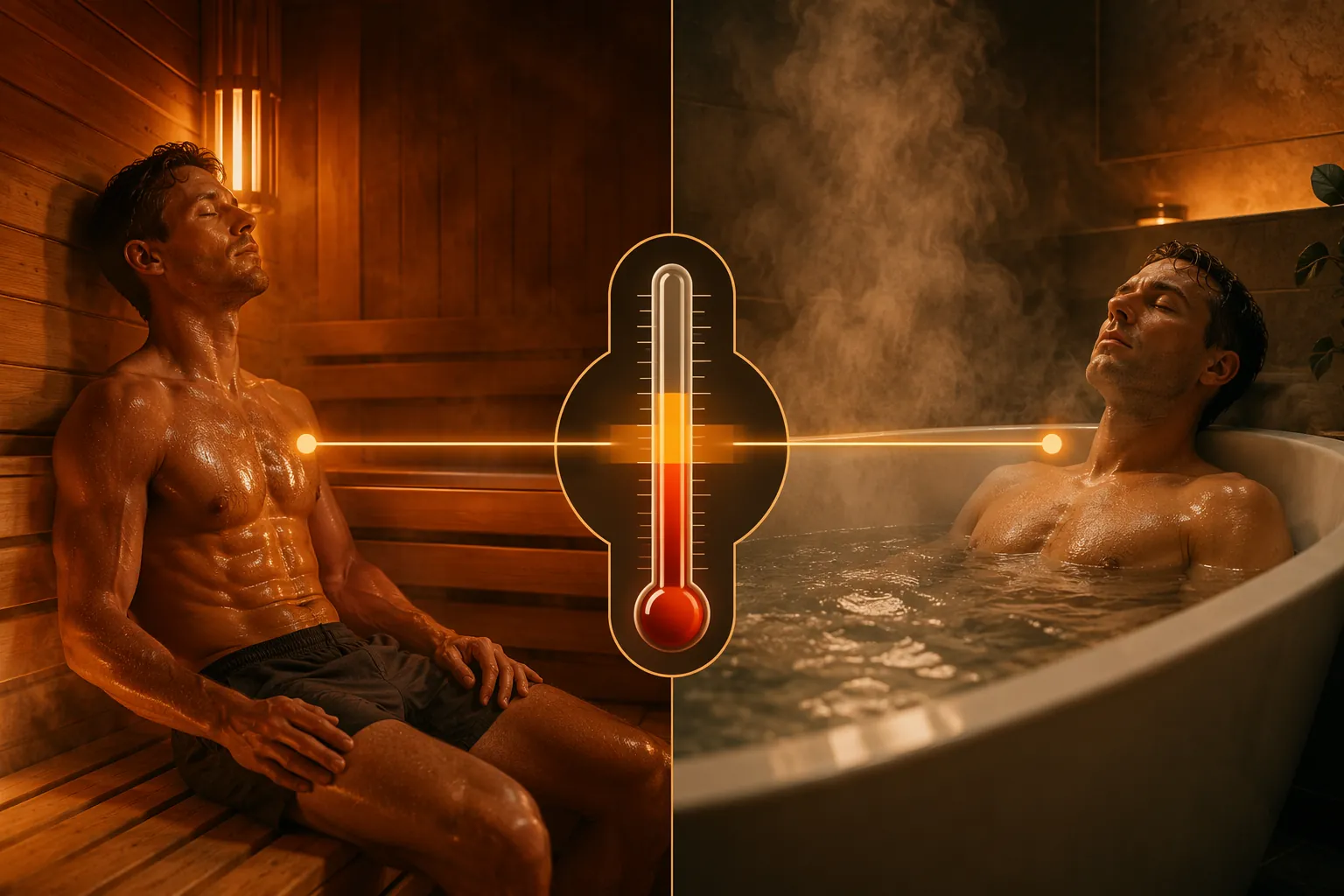
Koop’s heat-acclimation synthesis gives the useful governing principle: protocols that raise core temperature to roughly 38–38.5°C are markedly more effective, while methods that fail to reach that range provide negligible benefit.[4] That distinction saves the athlete from confusing discomfort with adaptation. Sweating in a hot room may feel productive. The better question is whether the session creates enough thermal strain to move the physiology without wrecking the next day.
There is another practical route. Zurawlew and colleagues tested a post-exercise hot-water immersion protocol: a 40-minute run followed by 40 minutes in 104°F water. In their 2016 study, this approach lowered resting core temperature, improved 5K time-trial performance in both temperate and hot conditions, and produced adaptations that persisted for at least two weeks.[5] The study does not prove that a bath after running prepares someone for 135 desert miles. It does show that post-exercise hot-water immersion can create measurable heat adaptations without requiring every run itself to happen in dangerous heat.
| Method | Published Protocol | Best Use |
|---|---|---|
| Dry sauna | Ulrich’s 180–200°F progression over five weeks, three to four days per week [3] | Useful when the runner can control duration and repeat sessions without adding impact |
| Post-exercise hot-water immersion | Zurawlew et al.: 40-minute run plus 40-minute bath at 104°F [5] | Useful when heat exposure can be attached to a normal run while still creating thermal strain |
| Outdoor heat running | No single Badwater-specific protocol is validated in the supplied evidence | Useful only when risk, hydration, route safety, and recovery cost are managed |
The sauna and bath methods should not be treated as rival hacks. They are two controlled ways to pursue the same target: repeated heat stress strong enough to drive adaptation, placed carefully enough that the runner can still absorb mileage. For some athletes, the safer choice may be the one that allows the most boring consistency.
Heat Adaptation Fades, So the Calendar Matters
Heat work cannot be finished in spring and filed away for a July race. Koop’s summary cites decay data suggesting heat adaptations begin declining after about 48 hours without exposure, at roughly 2.5% per day; core-temperature control may decay around 6%, while sweat-rate improvements may decline about 30% over two weeks.[4] The exact decay rate will vary by athlete and protocol, but the direction matters: heat adaptation is perishable.
That makes timing as important as toughness. A 4–8 week heat block close enough to the race can sharpen adaptation; the same block placed too early may leave the athlete with a memory of suffering and less of the physiology they wanted. The catch is that this block often overlaps with serious mileage. Heat sessions, harder sleep, elevated cardiovascular strain, and more complicated hydration all draw from the same account.
Hot-weather sleep is an underrated part of that account. If heat acclimation leaves an athlete wired, dehydrated, or sleeping poorly, the cost shows up in the next run. The principles in hot-weather sleep and fitness recovery are not separate from Badwater training; they are one of the ways the heat block either integrates or breaks loose.
The same goes for the hours after training. Cooling down, replacing fluid, getting carbohydrates and protein in, and reducing avoidable stress are not soft details during a block that combines high mileage with thermal load. A basic post-workout recovery routine becomes more important when the next session is not optional.
The Taper Still Has Jobs to Do
A Badwater taper is not a vacation from preparation. Webb’s late reduction in mileage and shift toward power walking shows the point: the athlete is unloading, but not drifting.[2] The final weeks should reduce accumulated fatigue while keeping the race’s actual demands close enough to feel normal.
Caffeine is one example. Veteran Badwater guidance includes stopping caffeine two weeks before the race to restore sensitivity.[6] That is not glamorous, and it will not show up in a training log as fitness. But if caffeine is going to be used as a tool during a long, hot race, then sensitivity is part of the system.
Nutrition is another place where Badwater punishes improvisation. Webb’s survival guidance describes a race-day pattern of 15–20 ounces of ice water per hour, no more than about 200 liquid calories per hour, and two to three Endurolyte capsules per hour during daytime heat.[6] Those numbers should not be copied blindly across athletes, body sizes, weather conditions, or sweat rates. Their real value is procedural: the stomach, the bottle exchange, the crew timing, and the electrolyte plan are rehearsed before the desert makes every mistake more expensive.
That rehearsal also separates training nutrition from race survival. The post-run recovery window during a high-mileage block may call for more complete refueling than a race-hour liquid plan allows. A runner comparing options such as milk, chocolate milk, and whey for post-workout recovery is solving a different problem from what the athlete solves at mile 80 in Death Valley. Both matter, but they should not be collapsed into one generic “fueling” bucket.
Hydration and electrolytes deserve the same distinction. Badwater’s daytime protocol is extreme because the environment is extreme. The underlying principle is more general: fluid, sodium, and calories have to match the session and the conditions rather than a slogan. For a less severe setting, the same reasoning behind whether you need electrolytes for home workouts still applies; the scale changes, not the need to think clearly.
Crew Logistics Are Part of Fitness
Badwater finishers do not just train their legs. They train the handoff. Veteran guidance treats crew leapfrogging, ice, bottles, clothing changes, pacing judgment, and communication as race-critical details.[6] That can sound administrative until the athlete is hot, under-fueled, and making worse decisions than they would make in a chair.
The crew is where private bravado becomes a public problem. If the runner refuses to slow down, misses calories, ignores heat strain, or mistakes stubbornness for discipline, other people inherit the consequences. A strong Badwater regimen therefore has to include boring rehearsals: where the crew vehicle stops, what the runner asks for, who tracks intake, who notices behavior changes, and when the plan changes before the athlete is capable of asking for it.
This is also why the finish rate should be read carefully. A curated field with prepared crews and experienced athletes can produce a high completion percentage without making the race broadly reproducible. The finishers are not proof that Badwater is manageable for anyone with enough grit. They are proof that a hard event becomes more finishable when fewer parts are left to personality.
What a Badwater 135 Finisher Training Regimen Actually Protects
The three-block structure is useful because it protects the athlete from the most seductive mistake in ultra training: proving readiness in ways that reduce readiness. A massive long run may prove tolerance for one day. A sauna streak may prove discipline. A hard final week may calm anxiety. None of those matters if the runner arrives with a recovery debt that turns heat, digestion, and sleep into opponents before the race has properly begun.
- Base volume builds durability through repeatable weeks, not a single oversized workout.
- Heat acclimation works best when it is timed, measurable, and counted as stress.
- The taper reduces fatigue while preserving specific skills such as power walking.
- Race execution depends on rehearsed calories, fluid, electrolytes, caffeine strategy, and crew decisions.
Copying Webb’s mileage or Ulrich’s sauna schedule does not make someone a Badwater finisher. The evidence is narrower and more useful than that. Successful preparation is less about becoming the highest-mileage runner in the field and more about arranging mileage, heat, taper, nutrition, and crew demands so none of those systems bankrupts recovery before race day.
References
- 90% of Badwater 135 runners finish. Here's what they can teach you about preparation, Jason Koop / CTS
- The Art of Finishing Badwater 135, Arthur Webb
- Heat Training Tips from a 20-Time Badwater 135 Finisher, Marshall Ulrich
- Ultrarunners' Heat Acclimation Cheat Sheet, Jason Koop / CTS
- Post-exercise hot water immersion study, Zurawlew et al., 2016
- Badwater 135 Survival Tips, Arthur Webb
This is general fitness education, not medical advice. For diagnosis or treatment of pain or injury, consult a qualified clinician.
Pick your next session
Browse all routines to find an appropriately-spaced next session.
Spot something off?
This content sits adjacent to health guidance — tell us if a citation or figure needs a correction.