
Can BPC-157 Improve Your Home Workout Recovery?
BPC-157 is promoted as a recovery peptide for home gym athletes, but human evidence is thin. This article examines the science, FDA review status, legal risks, and why foundational recovery habits matter more.
- Citation source
- PMC / University of Utah review
- Evidence level
- restrained inference
You finish a hard home workout, rack the adjustable dumbbells, and notice that one tendon or muscle is still complaining long after normal soreness should have faded. That is usually the moment BPC-157 starts to look less like an internet peptide trend and more like a possible shortcut back to training.
The appeal is not hard to understand. BPC-157 is promoted as a tissue-repair peptide, and the preclinical literature is not empty. A recent review describes more than 100 animal studies reporting regenerative effects across tendons, ligaments, skeletal muscle, bone, nerve, and other tissues.[1] For someone dealing with a stubborn elbow, knee, hamstring, or shoulder issue, that is enough to earn attention.
The problem is what happens next. A strong animal signal gets translated into home injection routines, clinic protocols, and research-chemical shopping carts before human evidence has done the boring but necessary work. For BPC-157 for home workout recovery, the honest answer in July 2026 is this: the biology is interesting, but you cannot rely on it yet as a proven, legal, quality-controlled recovery tool.
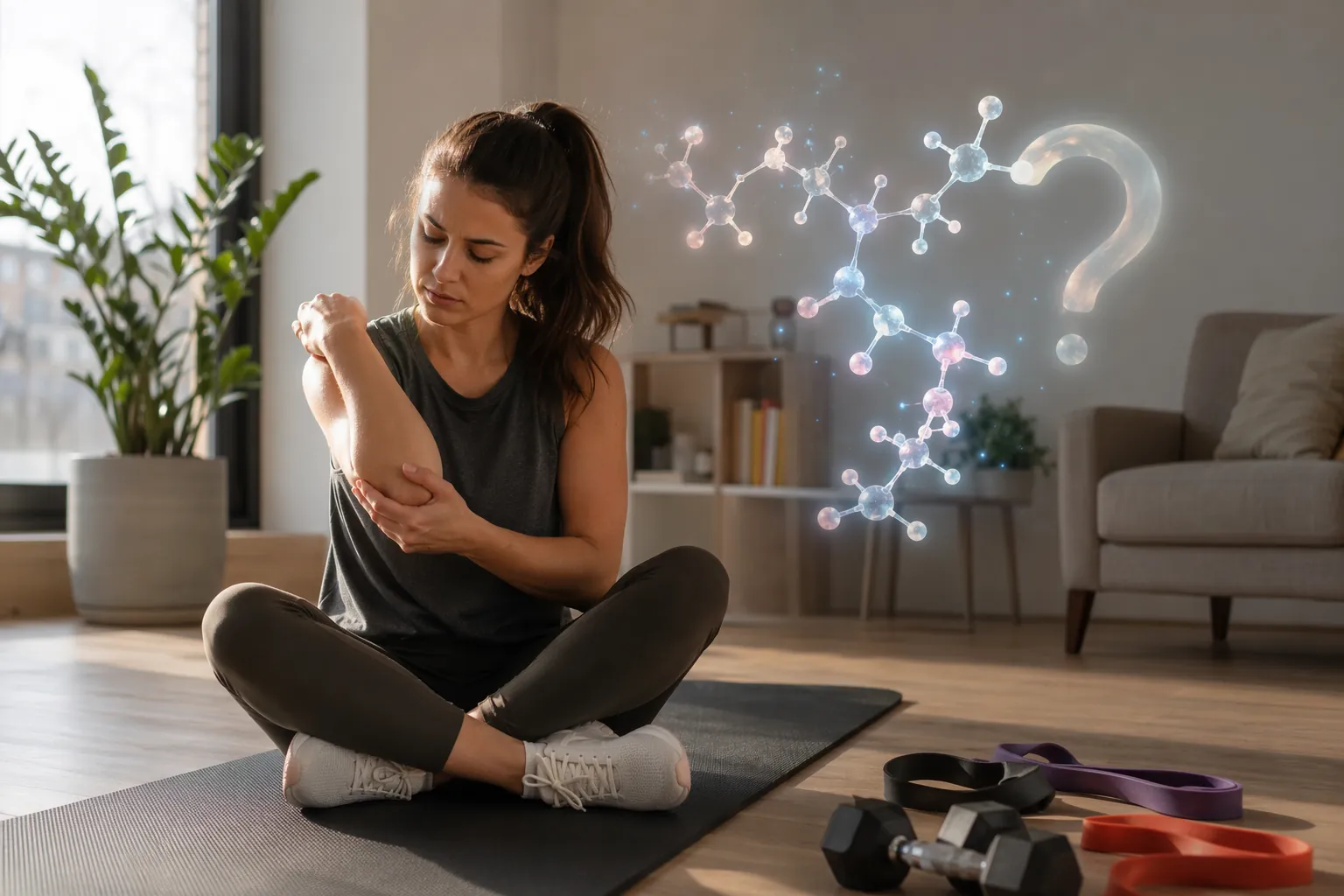
The Animal Evidence Is Real, But It Does Not Answer the Home-Gym Question
BPC-157 is often described as a fragment related to a body-protection compound found in gastric juice. Most of the serious interest comes from animal work where researchers have observed effects that sound directly relevant to training injuries: tendon-to-bone healing, ligament repair, muscle injury recovery, angiogenesis, collagen organization, and inflammation modulation.[1]
That matters because tendons and ligaments are exactly where many home exercisers get stuck. A muscle strain may calm down in days; a cranky patellar tendon, Achilles, elbow tendon, or irritated shoulder can turn into a months-long negotiation with load, volume, sleep, and patience. A compound that appears to improve tissue repair in animal models is not nonsense by default.
But animal healing studies are not the same as knowing what happens when a person injects a peptide after garage-gym squats or apartment resistance-band work. Animal studies can control the injury model, dose, timing, tissue sampling, and product quality in ways that do not resemble real consumer use. They can show biological plausibility. They cannot establish practical dosing, long-term safety, sport eligibility, product purity, or whether a home exerciser will recover faster than they would with a better load-management plan.

This is the distinction that gets flattened in marketing. “Supported by research” can mean many things. In BPC-157’s case, it mostly means supported by preclinical research. That is a legitimate starting point for science. It is not the same as a tested recovery protocol for humans who train alone and buy products online.
The Human Evidence Is Still Too Thin
The human evidence base is much smaller than the online confidence around BPC-157 suggests. The review cited above identifies only three small human pilot studies: one on knee pain with 16 participants, one on cystitis with 12 participants, and one intravenous safety report with 2 participants. All three came from the same research group, and none were randomized controlled trials.[1]
That is not a minor technicality. Randomized controlled trials are how researchers start separating treatment effects from natural healing, placebo response, changes in training behavior, regression to the mean, and selective reporting. If a tendon flare improves after BPC-157, that improvement might be from the compound. It might also be from two weeks of reduced load, better sleep, less pressing volume, or simply the normal arc of an irritated tissue settling down.
There is a Phase 2 trial registered for hamstring strain, but as of July 24, 2026, it is recruiting and has no posted results.[2] That trial is the kind of human evidence people should want: a specific injury context, human participants, and an outcome that could actually help sports-medicine decisions. Until results are posted and scrutinized, it cannot be used as proof that BPC-157 works.
| Evidence Type | What It Supports | What It Does Not Yet Prove |
|---|---|---|
| 100+ animal studies | Biological plausibility for tissue-healing effects in controlled models | That home exercisers recover faster, safely, or legally from real workouts |
| Three small human pilot studies | Early human signals worth further study | Reliable efficacy, dosing, or broad safety |
| Recruiting Phase 2 hamstring trial | A more relevant human question is being studied | Any outcome, because results are not posted yet |
| Clinic and practitioner protocols | How the market is already using BPC-157 | FDA-approved or trial-established dosing |
For a home exerciser, the missing information is not abstract. It is the information you would need before making a decision this week: who should use it, who should not, what dose has been tested, what route is safer, what adverse effects appear over time, what happens when the product is not pharmaceutical grade, and whether the benefit is large enough to justify the risk.
July 2026 Matters Because the Regulatory Picture Is Not Settled
The timing is important. The FDA Pharmacy Compounding Advisory Committee is reviewing BPC-157 for 503A compounding eligibility on July 23–24, 2026. As of the current date of this article, July 24, 2026, the outcome should be treated as pending, not resolved.[3]
For most people training at home, “compounding eligibility” sounds remote until they realize what it controls: whether certain pharmacies can legally compound a substance for individual patients under specific conditions. It does not mean a compound is proven effective. It also does not turn a peptide into an FDA-approved drug with established dosing, labeling, manufacturing standards, and post-market surveillance.
The broader sports-medicine world has been watching a peptide boom unfold faster than the evidence base. The American Orthopaedic Society for Sports Medicine’s Spring 2026 update frames peptides as an area of major interest but emphasizes that rigorous evidence has not kept pace with clinical and consumer enthusiasm.[4]
BPC-157 is also banned under the World Anti-Doping Agency’s S0 category, a class that covers non-approved substances. The ban has applied since 2022. That may sound irrelevant if you only train in a spare bedroom or apartment gym, but it matters if you enter tested strength sports, endurance events, martial arts competitions, or any setting where anti-doping rules can suddenly become part of your life.
The practical point is not that every home exerciser should think like an Olympic athlete. It is that non-approval has consequences. If a substance is not approved, not standardized for your use case, and prohibited in sport, then the burden of proof is higher before you let a sales page redefine it as ordinary recovery support.
What Would You Actually Be Buying?
This is where the question becomes less glamorous and more important. Even if you find the animal data persuasive, what exact product are you buying, from whom, and under what standard?
McGill University’s Office for Science and Society has warned about the “no proof required” culture around BPC-157 and similar compounds, especially when consumers buy from unregulated sellers. The concerns include unknown purity, contamination, incorrect dosing, and products marketed as research chemicals rather than approved human medicines.[5]
Those risks land differently when the compound is injected. With a capsule or powder, a bad product is still a problem. With a self-administered injection, sterility, concentration, storage, reconstitution, needle technique, and labeling errors become part of the decision. The home setting does not make those variables disappear; it usually removes the supervision that might catch a mistake.
Commercial peptide clinics and practitioner sites often describe subcutaneous BPC-157 protocols in the range of 200–500 micrograms per day for multi-week cycles. That should be read as evidence of market behavior, not as established medical guidance. Those protocols are not FDA-approved dosing instructions, and they come from financially interested practitioner or promotional sources rather than disinterested clinical trial guidelines.
Oral-versus-injection claims deserve the same restraint. Some promotional sources discuss low oral bioavailability estimates, but the research brief traces that range mainly to animal pharmacokinetic models and peptide-stability reasoning, not direct human recovery trials. That is enough to explain why sellers debate route of administration. It is not enough to tell a home exerciser which route is effective or safe.
Where BPC-157 Fits in a Home Recovery Decision
The strongest fair case for BPC-157 is narrow: animal research gives plausible reasons to study it for tissue repair, and a recruiting human hamstring-strain trial may eventually give more useful answers. That is a reason to watch the evidence. It is not a reason to treat BPC-157 as a dependable recovery tool today.
For a home workout recovery decision, the current answer depends on the verb. Can BPC-157 improve recovery? Maybe; the preclinical signal is strong enough that the question deserves proper trials. Can you rely on it now? No. The human data is too thin, dosing is not established, FDA status is unresolved as of July 24, 2026, and gray-market sourcing adds risks that have nothing to do with whether the molecule is biologically interesting.
There is also a quieter issue: if a tendon or muscle keeps flaring, a peptide may distract from the actual training problem. Too much volume, too little progression control, poor exercise selection, repeated failure sets, limited sleep, and under-eating are not exciting explanations. They are also the places where a home exerciser has the most control.
What to Prioritize While the Evidence Catches Up
None of the basics sound as futuristic as a healing peptide. That does not make them optional. If you train at home, your recovery system is mostly built from ordinary decisions repeated often enough to matter: food, fluid, sleep, programming, deloads, and attention to pain that changes how you move.
- Treat persistent tendon or joint pain as a load-management signal, not a challenge to out-supplement.
- Use recovery nutrition before experimental compounds; FitAtHome’s daily eating habits for home fitness recovery are a better first checkpoint.
- Match hydration and electrolytes to workout length, sweat, and heat rather than buying recovery products by default; start with electrolytes for home workouts or these cost-conscious hydration tips.
- Keep caffeine in perspective; coffee after workouts has a clearer everyday-use profile than an unapproved peptide.
- If pain persists, changes your mechanics, or keeps returning when load increases, involve a qualified clinician instead of escalating research chemicals.
The most defensible position in Q3 2026 is not to sneer at BPC-157 or to buy the hype. Watch the FDA compounding decision. Watch the human trial data. Do not treat clinic protocols as established dosing. Do not buy injectable peptides from unregulated vendors. Build recovery around the parts you can verify and control until the human evidence catches up.
References
- BPC 157 as Potential Therapy for the Management of Soft Tissue Injuries and Systemic Disorders, PMC / University of Utah.
- NCT07437547, ClinicalTrials.gov.
- FDA’s Review Of Peptides Signals A Growing Public Health Challenge, Forbes, July 21, 2026.
- The Boom of Peptides in Sports Medicine: Do We Know Anything More?, American Orthopaedic Society for Sports Medicine, Spring 2026.
- Body Protection Compound: No Proof Required, McGill University Office for Science and Society.
This is general fitness education, not medical advice. For diagnosis or treatment of pain or injury, consult a qualified clinician.
Pick your next session
Browse all routines to find an appropriately-spaced next session.
Spot something off?
This content sits adjacent to health guidance — tell us if a citation or figure needs a correction.