
How to Adapt Your Home Workout During a Florida Heat Warning
Florida heat advisories and excessive heat warnings make outdoor exercise unsafe and require modifications for home workouts. This guide breaks down NWS alert thresholds for Florida counties and explains how to adjust timing, intensity, cooling, and heat-illness recognition to train safely at home.
- Citation source
- NWS, CDC, Johns Hopkins Medicine
- Evidence level
- general guideline
If your phone just pushed a Florida heat advisory or excessive heat warning, treat it as a workout decision, not background weather. Outdoor exercise is off the table. The question is whether your home setup is cool enough for a deliberately easier session, or whether the safer move is to shorten, move, or skip the workout before symptoms start.
The first detail is your county. In Miami-Dade and Broward, a heat advisory can be issued when the heat index is expected to reach at least 105°F for 2 or more hours, and an excessive heat warning can be issued at 110°F or higher. In much of the rest of Florida, UF Emergency Management lists the heat advisory threshold at 108°F and the excessive heat warning threshold at 113°F.[1][2]
| Where you are | Heat advisory | Excessive heat warning | Workout decision |
|---|---|---|---|
| Miami-Dade or Broward | Heat index of 105°F or higher for at least 2 hours | Heat index of 110°F or higher | No outdoor workout; only train indoors if the room is cool enough and the session is reduced |
| Other Florida counties | Heat index of 108°F or higher | Heat index of 113°F or higher | No outdoor workout; modify the home session or move it to a cooler time or place |
That county split matters because a lazy statewide rule can push the wrong decision. A 106°F heat index may be advisory-level in South Florida even if someone elsewhere in the state is waiting for a higher number. For exercise, waiting for the worst category is a bad habit.
Read the Alert as a Training Load
The National Weather Service heat index chart groups risk into four zones: caution from 80°F to 90°F, extreme caution from 90°F to 103°F, danger from 103°F to 124°F, and extreme danger at 125°F and above. The chart specifically places prolonged exposure or physical activity into the risk calculation, which is why a heat index number becomes more than a forecast once you add sets, intervals, or a long conditioning block.[3]
A home workout does not erase that load. It removes direct sun and pavement heat, which helps, but the body still has to dump heat while muscles are working. A small bedroom, a garage bay, or a rental with weak air conditioning can drift into a range where the workout itself becomes part of the heat exposure.
Exercise decisions should be tied to the alert, not to how tough you felt last August. Outside Online’s July 2026 heat-index explainer makes the same practical point: the heat index chart is not just a comfort scale; it should change activity choices when exertion is involved.[4]
The risk is not theoretical this summer. On July 28, 2026, Herald-Tribune reported that more than 33 Florida counties were under extreme heat warnings, with heat index values forecast up to 115°F.[5] That is seasonal context, not a number to memorize. Your actual decision still starts with the current alert in your county.
Before You Touch the Dumbbells, Check the Room
A cheap room thermometer is more useful than a pep talk. Put it where you train, not across the house near the thermostat. If the room or garage is already around 90°F, a fan is not a safety plan. NPR’s July 2026 reporting on cooling without air conditioning cited public-health guidance that fans become ineffective above about 90°F indoors, and the Red Cross also warns that fans do not prevent heat-related illness in high heat.[6][7]
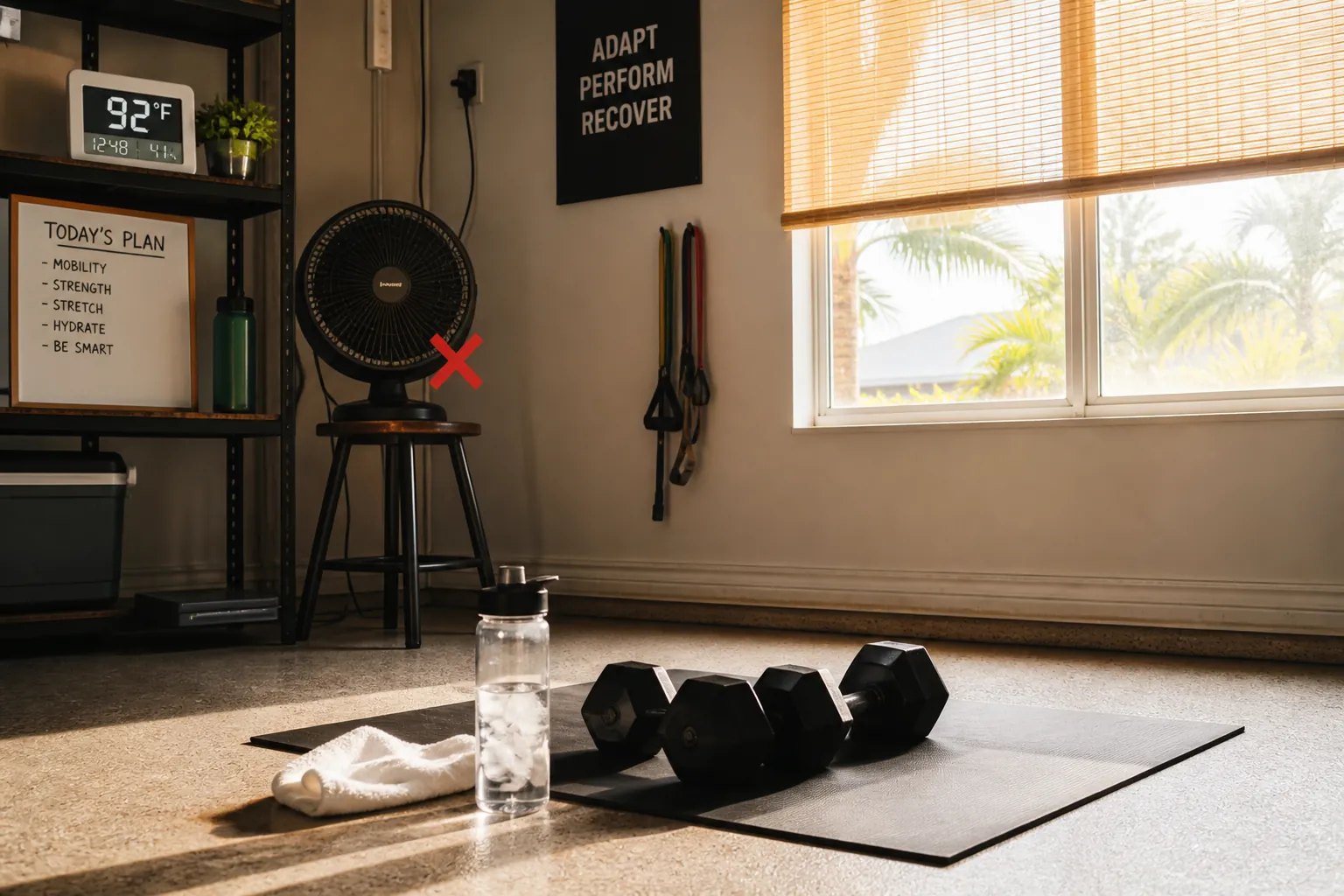
Fans still have a place. They can move air, support evaporation, and reduce stale heat buildup when the room is not already too hot. Open a shaded window if outdoor air is cooler than the room, pull blinds before the sun hits the glass, and avoid trapping yourself in a closed garage with concrete radiating heat from the day. Those are heat-management habits, not permission to train hard in a dangerous room.
Garage gyms need extra suspicion. Door orientation, roof exposure, insulation, and stored heat in the slab can make the space hotter than the official temperature suggests. If your setup lives beside the mower and hurricane bins, the practical upgrade may be less about buying another specialty bar and more about where the session happens on warning days. For layout and equipment choices in tighter garage setups, see this guide to garage gym equipment for small spaces.
The Home-Workout Modification Order
When a heat advisory or excessive heat warning is active, do not start by asking whether you can finish the workout as written. Start by changing the conditions.
- Move the session to the coolest part of the day, usually early morning or later evening.
- Measure the actual room, apartment, spare bedroom, lanai, or garage temperature.
- Shorten the workout before you start, rather than negotiating mid-session.
- Lower intensity: fewer hard sets, no all-out intervals, no high-rep finishers.
- Extend rest periods so heat and heart rate can come down between efforts.
- Pre-cool if the room is warm but still usable.
- Stop early if symptoms appear, even if the plan says one more round.
That order is important. Cooling tricks come after timing and room temperature, not before. An ice drink does not turn a 92°F garage into a safe conditioning space.
Shift the Session, Then Cut It Down
The easiest win is moving the workout away from the hottest hours. If that means a 20-minute strength maintenance session before breakfast instead of a 50-minute afternoon session, take the boring win. Consistency survives better when you stop treating every day like it deserves the full plan.
Cut volume first. Keep the main movement pattern and remove the extras: fewer accessory lifts, fewer rounds, fewer loaded carries, fewer circuits. A heat-warning day is not the day to stack squats, burpees, jump rope, and a finisher because the calendar says conditioning.
Intensity comes next. Strength work can often be made safer by leaving more repetitions in reserve, increasing rest, and avoiding breath-holding grinders. Conditioning should be the first thing downgraded because it drives heat production fast and makes it easier to ignore early warning signs.
If you are training without air conditioning, use a more specific plan than “take it easy.” This home workout guide for extreme heat without AC covers modifications that fit hot apartments and small home gyms.
Use Cooling Methods as Support, Not a Loophole
Hydration still matters, but it should stay practical. CDC guidance for athletes emphasizes drinking fluids, replacing salt and minerals lost through sweat, taking breaks, and adjusting activity in hot conditions.[8] For a home workout, that means you start hydrated, keep cold water nearby, and avoid turning the session into a sweat test.
Pre-cooling can help when the room is warm but not already over your line. BBC Future’s June 2026 guide to exercising in hot weather discusses ice slurry drinks and forearm immersion as practical cooling methods, along with heat acclimatization timelines of about 7 to 14 days.[9]
Ice slurry is the simple version: a cold, slushy drink before training can lower thermal strain for some athletes. At home, think of it as a modest assist before a reduced session, not a performance hack that lets you ignore an excessive heat warning.
Forearm immersion is even more garage-gym friendly. Fill a basin or sink with cool water and put your forearms in during a break. It is not glamorous, which is partly why it is useful. You can do it between blocks without pretending your floor fan has changed the laws of heat transfer.
Heat acclimatization belongs in a different category. It develops over repeated exposure across days, not in the hour after an alert hits your phone. If you have not gradually adapted, today is not the day to fake it.
Stop at Symptoms, Not at the End of the Program
Heat illness is easier to respect when you stop treating it as one sudden collapse. Johns Hopkins Medicine describes exercise-related heat illness as a progression that can move from heat cramps to heat exhaustion to heat stroke.[10]
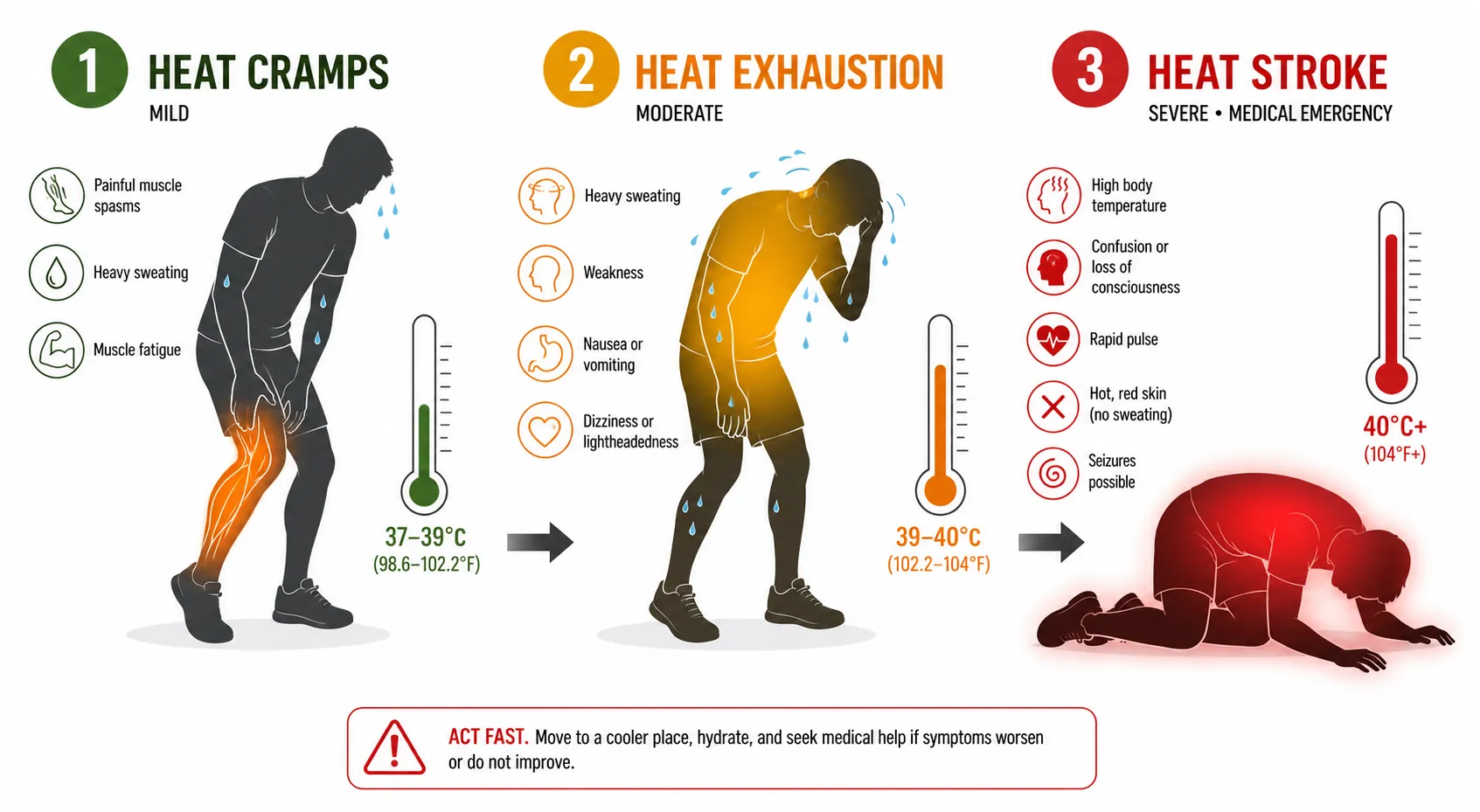
The early stage can look like painful muscle cramps during or after exercise. The next stage, heat exhaustion, can involve heavy sweating, weakness, dizziness, headache, nausea, fast heartbeat, or feeling faint. Heat stroke is a medical emergency, and Johns Hopkins distinguishes it as the severe stage in which the body can no longer control temperature normally.[10]
For a solo home workout, the rule has to be conservative: stop at cramps, dizziness, nausea, unusual weakness, confusion, chills, or a sense that your effort suddenly does not match the work. Sit down in a cooler place, cool the body, and do not resume the session just because the timer still has minutes left.
If you want a deeper breakdown of the progression, this guide to heat-illness stages during outdoor workouts pairs well with the indoor decisions here.
A Practical Decision Rule for Florida Warning Days
On a Florida heat advisory day, train only if you can move the session to a cooler time, keep the training space comfortably below about 90°F, shorten the work, lower intensity, and take longer rests. If one of those pieces fails, cut the workout sharply or move it somewhere cooler.
On an excessive heat warning day, raise the bar. If the indoor space is hot, especially around 90°F or higher, do not use a fan as your deciding safety measure. Pick mobility, easy technique work in a cooler room, or a rest day. For more detailed setup checks, this hot home-gym safety guide focuses on ventilation, solo training, and emergency recognition.
The successful workout during a Florida heat advisory or excessive heat warning is the one adjusted before heat illness starts. If the space is cool enough and the session is deliberately easier, train carefully. If the room is hot, the alert is high, or symptoms appear, move the session, shorten it hard, or skip it.
References
- NWS Miami's experimental heat criteria for Broward County, National Weather Service.
- UF Emergency Management extreme heat page, UF Emergency Management.
- NWS heat index chart, National Weather Service.
- What the heat index means for safety, Outside Online, July 2026.
- Herald-Tribune reporting on Florida counties under extreme heat warning, Herald-Tribune, July 28, 2026.
- Cooling without AC during extreme summer heat, NPR, July 15, 2026.
- Extreme heat safety, American Red Cross.
- Heat and Athletes, Centers for Disease Control and Prevention.
- Exercising in hot weather, BBC Future, June 2026.
- Exercise-related heat exhaustion, Johns Hopkins Medicine.
This is general fitness education, not medical advice. For diagnosis or treatment of pain or injury, consult a qualified clinician.
Pick your next session
Browse all routines to find an appropriately-spaced next session.
Spot something off?
This content sits adjacent to health guidance — tell us if a citation or figure needs a correction.