
How to Do Home Workouts During Extreme Heat Without AC
Practical, evidence-backed strategies for exercising at home in a small space without air conditioning during a heat wave. Learn when to train, how to modify intensity and duration, set up cross-ventilation, pre-cool, and hydrate safely.
- Equipment tier required
- none
- Duration
- 15 min
- Difficulty
- beginner
- Target area
- full body
- Noise level
- quiet
If you are trying to do home workouts during extreme heat, tips that assume central AC, a garage gym, or a backup membership are not very useful when you are standing in a small apartment with one fan, a mat, and the kind of afternoon air that feels already used up. You may still be able to train without AC, but the workout cannot be your normal workout with extra grit sprinkled on top. The safe version changes the time of day, shortens the session, lowers the effort, cools the room and your body on purpose, and uses a hydration schedule instead of guesswork.
Heat fatigue is not a moral failure. In hot conditions, your body sends more blood toward the skin to dump heat, which leaves less oxygen available for the muscles doing the work; that is one reason a familiar set of squats or pushups can suddenly feel ridiculous in July air that barely moves.[1] That explanation matters only because it should make you scale back sooner. It is not a reason to test whether you can out-discipline biology.
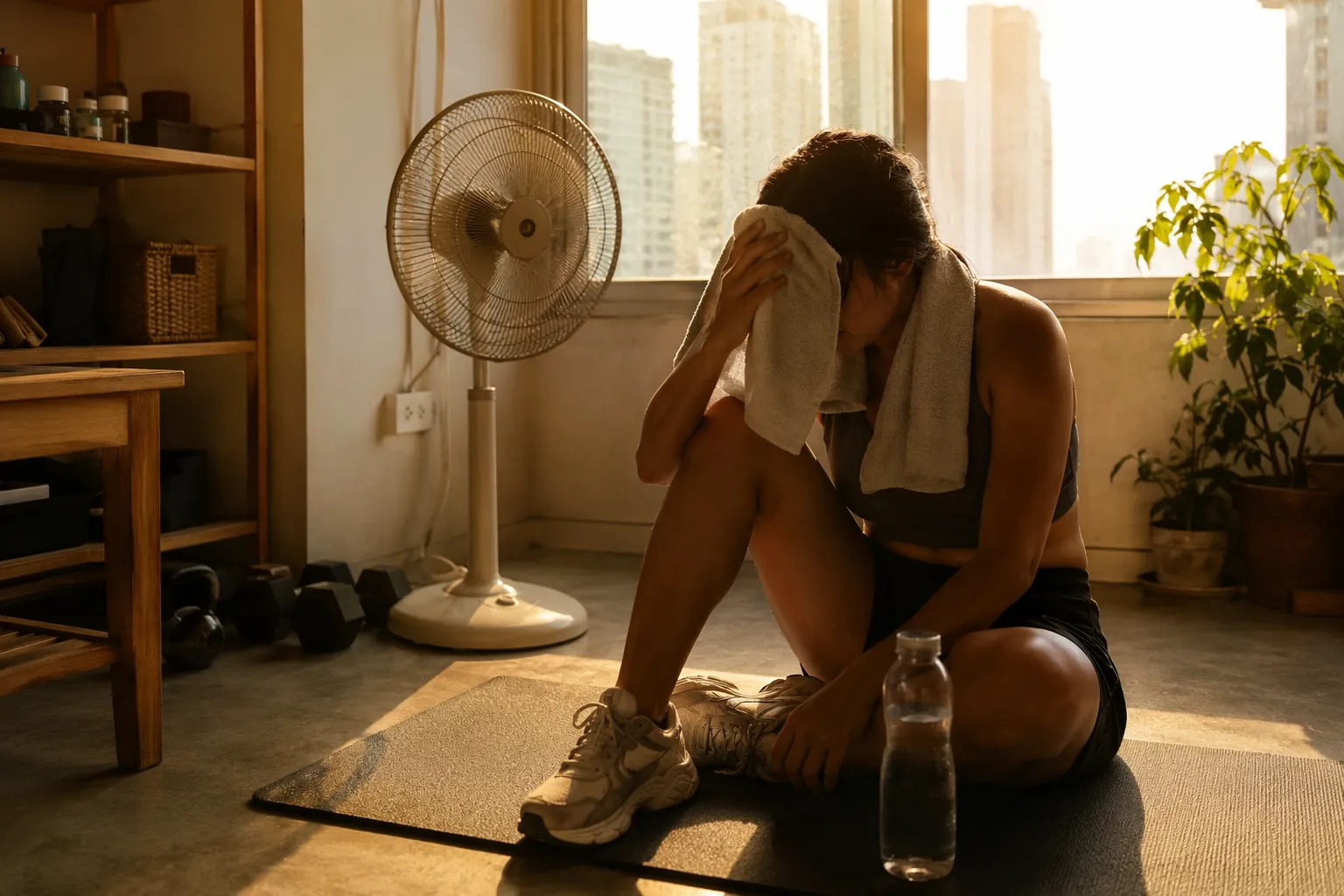
First decide whether today’s room is trainable
Before you touch a dumbbell, check the heat index and humidity for your area and compare it with what the room actually feels like. A room without AC often tracks closer to shaded outdoor conditions than people want to admit, especially if sun has been hitting the building all day. Heat-index categories are not a perfect indoor rule, but they are a useful warning system: around 80°F calls for caution, 90°F and above moves into extreme caution for exercise, and 105°F and above is treated as dangerous for activity outdoors.[2]
Humidity deserves its own vote. Sweat cools you by evaporating, and heavy, wet air slows that down. Cleveland Clinic guidance treats 90°F with relative humidity above 70% as dangerous for exercise, and says that when humidity is above 80% at 80°F, you should move the workout inside rather than keep exercising outdoors.[3] If your “inside” is also a sealed, humid room with no AC, that is not a loophole. It means you need a shorter, easier session—or no session.
Abrupt heat waves require extra humility. Heat acclimatization takes about 7–14 days of regular heat exposure, so the first brutal days of a hot spell are exactly when you should reduce expectations instead of trying to prove you are already adapted.[4] A routine can survive a scaled-back week. It may not survive turning one bad workout into heat illness.
| Decision point | What to do in a no-AC apartment |
|---|---|
| Timing | Train early morning or later evening; avoid the late-afternoon heat load when the room has stored the day’s warmth. |
| Length | Use 10–20 minutes as the default heat-wave session, not as a failure version of the real workout. |
| Intensity | Keep effort around RPE 5–7. You should be working, not bargaining with dizziness. |
| Movement choice | Favor lower-impact strength, mobility, controlled circuits, and longer rests over jump-heavy conditioning. |
| Cooling | Move air across the room, pre-cool your skin, and keep cold towels ready before the workout starts. |
| Hydration | Drink on a schedule before and during the session instead of waiting for thirst. |
| Stop rule | Stop immediately for nausea, dizziness, headache, confusion, or stopped sweating. |
Change the workout before the heat changes it for you
The easiest mistake is keeping the normal plan and promising to “listen to your body” later. In a hot room, later arrives quickly. Make the heat-wave version before you start: choose the cooler window, cut the volume, cap the effort, and remove the movements that spike your temperature fastest.
Morning is usually the better bet in an apartment because the walls, floors, and furniture have had overnight hours to release heat. Evening can work if your room actually cools down after sunset. Late afternoon is often the worst indoor training window because the outdoor peak and the building’s stored heat meet each other. If your only available time is 5 p.m. in a west-facing room, treat that as a different workout category, not as the same routine at an inconvenient hour.
A 10–20 minute session is not just “better than nothing.” In extreme heat, it is a legitimate programming choice. You are preserving the habit, getting some movement, and limiting how long your body has to manage rising heat load. That matters more than finishing every accessory exercise you wrote down on a cooler day.
Use RPE 5–7 and stop chasing normal numbers
Rate of perceived exertion is useful here because the same weight can cost more in heat. Aim for RPE 5–7: moderate to moderately hard, with enough control that you could stop cleanly, drink, and cool down without feeling like the room is spinning. This is not the day to match your best density circuit, add a finisher, or turn every rest break into planks.
If you usually do a dumbbell circuit, keep the basic pattern but change the stress. Goblet squats can become slower bodyweight squats. Jumping lunges can become reverse lunges. Burpees can become incline step-backs. Mountain climbers can become dead bugs or marching planks. You do not need a special heat-wave exercise library; you need fewer spikes, more control, and permission to rest before the room makes that decision for you.
A practical small-space template can be very plain:
- 3–5 minutes: easy mobility, breathing, and range-of-motion work.
- 8–12 minutes: two to four lower-impact strength moves, leaving several reps in reserve.
- 2–3 minutes: slow walking in place, stretching, and active cooling.
That may look too simple if you are used to measuring success by sweat, soreness, or total exercises completed. During a heat wave, those are sloppy metrics. The better question is whether you finished feeling steadier than when you started.
Set up airflow before you warm up
A fan pointed at your face feels good, but a single fan in a sealed room mostly moves hot air around. If you have two openings and two fans, create a path: one fan pulls cooler air inward from a window or doorway, while the other pushes warmer indoor air out through the opposite side. Home-gym cooling guidance commonly recommends this kind of cross-ventilation setup because it gives the room somewhere to send the heat you and your equipment are adding.[5]
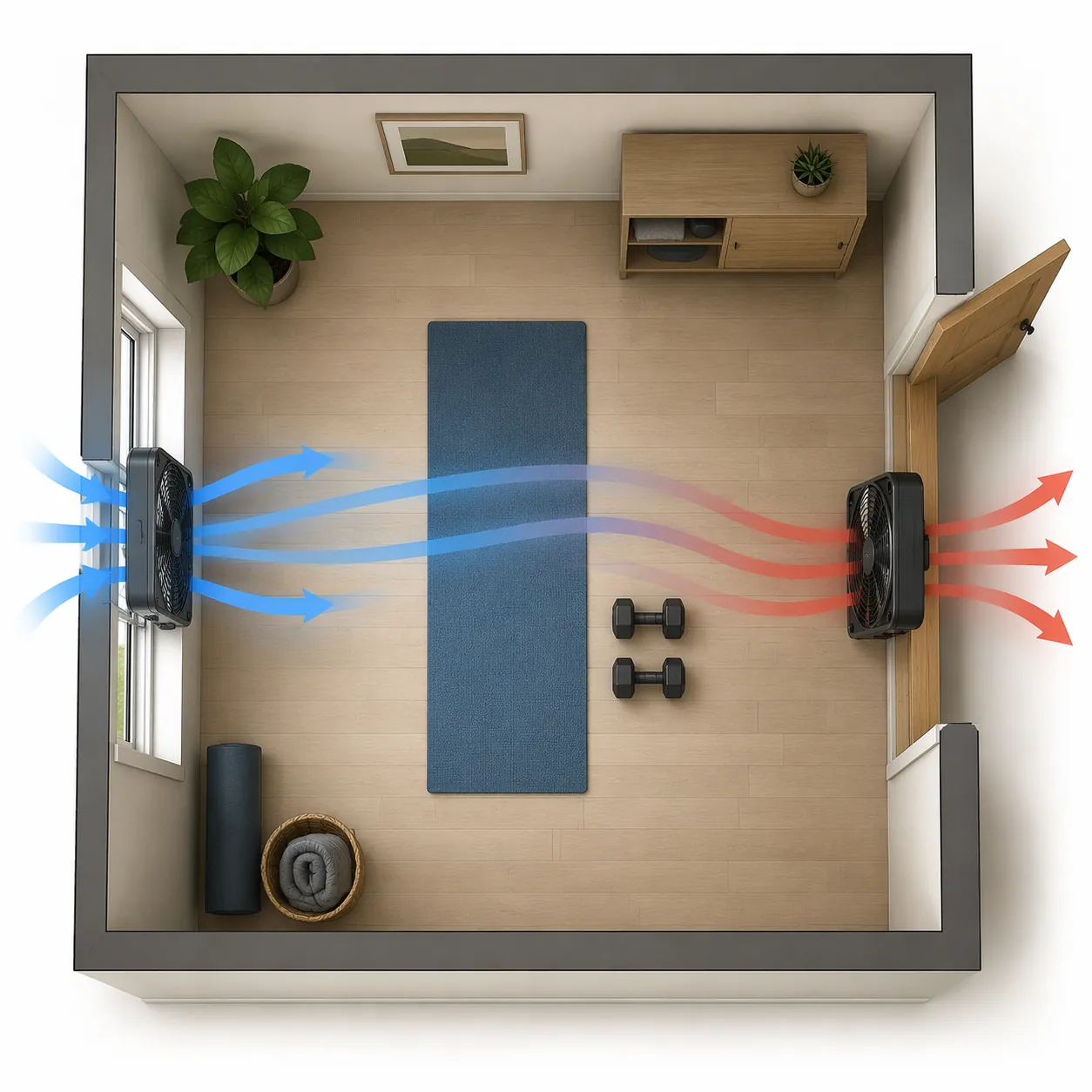
In a small apartment, that may mean one box fan at the window and one standing fan aimed toward the hallway. If the outdoor air is hotter than the indoor air during the afternoon, do not invite it in just because a diagram says “window.” Wait for the cooler window of the day, use curtains or blinds against direct sun, and move the workout closer to the airflow path without blocking exits or tripping over cords.
If the room is humid, a dehumidifier can help the air feel less oppressive even when it does not dramatically lower the temperature. The useful part is evaporation: drier air lets sweat do more of the cooling job it is supposed to do.[3][5] This is not a command to buy another appliance. It is a way to judge whether the one you already own is worth running before a short session.
Pre-cool like you mean to keep the session short
Pre-cooling is not fancy recovery culture. It is giving yourself a small buffer before your core temperature climbs. Cold water on the forearms and hands, or an ice slurry before exercise, can help increase that buffer in hot conditions.[1][4] In apartment terms, that can be as basic as running cool water over your forearms, holding a cold bottle, or drinking a cold blended ice drink before you start if your stomach tolerates it.
Keep a damp towel in the refrigerator or freezer and use it on the neck and wrists during rests. Those areas have high blood flow near the skin surface, which is why cold towels there can help cool the body efficiently.[6] Do this before you feel desperate. If the towel only appears after you are nauseated or confused, it is no longer a workout tool; it is part of stopping.
A heat-wave rest break can look like this: step away from the mat, sit or stand still, put the cold towel on your neck, drink, and let your breathing come back down before the next set. There is no prize for pacing the room pretending that rest does not count.
Hydrate on a schedule, not a vibe
Thirst is a late and inconsistent project manager. For hot-weather exercise, ACSM/NATA-aligned guidance commonly recommends drinking 16–20 ounces, or about 500–600 mL, of fluid 2–3 hours before exercise, then 7–10 ounces, or about 200–300 mL, every 10–20 minutes during exercise in the heat.[7][8] For a short no-AC home session, that means your water bottle should already be filled and within reach before the warmup begins.
| When | Fluid target | Apartment-workout translation |
|---|---|---|
| 2–3 hours before | 500–600 mL / 16–20 oz | Drink ahead of time if you know you plan to train in a hot room. |
| During the session | 200–300 mL / 7–10 oz every 10–20 minutes | For a 10–20 minute workout, pause at least once to drink instead of waiting until the end. |
| After | Rehydrate based on thirst, sweat, urine color, and how you feel | Keep cooling down; do not jump straight into a hot shower or chores in the same overheated room. |
During exercise in heat, an average sweat rate is often estimated around 1 liter per hour, though individual sweat rates vary widely.[9] That is one reason the 10–20 minute cap is useful: it limits how long you are losing fluid and accumulating heat. It does not make hydration optional. A short workout in a hot, humid room can still leave you lightheaded if you start dry and never pause.
If you want a deeper breakdown of timing your water breaks during ordinary sessions, use this as a companion plan: when to drink water during your home workout routine. In a heat wave, the difference is that the water break is not a nice optimization. It is part of the safety structure.
A workable no-AC heat-wave session
Use this as a pattern, not a prescription. The point is to keep the rhythm of training without pretending the environment is neutral.
| Block | Time | What to do |
|---|---|---|
| Room check | Before starting | Check heat index and humidity, open the safest airflow path, place water and cold towel within arm’s reach. |
| Pre-cool | 2–5 minutes | Cool forearms or hands with cold water; put a cold towel on neck or wrists while setting up. |
| Warmup | 3 minutes | Easy mobility: cat-cow, shoulder circles, hip hinges, marching in place. |
| Strength circuit | 8–12 minutes | Choose 2–4 controlled moves such as bodyweight squats, incline pushups, dead bugs, glute bridges, rows, or light dumbbell Romanian deadlifts. |
| Rest and drink | Every round or every few minutes | Sip water, use the cold towel, and keep the effort at RPE 5–7. |
| Cooldown | 2–3 minutes | Walk slowly, breathe, stretch lightly, and stay near airflow until you feel settled. |
If you use weights, reduce load before form degrades. If you train bodyweight, reduce speed before breathing becomes frantic. If you follow a video, ignore the instructor’s pace when your room is hotter than theirs. Pause the video. Skip the finisher. Let the session be boring enough to be repeatable.
When the safe workout is no workout
There are days when the routine is protected by not training. If the room is still hot and humid after you have changed the timing, opened airflow, shortened the plan, and prepared water, you do not owe the workout another negotiation. Switch to gentle mobility in a cooler spot, walk later if conditions improve, or postpone.
Stop immediately if nausea, dizziness, headache, confusion, or stopped sweating appears. These are not “monitor and see” details; they are heat-illness warning signs.[10] Mass General Brigham also flags symptoms such as dizziness, muscle cramps, nausea, headache, and weakness as signs of overheating during activity.[2] End the session, move to a cooler place if possible, cool the body, drink if you can do so safely, and seek medical help for severe or worsening symptoms.
The goal is not to prove you can work out in extreme heat. The goal is to make a safe decision each day. If finishing requires pushing through warning signs, the safe workout is the one you postpone.
References
- How to keep exercising when it's really hot — BBC Future, 2026
- Prevent Overheating During Workouts — Mass General Brigham
- Should You Exercise When It’s Hot? — Cleveland Clinic
- Heat Acclimatization — Korey Stringer Institute, University of Connecticut
- Garage Gym Cooling: Summer Workout Tips — RitFit Sports
- How to heat-proof your summer workout — NPR
- How to Stay Active in Warm Weather — American Heart Association
- Exercise Safely in Hot Weather — Academy of Nutrition and Dietetics
- Exercising in the Heat — Peloton
- Protect Yourself From the Dangers of Extreme Heat — CDC
What a small equipment investment adds
We don't have a build tagged to this exact tier yet. Browse all builds.
How often should you repeat this?
See our recovery and rest reference for citation-anchored rest-interval guidance.
Spot something off?
Tell us if a movement, tier assumption, or duration didn't match your experience.