
What the GLP-1 Home Fitness Warning Actually Means
Headlines about GLP-1 drugs and home fitness sound alarming, but the Wegovy FDA label actually lists increased physical activity as part of the treatment. This reference explains what the warning really targets — lean-mass loss during rapid weight loss — why home strength training is the evidence-backed countermeasure, and when to stop and contact a clinician.
- Citation source
- ACSM; CDC; FDA
- Evidence level
- General guideline with evidence review
- Recommended frequency
- 2–3 resistance-training sessions/week; 150 min/week moderate aerobic
A headline about a “GLP-1 home fitness warning” sounds like it should mean one thing: be careful exercising at home if you take semaglutide or tirzepatide. That is too blunt. The FDA-approved Wegovy label does not frame exercise as the problem; it says Wegovy is indicated “as an adjunct to a reduced calorie diet and increased physical activity” for chronic weight management in specified patients [1].
That label language matters because it separates two issues that often get blended together. One issue is medication safety, including FDA concerns about unapproved or compounded GLP-1 products, dosing errors, and handling or storage problems; that belongs in a medication-sourcing and clinician/pharmacist lane, not in a home-workout lane [2]. The other issue is body composition during rapid weight loss: when weight drops quickly, some of the loss can come from lean tissue. That second issue is the one a home exerciser can actually plan around.

So the useful question is not, “Is home exercise unsafe on a GLP-1?” It is: “Is today’s workout scaled to your symptoms, food intake, and muscle-preservation needs?” For most people, the warning points toward more deliberate strength training and protein, not toward avoiding exercise.
The lean-mass concern is real, but the numbers are not interchangeable
Lean mass is not a perfect synonym for “working muscle.” DXA and MRI substudies can capture lean tissue changes, but they do not automatically tell you whether a person became frail, lost strength, or lost daily function. That distinction is important because the strongest GLP-1 body-composition data come from substudies and reviews with different drugs, doses, durations, populations, and measurement methods.
| Source | What it reports | How to read it |
|---|---|---|
| Rossi et al. 2025, STEP-1 DXA substudy | In a STEP-1 DXA substudy of 140 participants, roughly 30–34% of weight lost was reported as lean tissue [3]. | Useful trial-level signal, but still a small body-composition substudy rather than a strength or function trial. |
| Rossi et al. 2025, SURMOUNT-1 DXA substudy | In a SURMOUNT-1 DXA substudy of 160 participants, about 25% of weight lost was lean mass, with lean mass decreasing by 10.9% [3]. | A tirzepatide-specific substudy; it should not be collapsed into the semaglutide figure as if every GLP-1 produces the same body-composition result. |
| Rogers 2024, ACSM’s Health & Fitness Journal | The review describes lean-mass losses in the 25–40% range during anti-obesity medication weight loss [4]. | A review range, not one universal percentage for every patient. |
| Codella et al. 2025 | The review gives a 15–40% range for lean-mass contribution during weight loss [5]. | A wider evidence synthesis; the range is a reason to individualize prevention, not to assume worst-case loss. |
| CNN/Neeland 2025 reporting | CNN cites a still wider 15–60% range in a strength-training context [9]. | This is the broadest cited range here and should be read as context-dependent, not as the most likely outcome for a home exerciser. |
| Hinge Health citing Prado/Lancet framing | Hinge Health describes lean-mass loss as up to 39% in its second-party discussion of GLP-1s and exercise [10]. | Useful clinician-facing framing, but it is not a substitute for the underlying trial methods. |
Those figures are worth seeing, but not as a stack of frightening percentages. A 25% share of weight lost as lean mass in one substudy, a 30–34% share in another, and a 15–60% review or media range are not the same claim. They differ because the studies did not all measure the same medication, dose, time window, baseline body composition, or endpoint.
Rossi et al. also point out a detail that often gets lost: in SURPASS-3 MRI findings, muscle quality and fat infiltration could improve even while lean mass decreased [3]. That does not make lean-mass loss irrelevant. It does mean a scan-based lean-mass number should not be treated as proof that every pound lost was a pound of useful contractile muscle taken away.
The same review notes that many trials lack standardized strength and function endpoints, leaving the clinical meaning of some lean-mass losses incompletely defined [3]. That is the most honest reading of the evidence: lean-mass loss is documented enough to plan against, but the evidence does not support the idea that exercise itself is the danger.
Who should be more careful about muscle loss
The people who need the most deliberate plan are not necessarily the people doing home workouts. They are the people most likely to lose function if lean tissue drops faster than strength is rebuilt.
- Adults in older age groups, especially those already worried about strength, balance, or independence.
- People starting with low baseline muscle or long periods of inactivity.
- People losing weight rapidly, particularly if appetite suppression makes meals irregular.
- People who are not getting enough protein because nausea, fullness, or food aversion has changed what they can tolerate.
- People who stop resistance training because they assume weight loss alone is the whole treatment.
Protein intake is not a side issue here. Rossi et al. cite Johnson et al. 2025 in noting that only 43% of participants reached a protein target in that context [3]. The exact target can vary, but the practical problem is familiar: a smaller appetite can make “just eat enough” surprisingly hard.
For readers over 50 or 65, the muscle-preservation question deserves extra attention. The same basic home-training tools still apply, but the margin for drifting into low protein and low strength work is smaller. Our guide to home-training protein after 50 covers that narrower situation without turning it into a bodybuilding plan.
The countermeasure is boring in the best possible way: lift, eat, repeat
CDC adult activity guidance still uses the familiar baseline: at least 150 minutes a week of moderate-intensity aerobic activity plus muscle-strengthening activities on 2 or more days a week [6]. In the GLP-1 context, the strength part moves from “nice to have” to “directly relevant,” because it is the part that tells the body to keep useful tissue while weight is dropping.
Rogers translates that into roughly 2–3 resistance-training sessions per week, totaling about 60–90 minutes, alongside aerobic work [4]. That is not a huge gym commitment. At home, it can be adjustable dumbbells, resistance bands, a backpack, or bodyweight progressions, as long as the exercises are loaded enough to feel like training rather than movement decoration.
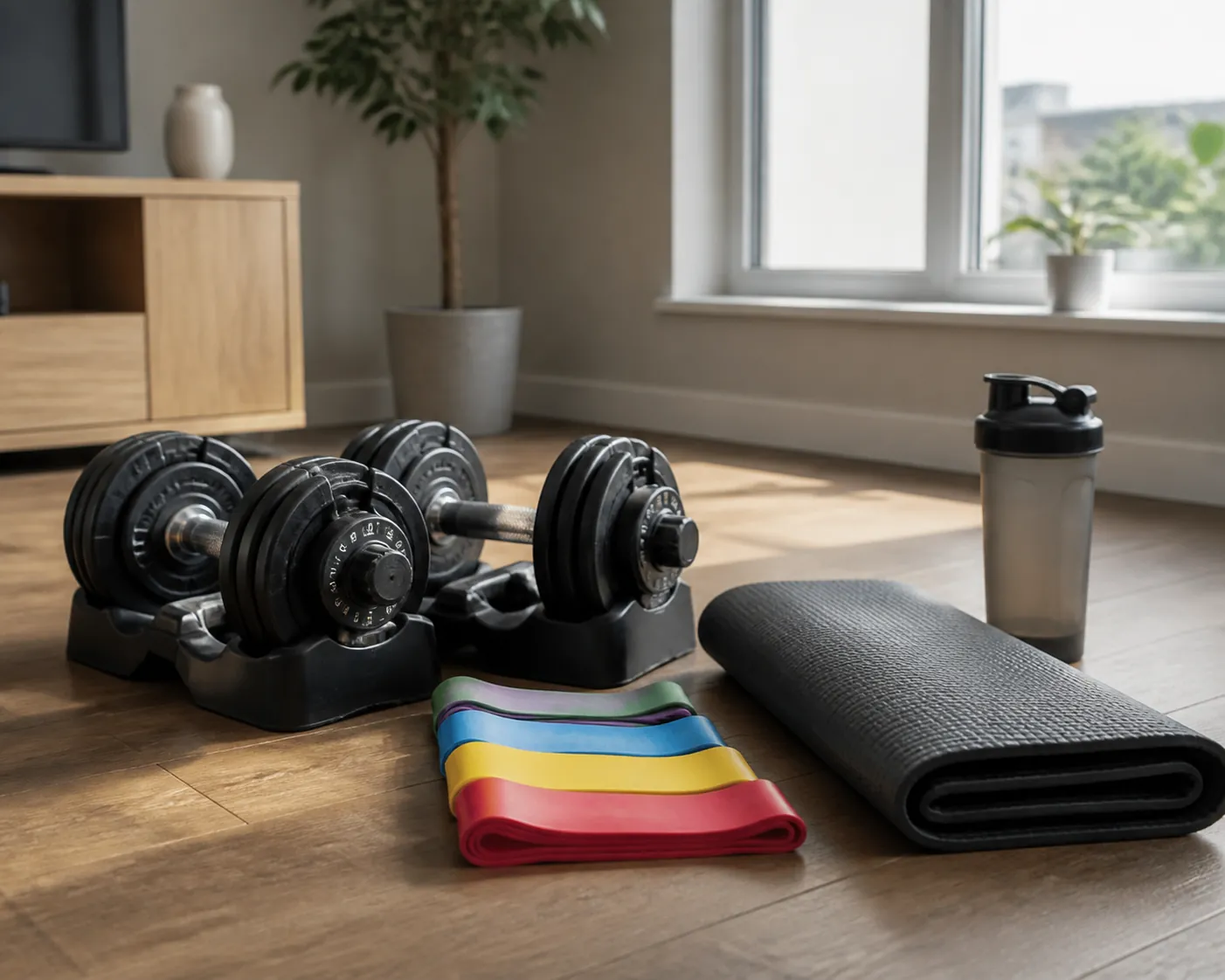
A practical home week can stay simple:
- Two or three strength sessions built around squat or sit-to-stand, hip hinge, push, pull, carry, and a trunk-stability exercise.
- Moderate aerobic work spread through the week: brisk walking, low-impact intervals, cycling, step-ups, or another option that does not aggravate nausea or dizziness.
- An easier version ready for low-appetite days, such as one set per movement instead of three, lighter loads, or more rest between sets.
- Progression only when food, fluids, and symptoms are steady enough to make the session safe.
Cleveland Clinic makes the same general point in clinician-facing language: exercise can help people taking GLP-1 medications preserve muscle, manage side effects, and support long-term weight maintenance [7]. Mass General Brigham similarly emphasizes starting small and adjusting activity to current tolerance rather than treating medication use as a reason to stay sedentary [8].
If you want the CDC-style baseline turned into a small-space plan, the health-expert consensus on weight-loss home workouts is the better place to build the week. The question here is narrower: deciding whether the warning changes the role of training. It does not. It changes how intentional the training needs to be.
Protein targets are ranges, not commandments
Protein advice around GLP-1 use is usually given as a range because body size, age, kidney history, total calories, training status, and tolerance all matter. In the sources reviewed here, common frames include about 1.2–1.6 grams per kilogram in muscle-preservation discussions, Stanford Medicine’s roughly 0.5–0.7 grams per pound framing, and a clinician-cited 60–75 grams per day target discussed by Hinge Health [10][11].
The safest way to use those numbers is not to pick the biggest one and force it through nausea. It is to make protein visible in the day: a protein-containing breakfast if tolerated, a shake when solid food is unappe représentationaling, Greek yogurt or eggs when cooking is too much, beans or tofu if that fits your diet, and a protein-centered dinner before the day disappears. Our protein floor guide for people eating less is a useful companion if reduced appetite is colliding with strength training.
This is also where a home routine can outperform vague wellness advice. You can see whether the dumbbells are getting heavier, whether the chair squat feels steadier, whether the band row is easier to control, and whether a low-energy day is just a lighter day rather than a skipped week.
What to do on the day you feel off
The home-gym problem is that there is no front desk, coach, or class instructor watching you turn pale between sets. That does not make home training unsafe; it means the stop rules need to be decided before the workout starts.
| How you feel today | Reasonable home-training decision |
|---|---|
| Appetite is lower, but you are not dizzy and can drink fluids. | Keep the session, but shorten it, use lighter loads, and avoid turning it into a personal-record day. |
| You recently changed dose or have had a rough GI day. | Start with a warm-up and one easy set per movement; stop if symptoms rise instead of settling. |
| You feel nauseated enough that bending, bracing, or lying down feels unsafe. | Skip loaded training and contact your clinician if nausea is interfering with safe movement or normal intake. |
| You feel dizzy, faint, unusually shaky, confused, sweaty, weak, or suspect low blood sugar. | Stop the workout and contact a clinician; do not try to “push through” a loaded home session. |
| You have trouble breathing or symptoms that feel urgent. | Stop exercising and seek medical help. |
Cleveland Clinic and Mass General Brigham both frame exercise during GLP-1 use as something to scale to the person’s current symptoms and tolerance, especially when nausea, low intake, or energy changes are present [7][8]. That is the right level of caution here: enough to keep someone from training through obvious warning signs, without pretending the medication label bans exercise.
If your main uncertainty is how to raise this with a doctor or prescribing clinician, use a concrete script rather than a vague fear: “My appetite is lower, I’m trying to strength train two or three days a week, and I’m worried about dizziness and protein intake. Are there symptoms or intake thresholds you want me to follow?” Our guide to how to discuss a weight-loss home routine can help turn that conversation into specifics.
What the warning actually means
Read the warning this way: GLP-1-associated weight loss can include meaningful lean-mass loss, especially when the person is older, under-muscled, inactive, losing quickly, or eating too little protein. That is a muscle-preservation problem. The FDA label’s own wording keeps physical activity inside the treatment plan, and the exercise literature points toward resistance training as the practical countermeasure [1][4].
For a home exerciser, that leaves a clear decision. Keep training if symptoms are manageable and the plan is scaled. Start smaller if appetite, dose changes, or energy have shifted. Prioritize two or three strength sessions a week and enough protein to support them. Stop and contact a clinician when dizziness, unsafe nausea, trouble breathing, or low-blood-sugar signs appear.
The warning is not “do not exercise on a GLP-1.” It is “do not let rapid weight loss happen without a muscle plan.”
References
- WEGOVY (semaglutide) injection, for subcutaneous use prescribing information — U.S. Food and Drug Administration, 2025
- FDA’s Concerns with Unapproved GLP-1 Drugs Used for Weight Loss — U.S. Food and Drug Administration
- Rossi et al. 2025 Acta Diabetologica review — Acta Diabetologica, 2025
- Rogers 2024 ACSM’s Health & Fitness Journal article — ACSM’s Health & Fitness Journal, 2024
- Codella et al. 2025 review — 2025
- Adult Activity: An Overview — Centers for Disease Control and Prevention
- Exercise for GLP-1 Use — Cleveland Clinic
- Fitness for People Taking GLP-1 Agonists — Mass General Brigham
- GLP-1 medications can lead to muscle loss. Here’s how strength training can help — CNN, 2025
- Ozempic and Exercise: How to Work Out While Taking GLP-1s — Hinge Health
- GLP-1s 101: What to Know About Weight Loss, Side Effects and Safe Use — Stanford Medicine, 2026
This is general fitness education, not medical advice. For diagnosis or treatment of pain or injury, consult a qualified clinician.
Pick your next session
Browse all routines to find an appropriately-spaced next session.
Spot something off?
This content sits adjacent to health guidance — tell us if a citation or figure needs a correction.