
Does Eating Less Protein Slow Muscle Gains at Home?
Eating less protein at home won't ruin your workout — but drop below roughly 1.2 grams per kilogram of body weight per day and the same training builds measurably less muscle. The evidence-backed answer covers the RDA floor, the 1.6 g/kg/day plateau, and why your training still outweighs your protein intake.
- Citation source
- International Society of Sports Nutrition; British Journal of Sports Medicine
- Evidence level
- Restrained inference from meta-analysis
If the question is “does eating less protein affect muscle building at home,” the honest answer is yes — but not in the catastrophic way fitness content often makes it sound. Your push-ups, band rows, split squats, dumbbell presses, and awkward living-room sets are not wasted because dinner was low-protein. The more accurate answer is that the same training probably builds less muscle when protein stays low, especially once intake drops below the active-person range.
Here are the useful numbers before anything gets overcomplicated: 0.8 grams of protein per kilogram of body weight per day is the U.S. RDA, and it is described as a minimum for preventing lean-mass loss in sedentary adults, not a muscle-building target. Active-person recommendations commonly sit around 1.2–2.0 g/kg/day, while the International Society of Sports Nutrition position stand gives 1.4–2.0 g/kg/day for people doing strength and power training. A practical muscle-building target is roughly 1.6 g/kg/day, because the strongest meta-analysis found that extra protein stopped adding much additional fat-free-mass benefit beyond about 1.62 g/kg/day. [1][2][3]
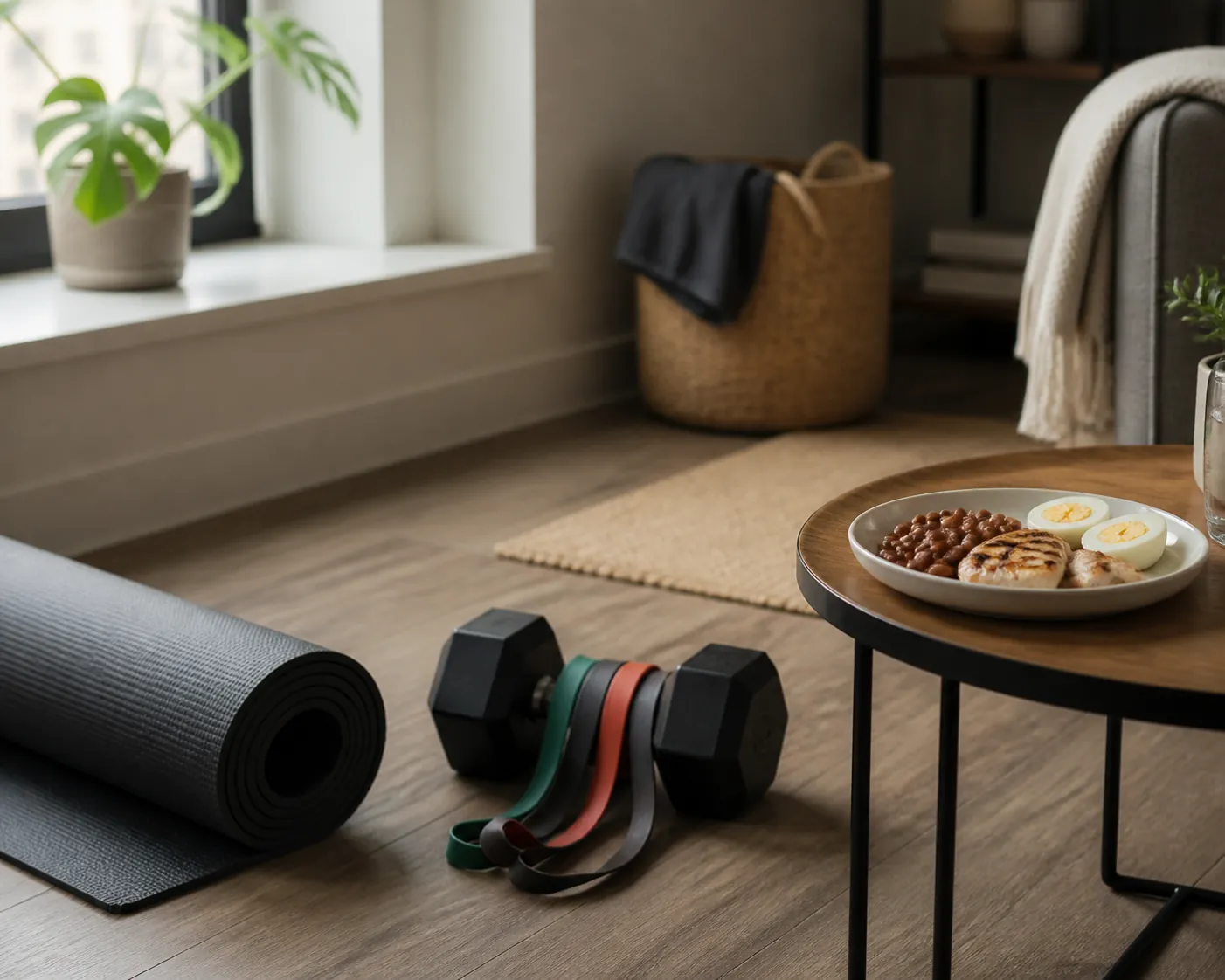
What “less protein” means in body-weight terms
“Less protein” is too vague to be useful. Less than a bodybuilder eats is not the same thing as less than your muscles can use. For a home trainee trying to gain muscle, the difference between 0.8, 1.2, and 1.6 g/kg/day is the difference between a sedentary floor, a reasonable lower edge for active training, and a strong practical target.
| Body weight | 0.8 g/kg/day | 1.2 g/kg/day | 1.6 g/kg/day |
|---|---|---|---|
| 130 lb / 59 kg | About 47 g/day | About 71 g/day | About 94 g/day |
| 160 lb / 73 kg | About 58 g/day | About 87 g/day | About 116 g/day |
| 190 lb / 86 kg | About 69 g/day | About 103 g/day | About 138 g/day |
| 220 lb / 100 kg | About 80 g/day | About 120 g/day | About 160 g/day |
That table is often more helpful than a debate about “high protein.” If a 160-pound person is eating 70 grams per day, they are not protein-free; they are just below the active range. If they are eating 110–120 grams per day, they are already close to the practical target. The cost of being low is usually slower progress, not a failed workout.
Training at home does not lower the protein target
There is one important limitation: the protein studies used here are not home-workout-specific trials. They are resistance-training studies, usually conducted in more controlled or gym-like settings. Applying them to home training is an inference from the biology of resistance exercise, not proof from a randomized trial run in apartments.
That inference is still reasonable. Muscle does not know whether tension came from a barbell, a pull-up bar, a loaded backpack, a dumbbell, a resistance band, or a slow single-leg squat. The protein need follows the training stress: how hard the muscle works, how much volume you do, how close sets get to failure, and how much muscle is being challenged. A light routine that never gets difficult will not create the same demand as hard progressive training. But if the home workout is truly resistance training, the protein math does not get discounted because it happened next to a couch.
That matters for people training with limited equipment. The first problem is usually not that home training is metabolically special. It is that home training can become too easy unless you deliberately progress it: more reps, harder variations, slower eccentrics, shorter rest, added load, or better exercise selection. If the workout is challenging enough to ask muscle to adapt, the nutrition question becomes the same one gym trainees face: are you giving the body enough protein to make the most of that signal?
The dose-response curve is real, but it is not a cliff
The cleanest single piece of evidence is the 2018 Morton meta-analysis in the British Journal of Sports Medicine. It pooled 49 randomized controlled trials with 1,863 participants and looked at how protein supplementation changed resistance-training gains in muscle mass and strength. On average, adding protein increased fat-free mass by about 0.30 kg and one-repetition-maximum strength by about 2.49 kg. The analysis also found no further fat-free-mass gains beyond a total protein intake of about 1.62 g/kg/day, with a 95% confidence interval of 1.03–2.20 g/kg/day. [3]
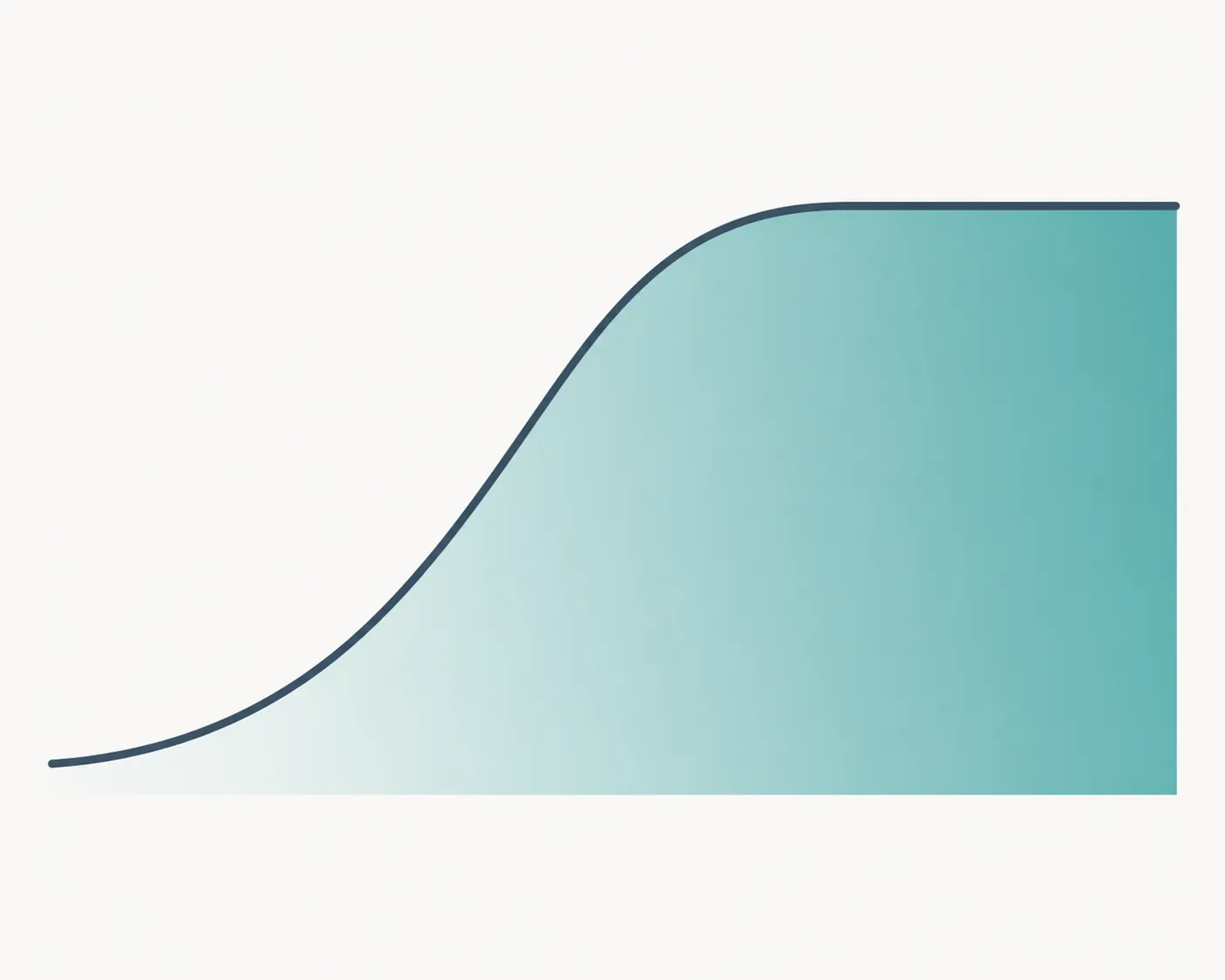
That is the shape most home trainees need to understand. Protein helps. The effect is measurable. But it behaves like a curve that rises and then flattens, not like a pass-fail switch. Going from clearly low protein toward the active range is likely to matter more than forcing intake far above the point where the curve has already flattened.
This is why 1.6 g/kg/day is a useful target rather than a moral test. It is high enough to sit near the point where additional lean-mass benefit appears to plateau in the Morton analysis, but it is not the same as saying every person must hit it every day or gain nothing. Someone averaging 1.3–1.4 g/kg/day while training hard is in a very different situation from someone living at 0.7–0.8 g/kg/day and expecting maximal muscle gain.
The lower boundary is where the practical warning belongs. The RDA-level intake of 0.8 g/kg/day was not designed as an optimal intake for building muscle in active people. For a trainee trying to add muscle, consistently sitting below roughly 1.2 g/kg/day means the same workouts are more likely to produce smaller gains than they would with a better protein base. [1]
Training still does the heavier lifting
The part of the Morton paper that deserves more attention than it usually gets is the comparison between protein’s added effect and the effect of resistance training itself. In the same analysis, resistance training alone produced an average increase of about 27 kg in one-repetition-maximum strength, while protein supplementation added about 2.49 kg on top. The authors described resistance exercise as “a far more potent stimulus” for strength gain than protein supplementation. [3]
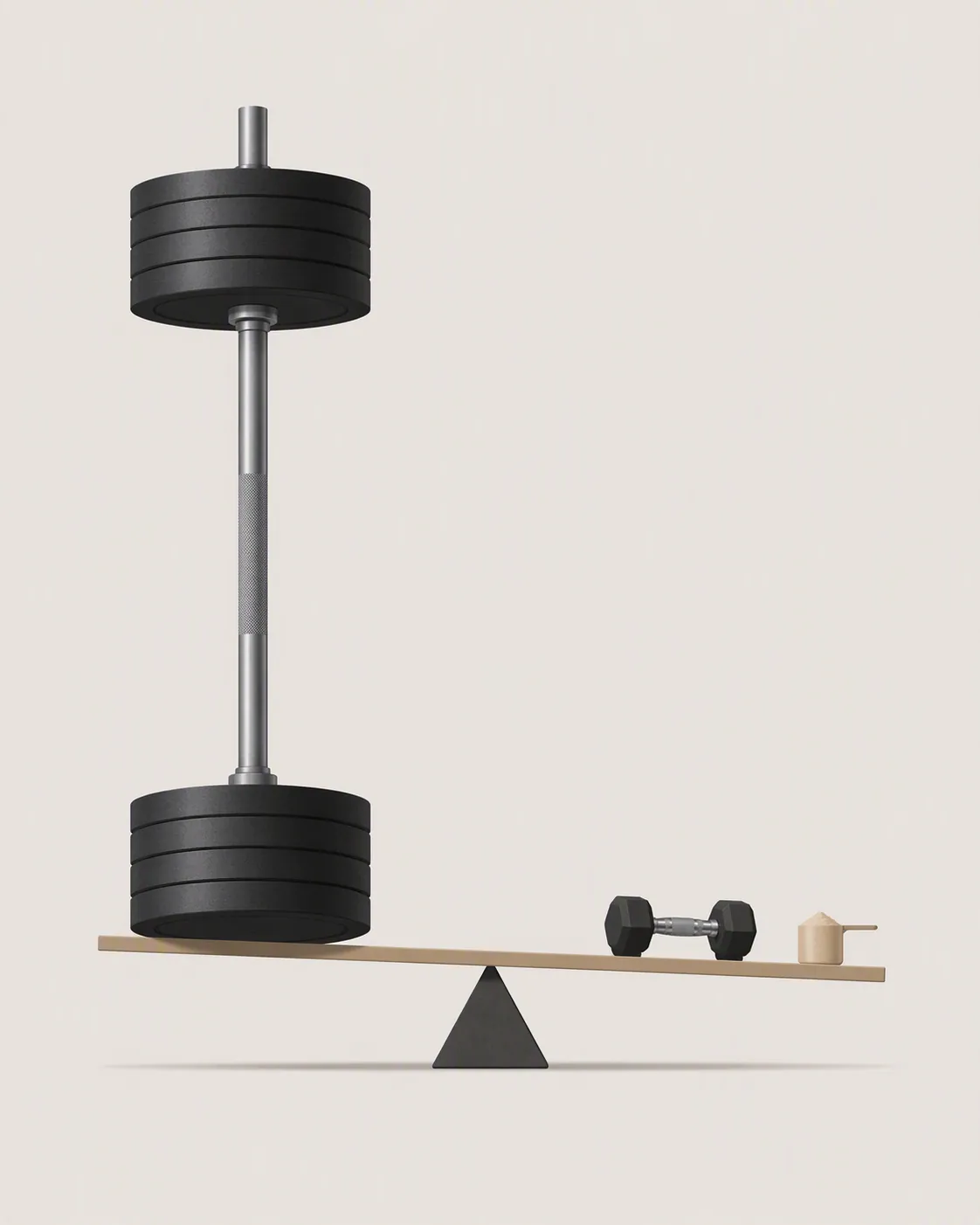
That does not make protein irrelevant. It puts protein in its proper place. Protein helps the body respond to training; it is not a replacement for training. If a home trainee is doing hard sets consistently, adding enough protein improves the return on that work. If protein is imperfect, the training stimulus still exists. The body still practiced force production. Tendons, coordination, skill, work capacity, and muscle fibers still received a reason to adapt.
This is also why the “all or nothing” version of the advice is so unhelpful. A person doing three months of progressive home training while eating below ideal protein is not in the same place as someone who did nothing. They may have left some muscle gain on the table, especially if intake stayed near the sedentary floor, but they did not erase the value of the training.
Protein works best when there is a training signal to use it
A 2022 meta-analysis in the Journal of Cachexia, Sarcopenia and Muscle supports the same general picture, with some caveats. Across 74 randomized controlled trials, added protein combined with resistance exercise produced small lean-mass gains, with a standardized mean difference of 0.22. The benefit was significant only in participants under 65 years and at protein intakes of at least 1.6 g/kg/day. Protein without resistance exercise showed no significant lean-mass effect. [4]
That review had industry-related funding and author employment disclosures, so it should not carry the whole argument by itself. It does, however, point in the same direction as the Morton analysis: extra protein is most useful when paired with resistance training, and the clearer benefits show up at higher total daily intakes rather than at the sedentary floor. [3][4]
The narrow lesson is important. You do not drink a shake and grow muscle because protein is magical. You train, the body receives a signal to repair and build, and adequate protein gives that process more material to work with. Without the training signal, extra protein is much less impressive.
Meal timing helps mostly because it helps you reach the day’s total
Protein timing is worth caring about only after the daily amount is no longer a mystery. Schoenfeld and Aragon’s review suggested that a practical way to reach 1.6 g/kg/day is about 0.4 g/kg per meal across at least four meals. Their broader point is more useful than obsessing over a narrow post-workout window: total daily protein is the main target, and distribution is a tool for reaching it. [5]
For a 160-pound person, that might mean spreading the day across several protein-containing meals instead of trying to fix the whole problem at 10 p.m. For someone with a small appetite, it may mean breakfast needs some protein instead of being only coffee and toast. For someone who eats mostly plant-based meals, it may mean making the protein source more deliberate. None of that requires turning every meal into a fitness-influencer plate.
What to do if you are currently below the target
Start by estimating where you already are. If your rough average is near 1.6 g/kg/day, chasing more protein is probably not the highest-return move. Put that energy into better training progression, sleep, consistency, and enough total food. If you are around 1.2–1.5 g/kg/day, you may be close enough that a small meal adjustment is all you need. If you are usually below 1.2 g/kg/day, that is where adding protein becomes a more meaningful lever.
- If training is consistent but meals are low-protein, add one reliable protein serving before redesigning your whole diet.
- If appetite is the issue, use easier textures or smaller portions more often instead of forcing one huge meal.
- If budget is the issue, prioritize repeatable staples over specialty products.
- If cooking fatigue is the issue, choose one or two default meals you can tolerate on busy days.
A protein powder can help close a gap, but it is not biologically required. It is just food in a convenient form. If you like shakes, a guide such as Do You Need a Post-Workout Protein Shake at Home? is more useful when it treats the shake as a convenience, not a ritual. Whole-food options can do the same job: eggs, dairy, beans, lentils, tofu, tempeh, chicken, fish, lean meat, or mixed meals that are simply built with enough protein in them.
If you need practical meal ideas rather than another lecture, something like high-protein tuna salad or a batch-friendly meal such as quick spicy rigatoni as post-workout meal prep can be more realistic than trying to eat plain chicken breast out of obligation. Alternative sources can work too; the question is total protein and food quality, not whether the source looks like standard gym food. For example, insect protein for muscle building at home is one of many ways to think beyond the usual whey-versus-chicken framing.
What the older-adult and no-training studies can — and cannot — tell you
Two side pieces of evidence are useful, but only if kept in their lane. A Harvard Health summary of a 2018 JAMA Internal Medicine trial reported that extra protein did not build more muscle in older men with an average age of 73 when there was no resistance-training program. That supports the point that protein without a training stimulus is weak evidence for muscle gain; it does not show that protein is unimportant for people who are actually training. [6]
The Castaneda study discussed by USDA ARS is also easy to overread. It involved older adults with moderate renal insufficiency on a prescribed low-protein diet of 0.64 g/kg/day, and resistance training helped prevent muscle loss in that context. That is encouraging evidence that training stimulus can matter even when protein is low, but it is not a general recommendation for healthy home trainees to live on very low protein. [7]
For anyone with a diagnosed medical condition that affects protein intake, general sports-nutrition targets are not the right authority. That is clinician territory. For a healthy home trainee trying to build muscle, though, the practical target remains much simpler: train progressively, get somewhere near the active protein range, and stop treating one imperfect day as proof that the work did not count.
The restrained answer
Eating less protein does affect muscle building at home when “less” means consistently below what active resistance training can use. The clearest target is about 1.6 g/kg/day, because that is where additional protein appears to stop adding much lean-mass benefit in the best available dose-response evidence. Try not to live below about 1.2 g/kg/day if building muscle is the goal. [1][3]
But keep training when protein is imperfect. Lower protein can slow progress; it does not erase the stimulus from hard sets. If you need a better training plan to make that stimulus stronger, a home routine such as Arnold Schwarzenegger’s home workouts for any budget belongs on the same priority list as improving protein.
References
- Dietary Protein and Muscle Mass: Translating Science to Application and Health Benefit — Nutrients, 2019.
- International Society of Sports Nutrition Position Stand: protein and exercise — Journal of the International Society of Sports Nutrition, 2017.
- A systematic review, meta-analysis and meta-regression of the effect of protein supplementation on resistance training-induced gains in muscle mass and strength in healthy adults — British Journal of Sports Medicine, 2018.
- Systematic review and meta-analysis of protein intake to support muscle mass and function in healthy adults — Journal of Cachexia, Sarcopenia and Muscle, 2022.
- How much protein can the body use in a single meal for muscle-building? Implications for daily protein distribution — Journal of the International Society of Sports Nutrition, 2018.
- Extra protein does not build more muscle — Harvard Health, 2018.
- Exercise Prevents Muscle Loss From Low-Protein Diets — USDA Agricultural Research Service, 2002.
This is general fitness education, not medical advice. For diagnosis or treatment of pain or injury, consult a qualified clinician.
Pick your next session
Browse all routines to find an appropriately-spaced next session.
Spot something off?
This content sits adjacent to health guidance — tell us if a citation or figure needs a correction.