
How to Know If a Home Workout Is Safe During a Heat Wave
Wondering if you can safely work out at home during a heat wave — and if so, how much? This guide turns the day's HeatRisk level plus your room's measured temperature and humidity into a clear train, scale, or skip decision, including the indoor rules most heat-wave tips leave out.
- Citation source
- CDC
- Evidence level
- General guideline
The workout decision starts before the warmup. Not with motivation, not with whether the dumbbells are already out, and not with the fact that you are technically “indoors.” During a heat wave, the room itself is part of the workout load. A sealed bedroom, a sun-facing studio, or a living room with one tired fan can be a very different training space from an air-conditioned home gym.
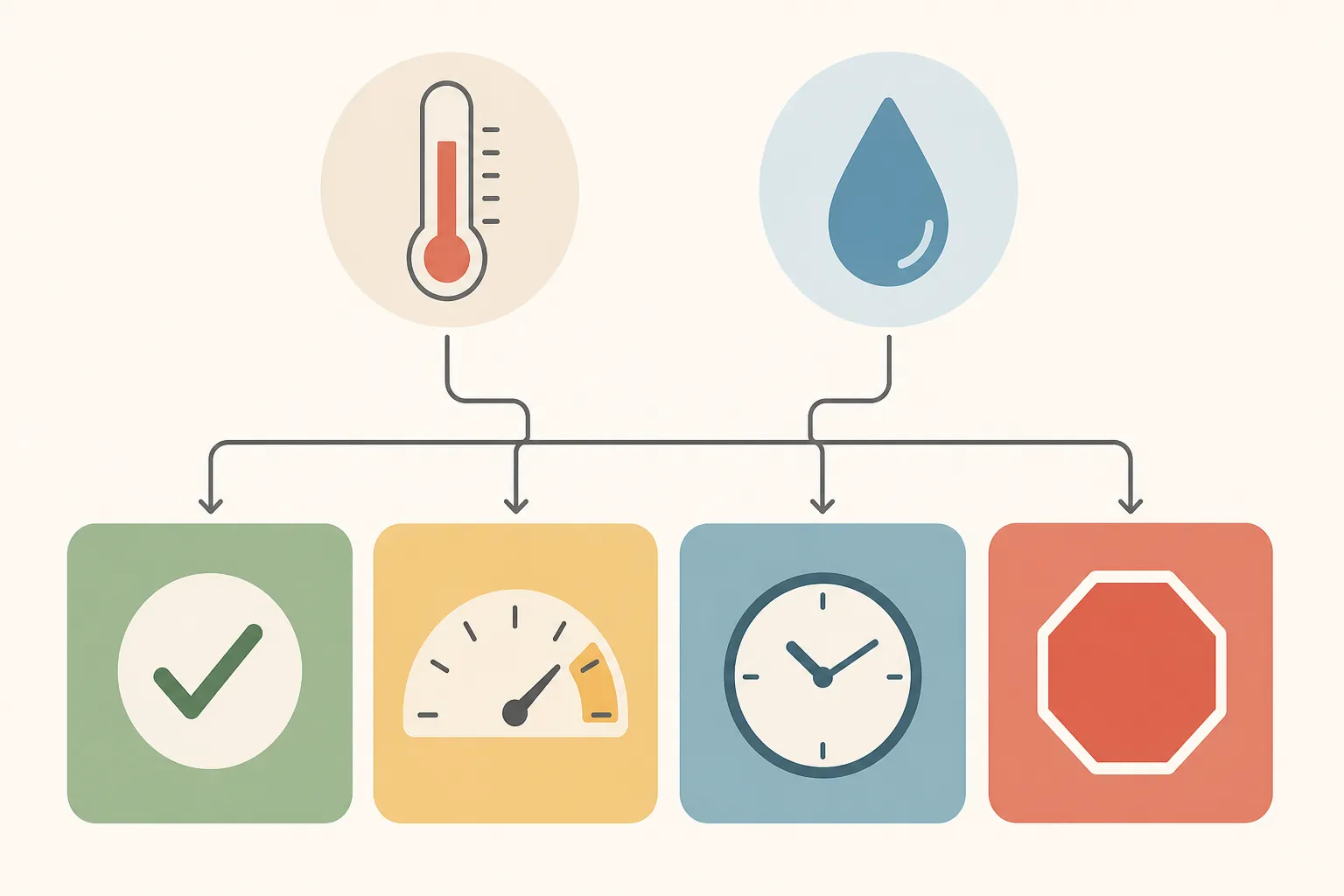
So useful heat-wave home-workout advice starts with a decision process: check the day’s HeatRisk level, measure the room’s temperature and humidity, then choose one of four outcomes — train, scale, shift, or skip.

The fast decision: train, scale, shift, or skip
Use this as the first pass. It is deliberately not a fake-universal chart, because the CDC HeatRisk scale, outdoor heat-index bands, and indoor temperature rules are different tools. The point is to stop pretending that “at home” automatically means “safe enough.”
| Decision | Use it when | What changes |
|---|---|---|
| Train, but stay conservative | HeatRisk is low enough that public-health guidance is not warning most people, your workout room is actually cool, humidity is not making the air feel heavy, and you have a real way to cool down. | Keep the session normal only if the room stays stable. Do not treat this as a day to chase a personal best. |
| Scale | HeatRisk is elevated, the room is warm or stuffy, humidity is high, you are early in the hot-weather period, or cooling depends mostly on a fan. | Cut intensity, shorten the session, extend rests, choose lower-heat movements, and stop before you feel cooked. |
| Shift | The room is likely to be cooler early morning or evening, or the current space is being heated by sun, poor airflow, or a weak window unit. | Move the session to a cooler hour or a cooler location instead of forcing the planned workout. |
| Skip | HeatRisk is severe, you cannot keep the room cool, the indoor temperature is around or above 90°F with fan-only cooling, humidity is pushing exertion into a danger zone, symptoms appear, or you cannot recover in a cool place afterward. | Cancel the workout. That is the training decision, not a discipline failure. |
Start with CDC HeatRisk, then check the room
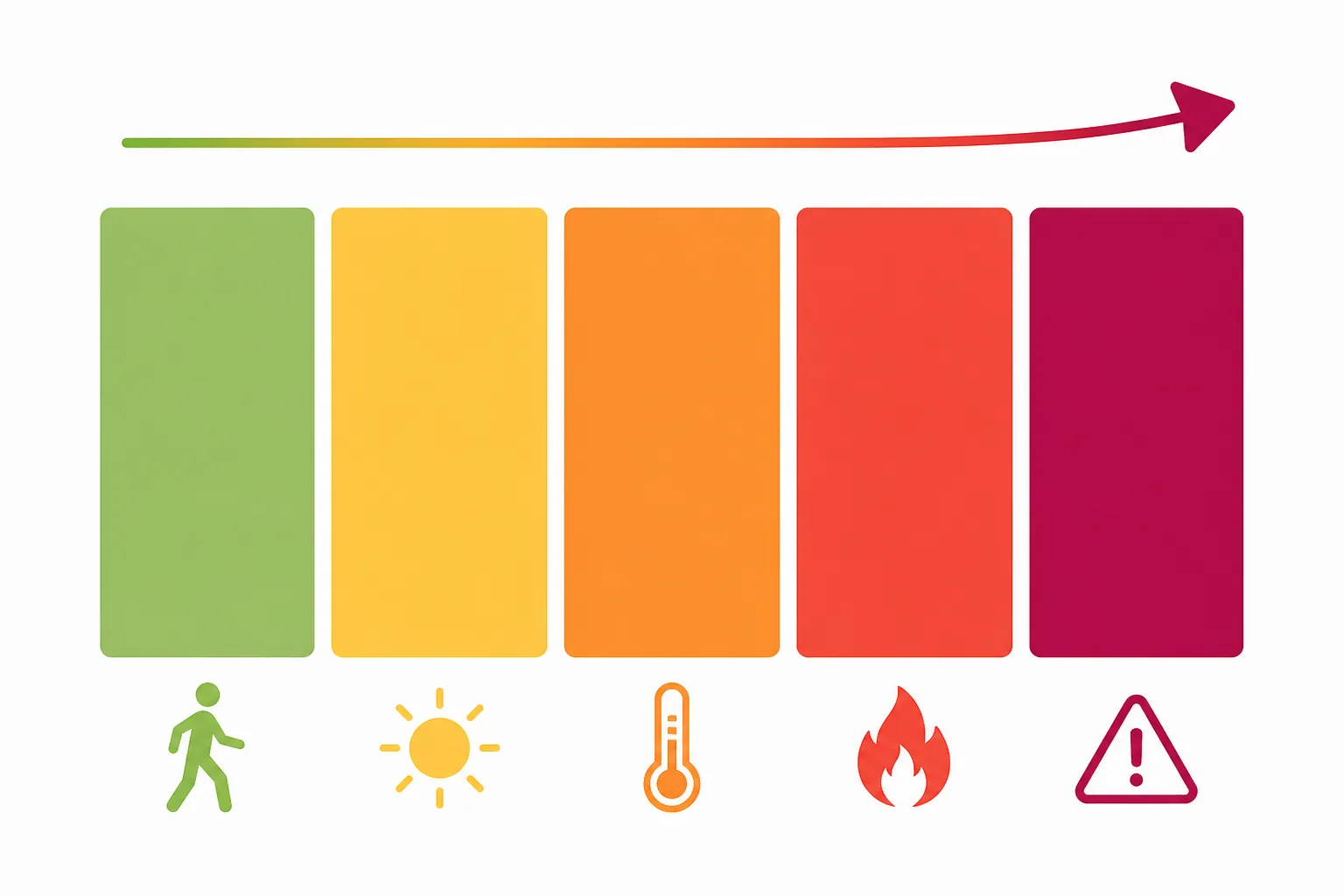
CDC HeatRisk is a five-level scale, from green level 0 to magenta level 4, designed to show how unusual the heat is for a location and how much health risk is expected that day. CDC guidance treats magenta level 4 as rare and/or long-duration extreme heat with risk to everyone, and says that staying cool at that level likely requires air conditioning; it also warns that fans may not cool you off at those temperatures. [1][2]
That matters for apartment workouts because HeatRisk answers the outside public-health question first: how dangerous is the day in your area? It does not know that your mat is next to a west-facing window, that the landlord controls the window unit, or that the only fan is blowing hot air from one corner to another. HeatRisk is the anchor, not the whole verdict.
A practical order looks like this:
- Check today’s CDC HeatRisk for your location before you change clothes.
- Measure the workout room, not the hallway, kitchen, or thermostat across the apartment.
- Check humidity if you can. A cheap hygrometer is useful because humidity changes how hard it is for sweat to cool you.
- Decide the session category before the first set: train, scale, shift, or skip.
- Re-check during the session if the room is warming up, sunlight is moving across the floor, or the fan is no longer making you feel cooler.
The indoor rules most heat-wave workout advice skips
A fan is not air conditioning. CDC says electric fans may provide comfort when the indoor temperature is below 90°F, but when indoor temperatures are above 90°F, fan use can increase body temperature instead of cooling you. [1]
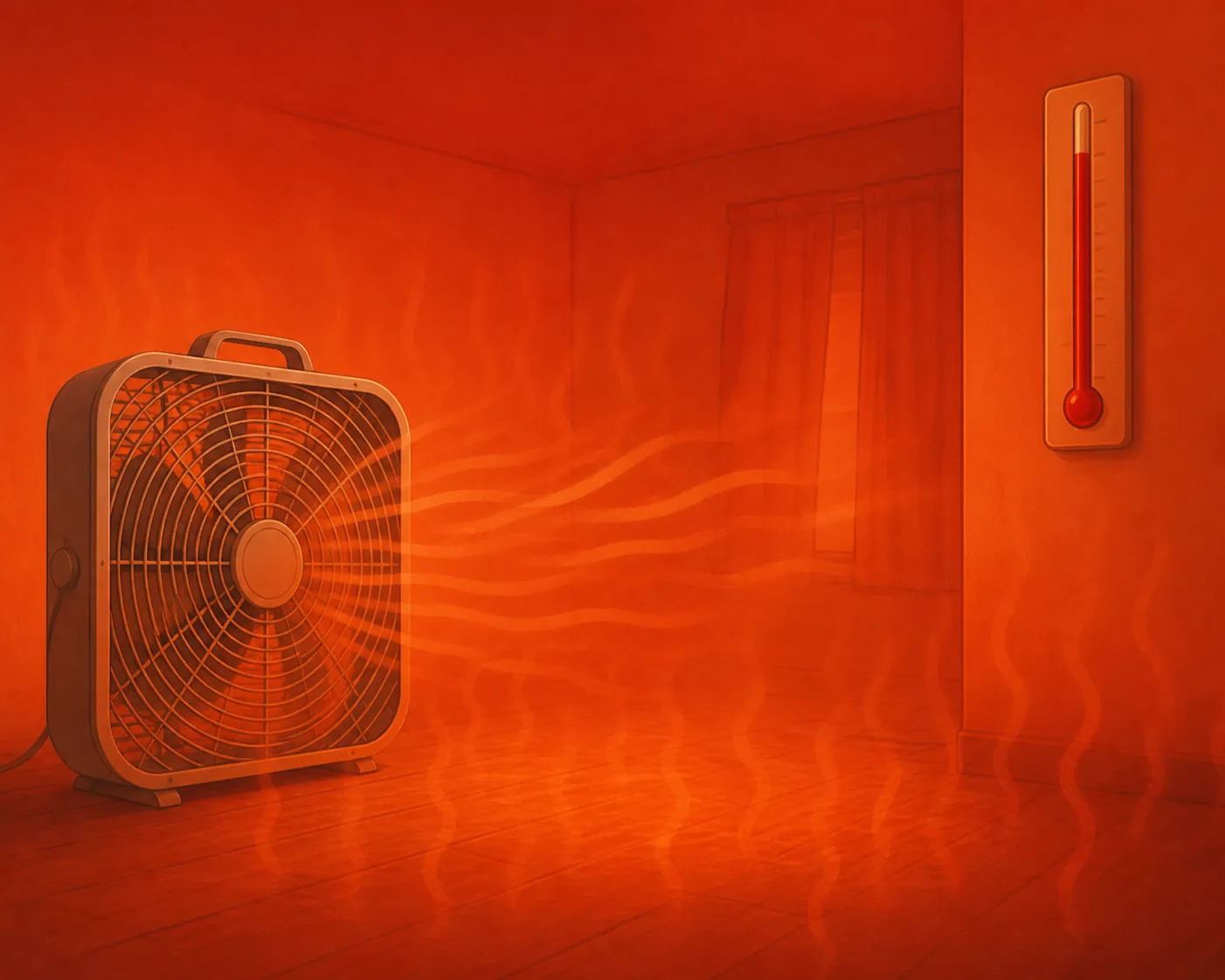
That is the cutoff that changes the workout decision before willpower gets involved. If the room is around or above 90°F and your cooling plan is “turn the fan up,” the safer choice is not a lighter burpee circuit. It is to stop, move somewhere cooler, or skip.
Humidity is the second indoor trap. The National Weather Service heat-index bands, as relayed by Peloton, put 80–90°F in a caution range, 90–105°F in an extreme-caution range where sunstroke, heat exhaustion, and heat cramps are possible, and above 105°F in a dangerous range. [3] That is a heat-index reference, not a direct reading from your wall thermometer, so do not jam it into the fan rule as if both systems measure the same thing.
A separate indoor-exertion warning appears in Chiroeco’s coverage of University of Colorado Hospital guidance: 90°F combined with humidity of 70% or higher makes exertion dangerous. [4] Because that is secondary-sourced here, it should be treated as a practical danger marker rather than a universal medical law. Still, if your room is hot and damp enough to match that combination, the workout has already lost the argument.
| Input | What it tells you | How to use it |
|---|---|---|
| CDC HeatRisk | How unusual and health-relevant the day’s heat is for your area. | Use it first. Red or magenta should make a home workout harder to justify, especially without air conditioning. [1][2] |
| Room temperature | What your body is actually training in. | If fan-only cooling is being used near or above 90°F indoors, do not rely on the fan to make the session safe. [1] |
| Room humidity | How well sweating can cool you. | High humidity should push you toward scaling, shifting, or skipping, especially when the room is already hot. |
| Outdoor heat index | How heat and humidity combine outside. | Use it as a warning layer, not as a replacement for measuring your workout room. [3] |
If the answer is “scale,” change the workout enough to matter
Scaling is not doing the same session while promising to be careful. Heat changes the cost of the work. The adjustment has to remove heat production, reduce continuous effort, or improve cooling time.
- Cut the duration first. A short session that ends cleanly is better than a full plan that turns into damage control.
- Lower the intensity. Keep strength sets submaximal, skip finishers, and avoid chasing breathless intervals in a hot room.
- Lengthen rests. Heat stress builds faster when every set starts before breathing and body temperature settle.
- Choose floor-based mobility, gentle core work, technique practice, light bands, or easy prehab instead of high-rep circuits.
- Move away from sunlit windows, shut blinds if they reduce radiant heat, and use the coolest room available.
- Stop early if the room warms up. The decision can change mid-workout.
If you need a lower-heat session idea, pick something that already avoids long continuous effort. A quiet prehab-style routine like the Travis Kelce prehab workout fits that purpose better than a sweaty conditioning block. A slower small-space strength session can work too, but only if the room check still supports training.
The safest swap may be a time swap. Sources describe peak heat windows differently — examples include noon to 3 p.m., 10 a.m. to 3 p.m., and 2 p.m. to 6 p.m. — so the clean rule is to avoid the middle of the day when possible and train early morning or evening if those hours are measurably cooler in your space. [3][4][6]
The first hot days are not normal training days
Heat acclimatization takes time. The Korey Stringer Institute describes heat acclimatization as a gradual process that commonly takes 7–14 days, and the American Heart Association also points to a 7–14 day adjustment period for activity in warm weather. [5][6]
That does not mean you should spend two weeks forcing workouts in a bad room so your body “gets used to it.” It means the first hot spell deserves a lower ceiling. If the weather suddenly jumps, your normal home workout is no longer normal just because the exercises are familiar.
For those first hot days, treat scaling as the default: shorter sessions, less volume, more rest, and no punishment for replacing training with mobility or recovery. If the room remains hot after the session, recovery is still part of the heat exposure. A post-session plan like a post-workout recovery routine at home is useful only if you can actually cool down.
Hydration helps, but it does not rescue a bad room
Drink before, during, and after training, and do not wait until you are already overheated to start. But hydration advice often gets overstretched in heat-wave workout tips. Water does not turn a sealed 90°F room into a safe training environment, and electrolytes do not make fan-only cooling work above its limit.
NPR’s practical heat-safety guidance also points toward choosing heat-friendlier exercise options and avoiding added heat load from direct sun; one example it reports is that midday sun can add about 20°F. [7] Indoors, the parallel is obvious: a sunlit room can keep heating up even while you are congratulating yourself for not running outside.
Symptoms end the session
This is not the place to self-manage serious heat illness. Stop the workout if you feel unwell, unusually weak, dizzy, nauseated, confused, chilled with goosebumps in heat, or unable to cool down. Move to a cooler place if you can and get help.
CDC describes heat stroke as a medical emergency and includes a body temperature of 103°F or higher among its warning signs; AHA materials use the same 103°F framing in warm-weather safety guidance, while some other sources use 104°F. If heat stroke is suspected, call 911. [1][6]
The plain boundary
A safe home workout during a heat wave is not the workout you can force yourself to finish. It is the one you are willing to downgrade or cancel after checking the actual conditions.
If HeatRisk is severe, the room is hot, humidity is high, the only cooling is a fan near or above 90°F, you do not have access to air conditioning when you need it, symptoms show up, or you cannot cool down afterward, skipping is the correct training choice.
References
- About Heat and Your Health — CDC.
- How to use the HeatRisk Tool and Air Quality Index — CDC.
- Exercising in the Heat — The Output by Peloton.
- Indoor fitness routine — Chiroeco.
- Heat Acclimatization — Korey Stringer Institute.
- How to Stay Active in Warm Weather — American Heart Association.
- How To Heat-Proof Your Summer Workout — NPR.
This is general fitness education, not medical advice. For diagnosis or treatment of pain or injury, consult a qualified clinician.
Pick your next session
Browse all routines to find an appropriately-spaced next session.
Spot something off?
This content sits adjacent to health guidance — tell us if a citation or figure needs a correction.