
Does Your 9-Hour Eating Window Affect Home Workout Performance?
If you follow a 9-hour intermittent fasting schedule, where you place your workout matters. This article explains which workout types perform best fasted and which benefit from being inside your eating window, so you avoid feeling weak and keep making progress.
- Citation source
- Peer-reviewed studies
- Evidence level
- restrained inference
A 9-hour eating window can work with home workouts. The part that decides whether it feels reasonable is not the fasting label; it is whether today’s workout asks for calm movement or real output.
If the session is mobility, walking, easy cycling, light bands, or a low-to-moderate bodyweight circuit, doing it before the eating window opens is usually the cleanest fit. If the session is dumbbell strength, HIIT, hard intervals, heavy lower-body work, or anything where you care about reps, speed, or power, place it inside the window or close to its start. That is the practical answer for a 9-hour eating window: keep easy work fasted if you like it, but put hard work near food.

There is one important evidence caveat before building the schedule: the closest research base is mostly 16:8 time-restricted eating, not an exact 15:9 protocol. A 9-hour window is slightly less restrictive than 16:8, so the evidence is useful as a guide, but it does not prove that every 15:9 schedule will behave identically.
Start With the Workout, Not the Clock
The same apartment setup can hold very different training demands. A 20-minute stretch on a mat before a shower is not the same as a dumbbell split squat circuit where every set gets close to failure. Fasting does not erase that difference.
| Workout type | Best placement with a 9-hour eating window | Why it fits |
|---|---|---|
| Mobility, stretching, easy yoga | Before the window or anytime | Low fuel demand; useful when mornings are quiet |
| Low-to-moderate cardio | Fasted if intensity stays controlled | Performance usually depends more on pacing than peak power |
| Light technique work or easy bands | Fasted or early in the window | Works if the goal is movement quality, not maximum output |
| Dumbbell strength training | Inside the window or within 1–2 hours of its start | Food nearby supports effort, refueling, and daily protein |
| HIIT, hard intervals, power circuits | Inside the window | Higher perceived effort and power demands make fasted placement less forgiving |
That table is not a rule against fasted training. It is a way to stop treating every workout as if it asks the same thing from the body. If you feel fine doing fasted mobility, there is no reason to move it. If your HIIT session turns into survival halfway through round three, that is useful information, not a character flaw.
Three Daily Schedules That Actually Fit Home Training
The cleanest way to make a 9-hour eating window work is to choose the schedule that matches your real day. Not the ideal day with no calls, no neighbors, no laundry on the exercise mat. The real one.
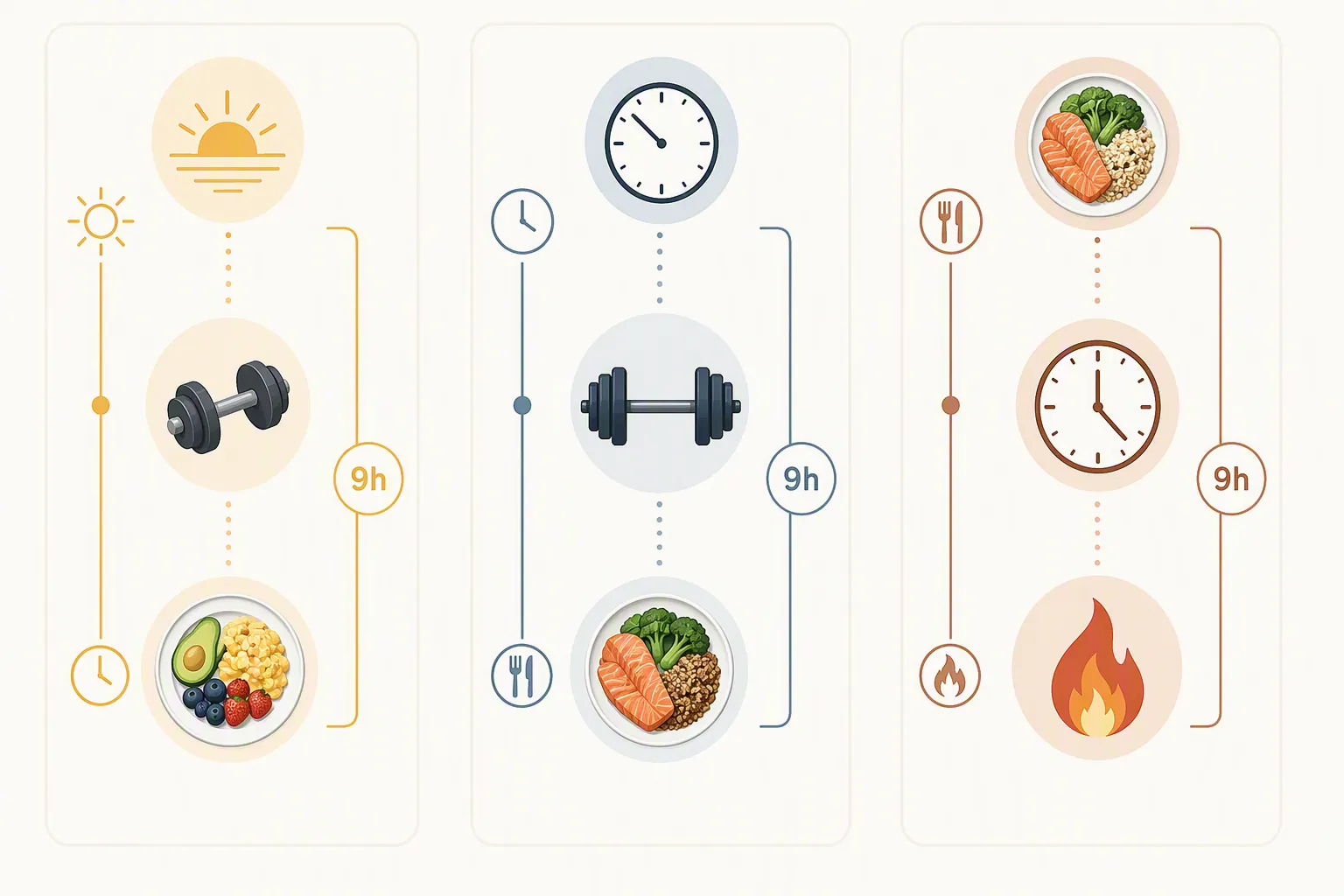
Option 1: Morning Fasted Trainer, Window Opens at 10 a.m.
This is the person who has a narrow opening before the day starts. The dumbbells are quiet enough, the floor is free, and the first meeting is not yet staring back from the calendar. The eating window opens at 10 a.m., so the workout happens before food.
- Best fit: mobility, stretching, easy cardio, low-impact circuits, light core, gentle bands.
- Use caution with: hard lower-body strength, HIIT, jump-heavy circuits, long sessions that leave you shaky.
- First meal: place protein early in the eating window instead of letting breakfast become only coffee and errands.
- Progress check: judge this schedule by energy during the session and consistency across the week, not by whether it feels impressively strict.
A fasted morning session can be excellent when the goal is to move well before the day gets crowded. It is less excellent when the workout depends on aggressive output. If the session needs you to push heavy goblet squats, repeat hard burpees, or chase a rep target, the 10 a.m. meal may be too far away to make the workout feel solid.
The adjustment does not have to be dramatic. Keep the morning slot, but change the workout type: mobility on fasted mornings, strength later in the window. If weekly scheduling is the bigger problem, the Home Fitness Recovery Blueprint is the better next place to sort hard days, easy days, and recovery spacing.
Option 2: Mid-Morning Workout, Eat Immediately at Noon
This schedule works well for someone whose eating window starts at 12 p.m. and who can train late morning. The session still begins fasted, but the gap between training and food is short. That changes the decision.
A 10:30 or 11 a.m. workout followed by a noon meal is a workable compromise for home strength training, especially if the session is moderate rather than brutal. You are not asking your body to lift hard at 7 a.m. and wait half the day to refuel. You are creating a short bridge from training to food.
- Best fit: moderate dumbbell strength, controlled circuits, tempo work, short interval sessions.
- Post-workout meal: protein plus carbohydrate belongs early, not as an afterthought three hours later.
- Watch for: fading performance in the final sets, unusual irritability, or needing to reduce load every week.
- Simple fix: move the workout 30–60 minutes closer to the meal or move the eating window earlier on hard training days.
This is also the schedule where people often under-eat without noticing. A compressed window makes it easier to skip the boring but necessary part: enough total food to support training. If lunch is delayed, the whole setup starts to behave like a longer fast than intended.
Option 3: Evening Trainer, Eat at Noon and Train at 5–6 p.m.
For strength and HIIT, this is often the most forgiving version of a 9-hour window. If the eating window runs from 12 p.m. to 9 p.m., a 5 or 6 p.m. workout sits comfortably inside it. You have already eaten, and you still have time afterward to refuel.
That does not mean the evening slot is automatically better. It can collide with family noise, apartment neighbors, fatigue from work, or the simple fact that your mat is now in the path of everyone else’s evening. But from a performance and recovery standpoint, it gives hard sessions the least cramped nutrition setup.
- Best fit: dumbbell strength, progressive overload work, HIIT, harder bike or rower intervals, lower-body sessions.
- Pre-workout: eat a normal meal earlier in the window; do not rely on the workout to prove you can train underfed.
- Post-workout: use the remaining window for a protein-focused meal or shake if dinner will be late.
- Boundary: if hard training near the end of the window leaves no appetite or no time to eat, move it earlier.
The evening trainer’s main job is not to force more discipline. It is to avoid letting the window close before recovery has started. If the workout ends at 8:45 p.m. and the window closes at 9 p.m., the schedule looks neat on paper and awkward in the kitchen.
Refueling Matters More Than the Perfect Fasting Ratio
The protein target is the anchor: aim for at least 1.6 grams of protein per kilogram of body weight per day when the goal is maintaining or building lean mass during resistance training and a compressed eating window.[3][4] Timing helps because the window is short, but timing does not rescue a day that simply comes in too low.
For a home exerciser, the practical problem is usually not knowing that protein matters. It is fitting enough of it into nine hours without turning every meal into a chore. That gets harder if the workout is late, appetite is low, or the first meal is small.
| Training placement | Refueling move | What to avoid |
|---|---|---|
| Fasted easy morning session | Put protein in the first meal when the window opens | Letting the first meal become only caffeine and a snack |
| Late-morning strength before noon meal | Eat a full protein-containing meal immediately after | Finishing the workout and delaying lunch until midafternoon |
| Evening strength or HIIT inside the window | Keep enough window left for dinner or a protein shake | Training so late that recovery food gets squeezed out |
Post-workout protein does not need to be complicated. A normal meal works. A shake works. If you are choosing between ready-to-drink milk protein and whey because the eating window is closing, the Fairlife Milk vs Whey comparison is useful for deciding what is easiest to repeat.
Readers already dealing with low appetite or medically influenced food restriction need to be more careful here. In that context, a fasting window can stack on top of an already reduced intake. The Mounjaro home workouts article is the more relevant starting point if the main issue is getting enough food to support training at all.
What the Research Supports, and Where It Gets Thin
The better studies are reassuring, but they are not a permission slip to ignore workout type. A 2024 systematic review by Conde-Pipó and colleagues found no negative impact of time-restricted feeding on aerobic or strength performance across the included research.[1] That supports the broad idea that time-restricted eating can coexist with training.
Moro and colleagues studied elite cyclists using a 16:8 time-restricted eating pattern for 4 weeks. The cyclists maintained VO2max and power output while losing 2% body weight.[2] That is a useful finding for performance anxiety: a restricted eating window did not automatically flatten aerobic capacity or power in that trained group.
Tinsley and colleagues found that active women following time-restricted feeding gained 2% fat-free mass and 5% muscle thickness.[3] For the home strength trainee worried that a shorter eating window means inevitable muscle loss, that is the more relevant signal than generic claims about fasting.
Stratton and colleagues also matter because they help keep the hormone discussion in proportion. Moro and colleagues observed reductions in free testosterone of 27% and IGF-1 of 12% in elite cyclists, but those changes did not translate into muscle loss in that study and did not replicate in Stratton’s resistance-training study.[2][4] That deserves attention, not panic.
The limits are still real. Most of this research uses young or trained participants, not a broad sample of people doing squats beside a sofa between work calls. The studies also do not settle the exact best hour for every workout. They support compatibility; they do not prove that fasted hard training will feel good for you.

Give the Schedule One to Two Weeks Before You Judge It
There can be a 1–2 week adaptation period when shifting workout timing around a fasting window. During that stretch, performance may dip before it normalizes.[1] That does not mean you should grind through every bad session, but it does mean one awkward workout is not enough evidence to throw away the plan.
Track the signs that actually affect training: whether warmups feel unusually heavy, whether you lose reps earlier than expected, whether interval pace drops sharply, whether you recover normally by the next session, and whether you can hit the daily protein target without force-feeding at night.
If easy fasted workouts feel fine, keep them there. If hard sessions feel flat, move them inside the eating window or within 1–2 hours of its start. If protein keeps getting squeezed out, widen the practical food plan before blaming the workout. The working rule is simple enough to use tomorrow: keep fasted work easy-to-moderate, put strength and HIIT near food, protect daily protein, and allow one to two weeks before deciding whether the timing truly works.
References
- Conde-Pipó et al. (2024) systematic review
- Moro et al. (2020) time-restricted eating study in elite cyclists
- Tinsley et al. (2019) time-restricted feeding study in active women
- Stratton et al. (2020) resistance training and time-restricted feeding study
This is general fitness education, not medical advice. For diagnosis or treatment of pain or injury, consult a qualified clinician.
Pick your next session
A 4-Week Home Workout Plan for Busy Parents (No Gym Required)
This structured four-week progressive workout plan is built for parents with limited time and no gym equipment. Each 15–25 minute full-body session fits around family life and builds consistency before intensity.
Spot something off?
This content sits adjacent to health guidance — tell us if a citation or figure needs a correction.