
A 4-Week Home Workout Plan for Busy Parents (No Gym Required)
This structured four-week progressive workout plan is built for parents with limited time and no gym equipment. Each 15–25 minute full-body session fits around family life and builds consistency before intensity.
- Duration
- 20 min
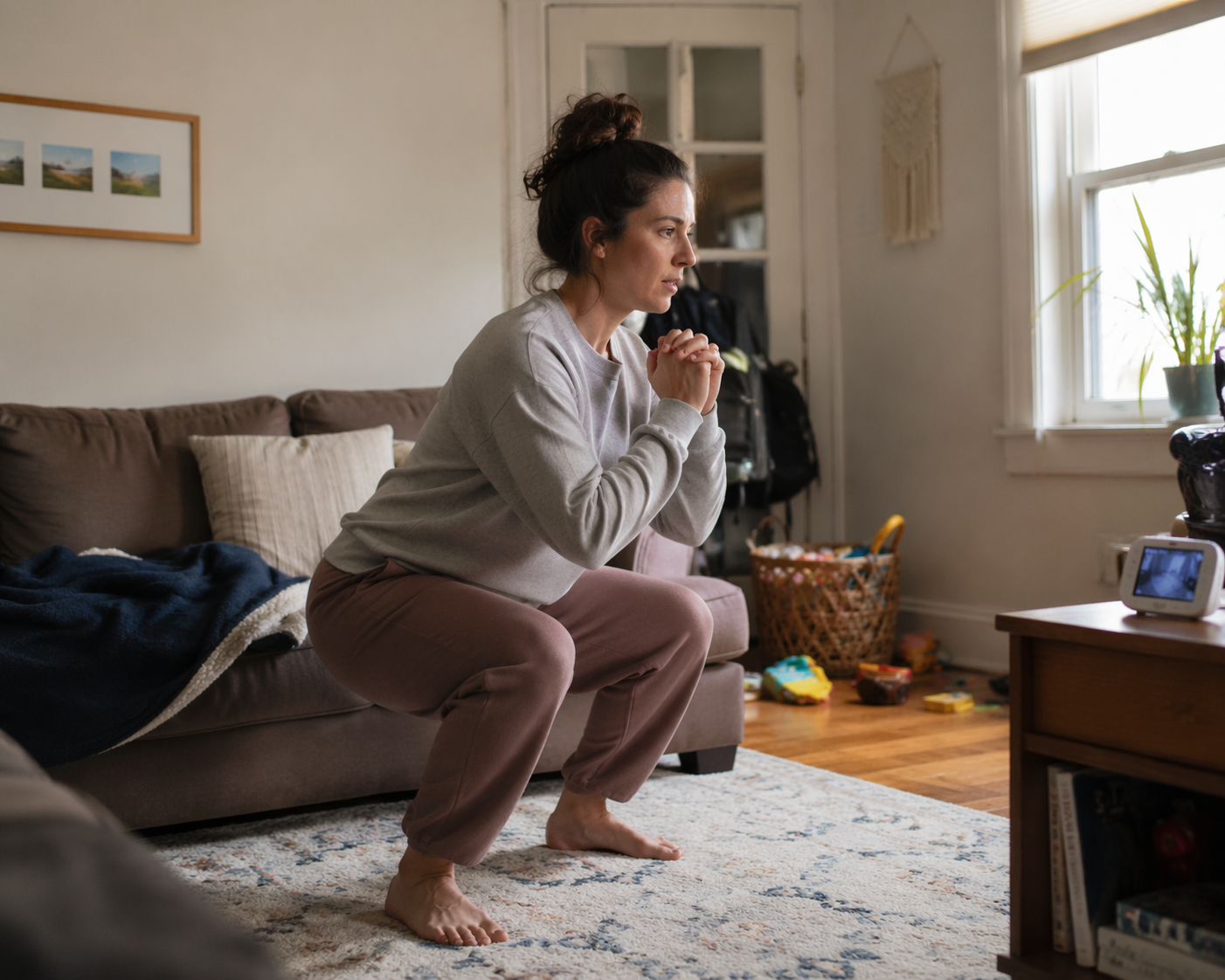
A realistic home workout plan for busy parents has to start with the part most plans skip: the workout is not the only task. Someone has to choose the exercises, clear the floor, keep one ear on the baby monitor, stop when a child needs help, and then decide whether a half-finished session still “counts.” That is why this four-week plan keeps the sessions short, full-body, and repeatable: 15–25 minutes, no equipment, 3–4 days per week, with the same small set of movements progressing gradually.
The time problem is not imaginary. A University of Houston study using NHANES data from 2007–2016 found that parents with two or more children ages 0–5 got 80 fewer minutes of vigorous weekly physical activity than adults without children.[1] The public health target still matters: U.S. physical activity guidelines recommend 150 minutes per week of moderate-intensity aerobic activity for adults, along with muscle-strengthening activity on two or more days.[2] But the first month of training does not need to solve the entire guideline. It needs to make exercise re-enter the week without turning the house into a gym.
The 4-week plan at a glance
This plan uses five basic movement patterns: squat, hinge or glute bridge, push, single-leg work, and core. ACE’s at-home exercise guidance for busy parents includes familiar bodyweight options such as squats, push-up variations, lunges, planks, and glute bridges, which are useful here because they require little space and can be scaled without equipment.[3]
| Week | Goal | Days | Session length | Main format |
|---|---|---|---|---|
| Week 1 | Start without overthinking | 3 days | 15–18 minutes | Simple circuit, easy pace |
| Week 2 | Add volume and confidence | 3 days | 18–22 minutes | More rounds or slightly longer work intervals |
| Week 3 | Improve density | 4 days if possible | 20–24 minutes | Timed circuits and short EMOM blocks |
| Week 4 | Practice a repeatable routine | 4 days if possible | 20–25 minutes | Tighter timing, harder variations only when ready |
If three days is all that happens, three days is the plan. The fourth day appears in Weeks 3 and 4 as an option, not a test of character. A parent who completes three sessions every week for a month has built something more useful than a perfect first week followed by silence.

Before the first session: make the workout smaller than the interruption
Pick a space where you can step forward, step back, lie down, and put your hands on the floor. That might be a rug beside the couch. It does not need to be a dedicated workout corner. If lunges do not fit, use reverse lunges or split squats in place. If push-ups on the floor feel too hard, use a countertop, couch arm, or wall.
Set one timer before you start. The goal is to remove small decisions: no searching for a video, no choosing between ten variations, no equipment setup. If the larger barrier is building the home-exercise habit itself, this plan pairs well with a broader guide to starting workouts at home and sticking with them.
Week 1: three sessions that are almost too easy to start
Week 1 is deliberately plain. The point is to learn the exercises, finish the session, and prove that a workout can survive the normal mess of a family day. Put the three workouts on nonconsecutive days if possible, such as Monday, Wednesday, and Saturday, but do not protect the schedule so tightly that one bad morning ruins the week.
| Part | What to do | Time |
|---|---|---|
| Warm-up | March in place, arm circles, hip hinges, easy squats | 3 minutes |
| Circuit | Squat x 8, incline push-up x 6–8, glute bridge x 10, reverse lunge x 6 each side, plank x 15–20 seconds | 2 rounds |
| Finish | Easy walking around the room and slow breathing | 2 minutes |
Move at a pace where you could answer a child without gasping. Rest whenever you need to. If the session is interrupted after one round, do the second round later or leave it. The win in Week 1 is not exhaustion; it is reducing the number of reasons to skip next time.
Week 1 exercise notes
- Squat: sit the hips back, keep the whole foot on the floor, and use a chair target if depth feels uncertain.
- Incline push-up: use a wall, counter, or couch; the higher your hands are, the easier the movement becomes.
- Glute bridge: keep ribs down, press through the heels, and stop when hips are lifted rather than arching the low back.
- Reverse lunge: step back instead of forward if floor space is tight; hold the wall lightly if balance is the limiting factor.
- Plank: use knees down if needed; a short clean plank is better than a long sagging one.
Week 2: add work without adding chaos
Week 2 keeps the same three-day structure and almost the same exercises. That repetition is intentional. A new parent-friendly plan should not ask you to relearn the workout right when the habit is starting to form.
| Part | What changes from Week 1 | Target |
|---|---|---|
| Warm-up | Same warm-up, slightly brisker | 3 minutes |
| Circuit | Add a third round if time and energy allow | 2–3 rounds |
| Reps | Squat x 10, incline push-up x 8–10, glute bridge x 12, reverse lunge x 8 each side, plank x 20–25 seconds | Controlled pace |
| Finish | One minute of slow breathing, then stop | 1–2 minutes |
This is the week where many people are tempted to add a harder workout because the first week felt manageable. Hold that line. Add the third round only when the first two rounds feel clean. If push-ups are improving, lower the incline a little. If lunges are still shaky, keep the easier version and make the reps smoother.
For readers who want a more standard non-parent-specific progression, a beginner bodyweight workout routine can be useful later. The difference here is that the parent version assumes the session may need to stop and restart, and the plan still has to make sense.
Week 3: use the clock, not more exercises
Week 3 introduces a fourth day if your week can hold it. The change is not a complicated split. It is better time control. Instead of counting every rep and wondering how long the session will take, you work inside fixed blocks.
One useful format is EMOM, short for “every minute on the minute.” A 2025 Men’s Health UK workout for busy dads uses a 20-minute EMOM structure to make the work-to-rest relationship predictable.[4] The format is useful, even if the audience framing is narrower than this plan needs: start a set at the top of the minute, finish the assigned reps, then rest until the next minute begins.
| Day | Format | Workout |
|---|---|---|
| Day 1 | Circuit | Squat x 12, incline or floor push-up x 8–10, glute bridge x 12, reverse lunge x 8 each side, plank x 25 seconds; 3 rounds |
| Day 2 | Short EMOM | Minute 1: squats x 10; minute 2: push-ups x 6–8; minute 3: glute bridges x 12; minute 4: plank x 20 seconds; repeat for 16 minutes |
| Day 3 | Circuit | Same as Day 1, but keep the easiest clean variation |
| Day 4 optional | Low-impact reset | Marching, step-backs, hip hinges, dead bugs, side planks; easy pace for 15–20 minutes |
The EMOM should not feel like a race. If squats take 25 seconds, rest for the rest of the minute. If push-ups take 50 seconds and your form is falling apart, the reps are too high or the incline is too low. The clock is there to end the decision-making, not to make the room feel like a boot camp.
Week 4: make the plan repeatable
Week 4 is where the plan becomes something you can repeat, not something you survive once. Keep four days if that has worked. Stay at three if four sessions made the week brittle. The progression now comes from cleaner form, slightly harder variations, or tighter rest—not from adding a pile of new movements.
| Day | Focus | Workout |
|---|---|---|
| Day 1 | Full-body strength circuit | Squat x 12–15, push-up variation x 8–12, glute bridge x 15, reverse lunge x 10 each side, plank x 30 seconds; 3 rounds |
| Day 2 | 20-minute EMOM | Minute 1: squats; minute 2: push-ups; minute 3: lunges or split squats; minute 4: plank or dead bug; repeat 5 times |
| Day 3 | Full-body circuit with easier variations | Repeat Day 1 but stop one rep before form breaks |
| Day 4 | Choice session | Repeat the EMOM, take an easy mobility-style session, or do one clean circuit if the week is overloaded |
Only progress one lever at a time. If you lower the push-up incline, do not also add reps. If you add a fourth day, do not also make every session harder. A parent’s recovery is not just about muscles; it is also about sleep interruptions, work stress, sick kids, and whether dinner is already late.
How to place the workouts in a real week
Parent workout schedules from Mom of the Year and Fit Father Project show the same basic pattern from different angles: busy parents often do better when training days are planned around family routines instead of treated as a separate lifestyle.[5][6] That might mean early morning, nap time, lunch break, after bedtime, or the first 20 minutes after school drop-off. The specific slot matters less than having a default.
| If your week looks like this | Use this schedule |
|---|---|
| Weekdays are packed, weekends are looser | Tuesday, Thursday, Saturday |
| Mornings are unpredictable, evenings are calmer | Monday, Wednesday, Friday after bedtime |
| You can manage short weekday sessions | Monday, Tuesday, Thursday, Saturday |
| A child is sick or sleep is wrecked | Two full sessions plus one 8-minute reset |
Do not keep moving a missed Monday workout forward one day at a time until the whole week feels behind. If Monday disappears, train Tuesday and continue. The plan is a route, not a debt ledger.
The low-energy version still counts
Some days need a smaller door into the workout. Use this version when you slept badly, the session has already been interrupted, or the idea of three rounds makes you want to do nothing.
| Move | Amount |
|---|---|
| Chair squat or regular squat | 8 reps |
| Wall or counter push-up | 6 reps |
| Glute bridge | 10 reps |
| Dead bug or knee plank | 20 seconds |
| Easy marching | 60 seconds |
Do one round if that is the day you have. Do two if the first round wakes you up. This is not a replacement for every session, but it protects the habit during weeks when a full plan would otherwise vanish.
Exercise swaps when space, joints, or noise get in the way
The best exercise is not the one that looks most advanced. It is the one you can do safely in the room you actually have. Use the swaps below without treating them as a downgrade.
| Planned move | Use this if needed | Why |
|---|---|---|
| Reverse lunge | Split squat holding a wall | Less stepping, easier balance |
| Floor push-up | Counter, couch, or wall push-up | Same push pattern, easier load |
| Plank | Dead bug | Less shoulder strain, good core control |
| Squat | Sit-to-stand from a chair | Clear depth target and lower intimidation |
| Glute bridge | Hip hinge with hands on hips | Useful if lying on the floor is not practical |
Bodyweight training can be thin on pulling movements because there is no bar, cable, or row machine. If you want to solve that gap without buying equipment right away, this no-equipment upper-body workout goes deeper into push-and-pull options. For lower-body progression beyond basic squats and lunges, use the science-based home leg workout as a next layer rather than something you need on day one.
What to do when a workout gets interrupted
Plan for interruption before it happens. If you stop during the warm-up, restart from the first circuit move. If you stop after one round, mark one round done and decide later whether to finish. If you stop during an EMOM, restart at the next full minute instead of trying to recreate the exact point where you left off.
- Under 3 minutes away: continue where you left off.
- 3–10 minutes away: restart the current round or EMOM block.
- More than 10 minutes away: count what you did and, if possible, add one low-energy round later.
- No chance to return: move on. Do not turn tomorrow into a punishment workout.
A workout that stops early is still information. Maybe the timing was wrong. Maybe the floor space was in the main traffic lane. Maybe the plan needs to happen before the child wakes up or after bedtime instead. Adjust the setup before you blame your discipline.
How hard should these sessions feel?
Most working sets should feel like you could do two or three more good reps. That is enough effort to train, but not so much that the next session feels threatening. During EMOM sessions, the final repeat should feel focused, not frantic. If you regularly have less than 10 seconds of rest before the next minute starts, reduce the reps.
Use discomfort as a signal, not a badge. Muscle effort is expected. Sharp pain, dizziness, chest pain, or symptoms that feel unusual for you are reasons to stop and get appropriate medical guidance. If you are returning after pregnancy, injury, surgery, or a long inactive period, the easier variations are not a delay; they are the start line.
After Week 4: repeat, simplify, or add a little structure
At the end of four weeks, choose based on what actually happened, not what you hoped would happen.
- If you completed most sessions: repeat Weeks 3–4 with slightly harder variations or one extra round on one day.
- If you were inconsistent: repeat Weeks 1–2 and protect the easiest schedule that worked.
- If you want a broader bodyweight plan: move to the beginner bodyweight routine and keep the parent-friendly scheduling rules.
- If you want guided sessions without buying gear: try one of the best free workout apps for limited home equipment.
- If equipment enters the picture: use a home gym workout plan that grows with your equipment instead of buying random pieces and hoping they form a program.
The useful part of this plan is not that it makes parenthood easier or turns 20 minutes into magic. It works because the next action is obvious: clear a small space, start the timer, do the known movements, and stop when the session is done.
References
- Parents with young children exercise less, University of Houston, July 2023
- Physical Activity Guidelines for Americans, U.S. Department of Health and Human Services
- At-home exercise routines for busy parents, ACE Fitness
- 20-minute workout for busy dads, Men’s Health UK, 2025
- Weekly workout schedule for real moms, The Mom of the Year
- Workouts for busy dads, Fit Father Project
What a small equipment investment adds
We don't have a build tagged to this exact tier yet. Browse all builds.
How often should you repeat this?
How Whoop and Oura Ring track recovery for home workouts
For home exercisers deciding between WHOOP and Oura Ring, the better sleep and recovery tracker depends on training style: WHOOP's strength-aware tracking fits dumbbell and grip-heavy sessions, while Oura's sleep-first scoring suits yoga and indoor cycling. The verdict hinges on how each builds its daily recovery score, their home-workout tracking gaps, and who pays for hardware versus subscription.
Spot something off?
Tell us if a movement, tier assumption, or duration didn't match your experience.