
Full Body Dumbbell Workout for Small Spaces: No Bench, Just Results
A complete, follow-along dumbbell routine designed for apartment dwellers and budget-conscious home gym owners who have no room for a bench. Learn how to program effective strength workouts in a 6x6 ft space using only adjustable dumbbells and a mat.
- Duration
- 30 min
The Minimal Viable Setup: What You Actually Need
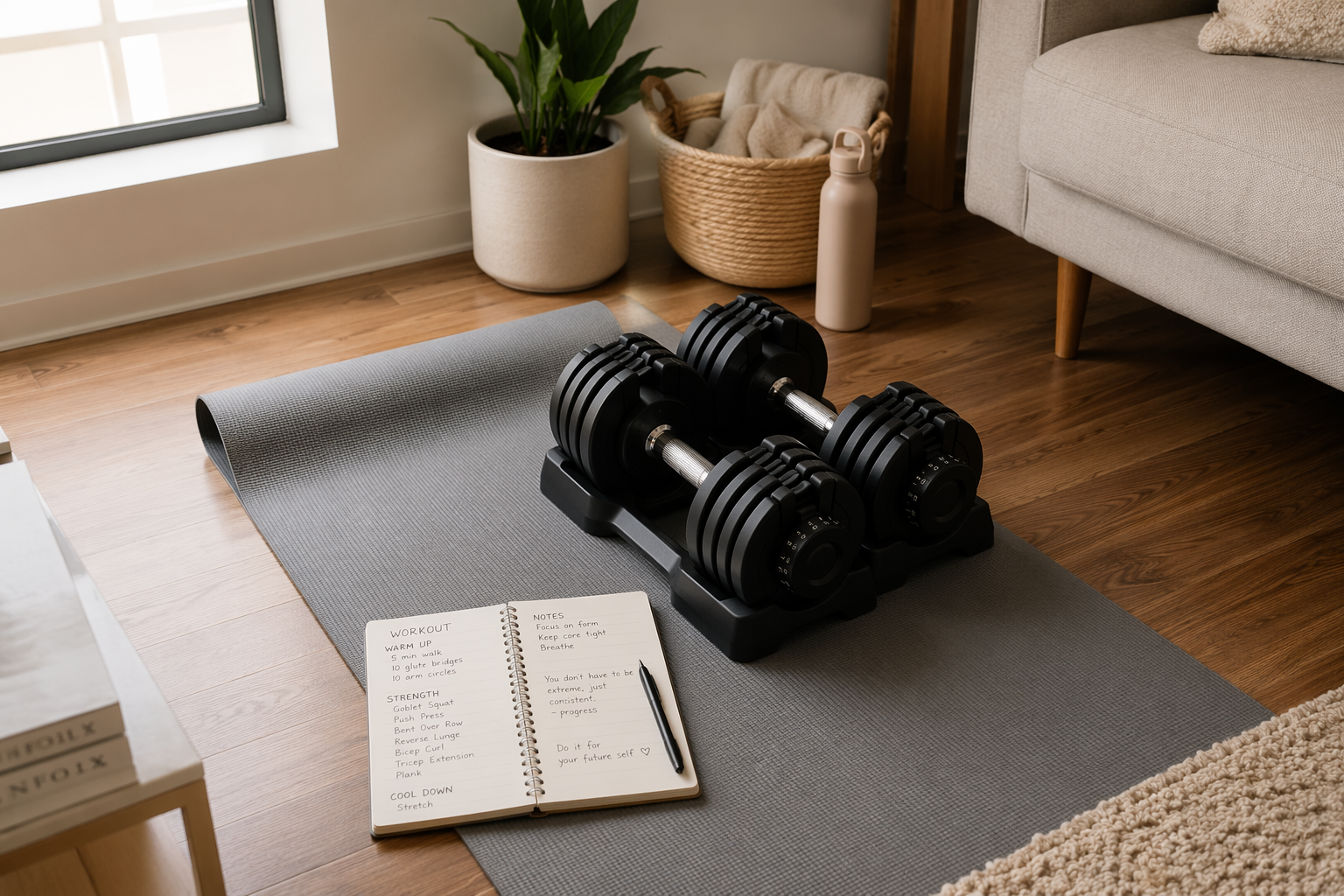
The idea that a productive strength session requires a room full of iron is a myth that keeps people from starting. For a full-body dumbbell workout that delivers measurable results, the equipment list is short: one pair of adjustable dumbbells and a yoga mat. That is it.
Adjustable dumbbells are the cornerstone of a small-space setup because they collapse a full rack of fixed-weight dumbbells into a footprint roughly the size of a shoebox. A typical 5–50 lb adjustable set occupies about 1.5 square feet of floor space when stored. Compare that to a traditional dumbbell rack, which can consume 15–20 square feet, and the space savings approach 90%. For apartment dwellers working with a 6x6 ft workout zone, that difference is the difference between a viable home gym and an impossible one.
The yoga mat serves two purposes: it defines your training area on hardwood or carpet, and it provides enough cushion for floor-based exercises like the floor press and glute bridges. No bench, no rack, no cable machine. If you are renting and worried about noise or wall damage, the renter's guide to a compact home gym covers flooring solutions and noise-dampening strategies that pair well with this setup.
Exercise Selection When You Don't Have a Bench
Removing the bench from your training equation forces a shift in exercise selection, but it does not limit your results. The key is choosing movements that load the major muscle groups through a full, safe range of motion while working within the constraints of floor-based positioning.
Here are the four foundational exercises that form the core of any no-bench dumbbell program:
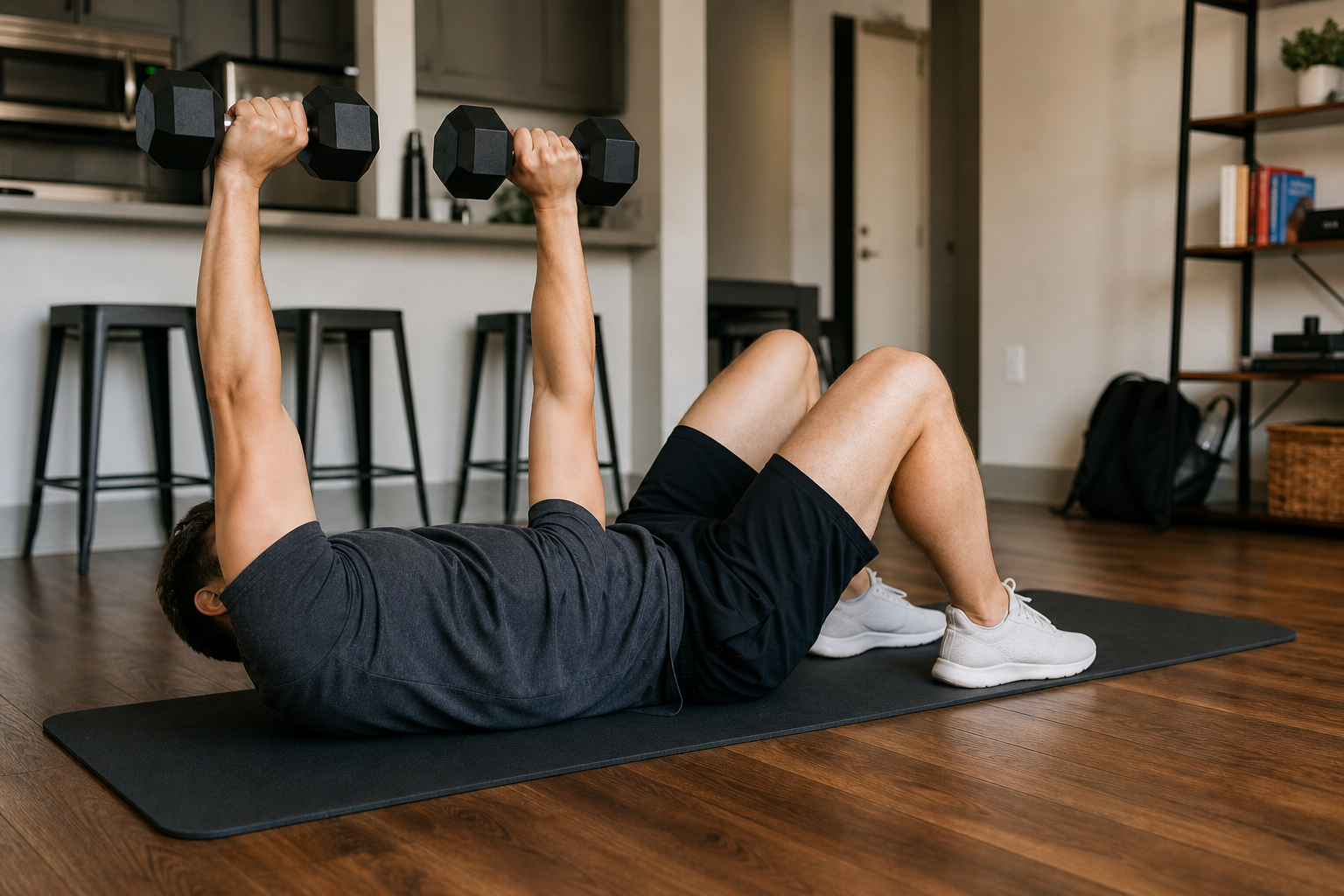
- Floor Press (Chest) — Lie on your back with knees bent and feet flat on the floor. Press the dumbbells from your shoulders to full extension. The floor stops your elbows at a safe depth, which shortens the range of motion compared to a bench press but also reduces shoulder strain. REP Fitness explicitly recommends the floor press as a bench alternative, noting it works a shorter range of motion and can be easier on the shoulders.
- Goblet Squat (Legs) — Hold one dumbbell vertically against your chest, elbows tucked. Squat to parallel or below, keeping your torso upright. This movement loads the quads and glutes heavily while requiring no rack, no spotter, and no bench. It is also the most beginner-friendly squat variation because the front-loaded weight naturally corrects torso position.
- Standing Overhead Press (Shoulders) — Press both dumbbells from shoulder height to full overhead extension. This is the single best shoulder builder available without a bench. Keep your core braced and avoid arching your lower back. If you have limited ceiling height, a seated version on the floor works as a substitute.
- Bent-Over Row (Back) — Hinge at the hips with a flat back, letting the dumbbells hang below your shoulders. Pull them to your lower ribcage, squeezing your shoulder blades together. This is the primary back mass-builder in a no-bench program and pairs naturally with the floor press as a superset.
These four movements hit every major muscle group: chest, back, shoulders, quads, glutes, and core (through stabilization). Add a single hip-hinge movement like a dumbbell Romanian deadlift for hamstring work, and you have a complete program.
How to Keep Progressing Without Heavier Dumbbells
The most common objection to adjustable dumbbells is that the weight increments eventually become too small to drive progress. A set that maxes out at 50 lb per hand will feel light after a few months of consistent training. But heavier dumbbells are not the only path to continued adaptation. Four evidence-backed scaling techniques can extend the useful life of your current set by months or years.
1. Tempo Changes (Eccentric Focus)
Slowing down the lowering phase of a lift increases time under tension, which drives muscle damage and metabolic stress — two primary hypertrophy signals. On a floor press, for example, lower the dumbbells over a 4-second count, pause for one second at the bottom, then press up explosively. A weight that felt manageable at a normal tempo becomes challenging at a controlled eccentric. The Built With Science article on dumbbell-only training specifically highlights tempo manipulation as a method to scale without heavier weights.
2. Single-Arm Work
Performing an exercise one arm at a time effectively doubles the load on the working side because the stabilizing demands increase. A single-arm overhead press with a 25 lb dumbbell feels significantly harder than a two-arm press with 25 lb in each hand. Single-arm rows, single-arm floor presses, and single-arm overhead presses are all viable substitutions that allow you to keep using the same dumbbell weight while increasing the stimulus.
3. The Pre-Exhaust Technique
This method involves performing an isolation exercise immediately before a compound movement, using the same muscle group. By fatiguing the target muscle first, the subsequent compound lift reaches failure at a lower weight. Jeremy Ethier, writing for Built With Science, demonstrated this approach in a 150-day transformation: he started with dumbbell flyes taken to failure, then immediately moved to dumbbell presses. Because the chest was already fatigued, the press reached failure without needing a heavy load. Ethier notes this was validated by a study he helped run, showing gains were nearly identical to traditional training.
4. Drop Sets
A drop set involves performing a set to failure, then immediately reducing the weight and continuing for additional reps. With adjustable dumbbells, this is as simple as turning the dial to a lower setting. The Sports Medicine review by Iversen et al. (2021) confirms that drop sets, along with supersets and rest-pause training, can roughly halve training time compared to traditional straight-set training while maintaining total volume. This makes drop sets doubly useful in a small-space context: they extend the life of your weights and compress your workout duration.
The 3-Day Sample Program (6x6 ft Friendly)
The following program is designed to be performed in a 6x6 ft area using only the exercises and scaling techniques described above. It follows a 3-day-per-week full-body split with at least 48 hours between sessions, which aligns with the Sports Medicine review's recommendation that weekly training volume is more important than frequency, and that a minimum of 4 weekly sets per muscle group using a 6–15 RM loading range is sufficient for progress.
Each session includes a brief warm-up (2–3 minutes of arm circles, leg swings, and bodyweight squats), the main work, and a cool-down. The Sports Medicine review advises restricting warm-ups to exercise-specific movements and only prioritizing stretching if flexibility is a specific goal, so keep the warm-up short and purposeful.
| Exercise | Sets x Reps | Rest | Notes |
|---|---|---|---|
| Goblet Squat | 3 x 8–12 | 60 sec | Go to parallel or below. Keep torso upright. |
| Floor Press | 3 x 8–12 | 60 sec | Elbows at 45 degrees. Pause at bottom for tempo work. |
| Bent-Over Row | 3 x 8–12 | 60 sec | Flat back. Pull to lower ribcage. |
| Standing Overhead Press | 3 x 8–12 | 60 sec | Core braced. Avoid arching lower back. |
| Dumbbell Romanian Deadlift | 3 x 10–15 | 60 sec | Soft knees. Hinge at hips. Feel the hamstring stretch. |
| Exercise | Sets x Reps | Rest | Notes |
|---|---|---|---|
| Single-Arm Floor Press | 3 x 8–12 per arm | 60 sec | Unilateral variation increases demand on the working side. |
| Goblet Squat (Tempo) | 3 x 8–10 | 60 sec | 4-second eccentric, 1-second pause at bottom. |
| Single-Arm Bent-Over Row | 3 x 8–12 per arm | 60 sec | Use a staggered stance for stability. |
| Standing Overhead Press (Pre-Exhaust) | 2 x 10–12 | 60 sec | Perform 1 set of lateral raises to failure, then immediately press. |
| Dumbbell Glute Bridge | 3 x 12–15 | 45 sec | Hold one dumbbell across hips. Squeeze glutes at top. |
| Exercise | Sets x Reps | Rest | Notes |
|---|---|---|---|
| Goblet Squat (Drop Set) | 1 x 8–12 + drop | 90 sec | Perform to failure, reduce weight by 10–15 lb, continue to failure. |
| Floor Press (Drop Set) | 1 x 8–12 + drop | 90 sec | Same drop set protocol. Use the same dumbbells if possible. |
| Bent-Over Row (Drop Set) | 1 x 8–12 + drop | 90 sec | Keep form strict. Do not let the drop set compromise back position. |
| Standing Overhead Press | 3 x 8–12 | 60 sec | Standard sets. No intensifier needed on this exercise today. |
| Plank with Dumbbell Drag | 3 x 6–8 per side | 45 sec | In plank position, drag a dumbbell from one side to the other. |
For readers who have access to a bench or prefer a more structured multi-track approach, the 6-Week Full Body Dumbbell Workout Plan provides beginner, intermediate, and advanced tracks with a progressive weekly schedule.
Space-Saving Superset Programming
Supersets — performing two exercises back-to-back with no rest in between — are the most effective way to compress workout time without sacrificing volume. The Sports Medicine review by Iversen et al. confirms that supersets can roughly halve training time compared to traditional straight-set training while maintaining total volume. In a small-space context, supersets have an additional advantage: they minimize equipment changes.
The ideal superset pairing uses the same dumbbell weight for both exercises and requires no movement of equipment between movements. Here are two pairings that work well in a 6x6 ft space:
| Superset Pairing | Exercises | Weight Strategy | Time Saved |
|---|---|---|---|
| Push + Pull | Floor Press + Bent-Over Row | Use the same dumbbell weight for both | ~50% (no rest between exercises) |
| Lower Body + Core | Goblet Squat + Plank with Dumbbell Drag | Use the same dumbbell for the squat; bodyweight for plank | ~40% (core exercise during squat rest period) |
What a small equipment investment adds
We don't have a build tagged to this exact tier yet. Browse all builds.
How often should you repeat this?
See our recovery and rest reference for citation-anchored rest-interval guidance.
Spot something off?
Tell us if a movement, tier assumption, or duration didn't match your experience.