
6-Week Full Body Dumbbell Workout Plan: Beginner, Intermediate & Advanced Tracks
A structured 6-week, 3-day/week full-body dumbbell program with three distinct experience-level tracks (beginner, intermediate, advanced). Includes progressive overload guidance, a printable workout tracker, and nutrition quick-reference to turn a list of exercises into a real, followable plan.
Why a Structured Plan Matters More Than Random Exercise Selection
The internet is full of full-body dumbbell workouts. A quick search returns dozens of exercise lists, each promising results. But a list of exercises is not a program. Without a defined duration, a progression framework, and a way to know when to add weight, most people stall after a few weeks — not because the exercises stop working, but because the structure runs out.
This 6-week plan fills that gap. It gives you three distinct experience-level tracks — beginner, intermediate, and advanced — so you start at the right intensity and know exactly how to progress session by session. Research consistently shows that muscles grow best when trained at least twice per week, and a full-body split done three times per week hits that frequency target cleanly. The plan is dumbbell-only, which means you can run it in a spare room, apartment living area, or garage without needing a power rack or cable machine.
If you want a deeper background on general full-body dumbbell programming principles — exercise selection, set and rep schemes, periodization concepts — our Complete Guide to Full Body Dumbbell Workouts covers that in detail. This article is the actionable version: a ready-to-follow 6-week plan with a printable tracker, tiered by experience level, so you can start today without designing anything yourself.
How This 6-Week Plan Works: Schedule, Rest Days, and Progression Logic
The plan runs Monday, Wednesday, Friday — three non-consecutive days per week. This schedule provides 48 hours of recovery between sessions, which is sufficient for full-body training because each workout hits the same muscle groups. The rest day between sessions is when your body repairs tissue and adapts to the stimulus.
Each week follows the same structure: three workouts, each built around compound movements (squat, press, row, hinge, overhead press) with accessory work layered on top. The difference between weeks is not a new set of exercises — it is progressive overload. You add weight, add reps, or reduce rest time as the weeks progress.
How to Choose Your Starting Tier
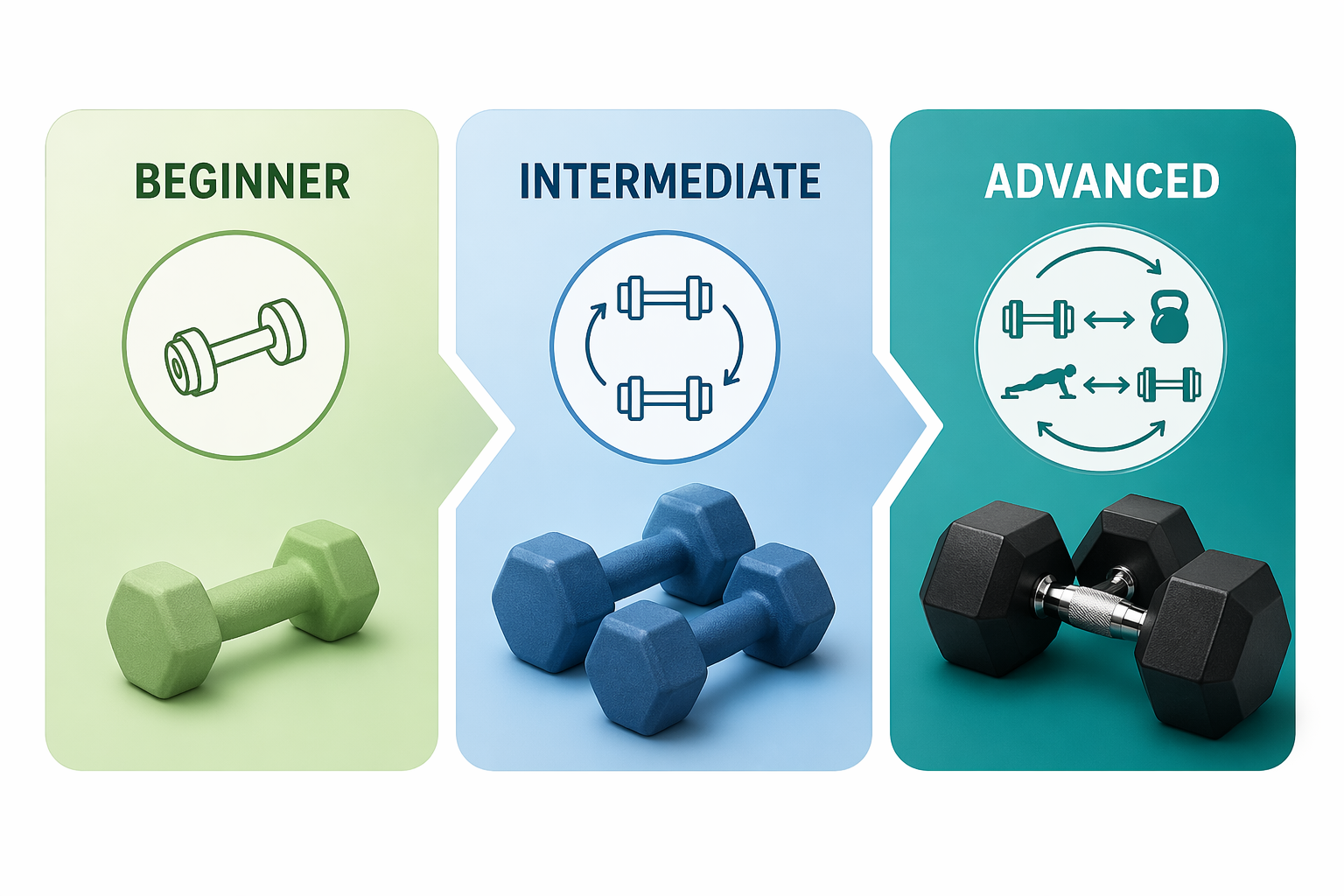
Self-select your tier based on your current training history, not your goals. A beginner who wants to build muscle should start on the beginner track. An intermediate lifter who wants fat loss should start on the intermediate track. Here is how to decide:
| Tier | Training History | Starting Cue |
|---|---|---|
| Beginner | Less than 6 months of consistent strength training, or returning after a 6+ month break | You are still learning movement patterns and need to establish a baseline weight for each exercise |
| Intermediate | 6–18 months of consistent training; you know your approximate 1RM for major lifts | You can complete 8–12 reps with controlled form on compound movements at a weight that feels challenging by rep 8 |
| Advanced | 18+ months of consistent training; you have experience with periodization and advanced techniques | You regularly train at 70%+ of 1RM and need supersets, tempo changes, or drop sets to continue progressing |
Tier 1: Beginner Track — Build Foundational Strength and Movement Patterns
The beginner track focuses on learning movement patterns with light-to-moderate loads and higher rep ranges (10–15 reps per set). The goal is not to max out — it is to build neuromuscular coordination, establish a baseline weight for each exercise, and develop the habit of consistent training.
Weight Selection Method for Beginners
Choosing the right starting weight is the most common point of confusion for new lifters. A practical method described by Bony to Beastly works well: grab a dumbbell you think you might be able to lift for 20–30 repetitions, but stop at 10. Keep doing gradually heavier warm-up sets until you hit muscle failure at 8–12 reps. That is your first real set. Write that weight down — it is your baseline for week 1.
An alternative approach from certified trainers uses rate of perceived exertion (RPE): you will know you picked a weight that is heavy enough if your final three reps feel really challenging but you are able to complete them with proper form. Both methods are compatible — use whichever makes more sense to you.
Beginner Track: Sample Week 1 Workout (Workout A)
| Exercise | Sets | Reps | RIR (Reps in Reserve) | Rest |
|---|---|---|---|---|
| Goblet Squat | 3 | 10–12 | 2 | 90 seconds |
| Dumbbell Bench Press (or Floor Press) | 3 | 10–12 | 2 | 90 seconds |
| Bent-Over Row | 3 | 10–12 | 2 | 90 seconds |
| Romanian Deadlift (RDL) | 3 | 10–12 | 2 | 90 seconds |
| Standing Overhead Press | 3 | 10–12 | 2 | 90 seconds |
| Plank (or Dumbbell Side Bend) | 3 | 30–45 sec | N/A | 60 seconds |
Workout B for week 2 swaps the goblet squat for a dumbbell front squat (or Bulgarian split squat if balance allows), the dumbbell bench press for an incline press, and the bent-over row for a single-arm row. The rep and RIR targets stay the same. This rotation prevents adaptation while keeping the movement patterns consistent.
Form cues for key beginner movements:
- Goblet Squat: Hold one dumbbell vertically against your chest, elbows pointing down. Keep your torso upright — the weight in front acts as a counterweight, allowing deeper range of motion. This is widely considered the best squat variation for beginners.
- Dumbbell Bench Press: If you do not have a bench, a floor press works a shorter range of motion and can be easier on the shoulders. Lie on the floor, press the dumbbells up from your chest, and let the floor stop your elbows at the bottom.
- Bent-Over Row: Hinge at the hips with a flat back, not a rounded spine. Pull the dumbbells toward your lower ribcage, squeezing your shoulder blades together at the top.
- Romanian Deadlift: Keep a slight bend in your knees. Hinge at the hips, pushing them back as you lower the dumbbells along your shins. You should feel a stretch in your hamstrings at the bottom.
Tier 2: Intermediate Track — Increase Volume, Shorten Rest, and Handle Heavier Loads
The intermediate track increases training volume (more sets or reps), shortens rest periods, and uses heavier loads — approximately 60–75% of your one-rep max. Research cited by Garage Gym Reviews indicates that resting 3–5 minutes between sets produces greater increases in absolute strength, but for a home training context where time is a constraint, 90–120 seconds is a practical compromise that still supports strength gains.
Exercise progressions from the beginner track: goblet squat becomes a dumbbell front squat (two dumbbells held at the shoulders), floor press becomes a full dumbbell bench press on a bench, and the bent-over row becomes a single-arm row with a heavier load. These progressions increase the demand on stabilizer muscles and allow heavier loading.
Intermediate Track: Sample Week 1 Workout (Workout A)
| Exercise | Sets | Reps | Load (% of 1RM) | Rest |
|---|---|---|---|---|
| Dumbbell Front Squat | 4 | 8–10 | 60–70% | 90–120 seconds |
| Dumbbell Bench Press | 4 | 8–10 | 60–70% | 90–120 seconds |
| Single-Arm Row | 4 | 8–10 per arm | 60–70% | 90–120 seconds |
| Romanian Deadlift | 4 | 8–10 | 60–70% | 90–120 seconds |
| Seated Dumbbell Shoulder Press | 3 | 8–10 | 60–70% | 90 seconds |
| Dumbbell Walking Lunge | 3 | 8–10 per leg | Moderate | 90 seconds |
Workout B for week 2 replaces the front squat with Bulgarian split squats, the bench press with incline dumbbell press, the single-arm row with a bent-over two-arm row, and adds a dumbbell pullover for lat and chest development. The set, rep, and rest parameters remain the same.
Tier 3: Advanced Track — Supersets, Complex Movements, and Added Isolation
The advanced track is designed for lifters who have outgrown straight-set training and need higher density to continue progressing. It uses supersets (pairing two exercises back-to-back with no rest), complex movements like the dumbbell snatch and renegade rows, and targeted isolation work. Rest periods drop to 30–60 seconds between supersets, which research suggests may be most effective when the training goal is muscular hypertrophy.
Advanced trainees can also use techniques like drop sets (reducing weight after reaching failure and continuing for additional reps) or tempo changes (slowing the eccentric phase to 3–4 seconds) to create new stimuli without increasing load beyond what dumbbells allow.
Advanced Track: Sample Week 1 Workout (Workout A)
| Superset | Exercise A | Sets x Reps | Exercise B | Sets x Reps | Rest Between Supersets |
|---|---|---|---|---|---|
| 1 | Dumbbell Snatch | 3 x 6–8 per arm | Renegade Row | 3 x 6–8 per arm | 60 seconds |
| 2 | Dumbbell Bulgarian Split Squat | 3 x 8–10 per leg | Dumbbell Pullover | 3 x 8–10 | 60 seconds |
| 3 | Incline Dumbbell Press | 3 x 8–10 | Bent-Over Row (pronated grip) | 3 x 8–10 | 60 seconds |
| 4 | Standing Overhead Press | 3 x 8–10 | Dumbbell Romanian Deadlift | 3 x 8–10 | 60 seconds |
| 5 | Dumbbell Bicep Curl | 3 x 10–12 | Overhead Triceps Extension | 3 x 10–12 | 45 seconds |
Workout B for week 2 swaps the snatch for a dumbbell clean and press, the Bulgarian split squat for a dumbbell reverse lunge with forward bend to overhead press, and the incline press for a flat dumbbell press. The superset structure and rest intervals remain the same.
The Progressive Overload Framework: How to Know When to Add Weight or Reps
Progressive overload is the single mechanism that drives all strength and hypertrophy gains. Every time you repeat a workout, you should try to do a little bit better than last time — either by adding weight, adding a rep, or improving form. The framework below applies to all three tracks.
The Rule: Add Weight When You Can Complete All Sets at the Top of the Recommended Rep Range
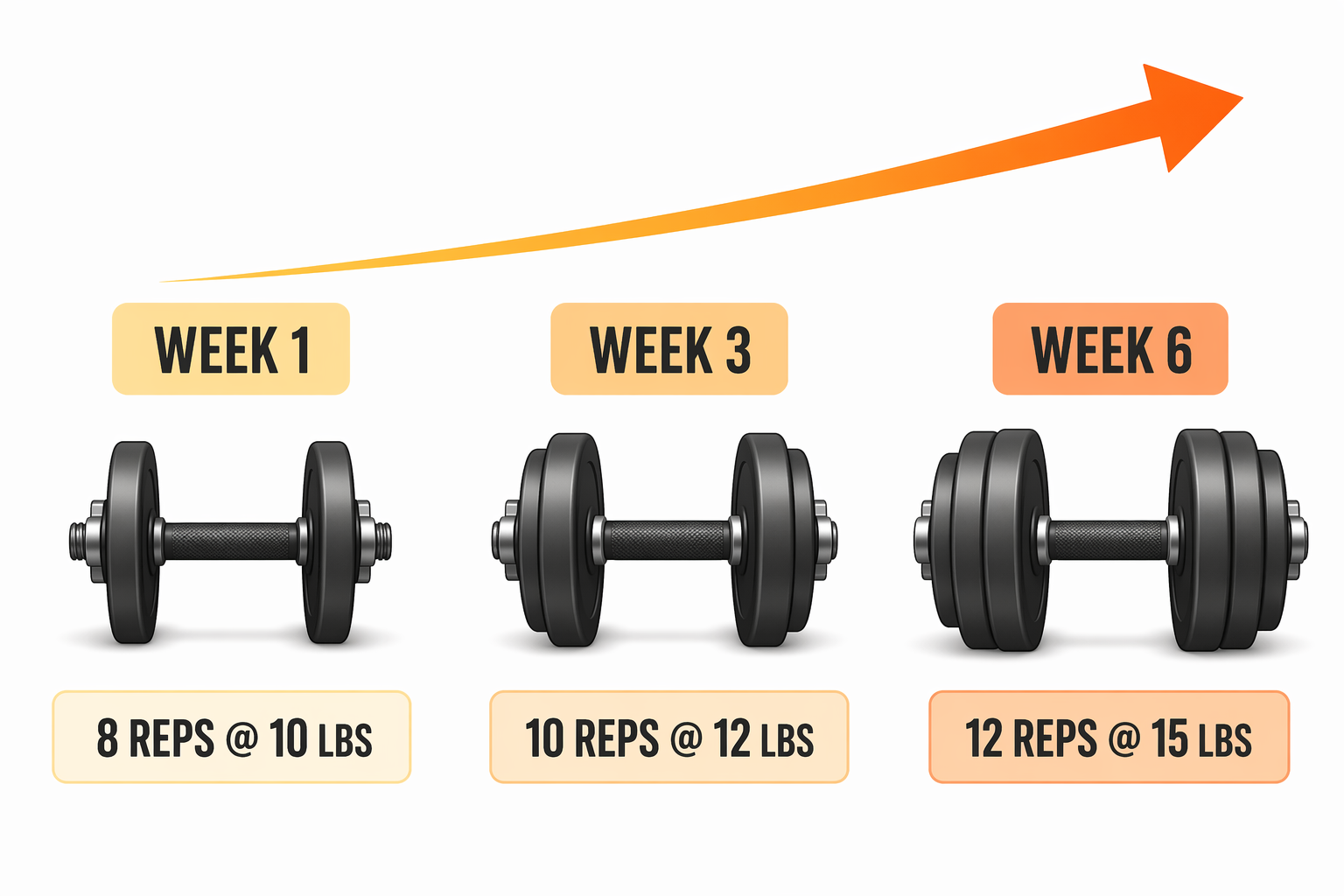
If your target is 8–12 reps for 3 sets, and you complete 12, 12, and 11 reps with good form, you are ready to increase the weight by the smallest available increment (typically 2.5–5 lbs per dumbbell). If you complete 10, 9, and 8 reps, stay at that weight and aim to add one rep to each set over the next sessions.
Here is a concrete example from Bony to Beastly: you start with 50 lbs x 10, 10, 9 on the dumbbell bench press. Next session, you aim for 10, 10, 10. Once you hit that, you move to 55 lbs and expect 10, 8, 7. Over several weeks, you work those 55 lbs sets up to 10, 10, 10, then move to 60 lbs. This is how linear progression works.
How to Track Progress Across 6 Weeks
| Week | Goal | What to Track |
|---|---|---|
| 1–2 | Establish baseline weights for each exercise | Weight used, reps completed per set, RIR |
| 3–4 | Add 1–2 reps per set where possible | Compare to week 1–2 numbers; aim for improvement on at least 4 of 6 exercises |
| 5–6 | Attempt small weight increases on compound lifts | If you hit the top of the rep range for all sets, increase weight by 2.5–5 lbs |
Printable Workout Tracker / Log
Tracking your workouts is the single most important habit for making progress. Without written records, you are guessing whether you lifted more than last session. Use the template below to log every set, rep, and weight for the full 6 weeks.
| Date | Exercise | Weight | Set 1 | Set 2 | Set 3 | Notes |
|---|---|---|---|---|---|---|
| Week 1, Mon | Goblet Squat | 30 lbs | 12 | 11 | 10 | Felt good, could add 2.5 lbs next week |
| Week 1, Mon | Dumbbell Bench Press | 25 lbs | 10 | 10 | 9 | Last rep of set 3 was hard — stay at 25 lbs |
| Week 1, Mon | Bent-Over Row | 30 lbs | 12 | 12 | 12 | Ready to move to 32.5 lbs |
| Week 1, Wed | Goblet Squat | 30 lbs | 12 | 12 | 11 | +1 rep on set 2 and 3 vs Monday |
| Week 1, Wed | Dumbbell Bench Press | 25 lbs | 11 | 10 | 10 | +1 rep on set 1 vs Monday |
Print this template or copy it into a notebook. Fill it out immediately after each set — do not rely on memory. If you prefer digital tracking, our comparison of the 6 best free workout planners covers apps and spreadsheets that can replace the paper log.
Nutrition Quick-Reference to Support Your Results
Training stimulus is only half the equation. Without adequate nutrition, your body cannot repair muscle tissue or build new tissue. This is not a full nutrition guide — it is a quick-reference to align your eating with your training goal.
| Goal | Calorie Target | Protein Target | Notes |
|---|---|---|---|
| Muscle Building | 200–300 calorie surplus above maintenance | 0.7–1g per pound of bodyweight | Prioritize protein at every meal; spread intake across 3–4 meals |
| Fat Loss | 300–500 calorie deficit below maintenance | 0.7–1g per pound of bodyweight | Higher protein helps preserve muscle mass during a deficit |
| Maintenance / General Fitness | Maintenance calories | 0.7g per pound of bodyweight | Focus on whole foods; protein timing is less critical |
If you are unsure of your maintenance calories, use an online TDEE calculator and track your weight for 2 weeks. Adjust by 100–200 calories per day if your weight is moving in the wrong direction. Protein is the most important macronutrient for training adaptation — hitting your protein target consistently matters more than meal timing.
What to Do After Week 6: Next Steps and Plateau-Busting Strategies
After completing the 6-week plan, you have several options depending on your progress and goals:
- Repeat the plan with heavier weights: If you are still making linear progress on most exercises, run the same plan again starting at your week 6 weights. You may find you can add another 5–10 lbs to your compound lifts in the second cycle.
- Move to the next tier: If you completed the beginner track and hit all rep targets by week 6, move to the intermediate track. If you finished the intermediate track and want more density, move to the advanced track.
- Explore plateau-busting strategies: If you stalled on multiple exercises in weeks 5–6, you may need a deload week (reduce volume and intensity by 40–50% for one week) or a change in exercise selection. Our Full Body Dumbbell Workout Progression article covers specific strategies for intermediate and advanced lifters who have outgrown linear progression.
- Specialize: If you want to focus on leg development, our leg day progression path provides a structured path from bodyweight to dumbbell-dominant leg sessions.
What a small equipment investment adds
We don't have a build tagged to this exact tier yet. Browse all builds.
How often should you repeat this?
See our recovery and rest reference for citation-anchored rest-interval guidance.
Spot something off?
Tell us if a movement, tier assumption, or duration didn't match your experience.