
Full Body Dumbbell Workout Progression: How to Keep Getting Results After You Outgrow Beginner Routines
Stuck in a dumbbell plateau? This guide shows intermediate home lifters how to use rep-range rotation, tempo manipulation, pre-exhaustion, and single-leg variations to keep building muscle without heavier weights.
- Duration
- 45 min
Why Your Dumbbell Gains Are Slowing Down (And Why It’s Not the Dumbbells’ Fault)
If you’ve been running a basic full-body dumbbell routine for the past four to eight weeks, you’ve probably noticed the same pattern: the first few weeks felt like a rocket ship, but now that 2.5 lb jump on each dumbbell either feels impossible or leaves your grip shot before your target muscles are fatigued. This is the intermediate plateau, and it’s not a sign that you’ve outgrown dumbbells. It’s a sign that you’ve outgrown linear progression.
With a barbell, you can add 2.5 lbs to the bar and keep moving. With dumbbells, the smallest increment is often 2.5 lbs per hand — a 5 lb total jump — which can represent a 10–15% increase on an upper-body movement. That’s a massive leap for your nervous system and connective tissue. Add in the fact that your grip and forearms have to stabilize two independent loads, and it’s no wonder simple weight progression stalls.
The good news is that you can keep building muscle with the dumbbells you already own for another six to twelve months — possibly longer — by manipulating variables that have nothing to do with the number on the side of the dumbbell. Rep ranges, tempo, exercise order, and set structure are all levers you can pull to create progressive overload without adding a single pound of weight.
Four Research-Backed Progression Strategies for Dumbbell-Only Training
The following four strategies are the core of this article. Each one addresses a specific limitation of dumbbell training — whether it’s the inability to make small weight jumps, the challenge of loading legs sufficiently, or the difficulty of maintaining intensity across a full-body session. Used together, they form a complete system for breaking through plateaus.
Before we dive into the details, it’s worth noting that a three-day-per-week full-body split remains an excellent choice for intermediate home lifters. A meta-analysis from Stronger By Science of 13 studies (305 subjects) found that higher training frequencies were associated with significantly more hypertrophy — about 38% faster growth overall. For trained subjects specifically, higher frequency groups grew about 32% faster. Each additional training day per week increased weekly hypertrophy by 0.11%. This means that running a well-structured full-body routine three times per week is not just a compromise for limited equipment; it’s a scientifically supported approach to maximizing muscle growth.
- Rep-Range Rotation (6-12-25 Method): Cycling heavy, moderate, and light rep days across the week to challenge different muscle fibers and motor units.
- Tempo Manipulation: Slowing the eccentric (lowering) phase to increase time under tension by 50–100%, making a lighter dumbbell feel significantly heavier.
- Pre-Exhaustion: Performing an isolation exercise to failure before a compound movement so the target muscle is already fatigued when you start the heavier lift.
- Drop Sets for Isolation Finishers: Taking the final set of an isolation exercise past failure by reducing weight and continuing, adding a potent hypertrophy stimulus.
Strategy 1: Rep-Range Rotation (The 6-12-25 Method)
The 6-12-25 method, popularized by Nourish Move Love, is a rep-range rotation strategy that involves performing three sets of an exercise with different rep targets: 6 reps with a heavy weight, 12 reps at a moderate weight, and 25 reps at a light weight. The idea is that each rep range challenges your muscles in a fundamentally different way — heavy loads target high-threshold motor units and maximal strength, moderate loads drive metabolic stress and hypertrophy, and light loads build muscular endurance and pump.
For dumbbell training, this method solves a critical problem: you don’t need to increase the weight every session to create progressive overload. Instead, you rotate the stimulus across the week. On your heavy day, you use the heaviest dumbbell you can manage for 6 reps. On your moderate day, you drop to a weight that allows 12 clean reps. On your light day, you use a weight that lets you hit 25 reps with good form.
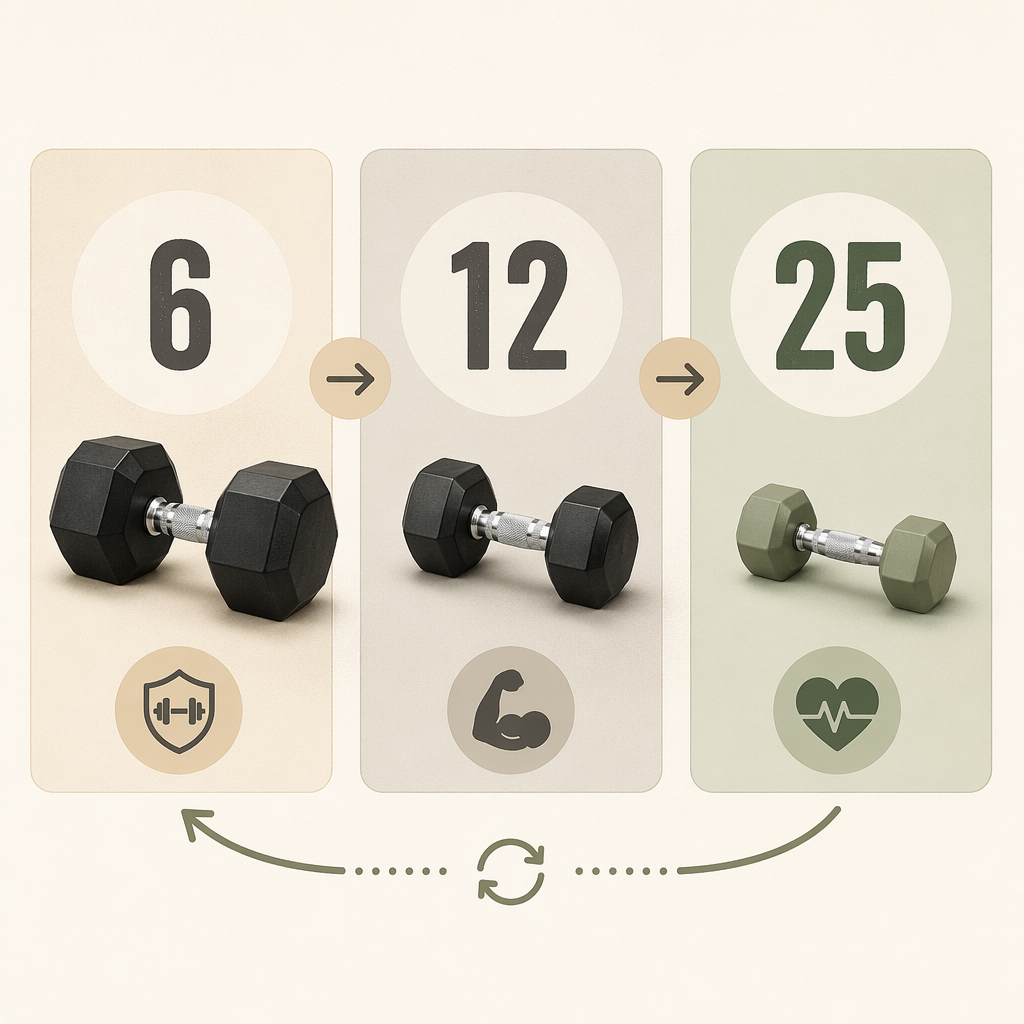
How to apply it to a dumbbell squat:
| Day | Rep Target | Weight Selection | Stimulus Focus |
|---|---|---|---|
| Heavy Day | 6 reps | Heaviest weight you can lift for 6 reps with good form | Maximal strength, high-threshold motor units |
| Moderate Day | 12 reps | Weight that reaches failure at rep 12 | Hypertrophy, metabolic stress |
| Light Day | 25 reps | Weight that reaches failure at rep 25 | Muscular endurance, pump, blood flow |
You don’t have to apply this to every exercise in your routine. A practical approach is to use the 6-12-25 rotation for your primary compound movements (squat, press, row) and keep your isolation work at a consistent 10–15 rep range. This prevents the session from becoming overly complex while still giving you the benefit of varied stimulus across the week.
Strategy 2: Tempo Manipulation (2-0-2 vs. 3-1-3)
Tempo manipulation is one of the most underused tools in home training. The tempo of a lift is typically written as a four-digit code: eccentric (lowering) phase, pause at the bottom, concentric (lifting) phase, pause at the top. A standard 2-0-2 tempo means you lower the weight for two seconds, no pause, and lift for two seconds. A 3-1-3 tempo means you lower for three seconds, pause for one second at the stretched position, and lift for three seconds.
Slowing the eccentric to 3–4 seconds can increase time under tension by 50–100% per rep. If you’re doing 10 reps at a 2-0-2 tempo, your total time under tension is about 40 seconds. At a 3-1-3 tempo, the same 10 reps take about 70 seconds. That extra time creates a powerful growth stimulus because your muscles are under mechanical load for longer, which drives metabolic stress and muscle fiber recruitment.
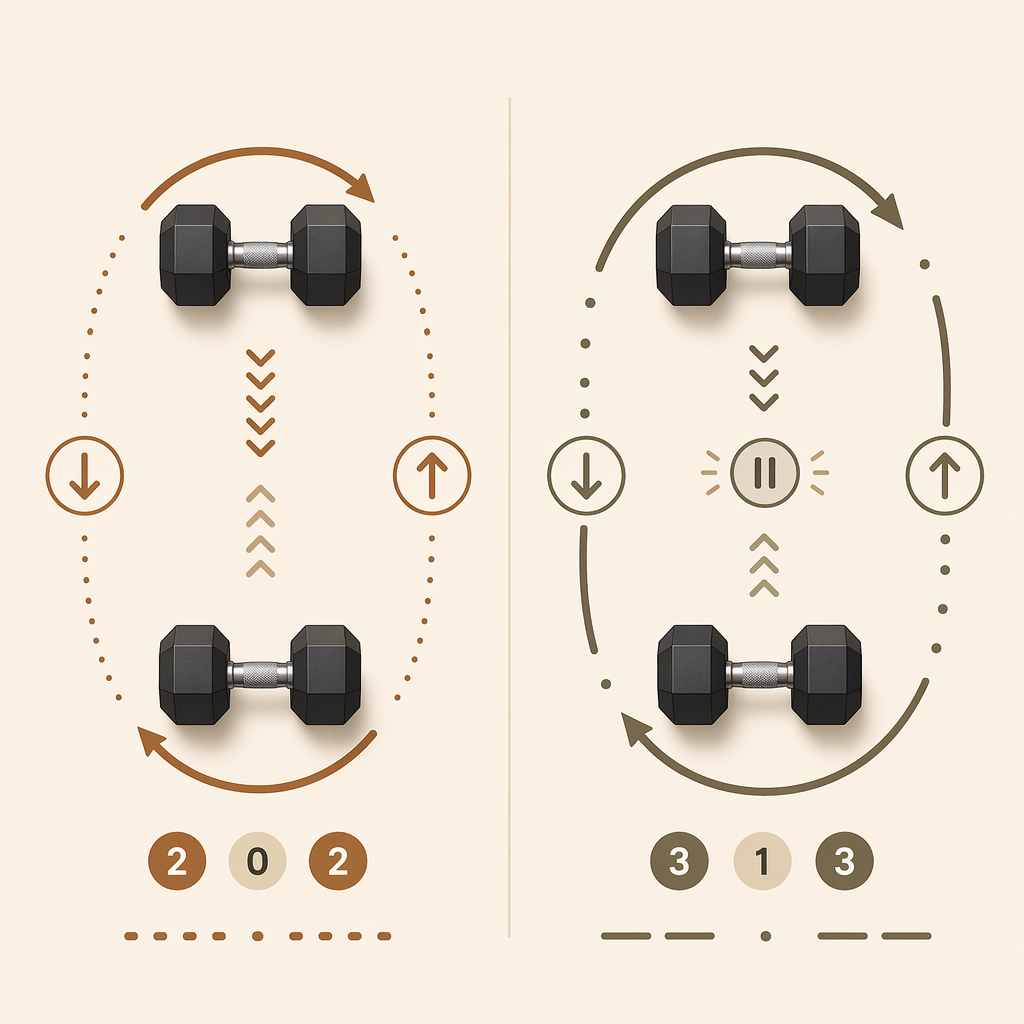
Practical application:
| Tempo | Eccentric | Pause | Concentric | Total Time (10 reps) | Effect |
|---|---|---|---|---|---|
| 2-0-2 | 2 sec | 0 sec | 2 sec | ~40 sec | Standard pace, moderate time under tension |
| 3-1-3 | 3 sec | 1 sec | 3 sec | ~70 sec | High time under tension, increased metabolic stress |
A controlled 3-1-3 tempo can make a 30 lb dumbbell feel like 40 lbs because your muscles are under load for longer. This is especially useful for upper-body pressing and pulling movements where your grip is often the limiting factor. By slowing down, you shift the demand from your grip to the target muscle group.
Strategy 3: Pre-Exhaustion (Flyes Before Presses)
Pre-exhaustion is a technique where you perform an isolation exercise to failure immediately before a compound movement that targets the same muscle group. The goal is to fatigue the target muscle so that the subsequent compound exercise becomes more challenging — even with a lighter dumbbell — because the muscle is already partially exhausted.
This technique was a key component of the 100-day dumbbell transformation documented by Men's Health UK. When the subject’s 50 lb dumbbells felt too light for chest presses, the solution was to start with dumbbell flyes to take the chest to failure, then switch immediately to a heavier press. The pre-fatigued chest muscle required more effort from the same weight, effectively creating progressive overload without adding a single pound.
Common pre-exhaustion pairings for dumbbell training:
- Chest: Dumbbell flyes (to failure) → Dumbbell bench press
- Shoulders: Dumbbell lateral raises (to failure) → Dumbbell overhead press
- Back: Dumbbell pullovers (to failure) → Dumbbell rows
- Legs: Dumbbell leg extensions (to failure) → Dumbbell squats
Safety cues:
Pre-exhaustion places a high demand on the target muscle and can increase injury risk if your form breaks down. Use a weight that allows you to maintain perfect technique on the isolation exercise. On the compound movement, expect to use a weight that is 10–20% lighter than your usual working weight. If you feel joint pain (especially in the shoulders during flyes), stop immediately and reduce the range of motion or switch to a different isolation exercise.
Strategy 4: Drop Sets for Isolation Finishers
Drop sets are a classic intensity technique where you perform a set to failure, then immediately reduce the weight by 20–30% and continue to failure again. This allows you to accumulate more reps at a high effort level than you could with a single straight set, creating a potent hypertrophy stimulus.
For dumbbell training, drop sets are best reserved for isolation exercises at the end of your workout — lateral raises, bicep curls, tricep extensions, and calf raises. These movements don’t require heavy loading to be effective, and the drop set protocol allows you to push past failure safely because the reduced weight is easier to control.
Drop set protocol:
- Select a weight you can lift for 10–12 reps with good form.
- Perform the set to concentric failure (you cannot complete another rep).
- Immediately reduce the weight by 20–30% (e.g., from 20 lbs to 15 lbs). Rest no more than 10 seconds during the weight change.
- Continue to failure again. This is one drop set.
- Limit drop sets to the final set of one or two isolation exercises per workout.
Exercise Swaps That Add Difficulty Without More Weight
Sometimes the most effective way to increase difficulty is not to add weight, but to change the exercise itself. The following substitutions increase the challenge by altering leverage, range of motion, stability demands, or the load distribution between limbs.
| Standard Exercise | Progression Swap | Why It’s Harder | Dumbbell Weight Adjustment |
|---|---|---|---|
| Goblet squat | Bulgarian split squat | Doubles the load per leg; adds balance and stability demand | Reduce weight by 20–30% initially |
| Standard push-up | Deficit push-up (hands on dumbbells) | Increases range of motion by 2–4 inches | No weight change needed |
| Bent-over row (two arms) | Single-arm row | Eliminates momentum from the stronger side; increases core demand | Reduce weight by 30–40% |
| Romanian deadlift (two legs) | Single-leg Romanian deadlift | Doubles load per leg; adds balance and hip stability demand | Reduce weight by 40–50% |
| Standard bicep curl | Paused bicep curl (3-sec hold at peak) | Increases time under tension at the most mechanically disadvantageous position | Reduce weight by 10–20% |
The Bulgarian split squat is perhaps the single most valuable swap for home lifters with limited dumbbell weight. By splitting your stance and elevating your rear foot, you effectively double the load per leg. A 40 lb dumbbell in a goblet squat position loads each leg with roughly 20 lbs. In a Bulgarian split squat, that same 40 lb dumbbell loads the front leg with nearly the full 40 lbs. This allows you to continue building leg strength and size even with relatively light dumbbells.
Sample Intermediate 3-Day Full Body Dumbbell Program
The following program incorporates all four progression strategies across a three-day training week. Each day has a different rep-range focus, tempo prescription, and set structure. Perform this program for 4–6 weeks before reassessing your working weights and adjusting the progression variables.
General warm-up (5 minutes):
- Arm circles (forward and backward) — 30 seconds each direction
- Bodyweight squats — 15 reps
- Cat-cow stretch — 10 reps
- Glute bridges — 12 reps
- Light dumbbell warm-up set (50% of working weight) — 8 reps for each primary movement
Day 1: Heavy (6 reps, 2-0-2 tempo)
| Exercise | Sets | Reps | Tempo | Rest |
|---|---|---|---|---|
| Dumbbell goblet squat | 3 | 6 | 2-0-2 | 90 sec |
| Dumbbell bench press | 3 | 6 | 2-0-2 | 90 sec |
| Dumbbell bent-over row | 3 | 6 | 2-0-2 | 90 sec |
| Dumbbell overhead press | 3 | 6 | 2-0-2 | 90 sec |
| Dumbbell Romanian deadlift | 3 | 6 | 2-0-2 | 90 sec |
| Dumbbell bicep curl | 2 | 8 | 2-0-2 | 60 sec |
| Dumbbell tricep extension | 2 | 8 | 2-0-2 | 60 sec |
Day 2: Moderate (12 reps, 3-1-3 tempo) with Pre-Exhaustion
| Exercise | Sets | Reps | Tempo | Rest | Notes |
|---|---|---|---|---|---|
| Dumbbell flyes (pre-exhaust) | 2 | 12 | 3-1-3 | 60 sec | Take to failure |
| Dumbbell bench press | 3 | 12 | 3-1-3 | 90 sec | Use 10–20% lighter than Day 1 |
| Dumbbell lateral raises (pre-exhaust) | 2 | 12 | 3-1-3 | 60 sec | Take to failure |
| Dumbbell overhead press | 3 | 12 | 3-1-3 | 90 sec | Use 10–20% lighter than Day 1 |
| Dumbbell single-arm row | 3 | 12 | 3-1-3 | 90 sec | Per arm |
| Dumbbell Bulgarian split squat | 3 | 12 | 3-1-3 | 90 sec | Per leg |
| Dumbbell leg curl (or glute ham raise) | 3 | 12 | 3-1-3 | 60 sec |
Day 3: Light (25 reps, 2-0-2 tempo) with Drop Sets
| Exercise | Sets | Reps | Tempo | Rest | Notes |
|---|---|---|---|---|---|
| Dumbbell goblet squat | 2 | 25 | 2-0-2 | 60 sec | Light weight, focus on depth |
| Dumbbell bench press | 2 | 25 | 2-0-2 | 60 sec | Light weight, full range of motion |
| Dumbbell bent-over row | 2 | 25 | 2-0-2 | 60 sec | Light weight, squeeze at top |
| Dumbbell overhead press | 2 | 25 | 2-0-2 | 60 sec | Light weight, control the descent |
| Dumbbell lateral raise | 1 drop set | 12 → failure | 2-0-2 | — | Drop set: 12 reps, reduce 20–30%, to failure |
| Dumbbell bicep curl | 1 drop set | 12 → failure | 2-0-2 | — | Drop set: 12 reps, reduce 20–30%, to failure |
| Dumbbell tricep extension | 1 drop set | 12 → failure | 2-0-2 | — | Drop set: 12 reps, reduce 20–30%, to failure |
Cool-down (5 minutes):
- Chest stretch (doorway or wall) — 30 seconds per side
- Lat stretch (overhead reach) — 30 seconds per side
- Quad stretch (standing) — 30 seconds per side
- Hamstring stretch (seated forward fold) — 30 seconds
- Deep breathing (diaphragmatic) — 5 slow breaths
When to Consider a Split Routine or Heavier Dumbbells
The techniques in this article can extend the life of your dumbbell-only training by six to twelve months, but they are not infinite. At some point, you will need to either increase the available weight or change your training structure to continue making progress.
Signs it’s time to consider a split routine:
- You can complete all three full-body sessions per week with no residual soreness or fatigue.
- Your recovery is consistently good, and you feel you could train more frequently.
- You’ve been running a full-body program for 12+ weeks and progress has stalled despite using all four progression strategies.
- You want to focus more volume on specific muscle groups (e.g., legs or back) without increasing session length beyond 60 minutes.
Signs it’s time to invest in heavier dumbbells or additional equipment:
- You can perform Bulgarian split squats with your heaviest dumbbell for 12+ reps with good form and still have 2+ reps in reserve.
- Your heaviest dumbbell (e.g., 50 lbs) feels light on compound pressing and rowing movements, even with a slow tempo.
- You’ve maxed out the weight on your adjustable dumbbells and cannot find a way to increase load through technique alone.
- You have the budget and space for heavier dumbbells (50–80 lbs) or a barbell and rack.
If you’re considering upgrading your equipment, the Home Fitness Decision Guide can help you evaluate your next steps based on your goals, space, and budget. For a detailed breakdown of what to buy and in what order, the Essential Equipment Checklist and Build Sequence provides a practical roadmap for upgrading your home gym without overspending.
Until then, the four strategies in this article — rep-range rotation, tempo manipulation, pre-exhaustion, and drop sets — give you everything you need to keep building muscle with the dumbbells you already own. The plateau is not the end of your progress. It’s just the beginning of smarter training.
What a small equipment investment adds
We don't have a build tagged to this exact tier yet. Browse all builds.
How often should you repeat this?
See our recovery and rest reference for citation-anchored rest-interval guidance.
Spot something off?
Tell us if a movement, tier assumption, or duration didn't match your experience.