
The Complete Guide to Full Body Dumbbell Workouts: How to Program, Progress, and Periodize With Just Dumbbells
A complete, evidence-based guide for home gym lifters who own dumbbells and want a structured full body workout. Covers exercise selection rationale, three sample programs (beginner, intermediate, no-bench), and a detailed progression framework for limited dumbbell increments.
- Duration
- 45 min
Why Full Body With Dumbbells?
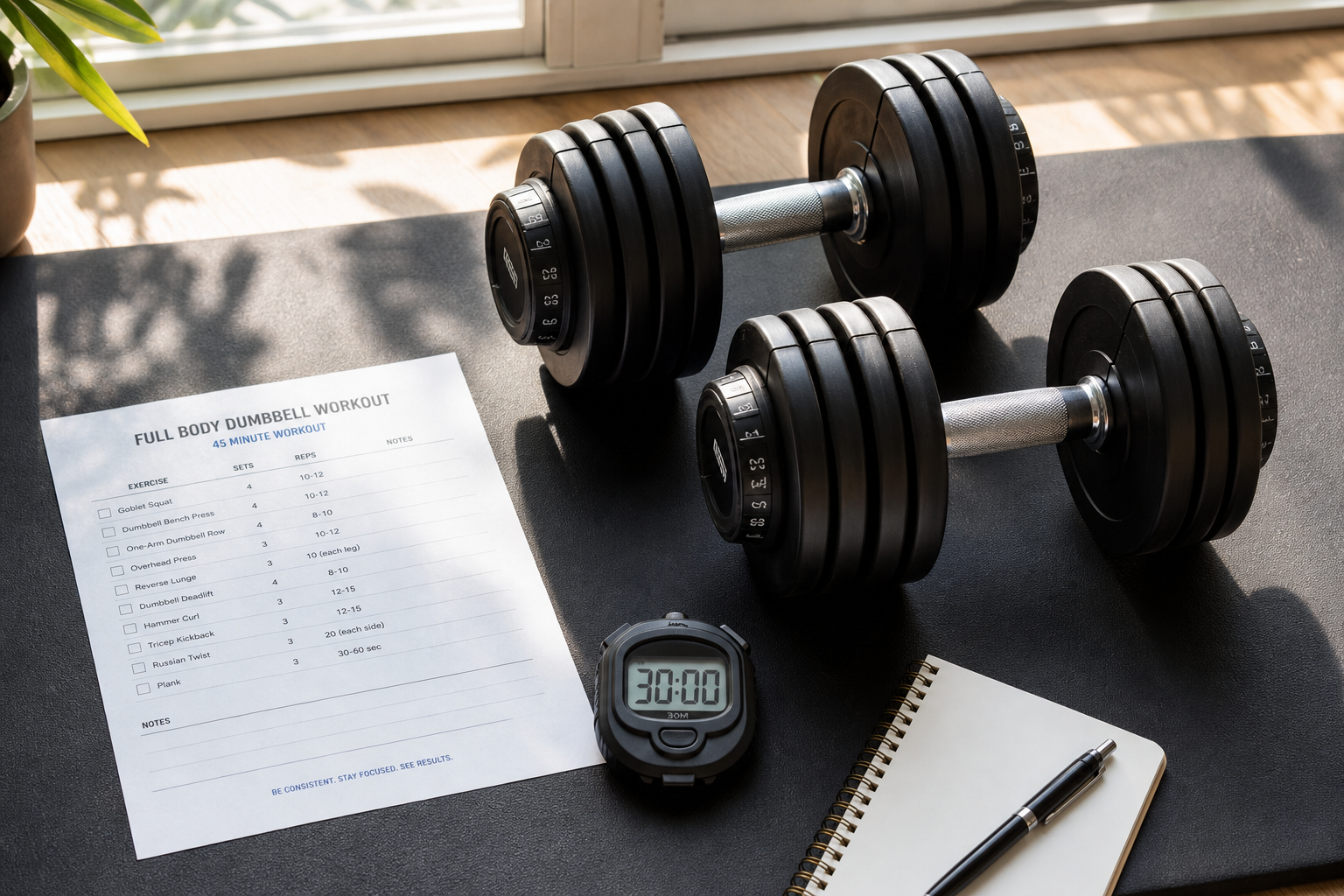
If you own a pair of dumbbells and have 30 to 45 minutes, three days per week, you already have everything you need to build muscle, lose fat, and get stronger. The question is not whether dumbbells work — it is whether you have a program that makes them work.
The evidence for full body training is well established. A 2024 meta-analysis by Ramos-Campo gathered all fourteen studies comparing full body routines against split routines and found that both approaches stimulate the same amount of muscle growth and strength gains when total weekly volume is matched. Twelve of those fourteen studies controlled for volume, making the comparison clean. This means you are not sacrificing results by choosing full body over a bodybuilding split.
Full body training offers practical advantages that matter for home gym users. You train each muscle group two to three times per week, which research suggests may produce superior growth compared to once-weekly training. Each session is shorter — typically 30 to 45 minutes — because you are not spending an entire workout on a single body part. And if you miss a session, you have not lost a week of stimulus for that muscle group; the next workout will hit it again.
A 2016 study published in Biology of Sport (Crewther et al.) found that full body workouts burned nearly three times more fat mass than split routines over a four-week period. While fat loss ultimately depends on calorie balance, the higher metabolic demand of compound, multi-joint movements likely contributes to this effect.
The bottom line: full body training with dumbbells is not a compromise. It is a time-efficient, evidence-backed approach that works for beginners and intermediate lifters alike. The programming logic — not the equipment — determines your results.
The Five Movement Patterns Every Dumbbell Workout Needs
A well-designed full body workout is not a random collection of exercises. It covers five fundamental movement patterns: squat, hinge, push, pull, and carry. Including all five in each session ensures balanced muscle development, joint health, and injury prevention. Skip one pattern consistently, and you create an imbalance that eventually limits progress.
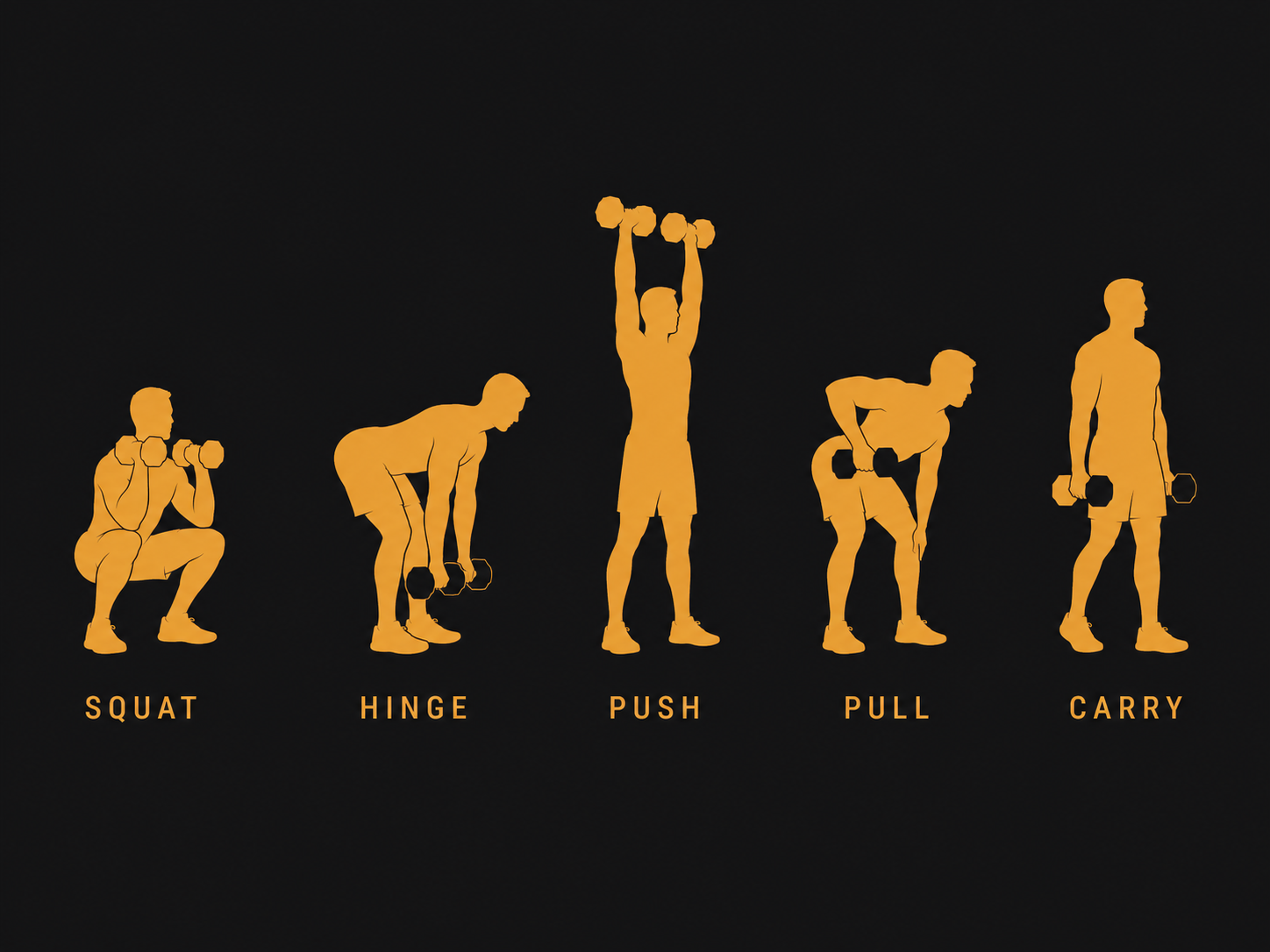
- Squat pattern: knee-dominant movements that target the quadriceps, glutes, and core. Goblet squats, front squats, and Bulgarian split squats all fall here.
- Hinge pattern: hip-dominant movements that work the posterior chain — hamstrings, glutes, and lower back. Dumbbell Romanian deadlifts (RDLs), single-leg RDLs, and glute bridges are the primary options.
- Push pattern: horizontal and vertical pressing that targets the chest, shoulders, and triceps. Dumbbell bench press, floor press, overhead press, and incline press cover this category.
- Pull pattern: horizontal and vertical pulling that works the back, biceps, and rear delts. Dumbbell rows, renegade rows, and pullovers are the most accessible dumbbell options.
- Carry pattern: loaded carries that build grip strength, core stability, and shoulder health. Farmer's carries, suitcase carries, and waiter's carries are simple but effective.
You do not need to include every pattern in every single workout, but over the course of a week each pattern should be trained at least twice. The sample programs later in this article are built around this framework.
Exercise Selection: Best Dumbbell Exercises for Each Pattern
Choosing the right exercise for each pattern matters more than having many options. The best dumbbell exercises are those that allow you to load the pattern effectively with limited equipment, maintain good form, and progress over time. Below is a table of recommended exercises with rationale and common form pitfalls.
| Pattern | Best Exercise | Why It Works | Common Mistake |
|---|---|---|---|
| Squat | Goblet Squat | Allows deeper range of motion with lighter loads; the front-loaded position keeps the torso upright and engages the core naturally. | Letting the elbows touch the knees at the bottom; keep the torso braced and elbows pointed down. |
| Hinge | Dumbbell RDL | Targets the entire posterior chain; easy to load progressively with dumbbells; low injury risk when form is correct. | Rounding the lower back at the bottom; keep a neutral spine and push the hips back. |
| Push (Horizontal) | Dumbbell Floor Press | Safer for shoulder joints than bench press for some lifters; limits range of motion naturally, reducing shoulder strain; no bench required. | Flaring the elbows; keep them at a 45-degree angle to the torso. |
| Push (Vertical) | Standing Overhead Press | Builds shoulder strength and core stability; can be loaded heavily; no bench needed. | Arching the lower back to press more weight; brace the core and squeeze the glutes. |
| Pull (Horizontal) | One-Arm Dumbbell Row | Allows heavy loading; supports the body with the free hand, reducing lower back strain; easy to correct imbalances. | Using momentum to row the weight; keep the torso stable and pull from the lats. |
| Pull (Vertical-ish) | Dumbbell Pullover | Works the lats and chest simultaneously; excellent for overhead pulling when you lack a pull-up bar. | Using too much arm bend; keep a slight bend in the elbows and focus on the lat stretch. |
| Carry | Farmer's Carry | Builds grip strength, core stability, and shoulder endurance; carries over to every other lift. | Shrugging the shoulders up; keep them packed down and walk with a tall posture. |
Sample Program 1: Beginner Full Body (Hypertrophy Focus)
This program is designed for someone who has been training consistently for 0 to 6 months and wants to build muscle. It uses a 3x/week schedule (e.g., Monday, Wednesday, Friday) with 48 hours of rest between sessions. Each workout takes approximately 45 minutes including warm-up.
The rep range is 8 to 12 for all exercises. Rest 60 to 90 seconds between sets. Aim for 1 to 2 reps in reserve (RIR) on each set — meaning you could have done one or two more reps with perfect form but chose to stop. This RIR target keeps the stimulus high without accumulating excessive fatigue.
| Exercise | Sets | Reps | Rest |
|---|---|---|---|
| A: Goblet Squat | 3 | 8–12 | 90 sec |
| B: Dumbbell RDL | 3 | 8–12 | 90 sec |
| C: Dumbbell Floor Press | 3 | 8–12 | 60 sec |
| D: One-Arm Dumbbell Row | 3 | 8–12 per side | 60 sec |
| E: Standing Overhead Press | 3 | 8–12 | 60 sec |
| F: Farmer's Carry | 3 | 30–45 sec per trip | 60 sec |
Warm-up (5–7 minutes): 5 minutes of light cardio (jumping jacks, high knees, or brisk walking in place), followed by 10 bodyweight squats, 10 glute bridges, and 10 arm circles each direction.
Cool-down (5 minutes): Hold a deep squat for 30 seconds, a standing hamstring stretch for 30 seconds per leg, and a doorway chest stretch for 30 seconds per side.
Perform this program for 8 weeks before reassessing. If you miss a session, do not double up the next day — just pick up with the next scheduled workout.
Sample Program 2: Intermediate Full Body (Strength-Hypertrophy Blend)
Once you have completed the beginner program or have been training consistently for 6 to 12 months, your body adapts to a fixed stimulus. The intermediate program introduces periodization: you alternate between strength-focused days (lower reps, heavier weight, longer rest) and hypertrophy-focused days (moderate reps, moderate weight, shorter rest).
The schedule remains 3x/week, but the workouts differ. Week 1 might be Strength A, Hypertrophy B, Strength A. Week 2 would be Hypertrophy B, Strength A, Hypertrophy B. This undulating periodization prevents stagnation and keeps progress moving.
| Day Type | Exercise | Sets | Reps | Rest |
|---|---|---|---|---|
| Strength A | Goblet Squat | 4 | 4–6 | 3 min |
| Strength A | Dumbbell RDL | 4 | 4–6 | 3 min |
| Strength A | Dumbbell Floor Press | 4 | 4–6 | 3 min |
| Strength A | One-Arm Dumbbell Row | 4 | 4–6 per side | 3 min |
| Strength A | Standing Overhead Press | 3 | 4–6 | 3 min |
| Strength A | Farmer's Carry | 3 | 20–30 sec heavy | 90 sec |
| Hypertrophy B | Bulgarian Split Squat | 3 | 8–12 per side | 60 sec |
| Hypertrophy B | Single-Leg RDL | 3 | 8–12 per side | 60 sec |
| Hypertrophy B | Incline Dumbbell Press (or Floor Press) | 3 | 8–12 | 60 sec |
| Hypertrophy B | Renegade Row | 3 | 8–12 per side | 60 sec |
| Hypertrophy B | Dumbbell Pullover | 3 | 8–12 | 60 sec |
| Hypertrophy B | Suitcase Carry | 3 | 30–45 sec per side | 60 sec |
On strength days, the weight should be challenging enough that you cannot complete more than 6 reps. On hypertrophy days, choose a weight that allows you to reach 12 reps on the first set but forces you to stop around 8 to 10 on the last set. This blend keeps both strength and muscle mass progressing.
Sample Program 3: No-Bench Full Body Workout
Not everyone owns a bench. That is not a limitation — it is a constraint that forces smarter exercise selection. You can still train every major muscle group effectively using floor-based and standing exercises.
The floor press replaces the bench press. The standing overhead press replaces any incline work. Dumbbell pullovers provide lat and chest stimulus. Goblet squats and RDLs cover the lower body without needing a bench for support. This program is a complete 3x/week full body routine that requires nothing but dumbbells and floor space.
| Exercise | Sets | Reps | Rest |
|---|---|---|---|
| Goblet Squat | 3 | 8–12 | 90 sec |
| Dumbbell RDL | 3 | 8–12 | 90 sec |
| Dumbbell Floor Press | 3 | 8–12 | 60 sec |
| One-Arm Dumbbell Row | 3 | 8–12 per side | 60 sec |
| Standing Overhead Press | 3 | 8–12 | 60 sec |
| Dumbbell Pullover | 3 | 10–12 | 60 sec |
| Farmer's Carry | 3 | 30–45 sec | 60 sec |
How to Progress When Dumbbells Have Fixed Increments
This is the section most full body dumbbell articles skip, and it is the most important one. If your dumbbells jump by 5 or 10 pounds between increments, you cannot simply add weight every week. You need a progression system that works within those constraints.
Double Progression
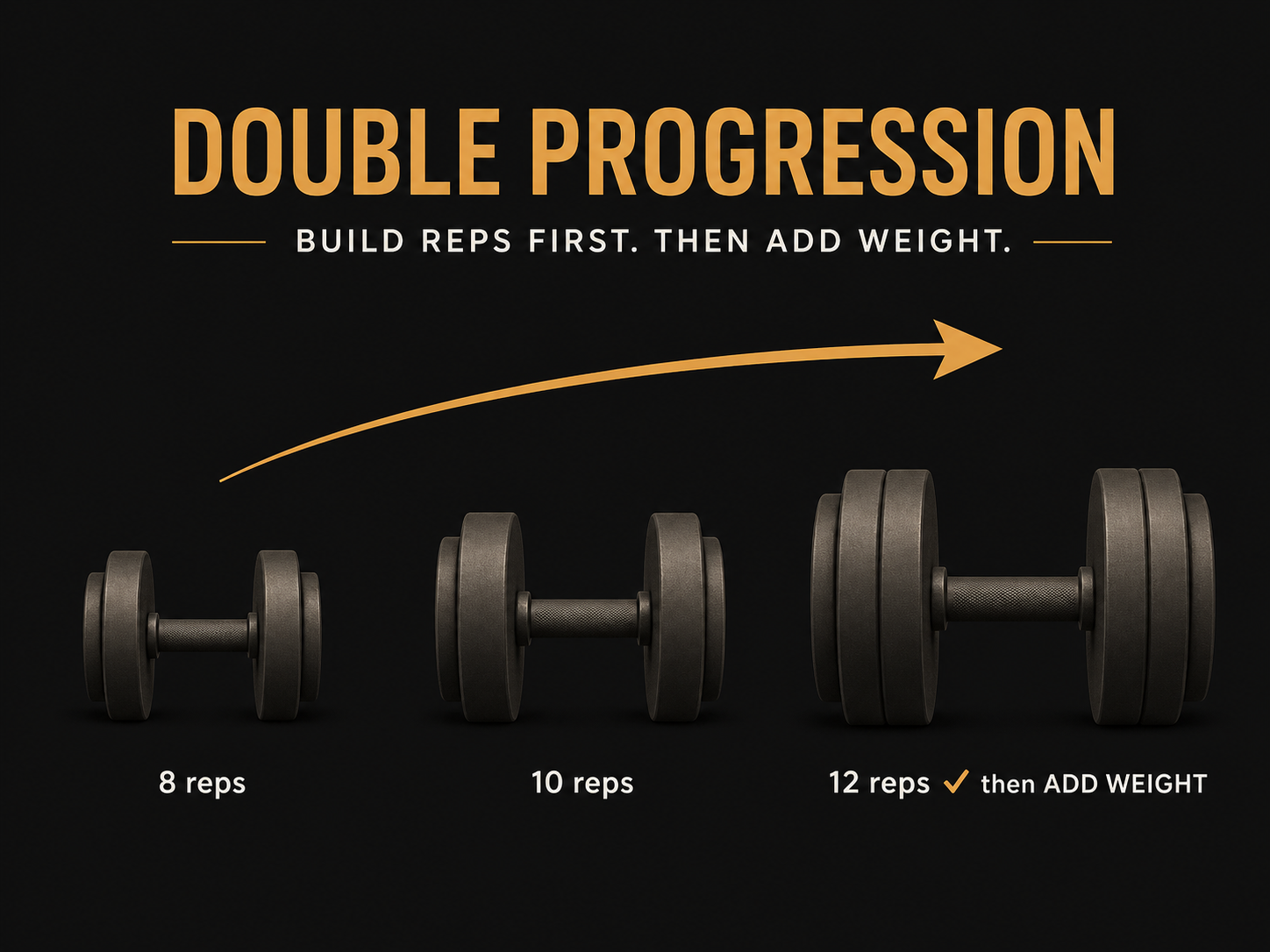
Double progression is the most reliable method for fixed-increment dumbbells. Here is how it works:
- Pick a rep range (e.g., 8 to 12 reps).
- Use a weight that allows you to complete at least 8 reps on your first set.
- Each session, try to add one more rep to your first set. If you hit 8 reps this week, aim for 9 next week.
- Once you can complete 12 reps on your first set with good form, increase the weight by the smallest available increment.
- When you increase the weight, your reps will drop back to the bottom of the range (likely 6 to 8). Repeat the process.
A real example from a home gym user on the Muscle & Strength forum: they started with 20 lb dumbbells and progressed to 40 lb dumbbells over 12 months using exactly this method. The key is patience — you do not need to add weight every week. Adding one rep per week is still progress.
| Week | Weight | Set 1 | Set 2 | Set 3 |
|---|---|---|---|---|
| Week 1 | 50 lb | 10 reps | 10 reps | 9 reps |
| Week 2 | 50 lb | 10 reps | 10 reps | 10 reps |
| Week 3 | 55 lb | 10 reps | 8 reps | 7 reps |
| Week 4 | 55 lb | 10 reps | 9 reps | 8 reps |
| Week 5 | 55 lb | 10 reps | 10 reps | 9 reps |
| Week 6 | 55 lb | 10 reps | 10 reps | 10 reps |
Rep Goal Schemes
A variation of double progression is the rep goal scheme. Instead of waiting until all three sets hit the top of the range, you set a total rep goal across all sets. For example, if your target is 30 total reps across 3 sets (10, 10, 10), you add weight when you hit 30 total — even if the distribution is 12, 10, 8. This approach works well for lifters who fatigue unevenly across sets.
Tempo Manipulation
When you cannot increase weight or reps, increase time under tension by slowing down the eccentric (lowering) phase. A 3-second eccentric on a dumbbell RDL or goblet squat makes the same weight feel significantly harder and stimulates muscle growth through mechanical tension. Use a 3-0-1 tempo (3 seconds lowering, no pause, 1 second lifting) for 3 to 4 weeks before attempting to add weight again.
Reduced Rest Periods
If you are resting 90 seconds between sets, drop to 60 seconds. If you are resting 60 seconds, drop to 45 seconds. The same weight becomes more challenging because your muscles have less time to recover between sets. This is a temporary progression tool — use it for 2 to 3 weeks before returning to standard rest periods with heavier weight.
When to Advance: Signs You Need a New Program
A program has a shelf life. Most full body dumbbell programs work well for 8 to 12 weeks before your body adapts and progress stalls. Here are the signs that it is time to change your program:
- No progress for 2–3 weeks: If you cannot add a rep or increase weight across any exercise for three consecutive sessions, your program has stopped providing a sufficient stimulus.
- Completing all sets at the top of the rep range: If you consistently hit 12 reps on all three sets of every exercise, you have outgrown the current load and rep scheme. You could simply add weight, but if this happens across multiple exercises, a program change is warranted.
- Boredom or lack of motivation: Psychological staleness is a real signal. If you dread your workouts, a new program can restore engagement.
- Stalled recovery: If you feel constantly fatigued, your joints ache, or your sleep quality drops, your program may be accumulating too much fatigue without enough variation.
When you decide to advance, you have two options: transition to a split routine (upper/lower or push/pull/legs) if you can train 4+ days per week, or adopt a more advanced full body program with periodization like the intermediate sample above. The Ramos-Campo meta-analysis confirms that both approaches work equally well — choose the one that fits your schedule and preference.
Common Mistakes and How to Fix Them
Even with a solid program, small form and strategy errors can limit progress. Here are the most common mistakes home dumbbell lifters make and how to correct them.
- Momentum cheating: Swinging the dumbbells during rows, presses, or curls reduces muscle tension and increases injury risk. Fix: slow down the eccentric to 2–3 seconds and pause at the bottom of each rep.
- Range of motion shortcuts: Partial reps (especially on squats and RDLs) reduce the stimulus. Fix: use a lighter weight if necessary and prioritize full range of motion. A goblet squat should go below parallel if your mobility allows.
- Ignoring the posterior chain: Many home gym lifters overemphasize pressing and neglect pulling and hinging. This creates muscle imbalances and can lead to shoulder and back issues. Fix: include at least one hinge and one pull exercise in every session.
- Inconsistent progression tracking: Without a log, you cannot know whether you are progressing. Fix: use a notebook, a notes app, or a strength logging app to record sets, reps, and weights for every session.
What a small equipment investment adds
We don't have a build tagged to this exact tier yet. Browse all builds.
How often should you repeat this?
See our recovery and rest reference for citation-anchored rest-interval guidance.
Spot something off?
Tell us if a movement, tier assumption, or duration didn't match your experience.