
Leg Workout Frequency at Home: How Often to Train for Strength and Muscle Growth
This article explains the optimal weekly frequency and per-session volume for home leg training, backed by research, and provides practical guidelines for progression and recovery without heavy barbells.
- Duration
- 30 min
The hard part about leg workouts at home is usually not finding another squat variation. It is deciding how often to train hard enough to grow without turning every lower-body session into a half-recovered grind.
For most home trainees, the best starting rule is simple: train legs twice per week, do about 10–20 hard working sets per session, and leave at least 48 hours between intense lower-body sessions. That lands between the two common mistakes: daily leg work that outpaces recovery, and one huge weekly leg day that is too exhausting to perform well and too infrequent to practice consistently.
Leg strength is worth taking seriously beyond the mirror. Harvard Health summarized a 2024 European Journal of Preventive Cardiology study reporting that people with high quadriceps strength had a 48% lower risk of developing heart failure after a heart attack than those with low quadriceps strength.[1] That does not mean a living-room split squat prevents heart failure by itself. It does make a basic point hard to ignore: stronger legs are not a cosmetic side project.
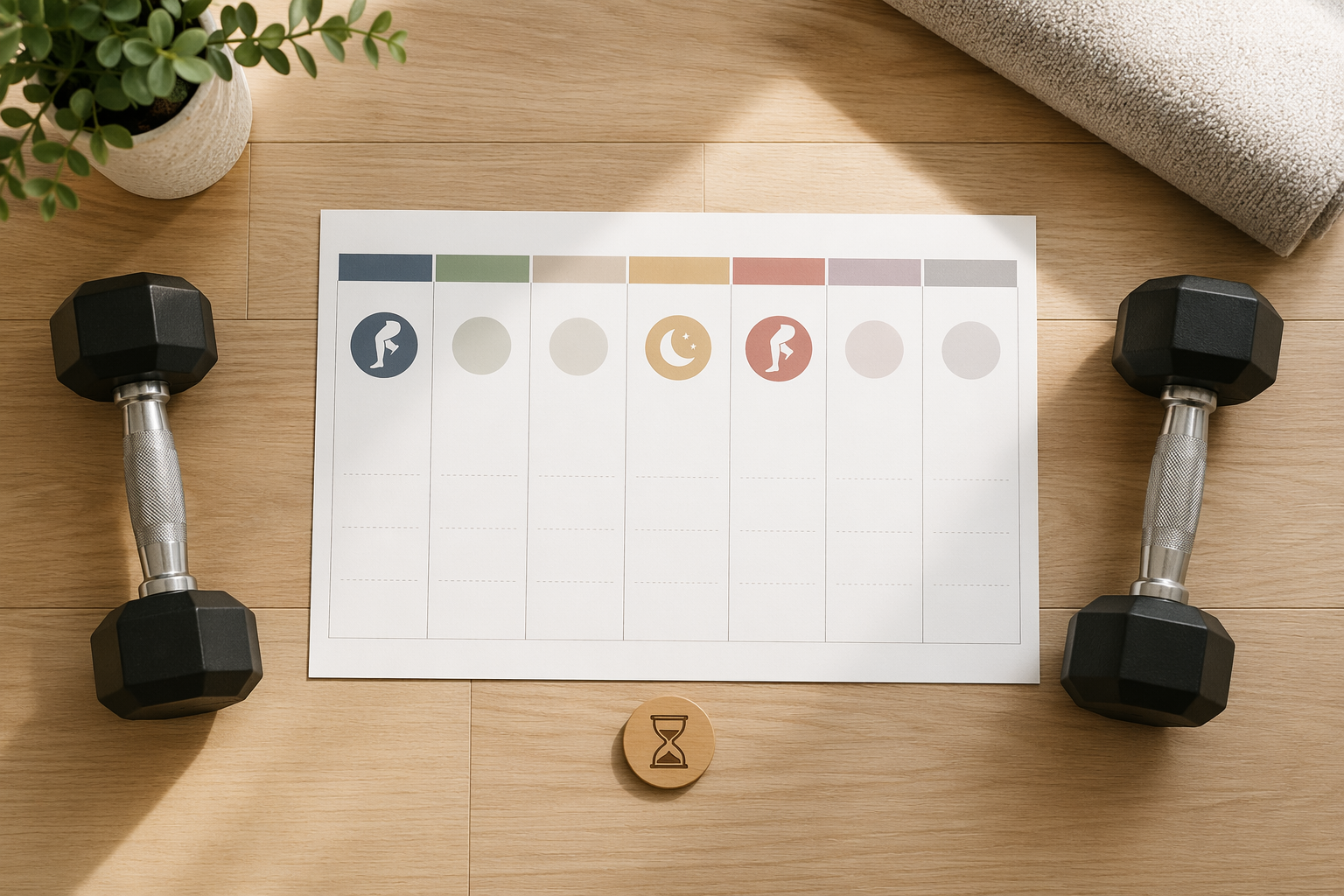
The short answer: two focused leg sessions per week
Twice weekly is not magic. It works because it lets you distribute enough hard work across the week without asking one session to carry everything. A home trainee can push lunges, split squats, hip hinges, glute bridges, calf raises, and squat variations with better form when the work is spread out instead of crammed into one marathon.
The strongest programming point in the available research is that total weekly volume matters more for hypertrophy than the exact number of training days. Healthline summarizes 2018 Journal of Sports Sciences research showing that total weekly sets are a major driver of muscle growth, more so than how those sets are split across the week.[2] So the question is not, “How can I make my legs sore as often as possible?” It is, “How can I accumulate enough quality hard sets and recover from them?”
For lower-body strength, a 2023 NIH/PMC meta-analysis found the highest lower-body strength gains at 2 sessions per week, with 2–3 weekly sessions producing the best 1RM improvements.[3] That finding should be used with some caution here: the full conclusion could not be independently checked from the accessible text, and 1RM strength research does not map perfectly onto dumbbell and bodyweight training at home. Still, it points in the same practical direction as the volume argument: two weekly lower-body sessions are a strong default, not a compromise.
| Weekly pattern | What usually happens at home | Better use |
|---|---|---|
| Daily legs | Fatigue rises faster than performance; sets become lighter, sloppier, or mostly endurance work | Reserve daily movement for walking, mobility, or very easy technique practice |
| One weekly leg day | The session gets crowded; later exercises suffer; soreness can be mistaken for progress | Split the same weekly work into two focused sessions |
| Two weekly sessions | Hard sets are easier to perform well, recover from, and progress | Use as the default schedule for strength and muscle growth |
Why daily leg workouts usually backfire
Daily hard leg training sounds disciplined until the sets start telling the truth. If Monday’s split squats leave your quads and glutes under-recovered, Tuesday’s squat jumps or lunges are not adding high-quality growth stimulus. They are often just adding fatigue.
Large lower-body muscles need time between intense sessions. Today.com states that leg muscles need at least 48 hours to recover between hard workouts, and SELF gives similar general guidance around spacing demanding leg sessions rather than hammering the same muscles daily.[4][5] This is general fitness guidance, not a controlled trial on home-only leg training, so it should not be treated like a law of biology. But as a programming floor, 48 hours is a sensible minimum.
There is a difference between training legs every day and using your legs every day. Walking, easy cycling, mobility drills, light step-ups, and casual bodyweight movement can fit between sessions if they do not interfere with performance. The problem is repeating hard sets for the same muscles before they have had a chance to adapt.
Why one weekly leg day often underdelivers
The classic once-a-week leg day has a different problem. It can feel productive because it is brutal. But brutal is not the same as well-programmed.
If all lower-body work has to fit into one session, the first exercises usually get the best effort and the rest become survival sets. A beginner may start with decent squats, then rush through lunges, hinges, glute work, and calves with form that gets worse by the minute. An intermediate trainee with dumbbells can run into the same issue: the target muscles are not necessarily getting more useful work, just more accumulated tiredness.
Frequency also affects practice. Split squats, single-leg Romanian deadlifts, step-ups, and tempo squats are skills. Training them twice per week gives you more chances to rehearse balance, depth, bracing, and control. That matters even more at home, where you may be using lighter loads and relying on cleaner execution to make exercises challenging.
How to count hard sets at home
A “hard set” is not every warm-up, every casual bodyweight squat, or every movement that makes your legs burn. For home leg training, count a set as hard when it is performed with good form and finishes close enough to failure that you could only do a few more clean reps.
The practical target of 10–20 hard sets per session is a working range, not a number handed down by a single study. It is a useful way to translate the research emphasis on weekly volume into home training. Beginners will often live near the lower end. Stronger trainees, dumbbell users, or people splitting quad-dominant and hip-dominant work carefully may tolerate the higher end.
SELF’s home leg exercise guidance gives beginners a starting point of 2–3 sets of 12–15 reps for movements, which fits well with the idea that newer trainees do not need huge volumes to get productive work.[5] The mistake is turning that into a permanent ceiling. As your legs adapt, the same 2 sets of easy squats stop meaning the same thing.
| Training level | Hard sets per leg session | What that might look like |
|---|---|---|
| Beginner | About 10–12 | 3 lower-body moves for 3–4 hard sets total each, or 4 moves for 2–3 sets each |
| Early intermediate | About 12–16 | A squat pattern, hinge pattern, single-leg pattern, glute move, and calves |
| More advanced home trainee | About 16–20 | More single-leg work, slower tempos, added dumbbell or band loading, and careful recovery tracking |
Do not count every set twice just because a movement hits multiple muscles. A Bulgarian split squat trains quads and glutes, but in your weekly log it is usually simplest to count it as one hard lower-body set. If you want more precision, track patterns instead: squat/lunge, hinge, glute bridge/thrust, calf raise. That keeps the plan honest without turning a home workout into a spreadsheet project.
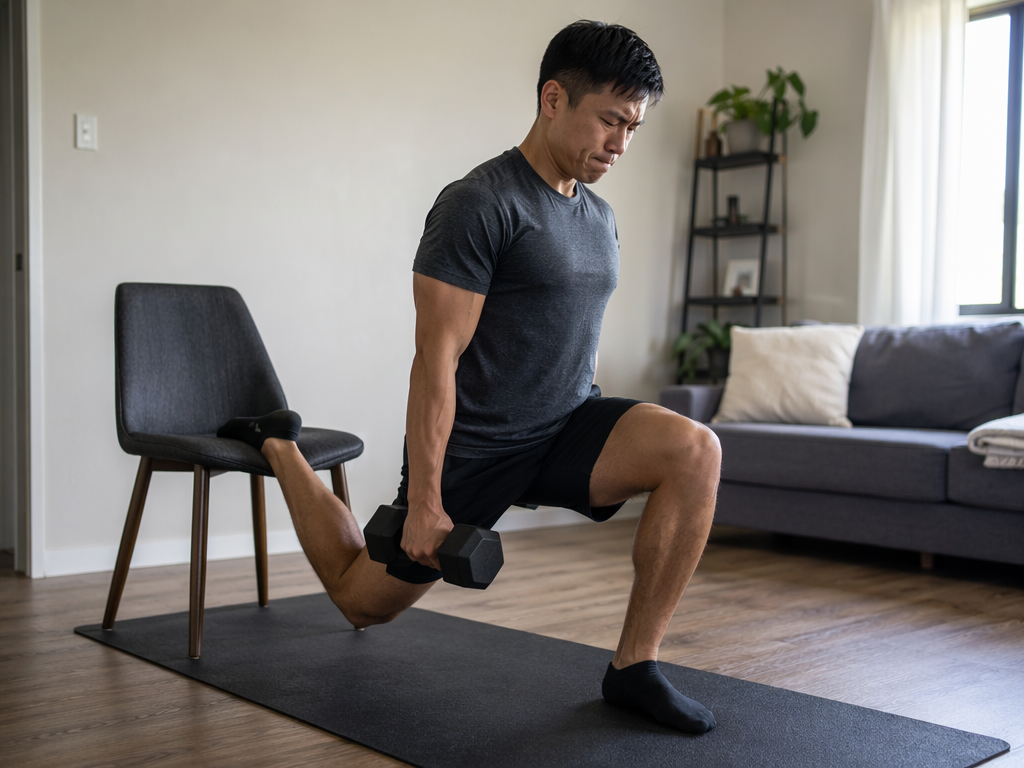
A simple two-day weekly layout
The exact days matter less than the spacing. Put at least 48 hours between hard leg sessions, then keep the sessions repeatable enough that you can compare this week’s performance with last week’s.
| Option | Session 1 | Session 2 | Works well when |
|---|---|---|---|
| Monday / Thursday | Lower body | Lower body | You want a clear midweek recovery gap |
| Tuesday / Friday | Lower body | Lower body | Weekends are busy or inconsistent |
| Wednesday / Saturday | Lower body | Lower body | You prefer more recovery after weekend activity |
A practical home session does not need a long menu. You need enough coverage to train the major lower-body patterns, then enough consistency to progress them.
- Squat or lunge pattern: bodyweight squat, goblet squat, reverse lunge, split squat, Bulgarian split squat
- Hip hinge pattern: dumbbell Romanian deadlift, single-leg Romanian deadlift, banded good morning
- Glute extension pattern: glute bridge, hip thrust, single-leg bridge
- Calf work: standing calf raise, single-leg calf raise, slow tempo calf raise
If exercise selection is the missing piece, use The Science-Based Home Leg Workout: EMG Data, Exercise Selection, and Programming for Real Results as the companion guide. This article is about how often and how much to train; the exercise library should serve that plan, not replace it.
The 15–20 rep ceiling: when bodyweight work has become too easy
Bodyweight leg training has one obvious problem: your legs can outgrow the basic version of an exercise quickly. At that point, doing more and more reps may build local endurance, but it becomes a poor way to keep driving strength and muscle growth.
Centr and Nerd Fitness both use a similar practical threshold: once you can perform about 15–20 clean reps of a bodyweight movement, it is time to make the exercise harder or add load instead of endlessly chasing higher reps.[6][7] This is one of the most useful rules for leg workouts at home because it gives you a clear progression trigger without needing a barbell.
For example, if bodyweight squats are clean and controlled for 20 reps, the next step is not automatically 30 or 50 reps. A better progression might be a slower tempo squat, a pause squat, a goblet squat with a dumbbell, or a split squat. If reverse lunges become easy in that range, move toward deficit reverse lunges, front-foot-elevated split squats, Bulgarian split squats, or added dumbbell loading.
- First, improve range of motion and control.
- Then slow the lowering phase or add a pause.
- Then move to a harder single-leg variation.
- Then add dumbbells, a backpack, or bands if available.
Bodyweight-only trainees who want that progression already organized can use The Progressive At-Home Leg Workout System: Beginner to Advanced (No Equipment Needed). The important thing is that progression has to change the demand of the set, not just extend the discomfort.
How to know if your frequency and volume are working
A good two-day plan should leave evidence. Your reps should rise, your form should improve, your variation should get harder, or your load should increase over time. If none of those things are happening, soreness is not enough proof that the plan is working.
| Signal | Likely meaning | Adjustment |
|---|---|---|
| You recover before the next session and performance slowly improves | Volume and spacing are probably appropriate | Keep the same schedule and progress gradually |
| You are still sore, heavy, or weaker after 48–72 hours | The session may be too large or too close to failure | Reduce hard sets, stop slightly farther from failure, or choose less damaging variations |
| Sessions feel easy and reps climb past 20 on several movements | The exercises are no longer challenging enough | Use harder variations, slower tempo, pauses, or added load |
| You train once weekly and progress has stalled | The weekly stimulus may be too infrequent or too compressed | Split the work into two sessions |
| You train daily but your legs always feel flat | Recovery is probably limiting performance | Replace hard daily work with two focused sessions and easier activity between them |
The cleanest log is not complicated. Write down the exercise, load or variation, sets, reps, and a short note on form. If Bulgarian split squats were 3 sets of 10 per side last week and 3 sets of 12 this week with the same depth and control, that is progress. If the reps went up only because every rep got shorter, it is not.
Where a third leg day fits
Some trainees can handle a third lower-body day, especially if one day is lighter, technique-focused, or aimed at calves and mobility rather than another full hard session. The 2023 meta-analysis noted strong lower-body strength results in the 2–3 times per week range, so a third day is not automatically wrong.[3]
But for most people training at home, the third day should be earned. Add it only after two weekly sessions are consistent, recoverable, and progressing. If the third session makes the two main sessions worse, it is not adding useful volume. It is stealing from the work that matters.
If you prefer not to build this yourself, Progressive Bodyweight Leg Training: A 6-Week Program Backed by Research is the better place to follow a ready-made progression.
The usable rule
Train legs twice per week. Keep at least 48 hours between hard sessions. Accumulate roughly 10–20 hard sets per session, with beginners closer to the lower end. When you can perform 15–20 clean reps of a bodyweight movement, make the exercise harder or add load. If recovery and performance both stay intact, the plan is doing its job.
References
- Building stronger legs, Harvard Health.
- Leg Workouts: The 15 Best Leg Exercises, and How to Plan a Leg Day, Healthline.
- Muscle strength gains per week are higher in the lower-body, PMC / NIH.
- 19 Best Bodyweight Leg Exercises You Can Do At Home, Today.com.
- 31 Leg Exercises at Home That Require No Equipment, SELF.
- The 9 best bodyweight leg exercises to do at home, Centr.
- The Beginner Bodyweight Workout, Nerd Fitness.
What a small equipment investment adds
We don't have a build tagged to this exact tier yet. Browse all builds.
How often should you repeat this?
How Whoop and Oura Ring track recovery for home workouts
For home exercisers deciding between WHOOP and Oura Ring, the better sleep and recovery tracker depends on training style: WHOOP's strength-aware tracking fits dumbbell and grip-heavy sessions, while Oura's sleep-first scoring suits yoga and indoor cycling. The verdict hinges on how each builds its daily recovery score, their home-workout tracking gaps, and who pays for hardware versus subscription.
Spot something off?
Tell us if a movement, tier assumption, or duration didn't match your experience.