How to Progress on a Full-Body Dumbbell Workout: A Step-by-Step Framework for Continuous Gains
Many home dumbbell workouts stall not because of the exercises, but because of a missing progression system. This article shows you exactly how to apply double progression and reps-in-reserve (RIR) to keep your full-body dumbbell routine effective for months without changing exercises.
- Duration
- 30 min
You had been running the same dumbbell routine for months. The pump still came, but the numbers didn’t move. Maybe you added a set here and there, swapped one exercise for another, but the dumbbells stalled at the same weight. The natural conclusion: the routine itself needs replacing. That assumption is exactly what keeps people cycling through workout plans every eight weeks without ever building sustained strength.
The real culprit isn’t exercise selection — it’s the absence of a structured progression system. Without a rule for when to add reps and when to add weight, the body adapts and stops responding, no matter how many new movements you throw at it. This article isn’t another 8-week schedule. It’s a framework you can graft onto any full-body dumbbell workout you already own.
Why Most Home Dumbbell Workouts Stop Working
Adaptation is the body’s job. Give it a repeated stimulus — say, 3 sets of 10 reps with 40-pound dumbbells — and eventually it stops seeing that as a challenge. The routine that built muscle in month one becomes maintenance by month three. The fix is systematic overload, and the simplest reliable system is double progression.
StrengthLog calls double progression "the gold standard of strength training progression for beginners." Bony to Beastly illustrates the cycle with a concrete example: a lifter goes from 50 lbs × 10, 10, 9 in week one to 50 lbs × 10, 10, 10 in week two, then jumps to 55 lbs × 10, 8, 7 in week three. That one clean loop — reps first, weight second — is the engine. I wouldn’t call it the gold standard because a controlled trial proved it superior; I call it the gold standard because it works with the equipment most people own and requires nothing more than honest tracking.
The Double-Progression Cycle, Start This Week
Pick a rep range — 8 to 12 is the most common for hypertrophy, and most home dumbbell work falls into this band. For each exercise, set a target weight and a rep window. The rule: do not increase the weight until you can hit the top of the rep range on every set. If your range is 8–12 and you hit 12 clean reps across all three sets, you earn the right to go heavier next session.
BuiltWithScience puts it plainly: "add weight when you can complete all sets and reps with good form at the top of the recommended rep range." That is the whole rule. Below are the three stages in a single visual.
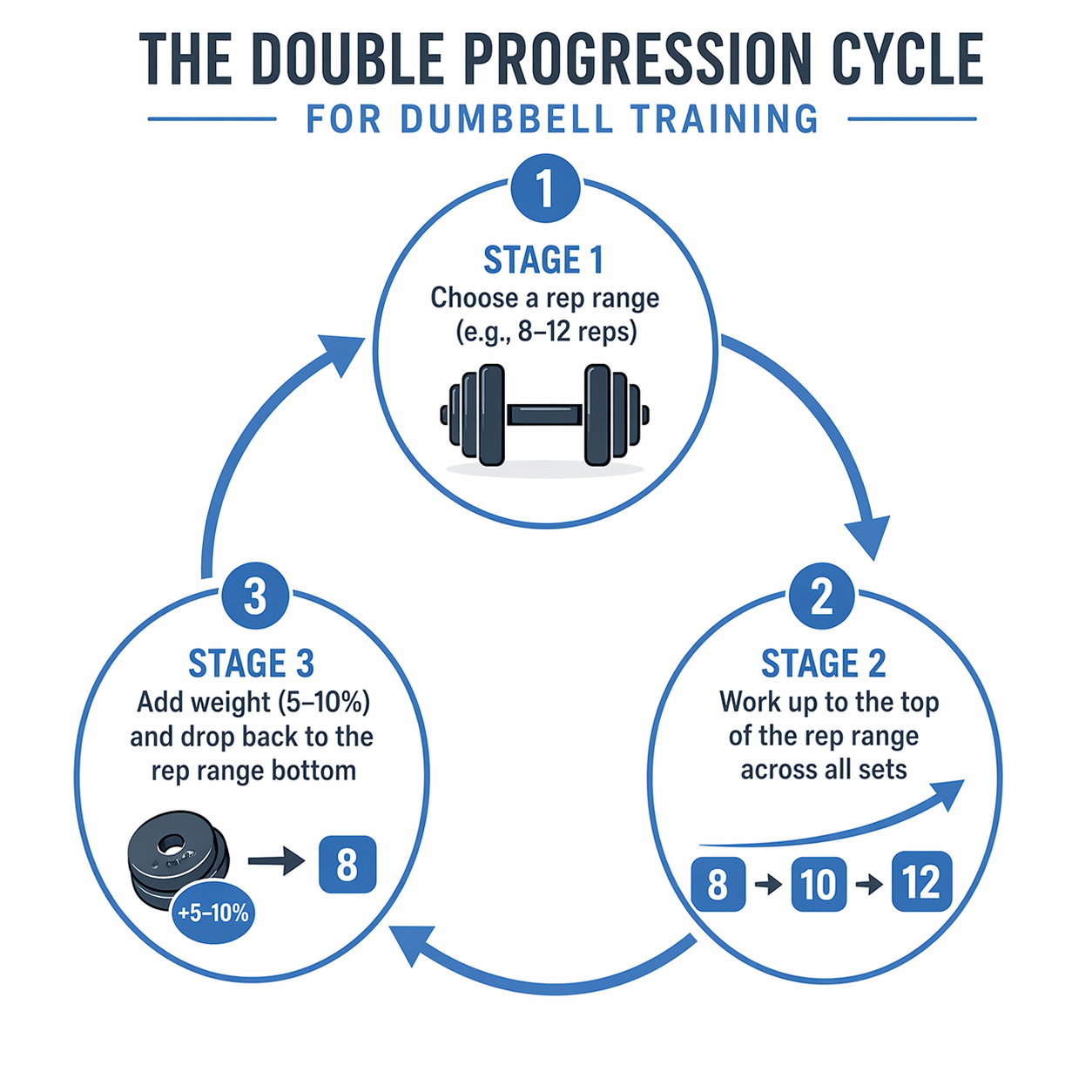
The exact numbers depend on your capacity, but the pattern is universal: you stay with a weight until you hit the top of the rep range across all sets, then you add weight and drop back to the bottom of the range. That is the cycle. Run it as long as you can.
How Close to Failure Should You Train? (RIR)
Most lifters assume that every set should be taken to absolute failure — the last rep you cannot grind out. That expectation produces cumulative fatigue, not faster growth. Reps in Reserve (RIR) is simpler: how many more reps you could have done after stopping the set. If you stop a set of 10 reps and know you could have done 2 more clean reps, that set was at 2 RIR.
Bony to Beastly prescribes specific targets: dumbbell bench press at 2 RIR, goblet squats at 1–2 RIR, Romanian deadlifts at 2–3 RIR. StrengthLog recommends 1–2 RIR for hypertrophy, noting it "triggers growth while reducing injury risk." The gauge below helps calibrate.
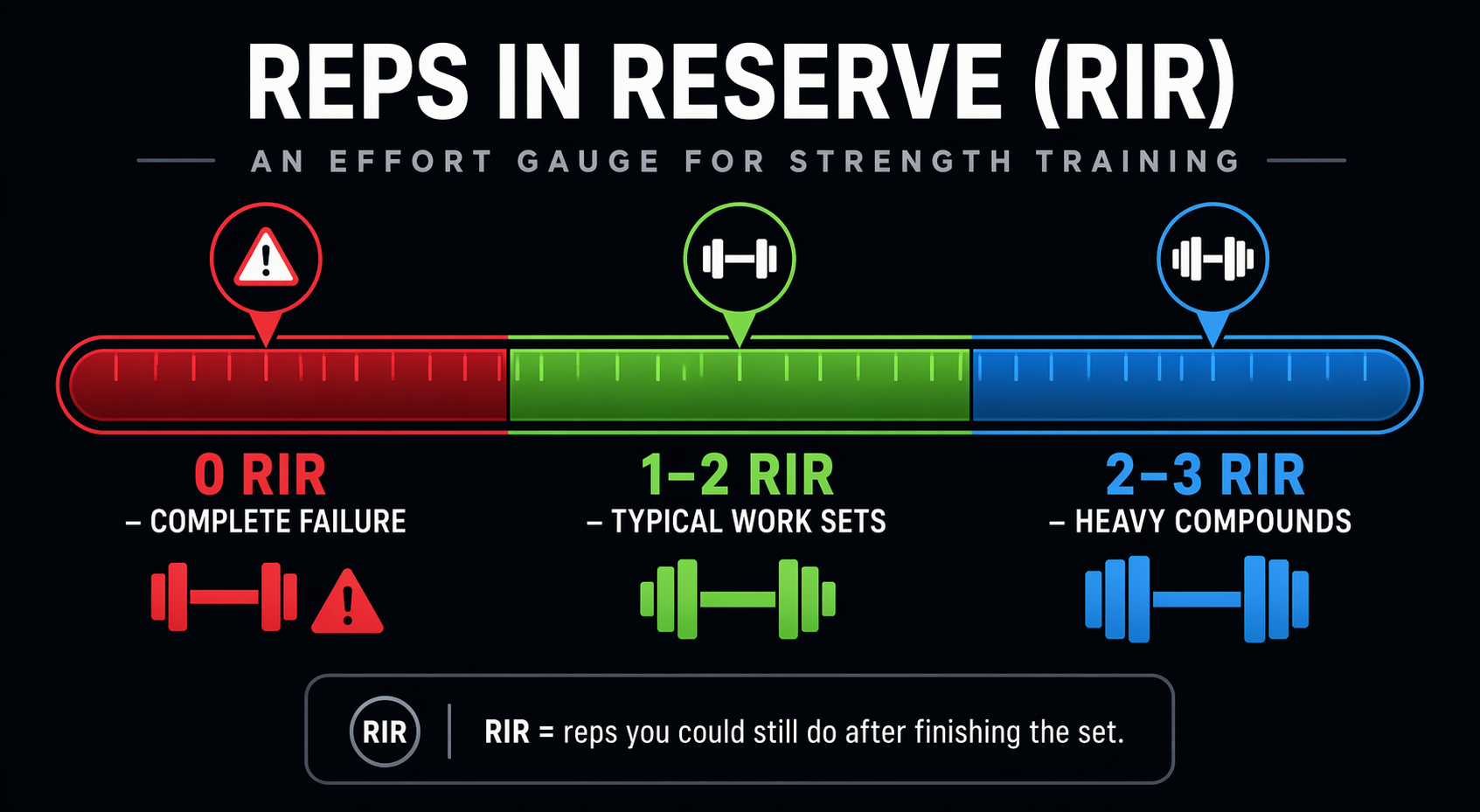
If you are new to RIR, aim for 2 RIR on most compound exercises and 1 RIR on isolation moves. You still get the same hypertrophy stimulus as training to failure as long as sets are taken close to failure, which is the key caveat. Muscle Evo cites research showing that low, medium, and high rep ranges all stimulate growth equally when sets are close to failure. But that doesn’t mean 30 reps with 10-pound dumbbells builds strength like 8 reps with heavy ones — proximity to failure matters more than rep count alone. For strength, you still need enough load to challenge the nervous system.
Rest Intervals: Which Evidence Do You Trust?
Should you rest 30 seconds or 3 minutes? The literature is split. An older PubMed review found that "moderate-intensity sets with short rest intervals of 30–60 seconds might be most effective for hypertrophy due to greater acute levels of growth hormone." More recent work from Muscle Evo counters that "longer rest periods (2–3 minutes) work better for hypertrophy than shorter ones (60 seconds or less)." In practice, the optimal rest depends on the movement. Here is what I recommend, based on the available evidence and real-world results:
| Exercise Type | Rest Interval | Why |
|---|---|---|
| Compound (bench, squat, row) | 2 minutes | Preserves performance across sets, necessary for progression tracking |
| Isolation (curls, lateral raises) | 60–90 seconds | Shorter rest is fine because fatigue accumulates less on single-joint moves |
| Heavy compounds (RDL, lunges) | 2–3 minutes | Longer rest allows the CNS to recover and maintain rep quality |
Both StrengthLog and BuiltWithScience converge on the same numbers: 2 minutes for compounds, 60–90 seconds for isolation. That is the consensus to follow. If in doubt, err on the long side; under-resting is far more likely to kill your progression tracking than over-resting.
The 5% Rule and the Dumbbell Increment Trap
On paper, the next step is straightforward: add 5% to the bar. In a home gym with adjustable dumbbells, 5% of 50 pounds is 2.5 pounds. Most adjustable dumbbells jump in 5- or 10-pound increments. You cannot make a 2.5-pound jump, which means the 5% rule becomes an aspiration, not a program.
If the next weight is too heavy, you have to bridge the gap. The simplest strategy is to expand your rep range. If you have been working in 8–12 and hit 12 across all sets, instead of jumping to a weight you cannot handle, bump the rep range to 12–15. Now you can continue adding reps with the same weight for several more sessions. Once you hit 15 clean reps across all sets, you have built the capacity to handle the next weight increment. Rep-range expansion is a practical way to apply double progression when the physics of your equipment prevents a smooth 5% increase.
Another option is to use slower eccentrics to increase time under tension. Bony to Beastly calls this the "push harder" option. That is valid, but I prefer rep-range expansion because it is easier to track consistently.
When Adding Weight Is No Longer Enough
After several weight bumps, you may reach a point where even rep-range expansion cannot bridge the next jump. That is when volume progression steps in. Instead of adding weight, add a set. If you have been doing 3 sets of an exercise, go to 4 sets. Or add a second isolation exercise for the same muscle group. A 2021 Sports Medicine review found that "minimal doses of resistance training ... can improve strength and functional ability" — meaning you do not need a huge volume increase to drive progress, but you do need a systematic increase. Adding one set per exercise every 4–6 weeks is a sustainable pace.
Deload weeks are part of the system, not a sign of weakness. Every 6–8 weeks, reduce your working weight or sets by about 40–50% for one week. The exact protocol matters less than the act of backing off. Without a deload, accumulated fatigue will eventually stall your progression regardless of how tight your double progression system is.
Troubleshooting: What to Check If You Haven't Progressed in 3 Weeks
If the numbers have not moved in three weeks, do not change the exercises. Change the variables in this order:
- Are you in the correct rep range for your goal? For strength, 3–6 reps; for hypertrophy, 6–15; for endurance, 15+. If you are chasing hypertrophy in a strength rep range, adjust the target. See the goal-specific rep range guide.
- Are you leaving too many reps in the tank? If your work sets feel easy, you are likely at 3+ RIR. Drop to 1–2 RIR and see if progress resumes.
- Are you resting enough? If you are rushing between compound sets, you are compromising rep quality. Use the rest table above.
- Are you tracking accurately? A notebook or app is non-negotiable. If you are guessing what you lifted last week, you are not applying double progression.
- Is it time for a deload? If you have been pushing hard for 6+ weeks without a down week, your nervous system may need a reset.
A Simple Tracking Template
You need only four columns per exercise: the date, the weight, the reps achieved on each set, and the RIR. Here is a minimal template you can copy into a notebook or spreadsheet:
| Date | Exercise | Weight | Sets x Reps | RIR |
|---|---|---|---|---|
| June 1 | Dumbbell Bench | 50 lbs | 3 x 10, 10, 9 | 2 |
| June 4 | Dumbbell Bench | 50 lbs | 3 x 10, 10, 10 | 2 |
| June 8 | Dumbbell Bench | 55 lbs | 3 x 10, 8, 7 | 2 |
Write down every session. The act of recording forces honesty. Without it, you will inevitably round up or forget, and the progression system collapses.
If you want a full program that applies this framework day by day, the 8-Week Full Body Dumbbell Workout Program uses double progression built into the schedule. For beginners, the 8-Week Beginner Full Body Dumbbell Program provides a gentler entry. But even if you run those plans, the framework here is what keeps them working beyond week eight.
After the first weight increase, the second becomes harder. The third might take twice as long. That is normal. The framework does not promise a linear path; it promises a controllable one. And for a home gym with a single pair of adjustable dumbbells, that is more important than any routine.
What a small equipment investment adds
We don't have a build tagged to this exact tier yet. Browse all builds.
How often should you repeat this?
How Whoop and Oura Ring track recovery for home workouts
For home exercisers deciding between WHOOP and Oura Ring, the better sleep and recovery tracker depends on training style: WHOOP's strength-aware tracking fits dumbbell and grip-heavy sessions, while Oura's sleep-first scoring suits yoga and indoor cycling. The verdict hinges on how each builds its daily recovery score, their home-workout tracking gaps, and who pays for hardware versus subscription.
Spot something off?
Tell us if a movement, tier assumption, or duration didn't match your experience.