
8-Week Full Body Dumbbell Workout for Beginners: Progressive Plan with Form Guides and Weekly Milestones
This 8-week progressive full body dumbbell workout plan is designed for complete beginners. It includes exercise form cues, a trial-and-error method for choosing your starting weight, and weekly milestones so you can track your progress and know when you're ready to advance.
- Duration
- 30 min
You bought a pair of dumbbells. Maybe adjustable, maybe a few fixed weights you grabbed secondhand. Now you open an app or a blog post and the first instruction is: "Choose a challenging weight." That is not an instruction. That is a guess. And if you guess wrong, the whole plan falls apart before you finish the first set.
This 8-week plan exists to remove the guesswork. It shows you exactly how to find your starting weight, which rep ranges to use, and how to know you are actually progressing. By the end, you will have a repeatable strength habit — not just a piece of paper you filled in for a month.
Why full-body three times a week
A full-body workout trains every major muscle group in each session. That means you squat, hinge, push, pull, and carry three times every week — Monday, Wednesday, Friday, with at least 48 hours between. For a beginner, higher frequency builds technique faster than a split routine that hits each muscle once per week. A 2021 study (PMC8372753) found that full-body and split routines produced similar strength and size gains in untrained individuals when total weekly volume was equal. But full-body gives you more practice per movement pattern. That matters when you are still learning where your back should be in a deadlift.
The 10 dumbbell exercises that cover everything
These ten movements hit every major push, pull, hinge, squat, and core pattern. I have listed them with the one form cue that prevents the most common mistake. Read each cue before you lift — it is faster than figuring out a sore back later.
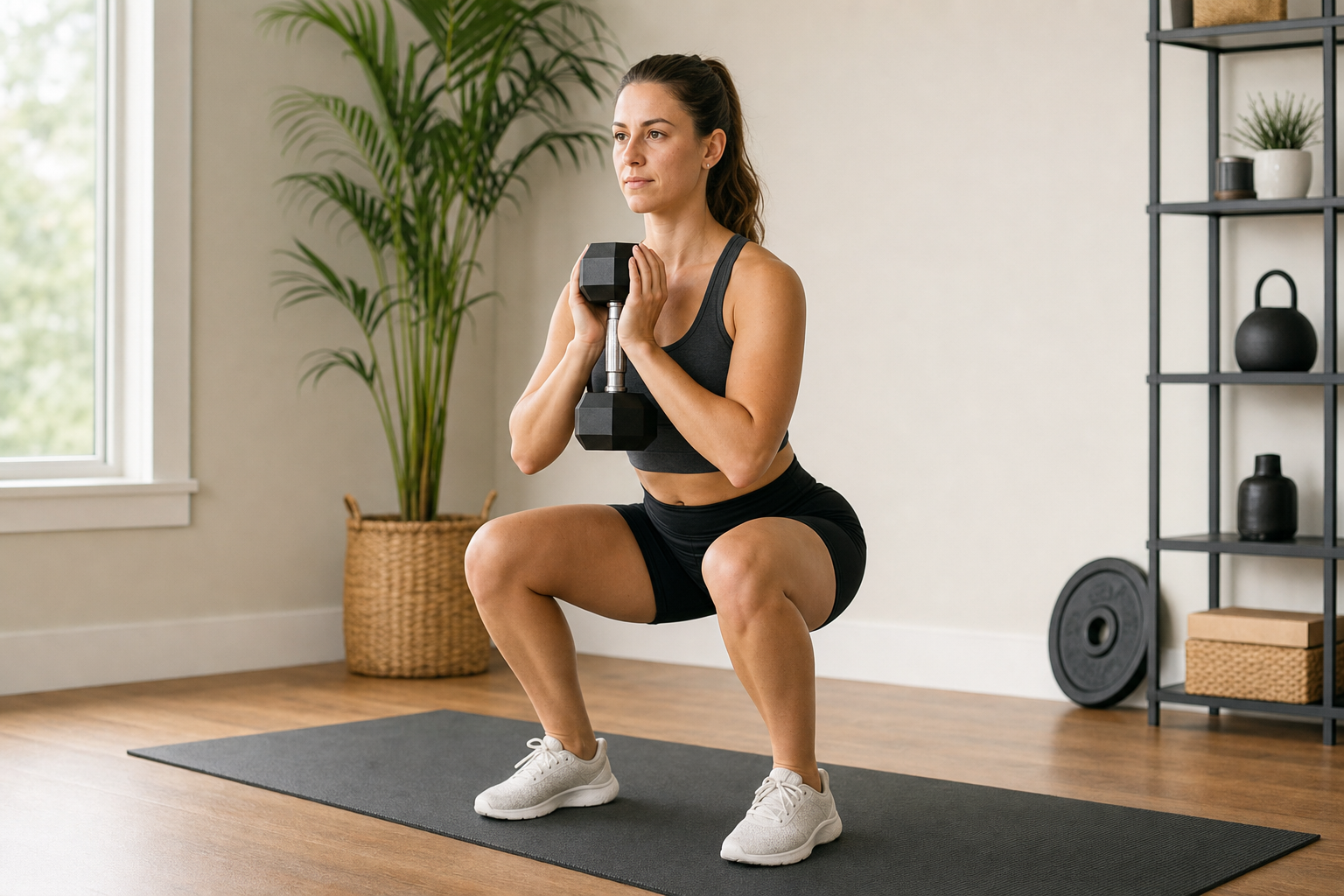
- Dumbbell Goblet Squat — Hold one dumbbell vertically against your chest, elbows pointing down. Keep your torso upright. Common mistake: letting your knees cave inward. Push your knees out toward your toes.
- Dumbbell Romanian Deadlift (RDL) — Hinge at the hips, not the waist. Keep a flat back. Let your hands travel down your thighs until you feel a stretch in the hamstrings — do not aim for the floor. Common mistake: rounding the lower back.
- Dumbbell Bench Press — Lie on a mat or bench, feet flat. Lower the dumbbells to chest level, elbows at about 45 degrees to your torso. Common mistake: flaring the elbows wide, which stresses the shoulders.
- Bent‑Over Dumbbell Row — Hinge at the hips, back flat, knees slightly bent. Pull the dumbbells toward your lower ribcage. Common mistake: jerking the body to move the weight — use a controlled pull.
- Standing Overhead Press — Stand with feet shoulder‑width, brace your core. Press the dumbbells from shoulders to lockout overhead. Common mistake: arching the back to push the weight up — use a weight you can press without leaning.
- Dumbbell Lateral Raise — Stand with a slight forward lean, dumbbells at your side. Raise them out to the side until arms are parallel to the floor. Common mistake: using momentum to swing the weights up — keep the movement slow and controlled.
- Dumbbell Bicep Curl — Stand with palms facing forward, elbows pinned to your sides. Curl the dumbbells toward your shoulders. Common mistake: swinging your elbows back — keep them fixed.
- Lying Dumbbell Triceps Extension — Lie on your back, hold one dumbbell overhead with both hands. Lower the dumbbell behind your head by bending your elbows, then extend. Common mistake: letting your elbows flare out — keep them pointing to the ceiling.
- Dumbbell Reverse Fly — Hinge forward with a flat back, palms facing each other. Raise your arms out to the sides, squeezing your shoulder blades together. Common mistake: using heavy weight and turning it into a row — light weight, controlled movement.
- Dumbbell Crunch — Lie on your back, knees bent, hold one dumbbell across your chest. Crunch up, exhaling at the top. Common mistake: pulling with the neck — keep a fist between chin and chest to avoid neck strain.
Dumbbells allow unilateral work for every exercise, which can help you spot if one side of your body is weaker or less mobile than the other. If you feel a consistent difference, do a few extra reps on the weaker side after the set.
How to pick your starting weight
This is the section most plans skip, and the reason most beginners stall. You need a method, not a guess. The trial‑and‑error method works like this:
- Pick a dumbbell you think you can lift 20–30 times. Do not lift that many. Stop at 10 reps.
- If those 10 reps felt easy (you could have done many more), switch to a heavier dumbbell.
- Keep going heavier until you reach a weight where you can just manage 8–12 reps with good form, and the last two reps are genuinely hard. That is your starting weight.
During the first two weeks, do not worry about leaving reps in the tank. Just focus on movement quality. For weeks 3–8, leave 1–2 reps in the tank (RIR 1–2): the last rep should feel hard but you could still do one or two more. Do not train to absolute failure every set — it is unnecessary for growth and increases injury risk for beginners.
The 8‑week program: double progression in practice
The program uses double progression: you add reps first, then you add weight. Here is a concrete example:
Week 1: 50 lb × 10, 10, 9 reps
Week 2: 50 lb × 10, 10, 10 reps — now all three sets are at the top of the rep range.
Week 3: 55 lb × 10, 8, 7 reps — you increase weight and accept that reps will drop. Then you repeat the process.
Below is the full 8‑week table. Perform this routine on Monday, Wednesday, and Friday, resting at least 48 hours between sessions.
| Phase | Weeks | Sets | Reps | RIR / Notes |
|---|---|---|---|---|
| Phase 1 – Form focus | 1–2 | 2 | 10–12 | No RIR target. Focus on movement quality. Stop at 10–12 even if you could do more. |
| Phase 2 – Build volume | 3–5 | 3 | 10–12 | RIR 1–2. Add one set. Push to the top of the rep range before increasing weight. |
| Phase 3 – Increase load | 6–8 | 3 | 8–10 | RIR 1–2. Heavier weight. Shorter rep range lets you handle a larger load safely. |
Rest 60 seconds between sets for hypertrophy (PubMed). But if your form starts breaking down, take 90–120 seconds. Adherence matters more than theoretical rest length.
5‑minute warm‑up and cool‑down
Do this before every session. It takes five minutes and prevents the muscle strains that kill consistency.
- Warm‑up (2–3 minutes) Arm circles (30s forward, 30s backward), bodyweight squats (10–15), leg swings (10 per leg), torso twists (30s). Then do one light set of each exercise with a very light weight (50% of your working weight) for 5 reps.
- Cool‑down (2–3 minutes) Chest stretch (30s per side), hamstring stretch (30s per side), quad stretch (30s per side), deep breathing in child's pose (30s).
Weekly milestones: objective checks you can pass or fail
These milestones are not motivational slogans. They are concrete self‑assessments. If you hit them, you are on track. If you do not, repeat the week.
- Week 2 end: You can complete all 2 sets of 10–12 reps for every exercise with good form, without needing to pause mid‑set. If not, repeat week 2.
- Week 5 end: You can complete all 3 sets of 10–12 reps with RIR 1–2. The last two reps feel hard but you could still do one more. If you are hitting failure early, reduce the weight slightly.
- Week 8 end: You can complete all 3 sets of 8–10 reps with the heavier weight and good form. Your squat and row weights should have increased by at least 5–10 lb from week 1.
When to move on
Do not leave this plan after 8 weeks just because the calendar says so. Stay on it until you hit all three milestones: you are at the top rep range for every set, you have increased weight on your main lifts, and you are getting bored. Then you are ready for a new challenge. The 6‑Week Home Strength Training Plan adds more equipment options and a similar progressive structure.
What a small equipment investment adds
We don't have a build tagged to this exact tier yet. Browse all builds.
How often should you repeat this?
Use WHOOP HRV and Resting Heart Rate to Plan Home Workouts
A practical daily decision guide for home-only WHOOP users: how to read your morning HRV and resting heart rate against your own baseline, apply the green-yellow-red recovery buckets, and run a quick confounder check — so you can make a concrete push, modify, or rest call for today's home workout without a coach.
Spot something off?
Tell us if a movement, tier assumption, or duration didn't match your experience.