
The Home Leg Workout Progression Guide: From Bodyweight Beginner to Dumbbell Advanced
This guide provides a structured progression path for home leg workouts, from bodyweight beginner exercises through advanced dumbbell variations. It covers the four key movement patterns, how to know when to progress, and sample weekly schedules for all experience levels.
- Duration
- 30 min
Why Leg Training Matters at Home
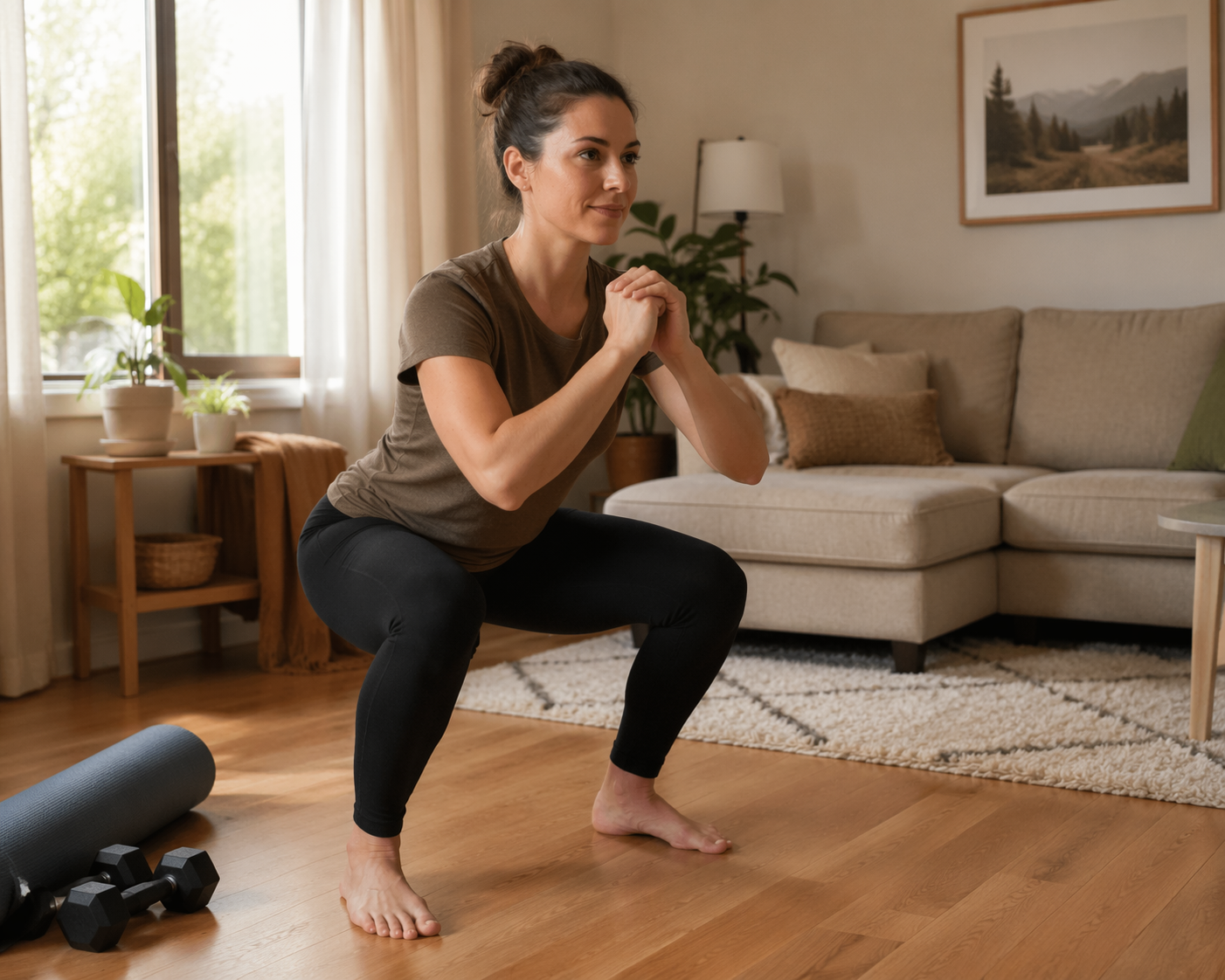
Leg workouts often get short shrift in home fitness routines. The reasoning usually goes: without a squat rack, a leg press machine, or a barbell, you can't build meaningful lower-body strength. That assumption is wrong, but it persists because most home exercisers stall at the bodyweight stage and never learn how to progress.
The muscles of the lower body — glutes, quadriceps, hamstrings, adductors, abductors, and calves — are the largest and most metabolically demanding muscle groups in the body. Training them consistently improves bone density, supports everyday movements like walking and stair climbing, and creates a hormonal environment that supports muscle growth across your entire body. As the TODAY.com article notes, since the glutes are recruited for any hip or thigh movement, it's impossible to work your legs without also addressing them.
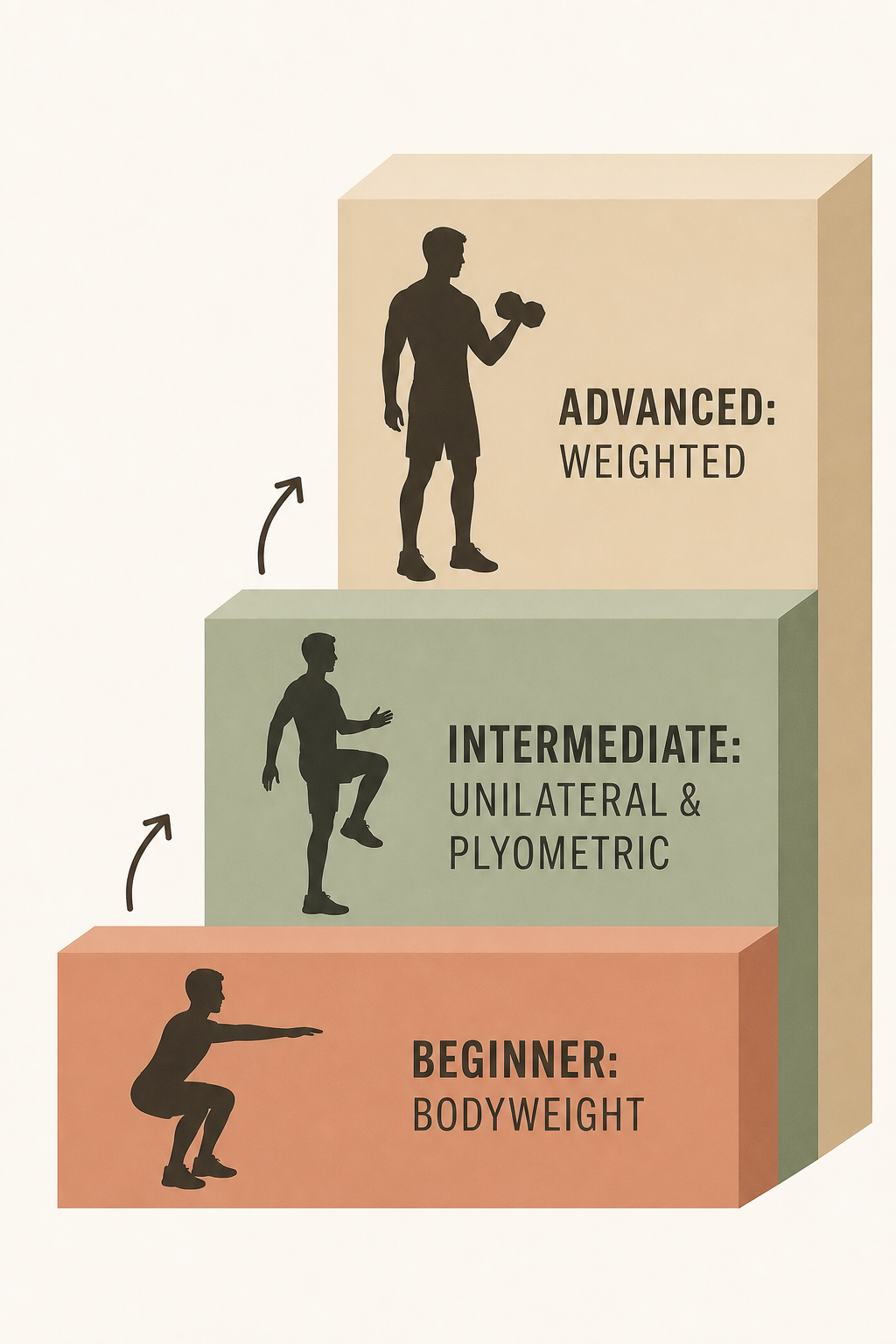
The core thesis of this guide is straightforward: effective home leg workouts follow a clear progression path. You start with bodyweight squat and lunge patterns, advance through unilateral and plyometric variations, then add dumbbells or other external load. Most home exercisers stall not because home workouts are ineffective, but because they don't know how to progress or when to advance. This guide gives you both the framework and the specific exercises for each tier.
The Four Essential Movement Patterns for Home Leg Workouts
Every effective leg workout, whether performed in a commercial gym or a 6x6-foot corner of your living room, is built on four fundamental movement patterns. Understanding these patterns is more important than memorizing a list of exercises — once you know the pattern, you can swap in any variation that fits your equipment and ability level.
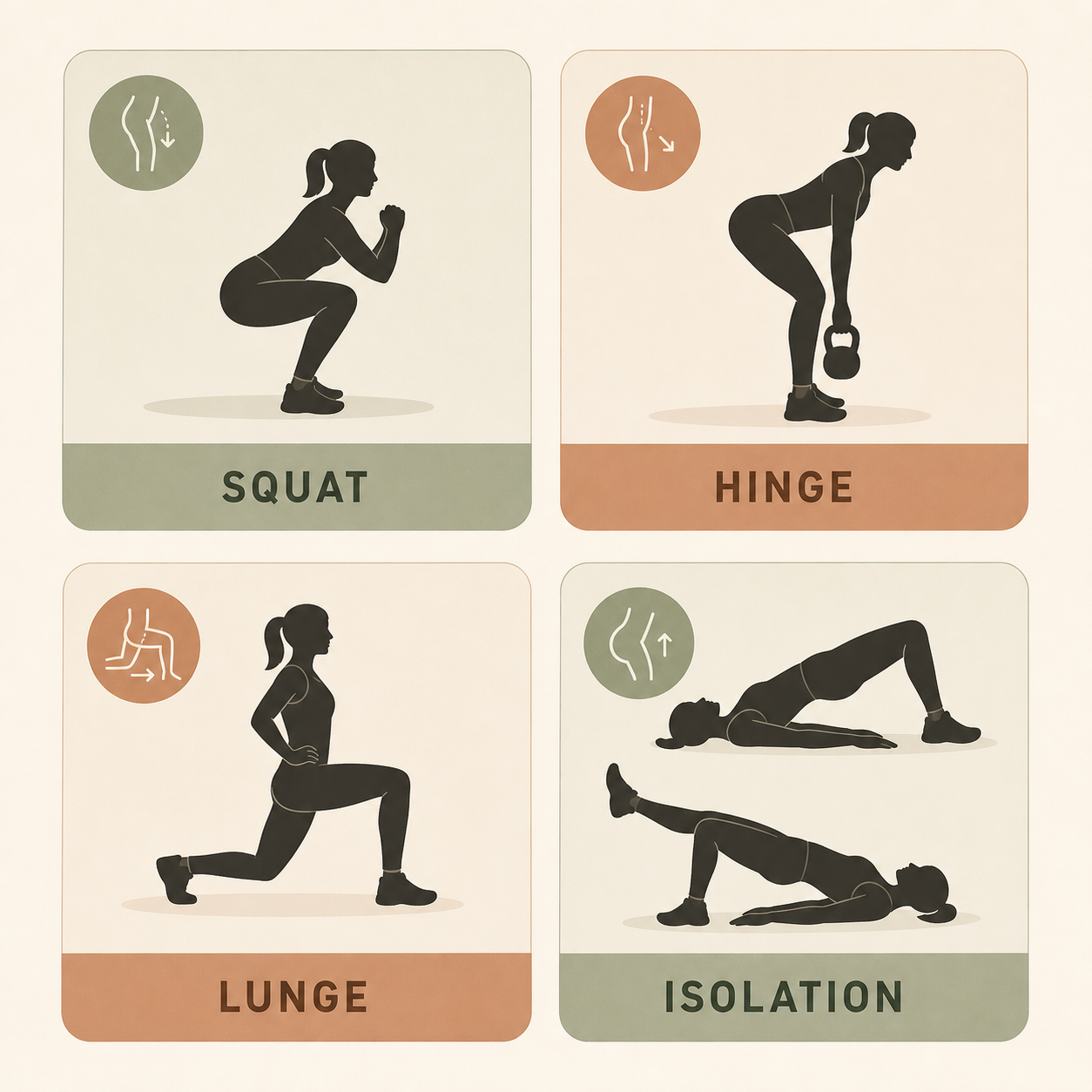
| Movement Pattern | Primary Muscles Targeted | Home Exercise Example |
|---|---|---|
| Squat | Quadriceps, gluteus maximus, calves (soleus and gastrocnemius) | Bodyweight squat, goblet squat |
| Hinge | Hamstrings, glutes, lower back | Single-leg deadlift, glute bridge |
| Lunge | Quadriceps, glutes, hamstrings, adductors | Forward lunge, reverse lunge, lateral lunge |
| Isolation | Calves, adductors, abductors | Calf raises, lying hip adduction |
The squat pattern is the cornerstone. As Healthline explains, the squat movement pattern primarily trains the quadriceps, gluteus maximus, and calves. The hinge pattern shifts the load to the posterior chain — hamstrings and glutes — and is essential for balanced leg development. Lunges add a unilateral component that challenges stability and addresses muscle imbalances. Isolation exercises like calf raises target specific muscles that the compound movements may not fully exhaust.
A well-structured home leg workout should include at least one exercise from each pattern. As you progress through the tiers below, you'll see how each pattern evolves from its simplest bodyweight form to more demanding variations.
Beginner Tier: Building a Foundation with Bodyweight
The beginner tier is about establishing movement competency and building a baseline of strength. At this stage, your goal is not to exhaust your muscles — it's to learn the movement patterns with proper form and build the neuromuscular coordination to perform them consistently.
SELF's article, featuring certified personal trainer Jess Sims and CSCS Ava Fagin, recommends that beginners start with two sets of 12 to 15 reps for each exercise. This volume is sufficient to stimulate adaptation without overwhelming recovery capacity.
Beginner Exercise Selection
- Bodyweight Squat: Stand with feet shoulder-width apart. Lower your hips back and down as if sitting into a chair, keeping your chest up and knees tracking over your toes. Drive through your heels to return to standing.
- Chair Squat: Place a sturdy chair behind you. Squat down until your glutes lightly touch the seat, then stand back up. This reduces the range of motion and builds confidence in the pattern.
- Glute Bridge: Lie on your back with knees bent and feet flat on the floor. Drive your hips upward, squeezing your glutes at the top. Lower with control.
- Reverse Lunge: Step backward with one leg, lowering your back knee toward the floor. Keep your front shin vertical. Drive through the front heel to return to standing. This variation is more stable than a forward lunge and easier on the knees.
- Calf Raise: Stand with feet hip-width apart. Rise up onto the balls of your feet, hold for a second, then lower slowly. Perform on a flat surface or the edge of a step for greater range of motion.
Perform this beginner circuit 2–3 times per week, allowing at least 48 hours between sessions. Complete 2 sets of 12–15 reps for each exercise, resting 60–90 seconds between sets. If you find it easy to complete 15 repetitions of an exercise with perfect form, that is your signal to move to the intermediate tier.
For a structured full-body beginner program that pairs well with this leg progression, see our 4-Week Beginner Home Workout Plan (No Equipment Required). It provides a complete weekly schedule that includes upper body, core, and cardio work alongside the leg exercises covered here.
Intermediate Tier: Unilateral Work and Plyometrics
Once you can comfortably complete 15–20 controlled reps of the beginner exercises, your body has adapted to bodyweight squat and lunge patterns. Continuing to add more reps will primarily build muscular endurance, not strength or size. As Healthline's bodyweight leg article states, once you can perform 15–20 reps of an exercise, you are primarily building endurance at that point, and reaping the benefits of long-term strength training will require adding an external load or increasing exercise difficulty.
The intermediate tier introduces two powerful progression tools: unilateral (single-leg) exercises and plyometric (jumping) variations. Unilateral exercises increase the load on each leg without requiring any additional weight — a Bulgarian split squat with bodyweight alone can be significantly harder than a bilateral bodyweight squat. Plyometric exercises add a power component that recruits fast-twitch muscle fibers and elevates your heart rate.
Intermediate Exercise Selection
| Exercise | Movement Pattern | Progression From |
|---|---|---|
| Bulgarian Split Squat | Squat (unilateral) | Bodyweight squat |
| Single-Leg Deadlift | Hinge (unilateral) | Glute bridge |
| Lateral Lunge | Lunge (frontal plane) | Reverse lunge |
| Jump Squat | Squat (plyometric) | Bodyweight squat |
| Single-Leg Glute Bridge | Hinge (unilateral) | Glute bridge |
The Bulgarian split squat is arguably the single most effective bodyweight leg exercise for home training. Place the top of your back foot on a chair or couch cushion, then lower your front knee toward the floor. This single exercise can challenge your quads, glutes, and stability more than any bilateral squat variation. Centr's guide lists the Bulgarian split squat as a key intermediate exercise alongside the single-leg glute bridge and squat jump tucks.
For the plyometric exercises, start with low-intensity versions. Perform a shallow jump squat rather than trying to jump as high as possible. Land softly with bent knees to absorb impact. If you have downstairs neighbors or joint concerns, skip the plyometric variations entirely and focus on the unilateral exercises — they provide plenty of stimulus without impact.
At the intermediate level, increase your sets to 3 per exercise and reduce your rep target to 10–15 per set. The higher intensity means you should reach technical failure within that rep range. Rest 60–90 seconds between sets. Continue training 2–3 times per week with at least 48 hours between sessions.
Advanced Tier: Adding Dumbbells and Complex Movements
When you can complete 15–20 reps of the intermediate exercises with perfect form, it is time to introduce external load. As Verywell Fit's beginner leg day workout states, if you find it easy to complete 15 repetitions of an exercise, that is your cue to add dumbbells or a medicine ball to make it harder.
The advanced tier combines the unilateral and plyometric progressions from the intermediate level with added weight. You do not need a full set of dumbbells — a single pair of adjustable dumbbells in the 15–40 lb range per hand is sufficient for most home leg exercises. If you do not own dumbbells, a heavy backpack, a filled water jug, or a sandbag can serve as an effective substitute.
Advanced Exercise Selection
- Goblet Squat: Hold a dumbbell vertically against your chest, cupping the top end with both hands. Perform a squat while keeping the weight close to your body. The goblet squat is the most accessible weighted squat variation for home training because it requires minimal mobility and the weight position naturally reinforces proper torso position.
- Dumbbell Bulgarian Split Squat: Hold a dumbbell in each hand and perform the Bulgarian split squat as described in the intermediate tier. This is one of the most demanding leg exercises you can do at home — start with a light weight and prioritize control over load.
- Dumbbell Staggered Deadlift: Stand with one foot slightly behind the other (staggered stance). Hold a dumbbell in each hand and hinge at the hips, lowering the weights toward the floor while keeping your back flat. This variation targets the hamstrings and glutes of the front leg.
- Pistol Squat Progression: The single-leg squat is the ultimate bodyweight leg exercise. Begin by squatting onto a low box or chair using one leg, then progress to a full unsupported pistol squat. Most people will need weeks or months to achieve this — it is a long-term goal, not an immediate expectation.
- Weighted Plyometric Combo: Hold a light dumbbell (5–10 lbs) and perform a jump squat or alternating jump lunge. This is an advanced movement that combines strength, power, and coordination. Use caution and ensure you have a soft landing surface.
At the advanced level, perform 3–4 sets of 8–12 reps per exercise. Rest 90–120 seconds between sets to allow for adequate recovery between high-intensity efforts. If you are looking for dumbbells or other equipment for this tier, our Best Space-Saving Home Gym Equipment guide covers compact and foldable options that work well in small spaces.
How to Know When to Progress: The 15–20 Rep Rule
The single most common reason home exercisers stall is that they stay on the same exercises at the same intensity indefinitely. The body adapts to a given stimulus within 4–6 weeks. Without progression, you stop seeing results.
The 15–20 rep rule is a simple, evidence-based threshold for knowing when to advance. As both Healthline and Centr explain, once you can complete 15–20 controlled repetitions of an exercise with good form, you are primarily building muscular endurance at that point. To continue building strength and muscle, you must increase the difficulty.
| Current Rep Max (Perfect Form) | Action to Take | Example |
|---|---|---|
| Under 12 reps | Stay at current tier. Focus on form and consistency. | Continue bodyweight squats at 3x10 |
| 12–15 reps | You are in the adaptation zone. Prepare to progress next week. | Add one more rep per set or reduce rest by 15 seconds |
| 15–20 reps | Progress to the next tier. | Move from bodyweight squat to Bulgarian split squat or add dumbbells |
| Over 20 reps | You have adapted. Immediate progression needed. | Skip to the next tier or add significant load |
This rule applies across all three tiers. When you can do 15–20 Bulgarian split squats per leg with perfect form, it is time to add dumbbells. When you can do 15–20 goblet squats with a 30-lb dumbbell, it is time to increase the weight or move to a more demanding variation like the pistol squat progression.
Sample Weekly Schedule for Home Leg Training
How often should you train legs at home? The research provides a clear answer. A 2015 study published in the Journal of Strength and Conditioning Research, cited by Verywell Fit, found that a group of participants who trained three times per week with the same total load as a group who trained only once per week saw greater gains in muscle mass than the once-per-week group. However, Healthline notes that research suggests training volume (total sets and reps) matters more than frequency for muscle growth, so higher volume sessions may produce better results than working legs multiple times per week.
The practical takeaway: 2–3 leg-focused sessions per week, with at least 48 hours of recovery between them, is the sweet spot for most home exercisers. SELF's article reinforces this, stating that in general you should wait at least 48 hours before working the same muscle group in a subsequent workout.
| Tier | Sessions/Week | Exercises/Session | Sets x Reps | Rest Between Sets |
|---|---|---|---|---|
| Beginner | 2–3 | 4–5 | 2 x 12–15 | 60–90 seconds |
| Intermediate | 2–3 | 4–5 | 3 x 10–15 | 60–90 seconds |
| Advanced | 2 | 4–5 | 3–4 x 8–12 | 90–120 seconds |
A sample week for an intermediate home exerciser might look like this: Monday — leg workout (Bulgarian split squats, single-leg deadlifts, lateral lunges, jump squats, calf raises). Wednesday — upper body or full-body strength work. Friday — leg workout (same exercises, aiming to increase reps or improve form). Weekend — active recovery or rest.
For a complete full-body strength program that includes leg work alongside upper body and core training, see our 6-Week Home Strength Training Plan. It provides a structured two-phase approach that can be paired with the leg-specific progression in this guide.
Progressive Overload Strategies Without a Gym
Progressive overload — the gradual increase of stress placed on the body during exercise — is the fundamental principle of strength training. Without it, your muscles have no reason to adapt and grow. The good news is that you can apply progressive overload at home using several strategies that do not require a gym membership or expensive equipment.
- Add Reps: The simplest method. Add one rep per set each week until you hit the 15–20 threshold, then progress to the next tier.
- Slow Down the Tempo: Increase the time under tension by lowering for 3–4 seconds, pausing at the bottom for 1 second, and driving up explosively. A 10-rep set at a 4-1-1 tempo takes 60 seconds — significantly more demanding than a 10-rep set at a normal pace.
- Go Unilateral: Switching from bilateral to unilateral exercises effectively doubles the load on each leg. A bodyweight Bulgarian split squat is harder than a bodyweight squat, even though you are using the same total weight.
- Add Household Weight: A backpack filled with books, a gallon water jug, or a bag of rice can serve as an effective weight for goblet squats, lunges, and deadlifts. Start with 10–15 lbs and increase gradually.
- Reduce Rest Periods: Decreasing rest between sets from 90 seconds to 60 seconds increases the metabolic demand and cardiovascular challenge of the workout. Use this strategy sparingly — it is better for endurance than pure strength.
- Increase Range of Motion: Deepening your squat or lunge increases the work your muscles must do. A full-depth squat requires significantly more glute and quad activation than a quarter squat.
The key takeaway is that progression is possible without a gym. The 15–20 rep rule gives you a clear signal for when to advance. The four movement patterns give you a framework for selecting exercises. The three tiers give you a path from absolute beginner to advanced lifter. All you need is a few square feet of floor space, a pair of dumbbells (or a heavy backpack), and the willingness to track your progress and advance when the time comes.
If you are unsure where to start or which overall home fitness approach is right for you, our Home Fitness Decision Guide provides a step-by-step pathway that helps you match your goals, available time, and space to the right routine or equipment.
What a small equipment investment adds
We don't have a build tagged to this exact tier yet. Browse all builds.
How often should you repeat this?
How Whoop and Oura Ring track recovery for home workouts
For home exercisers deciding between WHOOP and Oura Ring, the better sleep and recovery tracker depends on training style: WHOOP's strength-aware tracking fits dumbbell and grip-heavy sessions, while Oura's sleep-first scoring suits yoga and indoor cycling. The verdict hinges on how each builds its daily recovery score, their home-workout tracking gaps, and who pays for hardware versus subscription.
Spot something off?
Tell us if a movement, tier assumption, or duration didn't match your experience.