
Chuck Norris at 86: His Total Gym Routine and What It Teaches Us About Healthy Aging
Chuck Norris has used the Total Gym for nearly 50 years, starting with rotator cuff rehab in 1976. This article breaks down his current weekly workout split, the key principles behind his longevity, and provides a sample adapted Total Gym routine for readers 40+ who want to build strength and mobility at home.
- Duration
- 25 min
Why Chuck Norris's Fitness Routine Matters at 86
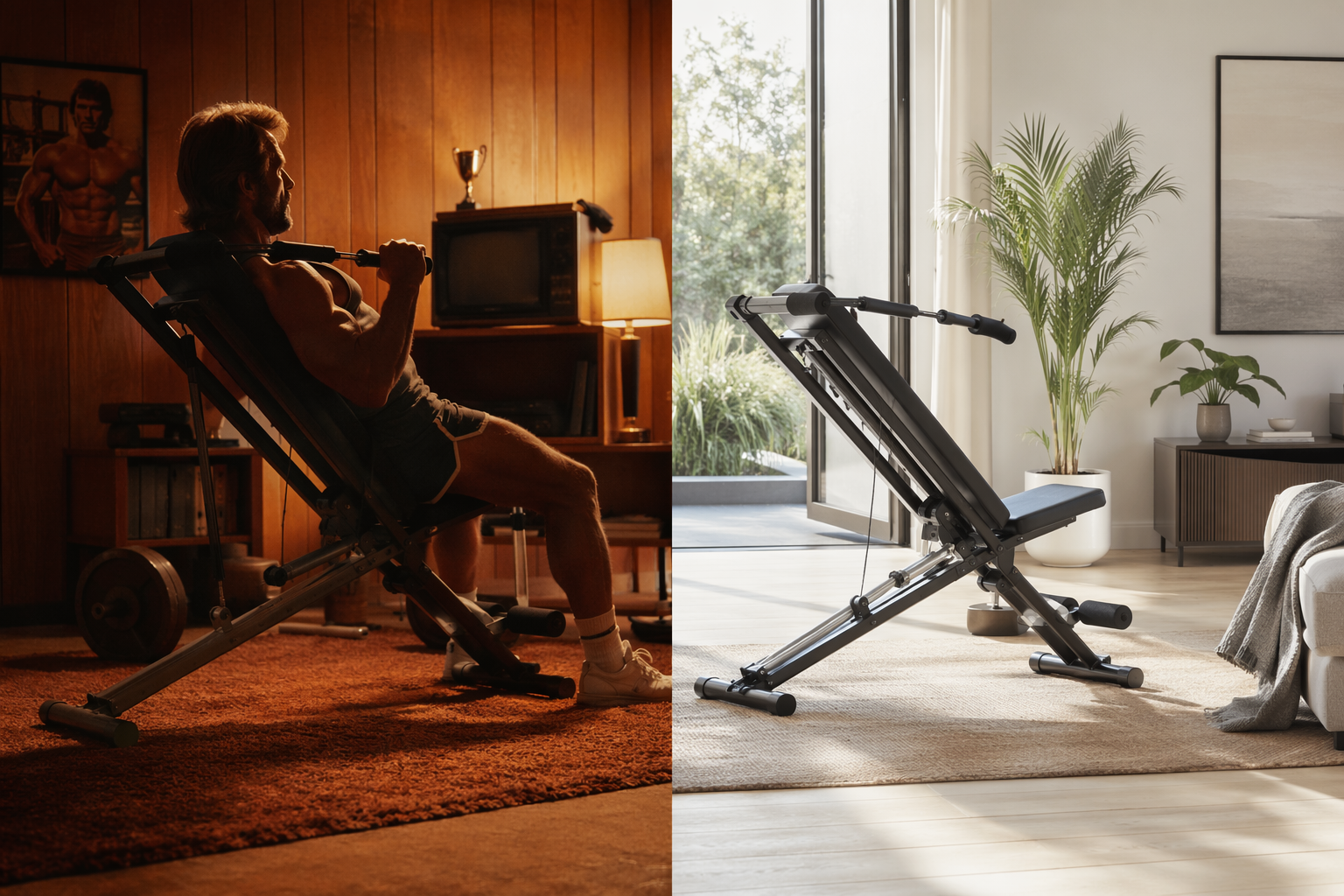
When you search for a "chuck norris workout machine," you are likely recalling the iconic Total Gym infomercials that aired in the 1990s. But the real story is not about nostalgia — it is about what a man who turned 86 in March 2026 can teach us about aging well. Chuck Norris has been using the Total Gym for nearly five decades, and his current training split proves that consistent, low-impact, bodyweight-based work can sustain strength, mobility, and cardiovascular health well into your 80s.
This article breaks down Norris's actual weekly routine, extracts the principles that drive his longevity, and delivers a practical Total Gym workout blueprint for readers 40 and older who want to build strength at home without punishing their joints. This is not a buyer's guide or a nostalgia piece — it is a program-adoption article built around a real, proven approach to healthy aging.
How It Started: The 1976 Rotator Cuff Injury That Led to the Total Gym
Norris's relationship with the Total Gym began not with an infomercial deal, but with an injury. In 1976, he tore his rotator cuff while lifting weights. Rather than opting for surgery, he turned to the Total Gym — a machine invented just two years earlier by Tom Campanaro in 1974 — to rehab his shoulder. According to Norris's own account, his injury healed within six weeks using the machine's variable-incline bodyweight resistance.
That origin story is important for anyone concerned about joint health or recovering from an injury. The Total Gym's design allows you to reduce the percentage of your bodyweight you are lifting by adjusting the incline angle. This makes it a natural fit for physical therapy — a field the company formally entered in 1988, where rehabilitation specialists and professional athletes began using it for partial bodyweight training. For the home user, this means you can start at a very low resistance level and progress gradually, which is exactly what Norris did.
Chuck Norris's Current Weekly Workout Split
Norris's weekly routine, as reported by Generation Iron, is divided into two distinct training blocks. It is not a grueling daily grind — it is a sustainable schedule that balances strength, cardiovascular work, flexibility, and active recovery.
| Day | Workout Components | Focus |
|---|---|---|
| Monday / Wednesday / Friday | 15 minutes on the Total Gym, 2-mile fast walk (or 30 minutes on the elliptical), 10 minutes of crunches, stretching | Strength, cardio, core, and flexibility |
| Tuesday / Thursday / Saturday | Martial arts (isolated kicks, hand and foot combos on a heavy bag), pool exercises (kicks and resistance work) | Power, coordination, and joint-friendly resistance |
| Sunday | Active recovery or complete rest | Recovery and adaptation |
A few details stand out. First, the Total Gym sessions are only 15 minutes. That is a short window, but the machine's design allows for high-density work — you move quickly between exercises without needing to change weights or adjust cables. Second, Norris includes a 2-mile fast walk or elliptical session on the same days, which keeps his cardiovascular system engaged without the impact of running. Third, the pool work is not just a cool-down; Norris reportedly states that water provides 12 times the resistance of air, making it a highly effective, joint-safe strength modality.
Norris also uses a heart rate formula to guide his intensity: subtract your age from 220, multiply by 0.6 and then by 0.9. The range between those two numbers is your target heart rate zone. For a 60-year-old, that would be roughly 96 to 144 beats per minute. This is a simple, equipment-free way to ensure you are working hard enough to get results without overexerting.
The Key Principles Behind His Longevity
Norris's routine is not just a list of exercises — it is a system built on several repeatable principles. These are the takeaways that matter more than any specific machine or movement.
- Low-impact first, high-intensity second. The Total Gym, pool work, and fast walking all minimize joint stress. Norris does not run, jump, or lift heavy free weights. He prioritizes movements that allow him to train daily without accumulating joint damage.
- Consistency over intensity. The 15-minute Total Gym sessions are short enough that skipping them feels unreasonable. This is a powerful psychological strategy for long-term adherence. A short workout you actually do is infinitely more valuable than a long one you avoid.
- Target heart rate as a guide. Using the 220-minus-age formula gives Norris a clear, objective intensity target. It removes guesswork and ensures he is working in the right zone for cardiovascular adaptation without drifting into dangerous territory.
- Stretching is non-negotiable. Every MWF session ends with dedicated stretching time. As we age, flexibility and range of motion decline faster than strength if not actively maintained. Norris treats flexibility work as a core component, not an afterthought.
- Variety prevents burnout. By alternating Total Gym days with martial arts and pool work, Norris avoids the monotony that kills most home fitness routines. Each session feels different, which keeps motivation high without requiring willpower.
What Home Fitness Enthusiasts 40+ Can Learn
Norris is a martial arts legend and former world champion, so his baseline fitness level is far above average. But the structure of his routine is entirely transferable to someone starting from a much lower point. The key is understanding how progressive overload works on a bodyweight machine like the Total Gym.
Unlike a barbell where you add plates to increase load, the Total Gym uses your own bodyweight and an adjustable incline. A steeper incline means you are lifting a higher percentage of your bodyweight. A shallower incline reduces the load. This means you can progress by gradually increasing the incline level over weeks and months, rather than by adding external weight. The Total Gym FIT, for example, offers 12 levels of resistance, which gives you a clear progression ladder.
For readers 40 and older, this is a critical advantage. Joint-friendly resistance that can be precisely dialed in reduces the risk of overuse injuries that often derail training programs. The machine's smooth glideboard and adjustable incline make it gentle on knees, hips, and the spine — areas that become more vulnerable with age.
Another lesson is the importance of active recovery. Norris does not take complete rest days — he does pool work and martial arts on his non-Total Gym days. For the average home fitness enthusiast, this could mean alternating a strength day with a walking day or a mobility session. The goal is to avoid the "all or nothing" trap where you train hard for a few days, then burn out and do nothing for a week.
Sample Adapted Total Gym Routine for Readers 40+
The following routine is adapted from the principles of Norris's approach, designed for someone 40 or older who wants to build full-body strength, improve mobility, and protect their joints. It uses the Total Gym's incline-based resistance and can be completed in 20 to 25 minutes.
| Exercise | Sets | Reps | Rest | Notes |
|---|---|---|---|---|
| Seated Chest Press | 2–3 | 12–15 | 45 seconds | Keep shoulders pulled back and down. Do not let the elbows flare out. |
| Seated Row | 2–3 | 12–15 | 45 seconds | Squeeze your shoulder blades together at the end of each rep. Avoid jerking the handle. |
| Leg Press (with squat stand accessory) | 2–3 | 12–15 | 45 seconds | Push through your heels. Keep your knees tracking over your toes, not collapsing inward. |
| Straight Arm Pulldown | 2–3 | 12–15 | 45 seconds | Engage your lats before pulling. Keep your core braced to prevent arching your lower back. |
| Glute Bridge (on glideboard) | 2–3 | 15–20 | 30 seconds | Drive your hips up, squeezing your glutes at the top. Lower with control. |
| Plank with Knee Tucks (on glideboard) | 2–3 | 10–12 per side | 30 seconds | Keep your hips level. Pull your knee toward your chest without rounding your back. |
Before starting, spend 3 to 5 minutes on light cardio — marching in place, arm circles, or a slow walk — to increase blood flow. After the main work, spend 5 minutes stretching your chest, lats, hamstrings, and hip flexors. This mirrors Norris's emphasis on stretching as a core part of every session.
For guidance on recovery between sessions, see our guide on how to recover from a bodyweight workout at home, which covers foam rolling, active rest protocols, and mobility work that complement this routine.
The Total Gym in 2026: Still Relevant for Home Fitness?
The home fitness market in 2026 is crowded with smart gyms, cable machines, and all-in-one strength systems that offer app integration and digital coaching. The Total Gym, by contrast, is a purely mechanical device — no screen, no subscription, no firmware updates. That simplicity is either a limitation or a feature, depending on your priorities.
For the reader focused on healthy aging, the Total Gym's advantages are clear: it has a compact footprint (the FIT model folds to 18.5 x 50.5 x 8.5 inches and weighs 66 pounds), supports over 85 exercises, has a 450-pound user weight capacity, and comes with a lifetime frame warranty. It has been used in physical therapy since 1988, and over 4 million units have been sold across 85 countries. The machine generates an estimated 24 million workouts per month worldwide, according to the company.
That said, the Total Gym is not a direct replacement for a full power rack or a cable crossover machine. If your goal is maximal strength gain or bodybuilding-level muscle hypertrophy, a barbell and plate setup or a dedicated functional trainer may be more appropriate. For a broader comparison of modern alternatives, see our smart home gym comparison for 2026.
Age Is a Number, Not a Limitation
Chuck Norris's 49-year journey with the Total Gym is not a marketing story — it is a case study in how to train intelligently across a lifetime. He started using the machine to recover from a torn rotator cuff at age 36. At 86, he is still training on it three days a week, walking two miles on the same days, and doing martial arts and pool work on the others. He celebrated his 85th birthday by climbing Mount Lassen, a 3,100-meter peak in California.
The lesson is not that you need a Total Gym. The lesson is that a consistent, low-impact, intelligently structured routine — built around movement every day, joint-friendly resistance, and a clear intensity target — can sustain your physical capacity far longer than most people assume. Whether you use a Total Gym, resistance bands, a cable machine, or just your own bodyweight, the principles are the same.
Start where you are. Listen to your body. Move every day. That is the blueprint.
What a small equipment investment adds
We don't have a build tagged to this exact tier yet. Browse all builds.
How often should you repeat this?
See our recovery and rest reference for citation-anchored rest-interval guidance.
Spot something off?
Tell us if a movement, tier assumption, or duration didn't match your experience.