
Low-Impact Strength Training: Why 'Low Impact' Doesn't Mean Low Results — And Which Equipment Actually Builds Muscle
This article challenges the assumption that low-impact exercise is only for cardio or maintenance. It shows intermediate fitness enthusiasts how to use specific equipment and targeted programming — slow eccentrics, progressive overload, and controlled tempo — to build real strength and muscle without joint stress.
- Duration
- 30 min
The Shift from Movement to Measurable Strength
For years, the phrase "low-impact exercise" has been shorthand for gentle movement — a recovery day activity, a senior fitness class, or a way to burn calories without breaking a sweat. That perception is changing rapidly. According to Les Mills trend data cited in a January 2026 analysis, 50% of fitness enthusiasts now incorporate low-impact strength training into their routines, and overall demand for low-impact workouts has risen approximately 30% year over year. The same report notes that 30% of gym-goers now prioritize low-impact workouts, with 20% citing joint issues as the primary driver.
This isn't a niche trend. It reflects a fundamental shift in how people think about training: the goal is no longer just to move without pain, but to build measurable strength without the cumulative joint stress that comes with high-impact or heavy-load work. The fitness industry is waking up to the fact that low-impact doesn't have to mean low-intensity, and it certainly doesn't have to mean low-results.
A Lagree Fitness study reported by Inspire Seattle found that participants who followed a structured low-impact strength program experienced a 30% improvement in muscle endurance over 12 weeks and a 25% reduction in joint pain compared to those doing high-impact workouts. These aren't maintenance numbers — they're growth numbers. The question is whether your current low-impact routine is designed to produce them.
Why Many Low-Impact Workouts Fail to Build Strength
If you've been doing low-impact cardio for months and wondering why your strength hasn't budged, the problem isn't the concept — it's the execution. Most low-impact routines fall into three traps that prevent muscle growth.
- Momentum-dependent movement. Fast-paced cycling, elliptical training, and even some rowing protocols rely on momentum to sustain output. When momentum does the work, your muscles don't have to. Strength gains require controlled resistance through a full range of motion — not spinning a flywheel.
- Insufficient progressive overload. Many low-impact machines offer resistance levels, but users rarely increase them systematically. If you're using the same resistance setting for weeks, your muscles have no reason to adapt and grow. Strength is a demand-response system — without increasing demand, there is no response.
- Lack of intentional time under tension. Muscle hypertrophy is driven by time under tension — the duration your muscle is under load during a set. Fast, uncontrolled reps reduce time under tension dramatically. A set of 10 fast reps might take 10 seconds. A set of 10 controlled reps with a 6-second eccentric phase takes over a minute. That difference is the difference between maintenance and growth.
The good news is that these are all fixable. You don't need to abandon low-impact training — you need to choose equipment that supports controlled resistance and program it with intention.
Equipment That Genuinely Builds Strength
Not all low-impact equipment is created equal when it comes to strength outcomes. The key differentiators are progressive overload potential, time under tension capability, and resistance scalability. Here's how the major categories stack up.
| Equipment Type | Progressive Overload Potential | Time Under Tension Capability | Resistance Scalability | Best For |
|---|---|---|---|---|
| Megaformer / Lagree | High — spring-based resistance with incremental adjustments | Excellent — slow, controlled tempo is built into the method | Moderate — limited by spring count and carriage position | Full-body strength with emphasis on core and stability |
| Rowing Machine (e.g., Concept2 RowErg) | High — adjustable damper setting and stroke rate control | Good — can be programmed with slow, powerful strokes | Moderate — resistance is air-based; requires stroke technique for load | Posterior chain strength and cardiovascular conditioning |
| Cable Machine | Very High — weight stack or plate-loaded with small increments | Excellent — full control over tempo and range of motion | Very High — up to 200+ lbs with micro-adjustments possible | Isolation and compound movements with constant tension |
| Adjustable Dumbbells (e.g., REP QuickDraw) | Very High — 5–50+ lbs in 2.5–5 lb increments | Excellent — full control over tempo and form | Very High — wide weight range in a compact footprint | Traditional strength exercises with full range of motion |
| Resistance Bands (e.g., Living.Fit) | Moderate — resistance increases with stretch length; limited by band count | Excellent — constant tension throughout movement | Moderate — up to 250 lbs combined; requires multiple bands | Portable strength training with variable resistance curves |
For a deeper comparison of cable machines versus free weights, see our Cable Machine vs. Free Weights: What Science Says About Muscle Growth, Safety, and When to Choose Each. If you're evaluating the cost of building a home gym around these tools, our Home Gym System Cost Breakdown covers what you get at every price tier from $300 to $6,000+.
Programming for Results: The Low-Impact Strength Protocol
Having the right equipment is only half the equation. Without intentional programming, even the best low-impact tools will produce mediocre results. The following principles are designed to transform any low-impact setup into a genuine strength-building system.
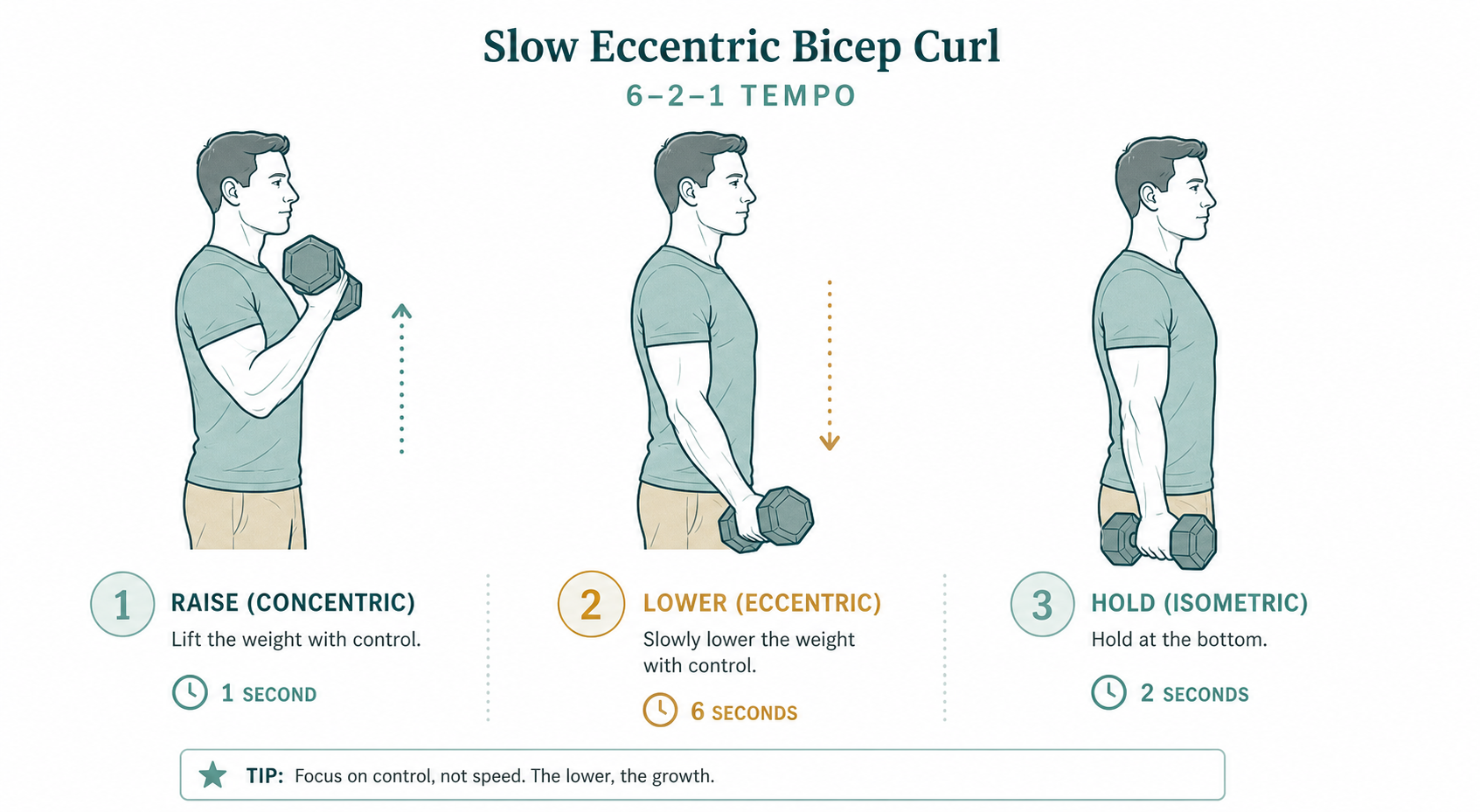
- Slow eccentrics. The eccentric (lowering) phase of a movement is where most muscle damage and growth signaling occurs. Program a 6-second lowering phase, a 2-second hold at the bottom, and a 1-second concentric (lifting) phase. This 6-2-1 tempo dramatically increases time under tension without requiring heavier weight.
- Logged resistance for progressive overload. Strength gains require systematic increases in demand. Log every session: the resistance level, the number of reps, and the tempo. Aim to increase resistance by 1–2% per session when you can complete all reps with perfect form and the prescribed tempo.
- RPE tracking. Rate of Perceived Exertion (RPE) on a 1–10 scale helps you gauge effort without a one-rep max test. For strength-building, work in the RPE 7–9 range — meaning you have 1–3 reps left in the tank at the end of each set. If you're below RPE 7, increase resistance. If you're at RPE 10 every session, back off and focus on tempo.
- Microloading. Small increments matter. If your equipment allows 2.5 lb or 5 lb jumps, use them. If you're using resistance bands, add a lighter band to increase resistance at the top of the movement without changing the starting tension. The goal is consistent, small increases — not dramatic jumps that compromise form.
For readers deciding between smart home gyms and traditional equipment for tracking resistance and progressive overload, our Smart Home Gym vs. Traditional Weights: A Decision Guide covers the trade-offs between digital resistance tracking and manual logging.
Measuring Progress: Functional Tests for Strength Gains
One-rep max testing isn't practical — or safe — for most low-impact training environments. Instead, use repeatable functional tests that measure real-world strength improvements. Test every 4 weeks at the same time of day, after a rest day, and record your results.
| Test | What It Measures | How to Perform | Progress Indicator |
|---|---|---|---|
| 30-Second Chair Stand Test | Lower body strength and endurance | Sit in a standard chair (17-inch seat height), arms crossed over chest. Stand up and sit down as many times as possible in 30 seconds. | Increase of 2+ reps over 4 weeks indicates strength gain |
| Single-Leg Balance Test | Stability and core strength | Stand on one leg with hands on hips. Time how long you can hold without touching the raised foot down or losing balance. Test both legs. | Increase of 10+ seconds over 4 weeks indicates improvement |
| Stair-Climb Time | Functional leg power and endurance | Climb a standard flight of 12 stairs as quickly as safely possible. Use the handrail only for balance, not for pulling. | Decrease of 1+ second over 4 weeks indicates strength gain |
These tests are simple, require no special equipment, and correlate well with overall strength and mobility. If your numbers are improving, your programming is working — regardless of whether you're lifting heavy weights or using resistance bands.
Sample Strength-Focused Low-Impact Weekly Split
The following weekly plan applies the principles from this article into a concrete, followable routine. It uses equipment types discussed above and emphasizes slow eccentrics, progressive overload, and RPE tracking. Adjust resistance and reps based on your current fitness level.
| Day | Session Focus | Equipment | Key Tempo | Sets x Reps | Rest Between Sets |
|---|---|---|---|---|---|
| Monday | Full-Body Strength | Cable machine or adjustable dumbbells | 6-2-1 (6s eccentric, 2s hold, 1s concentric) | 3 x 8–12 | 60–90 seconds |
| Wednesday | Posterior Chain & Core | Rowing machine (slow, powerful strokes) + resistance bands | 4-1-1 (4s drive, 1s hold, 1s recovery on rower); 6-2-1 for band work | 3 x 10 (rower); 3 x 12 (bands) | 60 seconds |
| Friday | Upper Body & Stability | Megaformer/Lagree or cable machine + resistance bands | 6-2-1 for all exercises | 3 x 10–15 | 45–60 seconds |
| Saturday | Active Recovery | Light resistance bands or bodyweight mobility | Slow, controlled movement; no RPE target | 2 x 15–20 | 30 seconds |
Log your resistance levels, RPE, and rep counts for each session. Aim to increase resistance by 1–2% per session when you can complete all reps with the prescribed tempo and perfect form. After 4 weeks, retest your functional tests (30-second chair stand, single-leg balance, stair-climb time) to measure progress. If you're improving, your low-impact strength program is working exactly as designed.
What a small equipment investment adds
We don't have a build tagged to this exact tier yet. Browse all builds.
How often should you repeat this?
See our recovery and rest reference for citation-anchored rest-interval guidance.
Spot something off?
Tell us if a movement, tier assumption, or duration didn't match your experience.