
The No-Bench Full-Body Dumbbell Workout: A Complete 3-Day Plan for Home
Build muscle and strength at home with just dumbbells and no bench. This complete 3-day full-body program uses smart floor substitutions and a proven progression system to help beginners and intermediate exercisers see real results in limited space.
- Duration
- 30 min
You Probably Think You Need a Bench
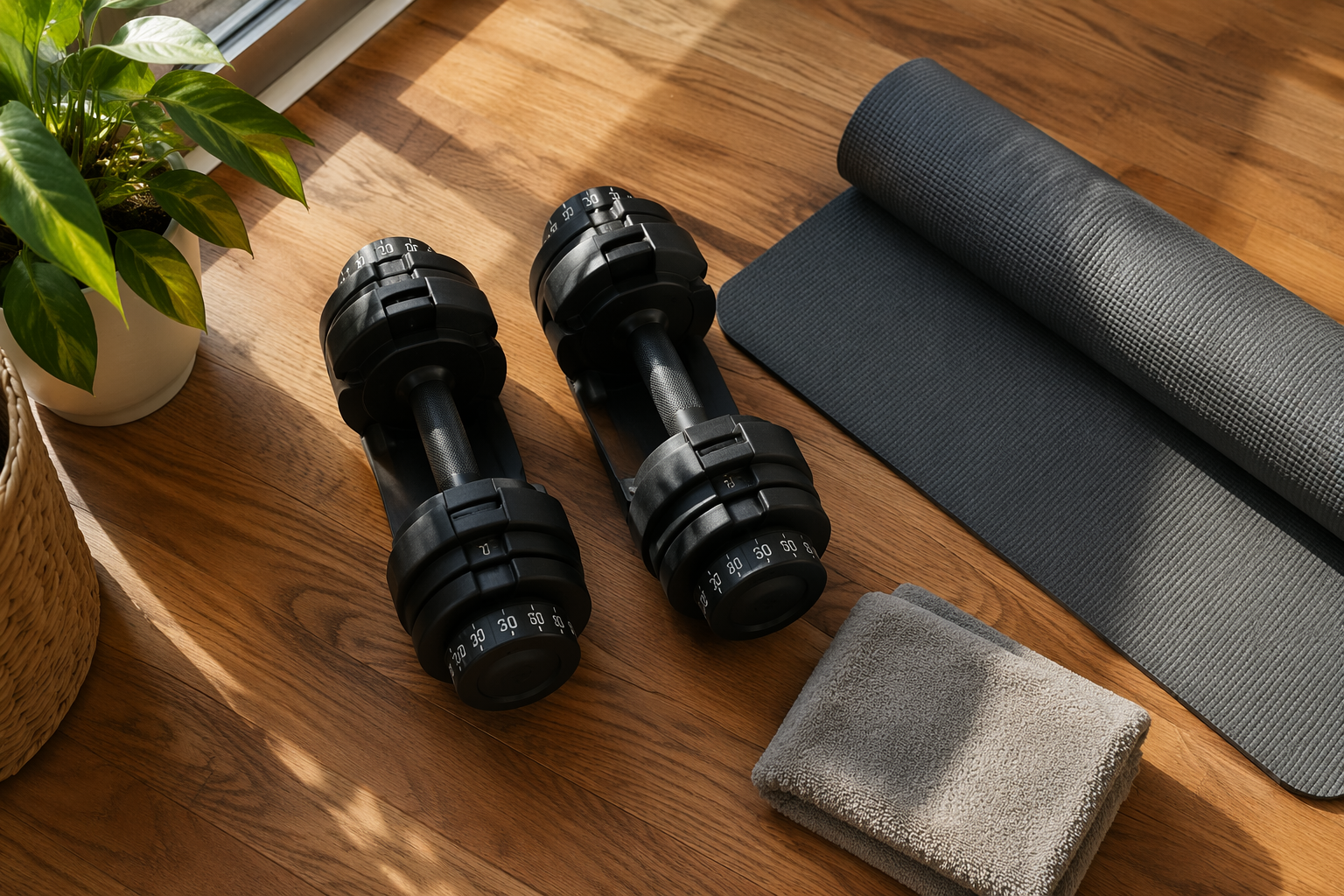
I built my first real strength in a 500-square-foot apartment with a single pair of adjustable dumbbells and no bench. The internet told me I needed a gym, or at least a flat bench, to make gains. I tested that story. It turned out to be marketing masquerading as physiology.
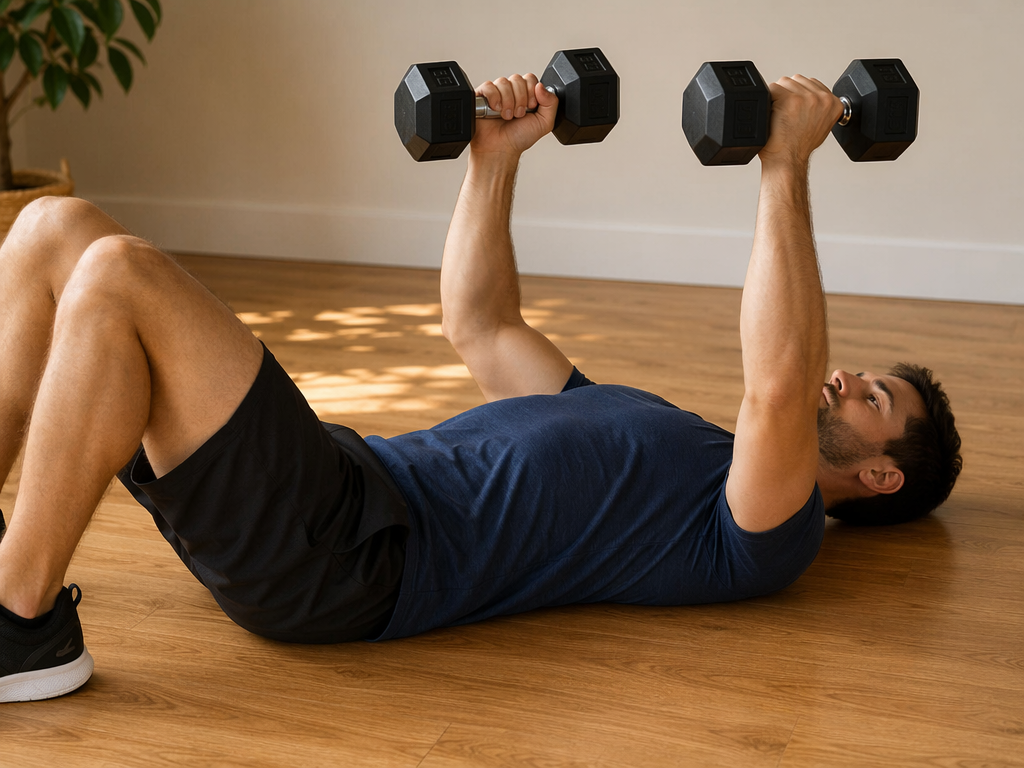
The bench press is not the only way to develop chest, shoulders, and triceps. The dumbbell floor press — lying on the floor with knees bent, pressing the weights up from a position where your upper arms rest on the ground — does the same job with a shorter range of motion. The trade-off is real: you lose the stretch at the bottom that contributes to hypertrophy in the lengthened position. But you also eliminate the shoulder-stress pattern that sends many lifters to physical therapy. For most home exercisers, the reduced risk is worth the slight compromise in muscle growth. I coach dozens of beginners through exactly this setup, and none of them has stalled because of the missing bench.
Why Full-Body Three Times a Week
The conventional wisdom says you need split routines — push day, pull day, leg day — to stimulate enough growth. The data says otherwise for people who are not advanced bodybuilders. A 2017 study in Frontiers in Physiology found that programs built around multi-joint (compound) exercises improve strength and maximal oxygen consumption more efficiently than programs using mostly single-joint exercises. A 2021 study (PMC8372753) confirmed that full-body and split routines produce similar strength and size gains for beginners when total weekly volume is equated.
The more attention-grabbing number comes from a 2016 study in Biology of Sport: full-body training reduced fat mass by 5.7% over four weeks, compared to 2.1% for split-body training — nearly three times the reduction. That figure comes from a single study on 24 male rugby players, not necessarily your neighbor starting a home workout. I present it as promising ancillary evidence, not a headline promise. The core finding that matters more for your goals is that strength gains are essentially identical when volume is matched.
The Seven Exercises That Cover Everything
You do not need a dozen movements. You need seven, chosen to cover push, pull, squat, hinge, and carry patterns without any bench. Each one is selected because it either works better for beginners or spares your joints when done on the floor.
- Goblet squat — the best squat for beginners. Holding a single dumbbell in front of your chest keeps your torso upright, lets you sink deeper, and gives a greater stretch on the quads.
- Dumbbell floor press — press from the floor, upper arms stop when they touch the ground. Shoulder-friendly alternative to bench press.
- Bent-over row — hinge at the hips, back flat, pull the dumbbells to your ribs. The fundamental horizontal pull.
- Romanian deadlift (RDL) — the hinge pattern that builds hamstrings and glutes. Keep a soft knee bend, push hips back, feel the stretch, then drive through the heels.
- Overhead press — seated or standing, press one or two dumbbells overhead. The vertical push.
- Lateral raise — the only isolation exercise on the list. Use light weight, control the movement, do not swing.
- Push-up or renegade row — alternates as a chest/triceps push or a horizontal pull with a core challenge. Both can be done on the floor with dumbbells.
That is the library. Now the schedule.
The 3-Day Full-Body Plan
Three non-consecutive days per week (Monday, Wednesday, Friday works well). Each day hits all major patterns, with the exercises rotated slightly so no session feels identical. Reps in reserve (RIR) of 1–2 for most sets — that means you stop when you could grind out one or two more reps, but you do not go to absolute failure. Rest 90 seconds for hypertrophy-focused sets, 3 minutes if you are training for strength. The rep range for hypertrophy: 8–15 per set, as recommended by REP Fitness.
| Exercise | Day A | Day B | Day C |
|---|---|---|---|
| Goblet squat | 3 × 8–12 | 3 × 8–12 | 3 × 8–12 |
| Floor press | 3 × 8–12 | — | 3 × 8–12 |
| Bent-over row | 3 × 8–12 | 3 × 8–12 | — |
| RDL | — | 3 × 8–12 | 3 × 8–12 |
| Overhead press | — | 3 × 8–12 | — |
| Lateral raise | 3 × 10–15 | — | 3 × 10–15 |
| Push-up or renegade row | 3 × 8–15 | 3 × 8–15 | 3 × 8–15 |
Day A emphasizes squat and push. Day B shifts to hinge and overhead pull. Day C brings back the floor press and adds the RDL. The renegade row or push-up appears every day to keep core and upper body volume balanced.
How to Actually Get Stronger: Double Progression
This is where most people stall. They do the same set of 10 reps with the same 30-pound dumbbells for months and wonder why nothing changes. The solution is double progression: first increase the reps within your target range, then increase the weight.
Here is a concrete example from Bony to Beastly for a bent-over row:
| Week | Weight | Sets × Reps | RIR |
|---|---|---|---|
| 1 | 50 lbs | 10, 10, 9 | 1–2 |
| 2 | 50 lbs | 10, 10, 10 | 1 |
| 3 | 55 lbs | 10, 8, 7 | 1–2 |
| 4 | 55 lbs | 10, 10, 9 | 1–2 |
| 5 | 55 lbs | 10, 10, 10 | 1 |
| 6 | 60 lbs | 9, 8, 7 | 1–2 |
The rule is simple: once you can hit the top of the rep range (12 reps for most exercises) across all sets, increase the dumbbell weight by the smallest increment you can — often 2.5 or 5 pounds. Then start again from the bottom of the range. This tiny, consistent pressure is what drives growth. It also works with your total rep score for a session, as the Men's Health UK no-bench circuit suggests: score your total reps and try to beat that number next time.
Warm-Up and Cool-Down for Floor-Only Training
A generic warm-up lifted from a gym routine will miss the specific demands of training on the floor. You need to open the hips and shoulders in positions you will actually use.
Warm-up (5 minutes, no weights):
- Glute bridges — 10 reps, hold the top for two seconds. Prepares the hips for floor pressing and squats.
- Wall slides — stand against a wall, slide arms up and down. Mobilizes the shoulders for overhead press and floor press.
- Cat-cow — 6 cycles on hands and knees. Loosens the spine after sitting all day.
- World's greatest stretch — 3 per side. Opens the hips and thoracic spine.
Cool-down (2 minutes): hold each stretch for 30 seconds — kneeling hip flexor stretch, seated hamstring stretch, child's pose.
What This Plan Can't Promise
I want to be straight with you about the numbers that catch the eye. The claim that 90 minutes of strength training per week adds up to four years of life expectancy comes from a 2024 study (DOI 10.3390/biology13110883), cited by Welltech. The underlying study was not independently verified during our review of this article. Treat it as an intriguing estimate from one analysis, not a settled figure.
The floor press does not fully replicate the bench press. The stretch at the bottom — when the bar touches your chest — is a potent stimulus for muscle growth at the lengthened position. The floor press cuts that stretch short. What you gain is reduced shoulder stress, which for most home lifters is a trade worth making. If you eventually add a bench, the floor press remains a useful secondary movement.
Start With the Plan, Stick With the System
You do not need a gym. You do not need a bench. You need a pair of dumbbells, a floor, and a structured plan that respects what you actually have. The three-day rotation and the double-progression rule are the system. Run it for six weeks, track your reps and weights, and you will see progress that would fool anyone who assumes you need a commercial gym.
For a deeper look at the science behind full-body training, see Why Full-Body Dumbbell Workouts Beat Split Routines for Fat Loss and Recovery. If you are new to home fitness and need guidance on what equipment to buy, the Home Fitness Equipment for Small Spaces guide covers adjustable dumbbells and compact setups.
What a small equipment investment adds
We don't have a build tagged to this exact tier yet. Browse all builds.
How often should you repeat this?
How Whoop and Oura Ring track recovery for home workouts
For home exercisers deciding between WHOOP and Oura Ring, the better sleep and recovery tracker depends on training style: WHOOP's strength-aware tracking fits dumbbell and grip-heavy sessions, while Oura's sleep-first scoring suits yoga and indoor cycling. The verdict hinges on how each builds its daily recovery score, their home-workout tracking gaps, and who pays for hardware versus subscription.
Spot something off?
Tell us if a movement, tier assumption, or duration didn't match your experience.