
You have been doing bodyweight squats and lunges for a few weeks. The first week your thighs burned after ten reps. Now you knock out twenty without thinking. The burn is gone, the pump is shorter, and the mirror has stopped returning your calls. That is not a failure of bodyweight training. It is a failure of the variable you have been changing.
When Squats Stop Working
The squat you started with is not the same squat you need now. Muscle growth requires progressive overload — continuously challenging the muscle with a stimulus it has not yet adapted to. When you could do only ten bodyweight squats, each rep was a challenge. Now that you can do twenty, the stimulus is gone. The movement pattern has become an endurance task, not a strength or hypertrophy task.
The threshold to watch is 15–20 controlled reps. Centr puts it plainly: "Once you can complete 15–20 reps of beginner leg exercises, introduce intermediate and advanced exercises to continue progressing." That number is not arbitrary. At that rep range, the mechanical tension per rep drops below what is needed to signal growth. You are now marking time.
You Don’t Need a Barbell to Overload
Most people hear "progressive overload" and assume they need a barbell. You don't. At home, you have four other dials to turn:
- Increase the time under tension — slow down the eccentric (lowering) phase.
- Increase the range of motion — go deeper or higher.
- Shift to unilateral work — one leg has to do the work of two.
- Increase the total volume — more sets per week.
A 2019 study found that squatting with full range of motion (thighs parallel or below) activates the adductors and glutes significantly more than half squats. Going two inches deeper, without adding a single pound, already restarts the overload signal. The InBody analysis of that study puts it simply: full ROM beats partial ROM for muscle development. You do not need a rack to go lower.
Unilateral work is the most overlooked lever. SELF put it well: single-leg moves "often feel more intense than bilateral moves and are an easy way to increase challenge without weights." The reason is mechanical: each leg now supports full bodyweight plus stabilization demand. A Bulgarian split squat with your own body weight can be harder than a barbell squat at 50% of your max.
The Four-Step Ladder
Here is the ladder that takes you from a standard squat to a full pistol squat. Each step increases mechanical tension through a different variable. Move on only when you can do 15–20 controlled reps of the current step.
Step 1: Standard Bodyweight Squat (Baseline)
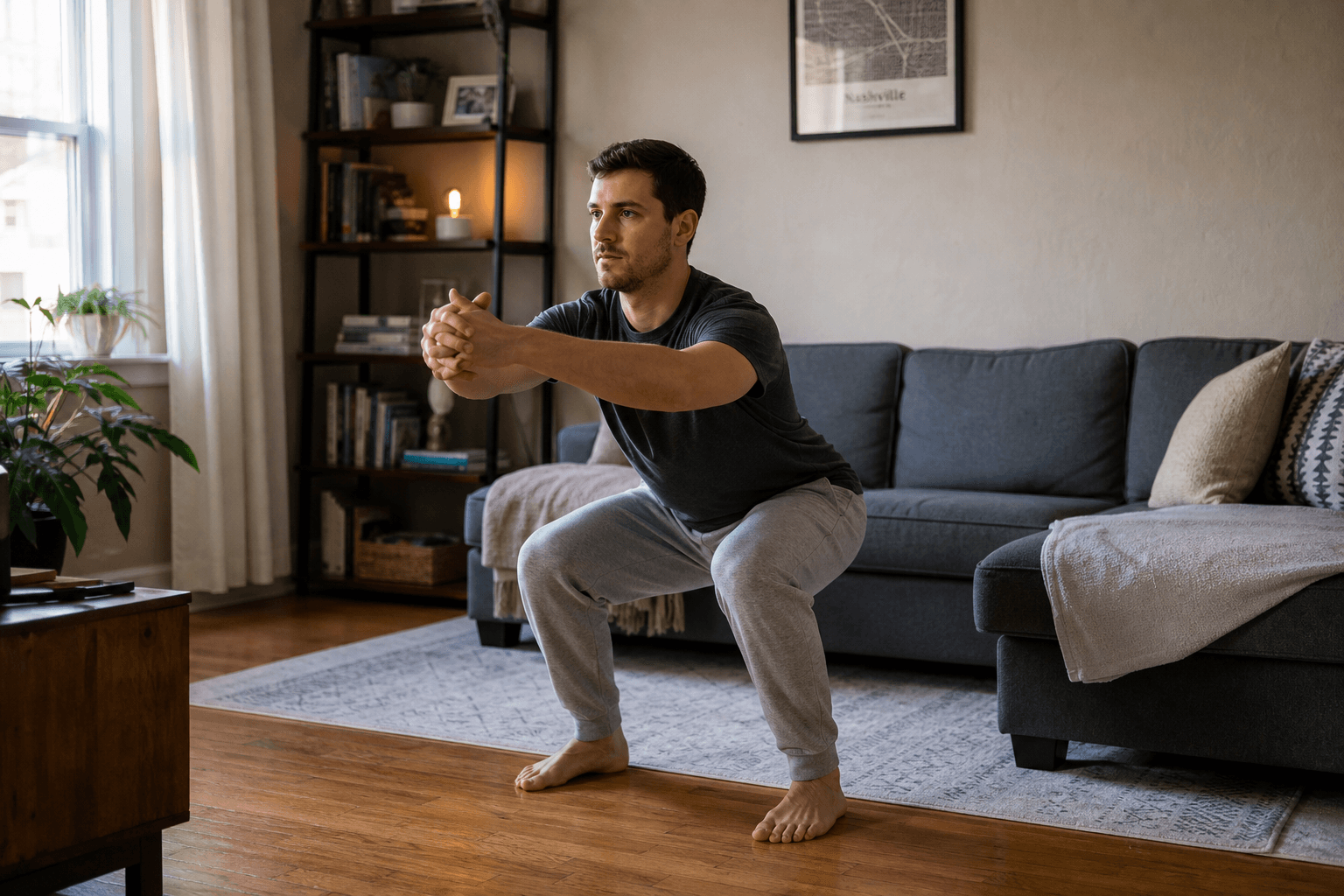
Feet hip-width, toes slightly out, thighs parallel to the floor at the bottom. This is the starting point. Do 2–3 sets of 12–15 reps with a controlled tempo (1 second down, 1 second up). Once you hit 20 reps with perfect form, move to Step 2.
Step 2: Slow Eccentric Squat (3-Second Lowering Phase)
Take three full seconds to lower yourself into the squat, pause at the bottom for one second, then drive up normally (1 second). The longer eccentric increases time under tension and recruits more muscle fibers. This single change can extend your bodyweight-only progression by several weeks. Same rep and set scheme as Step 1. When you can do 15–20 of these controlled, move to Step 3.
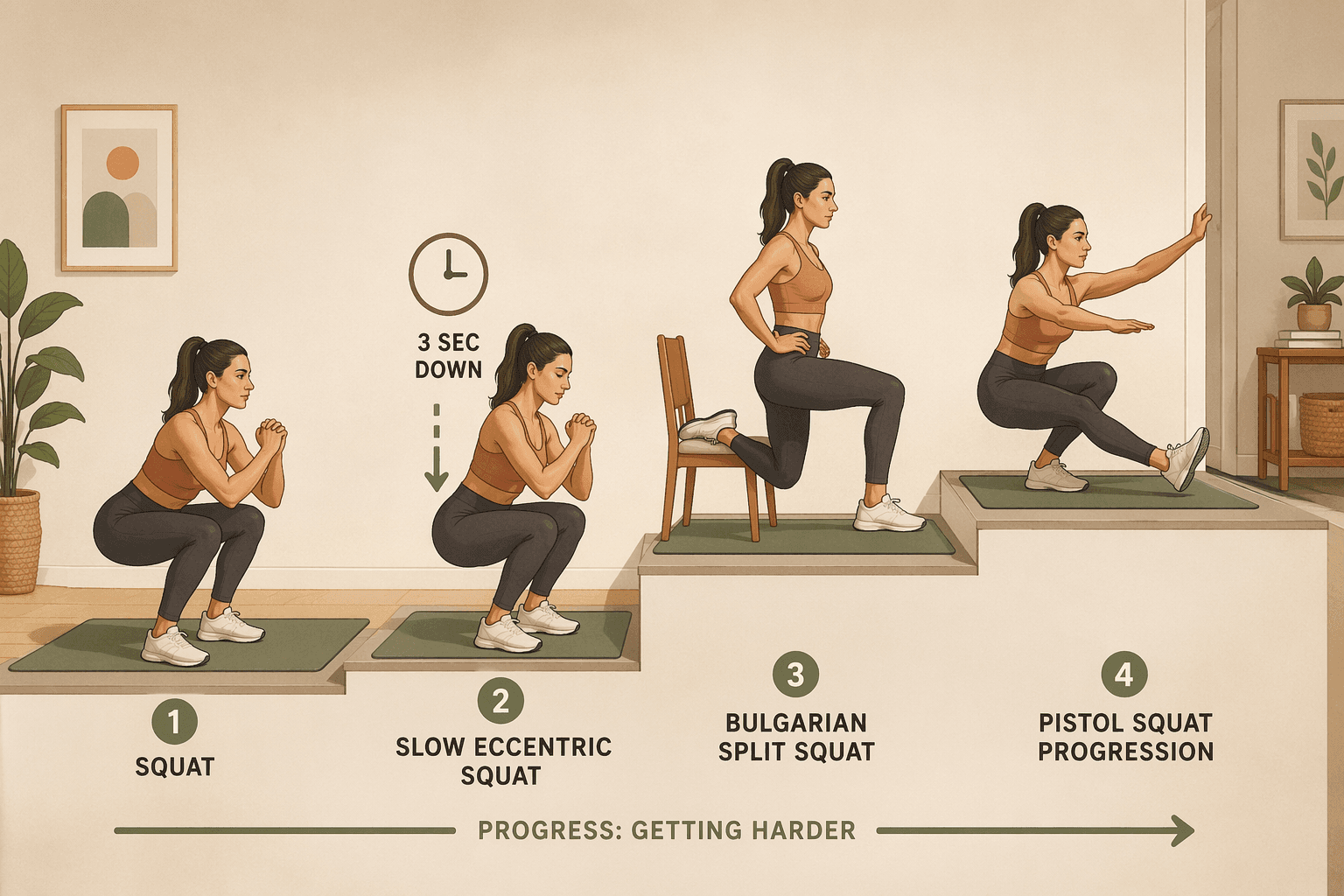
Step 3: Bulgarian Split Squat (Unilateral)
Place the top of your rear foot on a chair or couch. Your front foot is far enough forward that your shin stays vertical at the bottom. Lower until your front thigh is parallel to the floor. This is essentially a single-leg squat with support. A 2020 review found step-ups (a very similar movement) produced the highest glute activation among common leg exercises — I would not take activation as a direct measure of growth, but the unilateral demand is indisputable. Start with 2 sets of 8–10 reps per leg. When you can do 15–20 reps per leg controlled, move to Step 4.
Step 4: Assisted Pistol Squat (Full Unilateral)
Stand on one leg, extend the other leg in front of you, and squat down as low as you can. Use a wall or a doorframe for balance with one hand. Do not let the raised foot touch the floor. This is the most demanding bodyweight leg exercise. When you can do 10–15 reps per leg with only light hand assistance, you have maxed out the bodyweight-only ladder. At that point, any further progression requires adding resistance (bands, household objects, or dumbbells).
Volume: The Lever You’re Forgetting
You can also do more sets. That is volume. Changing exercises is not the only way to progress. Men's Health UK reports that a systematic review found 10–20 weekly sets per muscle group is the hypertrophy sweet spot, with a minimum effective dose of just 4 sets per week. I should note that review was posted on a preprint server — SportRxiv — and has not been formally peer-reviewed. Still, the 4-set minimum is consistent with decades of practical evidence.
For a beginner doing leg work twice a week (per the SELF 48-hour recovery rule and the Men's Health twice-a-week recommendation), that means 2–5 sets per session. Start at 4 total sets across two sessions, then add one set per session each week until you reach 10–12 weekly sets. Only then should you feel pressure to switch to harder exercises.
A practical example: Monday you do 2 sets of squats and 2 sets of step-ups. Thursday you do the same. Next week, add one set to each exercise. Within a month you are doing 12 weekly sets without changing a single exercise — and still growing.
Bands and a Backpack: The Bridge
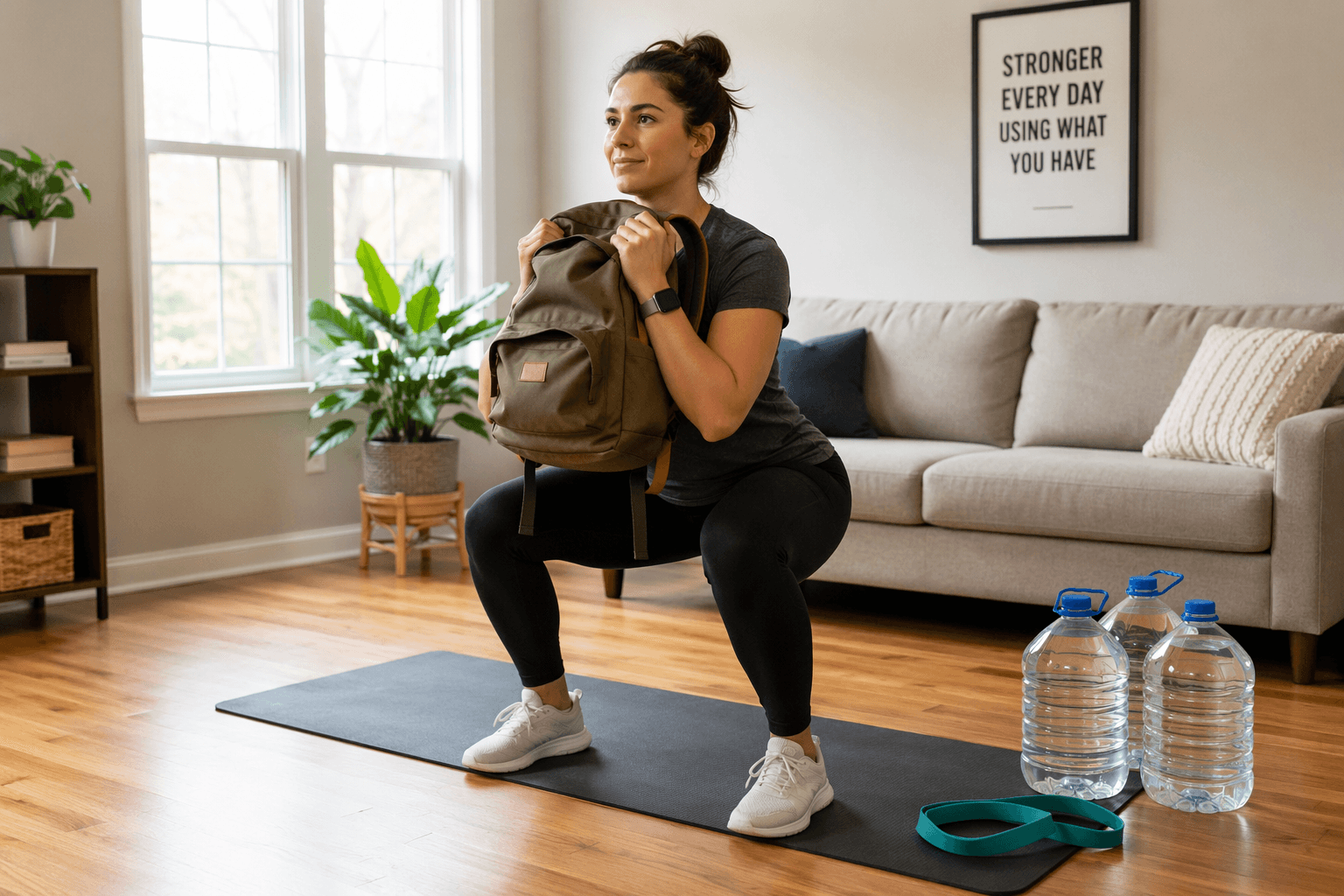
At some point — maybe after three or four months on the ladder — bodyweight alone will not cut it, even with tempo and unilateral tweaks. The next tier does not have to be a dumbbell. Centr suggests using household objects like a backpack filled with books or a water jug. A 20-pound backpack held against your chest turns a bodyweight squat into a loaded goblet squat. A resistance band looped under your feet and over your shoulders adds tension at the top of a squat where bodyweight offers the least resistance.
Bands are not a permanent solution — their resistance curve is non-linear and they become most useful at the top range of motion. But they can buy you another 6–8 weeks of progression before you truly need to invest in equipment. If you want to explore small purchases, the Best Home Exercise Equipment buying guide covers bands, adjustable dumbbells, and other options.
Do You Actually Need Dumbbells?
Dumbbells are not mandatory. If you have made it through the full bodyweight ladder, added bands and a backpack, and are still progressing at the 10–20 weekly sets range, keep going without them. But if your goal is serious hypertrophy — say, adding visible size to your quads and glutes — dumbbells make it easier to load the eccentric and maintain tension through full ROM. The key exercises are goblet squats, Romanian deadlifts (which hit the hamstrings in a way no bodyweight exercise can), and weighted Bulgarian split squats.
Healthline recommends 3–5 exercises per leg workout with 3 sets of 8–12 reps for beginners using weights. Men's Health echoes 3–4 sets of 8–12 reps for hypertrophy on compound lifts. The same progression logic applies: start at 3 sets, add a set when you can hit 12 reps cleanly, and when you reach 20 reps total across all sets on a given exercise, consider increasing the dumbbell weight by 2–5 pounds.
For a complete dumbbell training system, see the Full Body Dumbbell Workout Progression article.
Sample 4-Week Plan
This is a template, not a prescription. Adjust sets down if you're sore, up if you feel you can do more. The ladder, the volume data, and the 2x/week frequency all feed into it.
| Week | Exercises | Sets x Reps | Key Variable |
|---|---|---|---|
| 1 | Bodyweight squat, slow eccentric squat, step-ups (on chair) | 3 x 12–15 | Establish form and tempo |
| 2 | Slow eccentric squat, Bulgarian split squat, step-ups | 3–4 x 12–15 | Introduce unilateral work |
| 3 | Bulgarian split squat, assisted pistol squat, slow eccentric squat | 4 x 10–12 | Increase volume and reduce reps slightly |
| 4 | Bulgarian split squat, assisted pistol squat, weighted squat (backpack) | 4–5 x 10–12 | Add external load if ready; maintain tempo |
Comments
Join the discussion with an anonymous comment.