
The Real Question
You have a pair of dumbbells and a bench. Probably a pull-up bar. And somewhere in the back of your mind, you wonder: can this really build the kind of muscle and strength that people credit to barbells and squat racks? It is a reasonable question. Most messaging around serious strength training treats dumbbells as a stepping stone, not a destination.
But the research tells a different story. A 2024 European Journal of Sport Science study took 23 experienced lifters, matched their training volume at 75 sets per week, and compared full-body training to a split routine. The full-body group lost significantly more whole-body fat mass—especially in arms, legs, and hip/thigh areas—and reported up to 7.5 times less lower-body DOMS. That is not a minor difference. It is a practical advantage: less soreness means you can train more consistently.
Another 2021 study in BMC Sports Science, Medicine and Rehabilitation tested 50 untrained women over 12 weeks. One group trained full-body twice a week, the other trained a split four times a week. Both groups increased 1RM bench press by roughly 25-30%, lat pulldown by 26%, leg press by 29%, and muscle mass by about 1.8%. No statistically significant difference. When weekly volume is matched, full-body training is not a compromise—it is an equally effective strategy.
What Dumbbells Do Better
Barbells let you load heavy. Nobody disputes that. But dumbbells offer advantages that are often overlooked. A 2017 Frontiers in Physiology study compared multi-joint (compound) exercises to single-joint exercises over eight weeks in 36 active males. The compound group improved VO2max by 12.5% versus 5.1% in the single-joint group, and showed greater strength gains in bench press, knee extension, and squat. Multi-joint exercises are simply more efficient—and dumbbells let you perform almost any compound movement: presses, rows, squats, deadlifts, carries.
Then there is range of motion. On a barbell bench press, the bar stops at your chest; with dumbbells, you can lower past that point, stretching the pecs further. Similarly, dumbbell rows allow a deeper retraction. Unilateral work—single-arm presses, single-leg RDLs—forces each side to work independently, correcting imbalances and engaging stabilizers that a barbell would let skate by.
One older study from Biology of Sport (2016) claimed that a full-body dumbbell routine burned nearly three times as much fat mass as a split routine. I want to be honest: I have not verified the original abstract—this claim comes second-hand through a review article. Treat it as an interesting data point, not a settled conclusion. The EJSS study above is on stronger ground because it is a controlled, matched-volume trial.
The System That Makes It Work
You can have the best exercises in the world. Without a system, they are just a list. Here are the levers that turn a list into a program.
- Rep ranges: For hypertrophy, aim for 8-15 reps per set. That is the sweet spot from the evidence.
- RIR (reps in reserve): Stop 1-2 reps short of failure on most sets. This manages fatigue while still providing a strong growth signal. On your last set of an accessory exercise—curls, lateral raises, rows—you can take it to failure if you want.
- Set volume: 10-20 working sets per muscle group per week. Spread across three full-body sessions, that means about 3-6 sets per muscle per session.
- Frequency: Train each muscle group 2-3 times per week. Full-body routines naturally hit this. The PMC 2021 study used 2 days per week for full-body and still built strength.
- Rest intervals: 3-5 minutes between sets for absolute strength, 30-60 seconds for hypertrophy. (Source: PubMed 2009)
The 3-Day Plan
This is the heart of the article. Each day uses supersets—pairing a push exercise with a pull exercise. Supersetting cuts workout time roughly in half while keeping heart rate elevated, and research shows it has no negative effect on muscle or strength gains (Bony to Beastly).
Perform the supersets in the order listed. Rest 60 seconds between supersets (hypertrophy focus) or 3 minutes if strength is the priority. Use the DEXA case study later as a benchmark, not a guarantee.
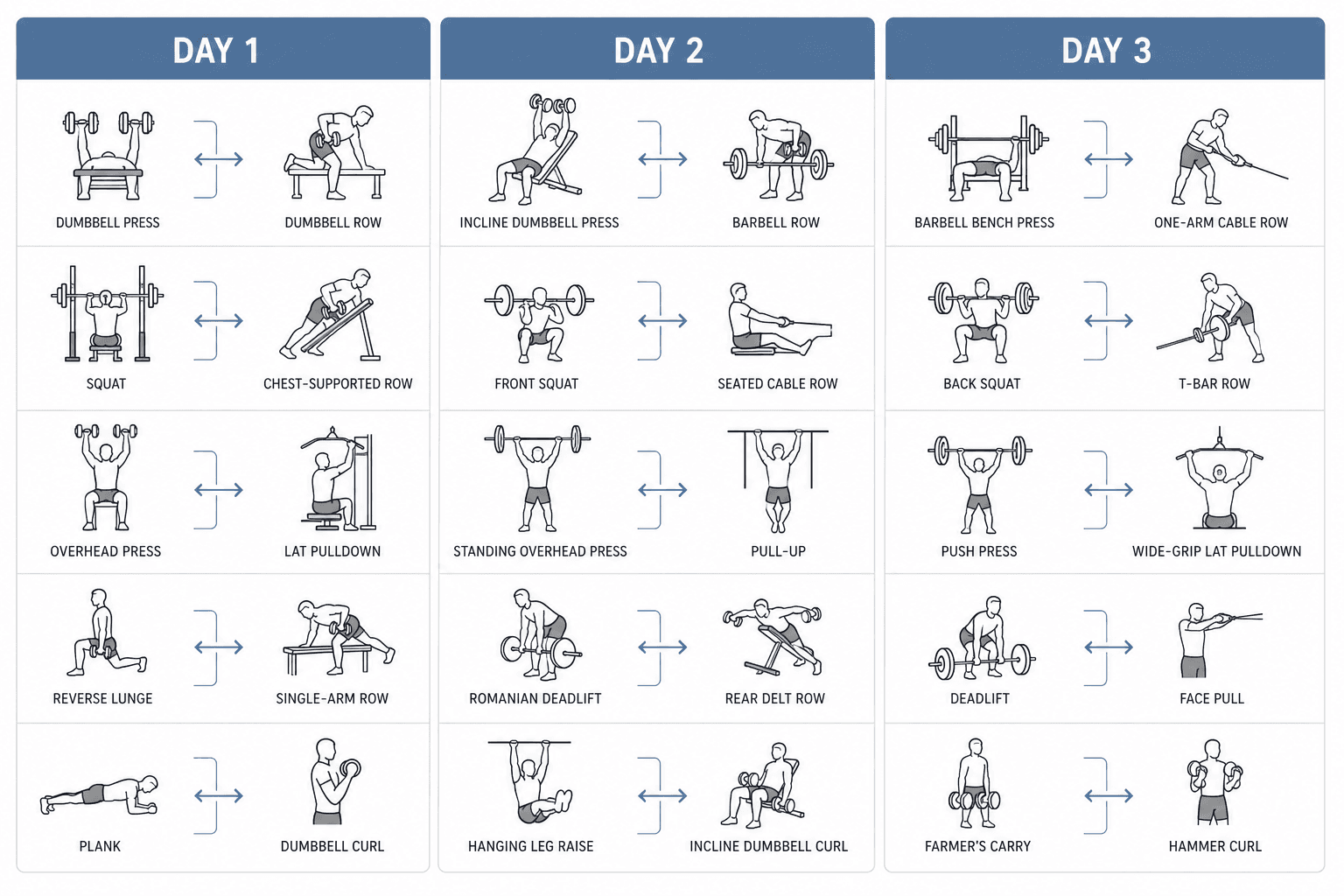
| Day | Superset 1 | Superset 2 | Superset 3 | Accessory / Isolated |
|---|---|---|---|---|
| 1 | Dumbbell Bench Press (RIR 1-2) + Bent-Over Row (RIR 1-2) | Dumbbell Shoulder Press (RIR 1-2) + Pull-Up or Lat Pulldown (RIR 0-1) | Goblet Squat (RIR 1-2) + Romanian Deadlift (RIR 1-2) | Planks or Hanging Knee Raise 2x max |
| 2 | Incline Dumbbell Press (RIR 1-2) + One-Arm Dumbbell Row (RIR 1-2) | Lateral Raise (RIR 0-1) + Face Pull (RIR 1-2) | Walking Lunges (RIR 1-2) + Leg Curl (RIR 1-2) | Dumbbell Bicep Curl (RIR 0) 2 sets |
| 3 | Dumbbell Floor Press or Close-Grip Press (RIR 1-2) + Seated Cable Row or Dumbbell Row (RIR 1-2) | Arnold Press (RIR 1-2) + Chin-Up or Neutral Grip Pull (RIR 1-2) | Front Squat or Goblet Squat (RIR 1-2) + Stiff-Leg Deadlift (RIR 1-2) | Dumbbell Shrugs (RIR 0) 2 sets |
Why these pairings? Each superset combines a horizontal or vertical push with a horizontal or vertical pull. This keeps blood flow balanced across the joint, reduces the chance of impingement, and lets you move quickly from one exercise to the next without resting between moves in the pair.
For example, on Day 1 you perform a set of Dumbbell Bench Press, immediately follow with a set of Bent-Over Row, then rest 60 seconds. Repeat. The mechanical work is high; the elapsed time stays under 45 minutes.
What One Person Did (and What It Means)
Numbers from controlled trials are one thing. A real person doing it is another. The Built With Science case study followed Dayton, a 150-day participant who used only dumbbells, a bench, and a pull-up bar. The results were verified by DEXA scans: he gained 7 pounds of muscle, lost 26 pounds of fat, dropped his body fat from 33% to 23.5%, and reduced visceral fat by 70%.
Those numbers are striking. But I need to be clear: this is a single-participant example, not a controlled trial. It shows what is possible when the programming principles are applied consistently over five months. It does not prove the routine will work for everyone. What it does is demonstrate that the principles in this article—full-body frequency, progressive overload, RIR management—can produce real-world results.
The pre-exhaust technique from that same source deserves a mention here: when dumbbells feel too light, do an isolation exercise like dumbbell flyes before your bench press. A study cited in the article found pre-exhaust produced nearly identical gains to traditional training, with the difference made up by adding one or two extra sets.
How to Beat Last Week
The single most actionable piece of this entire article is the tracking system. Without it, you are guessing. Here is the concrete method from Bony to Beastly:
- Record every set: exercise, weight, reps. Use a notebook, a spreadsheet, or a free workout app.
- Each week, aim to beat the previous week's numbers. First add a rep to each set. Once you hit the top of your rep range (say 12 reps on every set), increase the weight by the smallest increment (5 lbs or 2.5 kg) and drop back to the bottom of the rep range (8 reps).
- Example: 50 lbs × 10,10,9 → next session 50 lbs × 10,10,10 → then 55 lbs × 10,8,7.
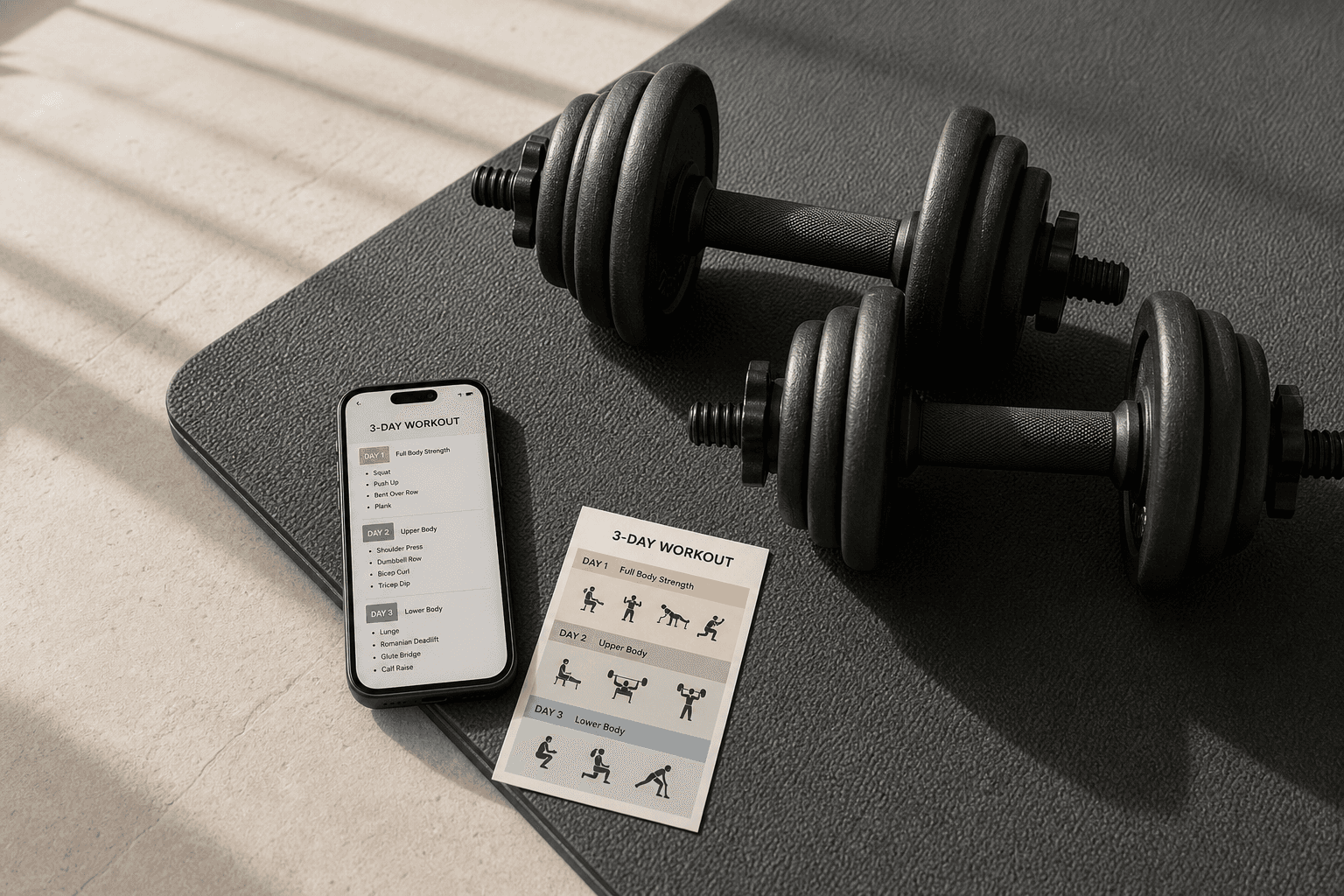
Workout sheets are essential. Write down exercises, weight, and reps every single session. Then look at what you did last week and decide how to beat it. That decision is progressive overload.
When Your Dumbbells Get Too Light
At some point, your heaviest dumbbells will feel manageable. That is a good problem. Here is how to keep progressing without buying a rack of iron.
- Pre-exhaust: Start with an isolation exercise (flyes, leg extensions) to fatigue the target muscle, then go into the compound. The muscle is pre-tired, so the compound becomes harder even with the same weight.
- Tempo manipulation: Slow down the eccentric (lowering) phase to 3 or 4 seconds. This increases time under tension without any extra weight. On a dumbbell bench press, lower slowly, pause, then press up in 1 second.
- Unilateral shifts: Switch to single-arm presses or single-leg RDLs. Each side has to handle the full load, and your core works harder to stabilize. It effectively doubles the relative intensity per limb.
- Add an extra set: If you are doing 3 sets per exercise, go to 4. Volume is a direct driver of hypertrophy.
These modifications are not a sign that you have outgrown dumbbells. They are tools that let you extend the usefulness of your existing equipment by another several months or more. Most lifters will not need to move past dumbbells for years.
A final note: the 2022 Sports Medicine review on minimal-dose resistance training concluded that lower volumes with minimal equipment can still improve strength and function. You do not need a gym to make progress. You just need a system.


Comments
Join the discussion with an anonymous comment.