
A Static Routine Stalls by Week 4
I have watched too many people settle into a three-day dumbbell circuit, run through the same exercises with the same sets and reps, and then wonder why progress flatlines after the first month. The routine was good enough to start, but it has no built-in reason to get harder. That is the problem.
Progressive overload – systematically increasing the training stimulus – is the only mechanism that keeps strength and muscle growth going. Without it, your body adapts and you spin your wheels. A meta-analysis of 13 studies with 305 subjects found that training each muscle twice a week produces significantly more hypertrophy than doing it once – 38% more growth per muscle group on average. Yet most static full‑body routines only hit each muscle once per session, so they rely on a single weekly stimulus and nothing more.
This article is not another workout to copy and paste. It is a progression framework designed to keep you gaining for 12 weeks and beyond.
Full‑body training itself has advantages for fat loss and recovery that splits cannot match. One small study found that full‑body workouts burned nearly three times as much fat mass as a split routine over four weeks – but that finding comes from a secondary citation and I treat it as suggestive, not settled. What I find harder to dismiss is the Frontiers in Physiology data showing that multi‑joint programs improved VO₂max by 12.5% versus 5.1% for single‑joint work, and squat 1RM by 13.8% versus 8.3%. Compound movements simply deliver more per minute. Combined with three sessions per week – each hitting the whole body – you get the frequency advantage without juggling a split.
The Harvard Health guidelines recommend 2–3 strength sessions per week at 70–85% of your one‑rep max. For a dumbbell‑only lifter who does not know their 1RM, that translates roughly to rep ranges of 6–15 – note that these guidelines are for the general population, but they serve as a reasonable intensity anchor. The three‑phase plan below uses those ranges in a deliberate progression.
The Three-Phase Solution: Foundation, Accumulation, Intensification
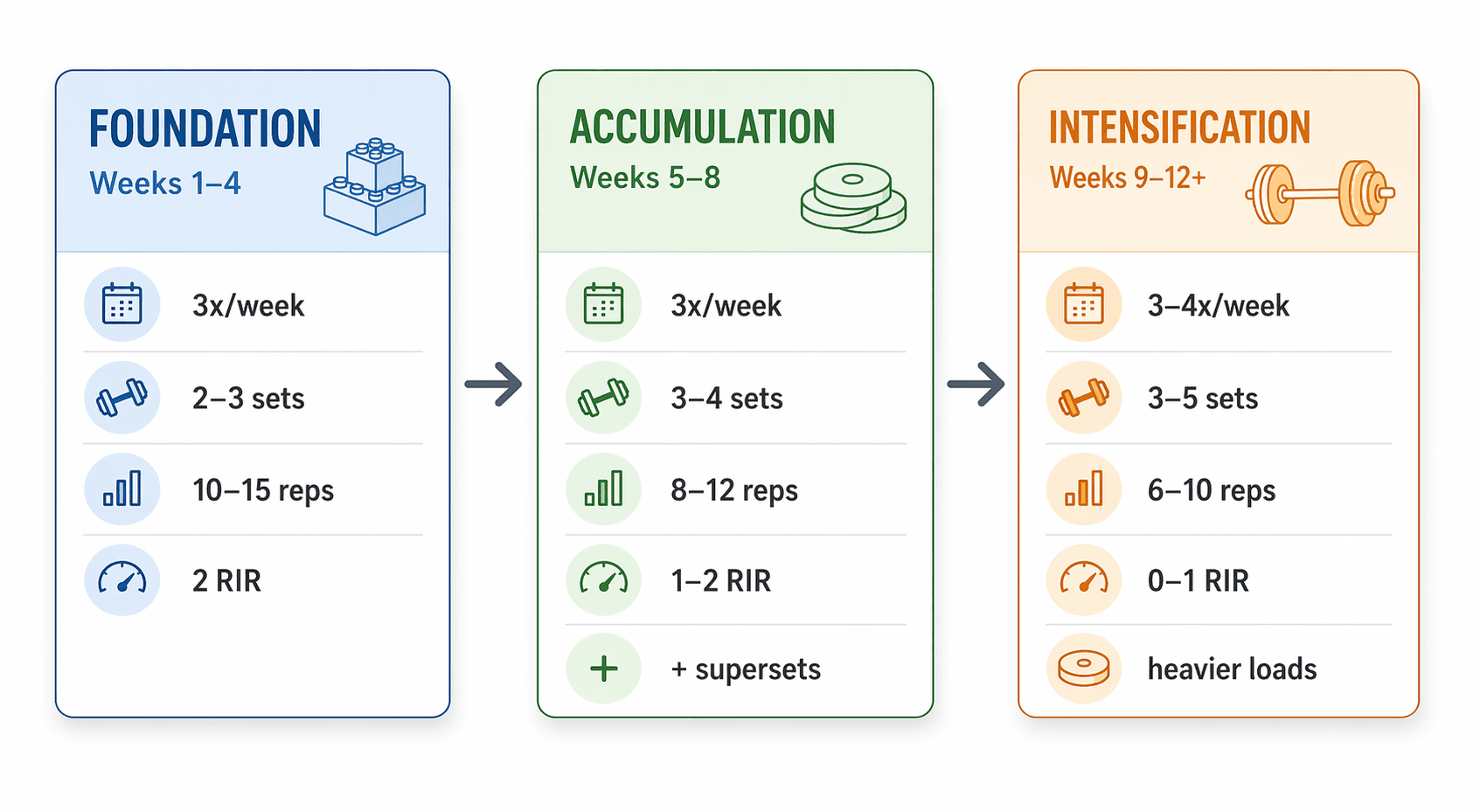
Instead of asking “are you a beginner or intermediate?” – the approach we used in our 8‑week full body dumbbell program – this plan asks “what phase of adaptation are you in?” The same person cycles through all three phases as they progress. Every four weeks a training variable shifts – sets, reps, RIR, rest periods, supersets – and the stimulus stays fresh.
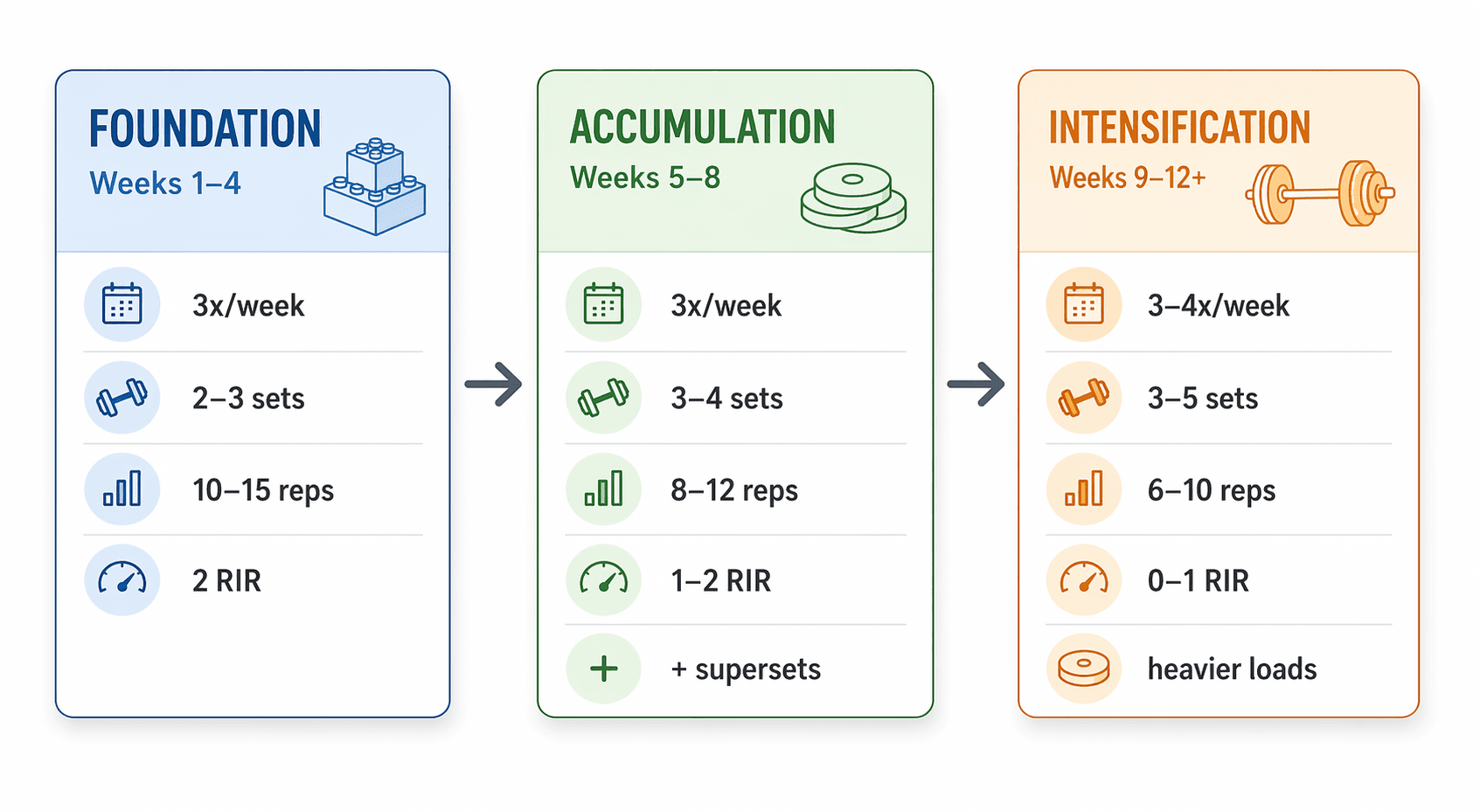
Here is the high‑level map:
| Phase | Weeks | Sets | Reps | RIR | Rest | Key Focus |
|---|---|---|---|---|---|---|
| Foundation | 1–4 | 2–3 | 10–15 | 2 | 60–90s | Movement quality, connective tissue adaptation |
| Accumulation | 5–8 | 3–4 | 8–12 | 1–2 | 30–60s (supersets) | Volume and metabolic stress |
| Intensification | 9–12+ | 3–4 | 6–10 | 0–1 | 90–120s | Strength and muscular density |
Each phase uses the same base exercises, but the rep schemes and set counts change. You are not learning new moves every month – you are applying a different stimulus to the same movements.
Phase 1: Foundation (Weeks 1–4)
The first month is about teaching your body the movement patterns and letting connective tissue adapt. Higher reps (10–15) with moderate weight keep stress low enough to avoid injury while building a base.
A 2021 PMC loading review found that loads as low as 30% of 1RM produce similar hypertrophy to heavier loads, as long as you train close to failure. So 10–15 reps is not a waste – it builds muscle just as well as 8–12, provided the last two reps are hard. The RIR of 2 means you stop when you could still do two more reps with good form. If you are new, RIR can be slippery – my rule of thumb: if you think you could do 2–3 more, that is about RIR 2. As you gain experience, the feeling becomes more reliable.
Your primary exercise each session is the goblet squat. Bony to Beastly calls it the best beginner squat variation, and I agree – holding the dumbbell at chest height forces your torso upright, making it easier to reach depth without falling back. It also demands core stability.
| Exercise | Sets | Reps | Notes |
|---|---|---|---|
| Goblet Squat | 3 | 10–15 | Keep dumbbell vertical against chest; go to parallel or below. |
| Dumbbell Bench Press | 3 | 10–15 | No bench? Use floor press (dumbbell starts on ground, press up from the floor). |
| One‑Arm Dumbbell Row | 3 | 10–15 per side | Support on a chair or bench; keep back flat. |
| Standing Overhead Press | 3 | 10–15 | Feet shoulder‑width; brace core; avoid arching. |
| Dumbbell Romanian Deadlift | 2 | 12–15 | Hinge at hips, keep dumbbells close to legs. |
Choose a weight that makes the last two reps of each set genuinely tough but not a grind. If you breeze through, go up next session.
Phase 2: Accumulation (Weeks 5–8)
After four weeks of foundation work, your body is ready for more total volume. Sets go up to 3–4, reps drop to 8–12, and you pair exercises into supersets – one pressing movement with one pulling movement, or a squat with a lunge. The same PMC loading review confirms that 8–12 reps at the same relative intensity produces identical hypertrophy to heavier loads, so you lose nothing while gaining the ability to handle more work.
Rest drops to 30–60 seconds between superset pairs, which keeps heart rate elevated and adds a metabolic stress component. The Garage Gym Reviews article cites a Sports Medicine review identifying 30–60 seconds as most effective for hypertrophy. Stick to that range; longer breaks from Phase 1 were necessary for the lower intensity sets, but now the volume is higher and you want the muscle to adapt under time pressure.
| Superset | Exercise A | Exercise B | Sets | Reps |
|---|---|---|---|---|
| 1 | Goblet Squat | Dumbbell Row (each side) | 4 | 10–12 |
| 2 | Floor Press (or Bench) | Dumbbell Romanian Deadlift | 4 | 10–12 |
| 3 | Standing Overhead Press | Dumbbell Reverse Lunge (each side) | 3 | 10–12 |
You can cycle the same base exercises or swap one for a similar compound move – for example, replace goblet squats with dumbbell front squats if you have the mobility. The goal is to hit every muscle group with roughly 12–16 total sets per week.
Phase 3: Intensification (Weeks 9–12+)
By week nine you have built a solid base and accumulated meaningful volume. Now you shift toward intensity. Reps drop to 6–10, RIR goes to 0–1 (meaning you stop when you genuinely cannot complete another rep with good form), and rest periods extend to 90–120 seconds to allow full recovery between heavy sets. This rep range corresponds roughly to 75–85% of 1RM, which the Harvard guidelines identify as the sweet spot for strength gains – again, a general anchor, not a precise target for dumbbell-only lifters.
You can stay at three full‑body sessions per week, or if your schedule allows, split into a 4‑day upper/lower rotation (upper, lower, rest, upper, lower, rest, rest). The sample below keeps the 3‑day full‑body format for simplicity.
| Exercise | Sets | Reps | Notes |
|---|---|---|---|
| Goblet Squat | 4 | 6–8 | Go heavier; use a challenging weight. |
| Dumbbell Bench Press | 4 | 6–8 | Floor press works if no bench. |
| One‑Arm Dumbbell Row | 4 | 6–8 per side | Focus on pulling the dumbbell into your hip. |
| Standing Overhead Press | 3 | 8–10 | Heavy enough that final reps are a grind. |
| Dumbbell Romanian Deadlift | 3 | 8–10 | Keep tension on hamstrings; do not lock out. |
How to Actually Overload: The Double-Progression Method (with a Worked Example)
The biggest reason dumbbell routines stall is that people try to add five pounds every week – an approach that works with barbells loaded with 2.5‑lb plates but fails when your smallest dumbbell jump is five or ten pounds. The solution is the double‑progression method: first add reps within your rep range, then add weight and start over at the bottom of the rep range.
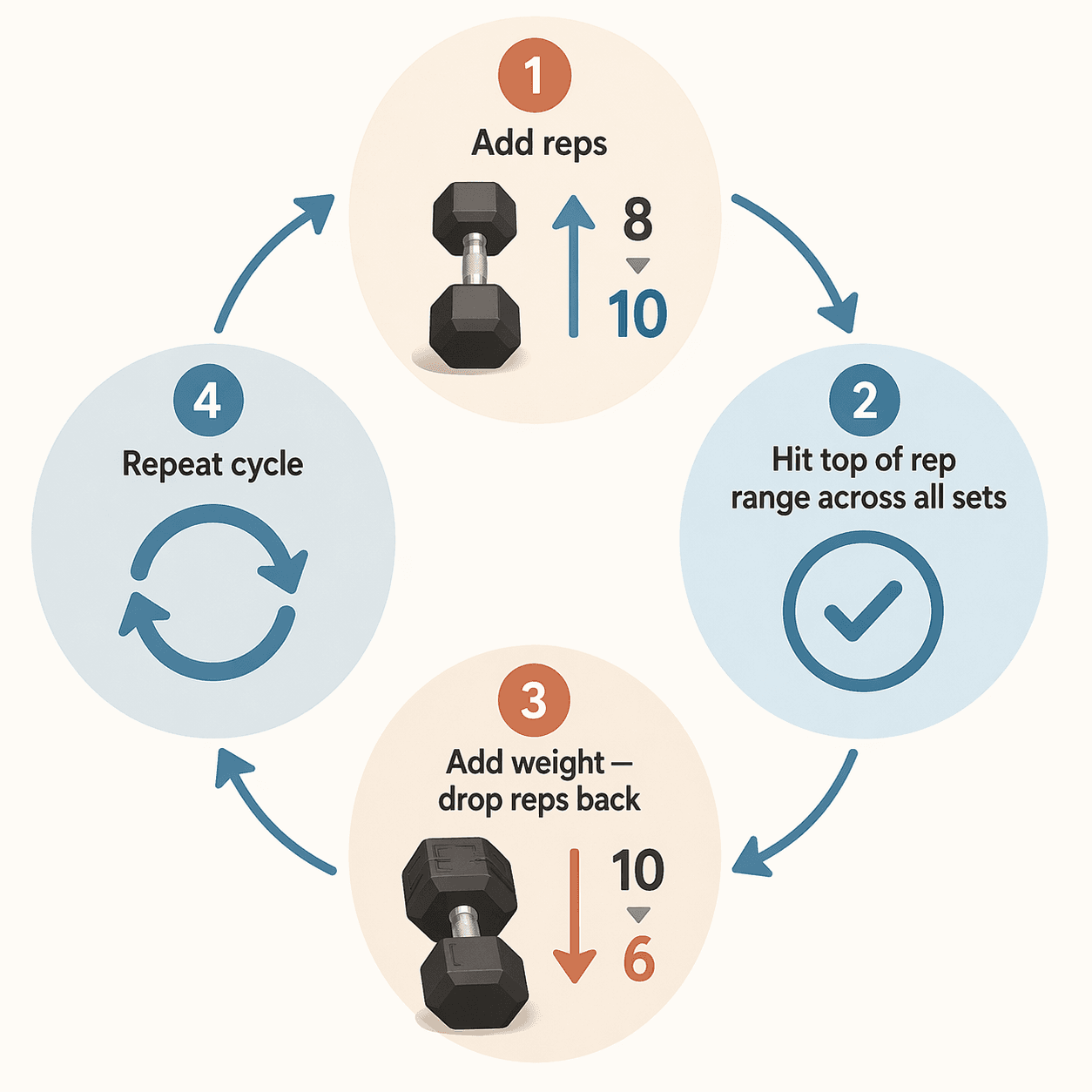
Let me show you exactly how this looks for dumbbell bench press, using the Phase 3 rep range of 6–8:
| Week | Set 1 | Set 2 | Set 3 | Set 4 | Action |
|---|---|---|---|---|---|
| 9 | 35 lb x 8 | 35 lb x 8 | 35 lb x 7 | 35 lb x 7 | Reps are in the 6–8 zone but not at the top on last two sets. |
| 10 | 35 lb x 8 | 35 lb x 8 | 35 lb x 8 | 35 lb x 7 | Hit 8 on first three sets; last set still at 7. |
| 11 | 35 lb x 8 | 35 lb x 8 | 35 lb x 8 | 35 lb x 8 | All sets hit 8 reps – time to add weight. |
| 12 | 40 lb x 6 | 40 lb x 6 | 40 lb x 6 | 40 lb x 6 | Start over at 6 reps with heavier dumbbells. |
You do not add weight until you can hit the top of the rep range across all sets with good form. That may take two weeks or three. That is normal. Once you hit 8,8,8,8, jump to the next dumbbell (40 lbs) and start at 6,6,6,6.
This rep‑first loading works for every major lift in the program. I have seen people spend months on the same squat weight because they were waiting to feel strong enough to jump five pounds. The double‑progression method gives you a clear, measurable rule: hit the top rep across all sets, then add weight. No guessing.
For a deeper dive into the system – including what to do when you stall and how to program deload weeks – check out our complete progressive overload guide.
No Bench? Here’s the Fix for All Phases
If you do not have a bench, substitute floor presses for dumbbell bench press in any phase – the range of motion is slightly shorter, but the overload logic remains the same. You can also add incline push‑ups (feet on the ground, hands on a chair) as a finisher for the upper chest. The rest of the program stays unchanged.
For Phase 2, pair exercises as supersets: goblet squat + row, floor press + RDL, overhead press + reverse lunge. For Phase 1 and Phase 3, perform each exercise as a straight set with the prescribed rest interval.
The Bottom Line: Stop Looking for a Single Workout
The workout is not the product. The progression is. A static routine will carry you through a few weeks of novelty, and then you stall. A phase‑based plan with a clear overload method – Foundation, Accumulation, Intensification, plus the double‑progression rule – keeps your body adapting because the stimulus keeps changing.
If you want a shorter commitment before jumping into 12 weeks, our 8‑week full body dumbbell program is a solid starting point. But if you are ready to commit to real, sustained progress, the framework above gives you everything you need – including the rule to follow when the weight gets easy. That is the part most routines forget.
Comments
Join the discussion with an anonymous comment.