
The No-Equipment Leg Day Blueprint: A 3-Tier Progression from Beginner to Advanced
A months-long roadmap that takes you from basic bodyweight squats to advanced pistol squats and Nordic curl progressions — using zero equipment, only your bodyweight and household items.
A person who searches for "leg workouts at home" usually wants a list of exercises. They get one, try it for two weeks, feel sore, then stall. Next search, another list. After a few cycles they conclude that bodyweight leg training cannot build real strength or size. They are wrong — but not about the exercises. They are wrong because they treated a library as a roadmap.
I have watched this happen for years. The bottleneck is never the exercise itself. It is the absence of a structured progression with honest benchmarks. A bodyweight squat in week one and the same squat in week twelve produce radically different effects — but only if you know how to change the variables. This article is that change.
What the Data Says About Bodyweight Leg Gains
Skeptics point to the lack of external load. The data disagrees.
A 2015 study in the Journal of Strength and Conditioning Research found that training three times per week with the same total load as a once-per-week group produced greater muscle mass gains. That study is cited in a Verywell Fit article that also reports 1-2 pounds of lean muscle per month is possible with consistent bodyweight strength training. Conditional on consistency and adequate protein — without those, the estimate drops toward zero.
The legs are uniquely suited to bodyweight work. They are roughly evenly split between Type I and Type II fibers, according to BuiltWithScience. That means both high-rep and low-rep approaches can drive growth — you are not locked into one rep range.
Two more numbers:
- A study by Morse et al. found a two-fold increase in muscle size in subjects who performed full range-of-motion squats compared to partial squats over eight weeks. Double the growth. That is a strong hook for why squat depth matters.
- A 2020 review (PubMed 32132843) found step-ups produced the highest gluteus maximus activation among multiple exercises, including squats, deadlifts, lunges, and hip thrusts, as cited by InBody. I should note: that review likely used barbell step-ups, not bodyweight. The movement pattern is the same, but the load difference matters.
The Real Bottleneck: Progression Logic, Not Exercise Selection
You now know bodyweight training can work. The question is: why did your previous attempts stall? Because you had a list, not a ladder.
The framework below uses three tiers: Foundation, Development, Mastery. Each tier has specific rep targets, form checks, and a clear test for advancement. Move up only when you pass the test. Do not move up because you feel bored. Boredom is not a benchmark.
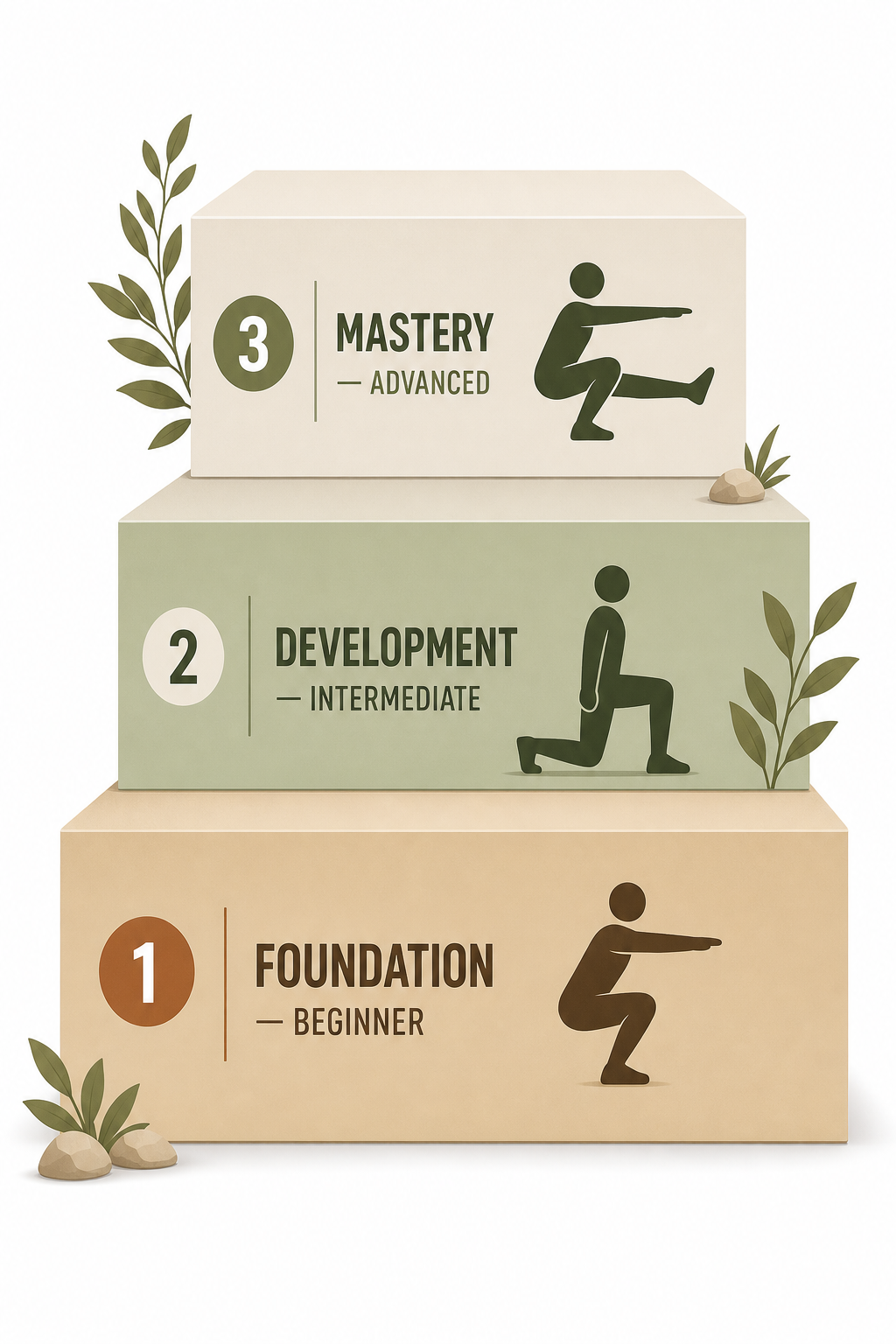
Tier 1 – Foundation: Build the Patterns with Full ROM
The goal here is not strength or size. It is movement quality. If you cannot squat to below parallel with your chest up and heels down, you are not ready for harder variations. Full range of motion is non-negotiable — the two-fold growth study above applies directly to squat depth.
Perform this circuit 2-3 times per week, resting 60 seconds between rounds.
| Exercise | Sets x Reps | Form Check |
|---|---|---|
| Bodyweight Squat | 3 x 10-15 | Below parallel, chest up, knees tracking toes |
| Reverse Lunge | 3 x 10-12 per leg | Front knee stays behind toes, back knee hovers |
| Single-Leg Glute Bridge | 3 x 10-15 per leg | Hips fully extended, not overextended |
| Copenhagen Plank (Isometric) | 3 x 15-20 sec per side | Body in a straight line, no sagging |
Advancement criteria: When you can complete 3 sets of 15 reps on all four exercises with perfect depth and no compensation (e.g., heels coming off the ground, upper back rounding), you are ready for Tier 2. If you cannot, stay here. There is no shame in repeating weeks — the goal is pattern mastery, not speed.
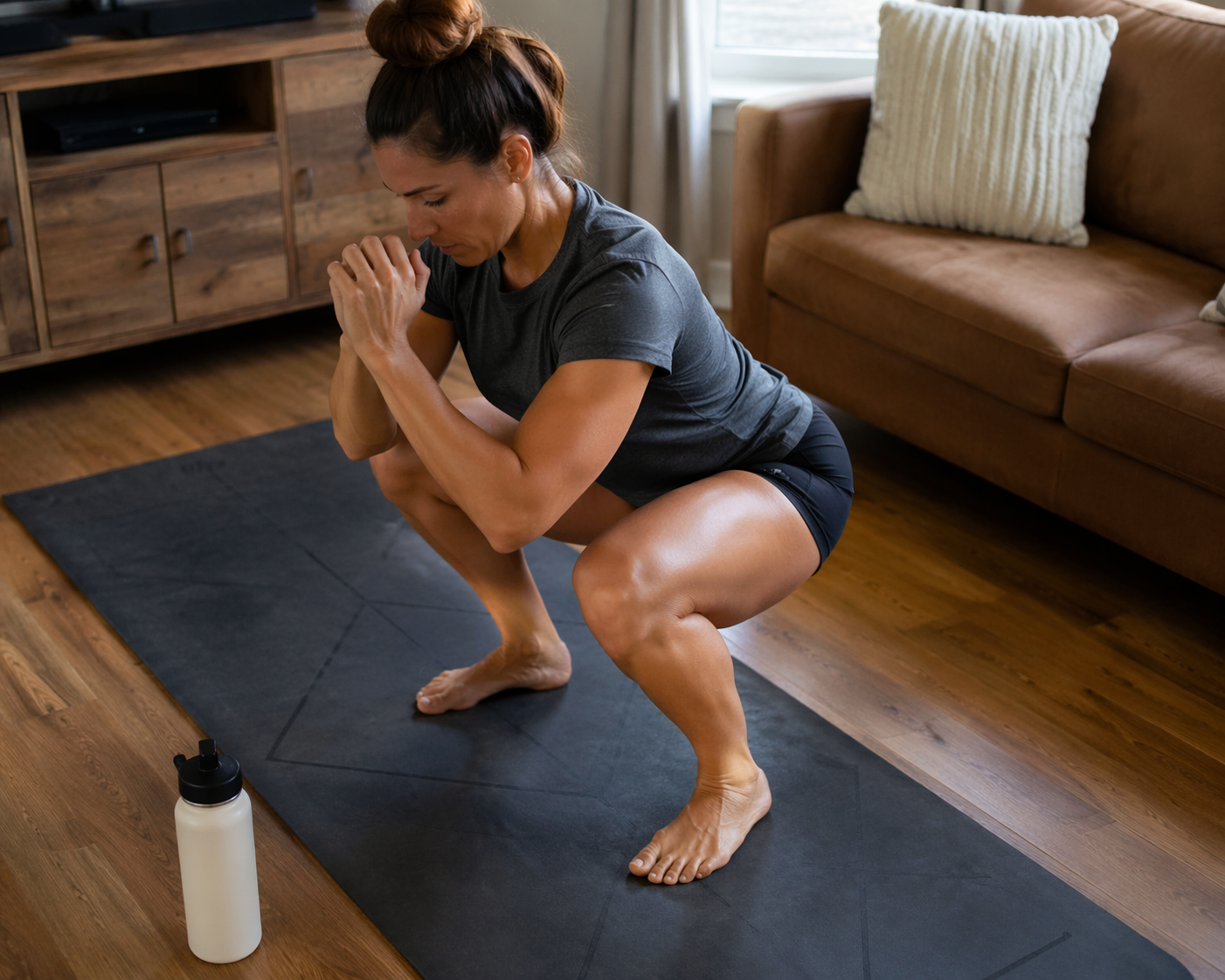
Tier 2 – Development: Unilateral Work and the APEX Circuit
Once the basic patterns are solid, you shift to unilateral loading and increased intensity. The APEX format, from ATHLEAN-X, combines an anterior chain exercise, a posterior chain exercise, an explosive exercise, and a corrective circuit for the hips. The key is the work/rest scaling: Beginner 15/15, Intermediate 20/10, Advanced 25/5. You do not get to choose your level — you self-test by completing the circuit at a given ratio with good form.
Here is the Tier 2 circuit. Perform each exercise for the set work duration, rest for the set rest duration, then move to the next. Complete 4 rounds.
| Phase | Exercise | Work : Rest (Start) | Work : Rest (Target) |
|---|---|---|---|
| Anterior | Bulgarian Split Squat (assisted if needed) | 15s : 15s | 25s : 5s |
| Posterior | Single-Leg Glute Bridge (elevated) | 15s : 15s | 25s : 5s |
| Explosive | Jump Squat (land softly) | 15s : 15s | 25s : 5s |
| Corrective | Banded Clamshell or Hip Circle Walk | 15s : 15s | 25s : 5s |
The claim that unilateral bodyweight exercises double the relative load per leg simplifies a more complex reality. Balance demands are real — a Bulgarian split squat with a wobble is not the same as a stable, controlled rep. Progress through assisted versions (holding a doorframe or chair) before attempting fully unassisted. Do not rush this. Unstable load is less effective than stable load.
Self-test for advancement: Complete all four rounds at the 25/5 ratio with consistent form, no excessive soreness the next day, and a noticeable smoothness in the explosive phase. Then — and only then — move to Tier 3.
Tier 3 – Mastery: Advanced Bodyweight Progressions
Tier 3 is where the real skill work begins. Pistol squats, shrimp squats, Nordic curl progressions, single-leg hopping. These movements demand significant strength, balance, and mobility. They also require patience — months of dedicated practice without shortcuts.
The Nordic curl progression is exceptionally hard without equipment. A bed frame, a heavy couch, or a partner holding your ankles can work, but the leverage is unforgiving. I recommend two realistic alternatives: towel leg curls (lie on your back, loop a towel around a foot, and curl the heel toward you while driving the hips up) and single-leg hip thrusts on a low surface. These hit the hamstrings hard without the joint stress of a bad Nordic attempt.
- Pistol Squat Progression: Chair-assisted → Doorframe-assisted → Full (unassisted) → Tempo (3-second eccentric) → Weighted (holding a book)
- Single-Leg Hip Thrust: Both feet on ground → One foot elevated → Pause at top → Addition of a dumbbell or water jug
- Plyometric Work: Box step-ups (using a sturdy chair) → Low box jumps (8-12 inches) → Lateral hops → Single-leg bounds (very advanced)
Advancement criteria: For pistol squats, an unassisted rep with full depth and control counts as one. When you can achieve five per leg, you may add load or tempo. For Nordic curls, a successful negative (control the descent for 3 seconds) is the starting point — a full concentric comes later. Do not aim for multiple reps immediately. These are skill movements, not volume drills.
When to Move Up: Rep Targets and Form Checks
This is the part most articles skip. Here are the explicit tests for each tier.
| Tier | Advancement Test | What to Check |
|---|---|---|
| 1 → 2 | 3x15 full-ROM squats with chest up, depth below parallel, heels down | No rounding, no heel lift, controlled tempo |
| 2 → 3 | Complete 4 rounds of APEX at 25/5 with consistent form and no soreness | Smooth transitions, no wobble on split squats, soft landing on jumps |
| 3 (progress) | 5 unassisted pistol squats per leg OR 3-second negative on Nordic curl | Full depth on pistol, no hip hinge compensation on Nordic |
12-Week Sample Calendar and Troubleshooting
Here is a workable calendar. Modify based on your schedule, but keep the progression order. Three sessions per week is the sweet spot supported by the research — the once-per-week group in the Schoenfeld study gained less muscle.
| Weeks | Tier | Frequency | Details |
|---|---|---|---|
| 1-4 | Foundation | 3x/week | Repeat the circuit, focus on depth and form. RPE should be 6-7. |
| 5-8 | Development | 3x/week | Run APEX circuit. Start at 15/15, test 20/10 after week 6, aim for 25/5 by week 8. |
| 9-12 | Mastery | 2-3x/week | Practice progressions. Alternate between pistol focus and hip thrust focus. Add plyometrics once per week only. |
Troubleshooting:
- Soreness that lingers: Reduce frequency to 2x/week, or use longer rest intervals. Do not push through sharp pain.
- Too easy: Add tempo. 3-second eccentric on any exercise increases time under tension without adding weight. Or increase reps to 20-25 for Foundation exercises.
- Plateau on advanced moves: Go back to assisted versions for 2-3 weeks. A regression is not failure — it is reinforcing the pattern.
- Boredom: Change the order of exercises, or swap in one new variation per session. But do not change the tier until you pass the test.
The Bottom Line: Structure Transforms Bodyweight Leg Training
Tier 1 builds the foundation. Tier 2 adds intensity through unilateral and explosive work. Tier 3 opens advanced progressions that few people ever reach. The entire journey takes months, not weeks, and the monthly muscle gain is real but conditional on consistency and protein.
This is not the same as an article on programming leg day for strength, hypertrophy, or endurance — that guide assumes you already have a base. This article is the on-ramp. It takes you from "I cannot do ten bodyweight squats well" to "I can do a controlled pistol squat." No equipment needed. No shortcuts.
The challenge I leave you with is simple: follow the advancement criteria, and you will progress. Skip them, and you will join the crowd of people who think bodyweight legs don't work. The choice is on which side of that crowd you want to stand.
What a small equipment investment adds
We don't have a build tagged to this exact tier yet. Browse all builds.
How often should you repeat this?
See our recovery and rest reference for citation-anchored rest-interval guidance.
Spot something off?
Tell us if a movement, tier assumption, or duration didn't match your experience.