
Best Fitness Tracker for Recovery: A Metric-by-Metric Buying Guide
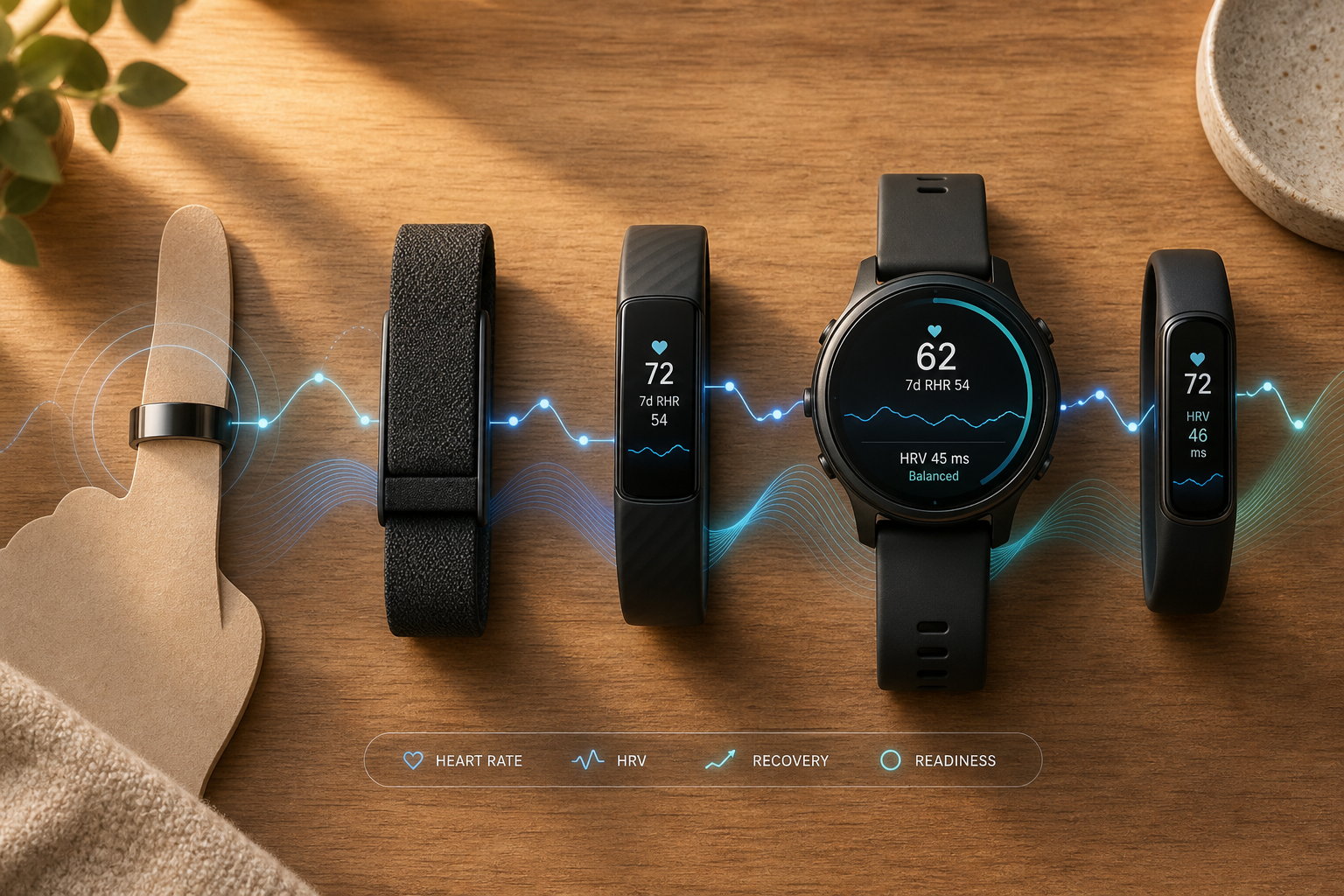
If your home fitness routine prioritizes recovery, you need a wearable that accurately tracks HRV, sleep stages, and resting heart rate. This guide ranks the top fitness trackers by recovery metric performance—not brand or price—so you can choose the right device for your training.
What Makes a Fitness Tracker Best for Recovery
You train three to six times a week. You wake up, check a readiness score, and decide whether to push or rest. That score is only useful if the wearable behind it actually knows how well you slept and how your nervous system is recovering. The best fitness tracker for general use—most features, best brand, lowest price—is rarely the best for recovery. The real question is not “which tracker has the most features” but “which tracker accurately measures the four metrics that tell you whether you’re recovered.”
That shift matters because the difference between a reliable recovery reading and a misleading one can be the difference between a smart rest day and an overtraining week. Most roundups ignore this lens. This one doesn’t.
The Four Numbers That Actually Tell You Whether You’re Recovered
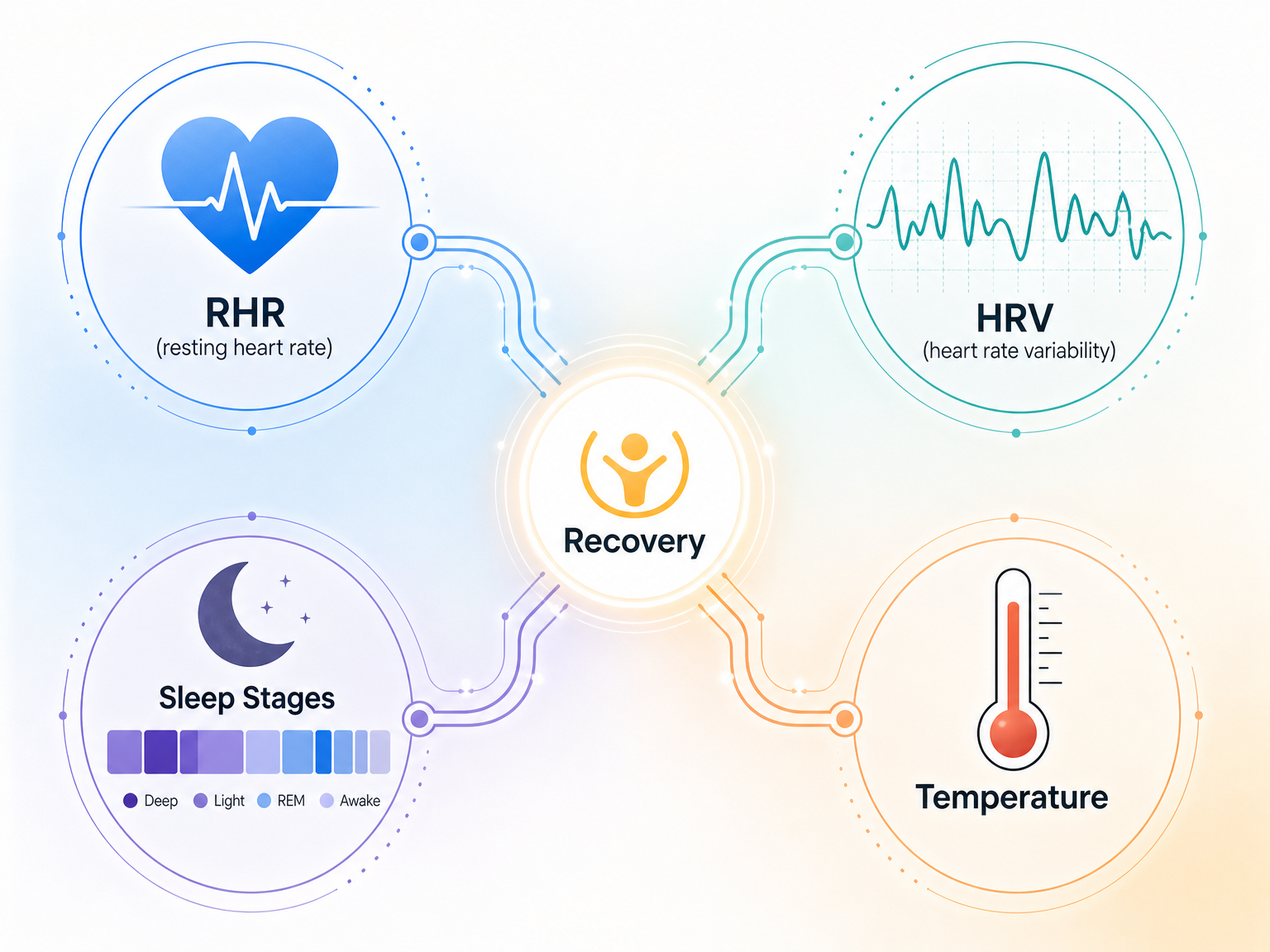
Heart rate variability (HRV) is the most direct consumer-accessible window into autonomic nervous system recovery. Higher HRV generally means you’re ready to train; lower readings suggest accumulated fatigue. Resting heart rate (RHR) trends downward as fitness improves, and a spike upward can signal insufficient recovery. Sleep staging—how much deep and REM sleep you get—affects muscle repair and cognitive recovery. Skin temperature changes can indicate illness or overtraining.
Here’s what the research says about how accurately the leading wearables measure each metric. See the full accuracy comparison.
| Metric | Oura Ring Gen4 | Whoop 5.0 | Garmin Fenix 6 | Apple Watch S8 | Fitbit Sense 2 |
|---|---|---|---|---|---|
| HRV concordance | CCC 0.99, MAPE 5.96% | CCC 0.94, MAPE 8.17% | CCC 0.87, MAPE 10.52% | Not tested in same study | Not tested in same study |
| Sleep/wake accuracy | 91.8% (96 participants) | No peer-reviewed data | No peer-reviewed data | ≥95% sensitivity | ≥95% sensitivity |
| Sleep staging (deep/light/REM) | 76–79.5%, non‑significant vs PSG | No peer-reviewed data | No peer-reviewed data | Underestimates deep sleep by 43 min, overestimates light sleep by 45 min | Overestimates light sleep by 18 min, underestimates deep sleep by 15 min |
| Heart rate | Not tested in CNET run | Not tested | Garmin Venu 4 error 3.89% | Error <1% (1.4 bpm) in CNET N=1 | Error <8% in CNET N=1 |
The Oura HRV numbers are the best consumer-wearable evidence I’ve seen. But the 2025 study that produced them had only 13 participants over 536 nights. That’s a strong signal, not a universal truth. Individual variation exists, and one study doesn’t settle the matter. The sleep staging results from PubMed are more robust (96 participants), and they show Oura’s staging is not significantly different from polysomnography—the gold standard. That alone sets it apart from Fitbit and Apple Watch, which have real, clinically measured errors that can mislead your readiness score. Source
The Insight That Saves You From Obsessing Over Absolute Numbers
After seeing that Oura rings circles around Fitbit in sleep staging accuracy, it’s tempting to think Oura is the only reliable option. But a 14-day single-person experiment from Lifehacker wearing five devices simultaneously (Oura, Apple Watch, Garmin, Fitbit, Whoop) found something that changes the conversation: while absolute HRV and RHR numbers differed (Oura gave the highest HRV, Apple Watch the lowest; RHR showed a roughly 10‑beat range), the directional trends—up, down, stable—moved together across all five devices. That means for daily readiness decisions, you don’t need a perfect HRV reading; you need to know whether you’re improving or declining. Any of these wearables can give you that. Full experiment
This doesn’t excuse poor sleep staging accuracy—if a device tells you you had more deep sleep than you actually did, you might think you recovered when you didn’t. That’s where the distinction between trend‑tracking and absolute accuracy still matters. But for HRV and RHR trends, the gap between Oura and Fitbit is smaller than the marketing would have you believe.
Tier 1: The Recovery Specialists – Oura Ring and Whoop
If raw accuracy is your priority, Oura Ring Gen4 (or the newer Gen5) is the leader. Its HRV concordance with ECG is the highest measured in any consumer wearable to date: CCC 0.99, MAPE 5.96%. Its sleep staging accuracy is the only one that isn’t statistically different from polysomnography. But Oura has real tradeoffs: it costs $349–$499 upfront plus $5.99/month for the subscription, and it’s not a real‑time workout tracker—you can’t glance at your wrist for heart rate during a set. Read our full Oura Ring review for a deeper dive.
Whoop 5.0, by contrast, is built around a strain‑to‑recovery loop. Its HRV accuracy is still excellent (CCC 0.94, MAPE 8.17%), and its daily guidance—how hard to train based on recent recovery—is more actionable than Oura’s readiness score for athletes who want prescriptive coaching. But Whoop has no screen and requires a $239/year subscription (with the device included). Over two years, that’s $478, comparable to Oura’s 2‑year total of $493–$643. Is the Whoop Fitness Tracker Worth It for Home Workouts? covers that question in detail.
| Feature | Oura Ring Gen4 | Whoop 5.0 |
|---|---|---|
| HRV accuracy (CCC) | 0.99 | 0.94 |
| Sleep staging vs PSG | Non‑significant difference | No peer‑reviewed data |
| Real‑time workout HR | No | No (no screen) |
| Subscription | $5.99/month | $239/year |
| 2‑year total cost | $493–$643 | $478 |
| Who it’s best for | Recovery purists who want the most accurate sleep/HRV data | Athletes who want daily strain‑to‑recovery coaching |
Tier 2: Garmin – The No‑Subscription Recovery Powerhouse
Garmin’s Vivoactive 6 ($300) and Forerunner 965 offer Training Readiness, Body Battery, and HRV Status without any subscription. The HRV accuracy (MAPE 10.52% for Fenix 6) is a few points behind Oura, but trend‑tracking studies suggest that gap is irrelevant for daily decisions—the directions match. Garmin also gives you built‑in GPS, 11‑day battery life (Vivoactive 6), and real‑time heart rate during workouts. Check out our guide to the best Garmin trackers for home gyms for model‑specific recommendations.
The key tradeoff: Garmin’s sleep staging hasn’t been tested as rigorously as Oura’s in peer‑reviewed studies. If precise deep‑sleep measurement matters to you, Oura is still the safer bet. But if you want a single wearable that covers recovery, workouts, and GPS without a monthly fee, Garmin is the most practical option.
Tier 3: Smartwatches with Recovery Features – Apple Watch and Pixel Watch
The Apple Watch Series 11 ($399+) has the best heart‑rate accuracy of any smartwatch (error <1% in CNET’s single‑runner lab test), and its Vitals app now surfaces overnight metrics. But its sleep staging is poor: it underestimates deep sleep by 43 minutes and overestimates light sleep by 45 minutes per the 2024 PubMed study. HRV readings also trend lower and “sometimes disagreed with trends” in the Lifehacker experiment. For a full‑featured smartwatch that happens to offer some recovery tracking, it’s fine—but “some” is the right word. Our smartwatch vs. fitness tracker decision framework can help you decide if you really need a full watch OS.
Tier 4: Budget Entry – Fitbit Charge 6 and Inspire 3
Fitbit devices under $200 (Charge 6 at $159.95, Inspire 3 at $99.95) include a Daily Readiness Score, but it requires a Premium subscription ($9.99/month). Their sleep staging accuracy is flawed—overestimating light sleep by 18 minutes, underestimating deep sleep by 15 minutes—which can make the readiness score unreliable. Step count accuracy, however, is excellent (0.32% error for Inspire 3 per Wirecutter). If your budget is tight and you just want basic recovery trends, these are usable, but the subscription cost over a year ($120) pushes the total above many better‑tracking alternatives.
The Dual‑Wielding Option: Garmin + Oura
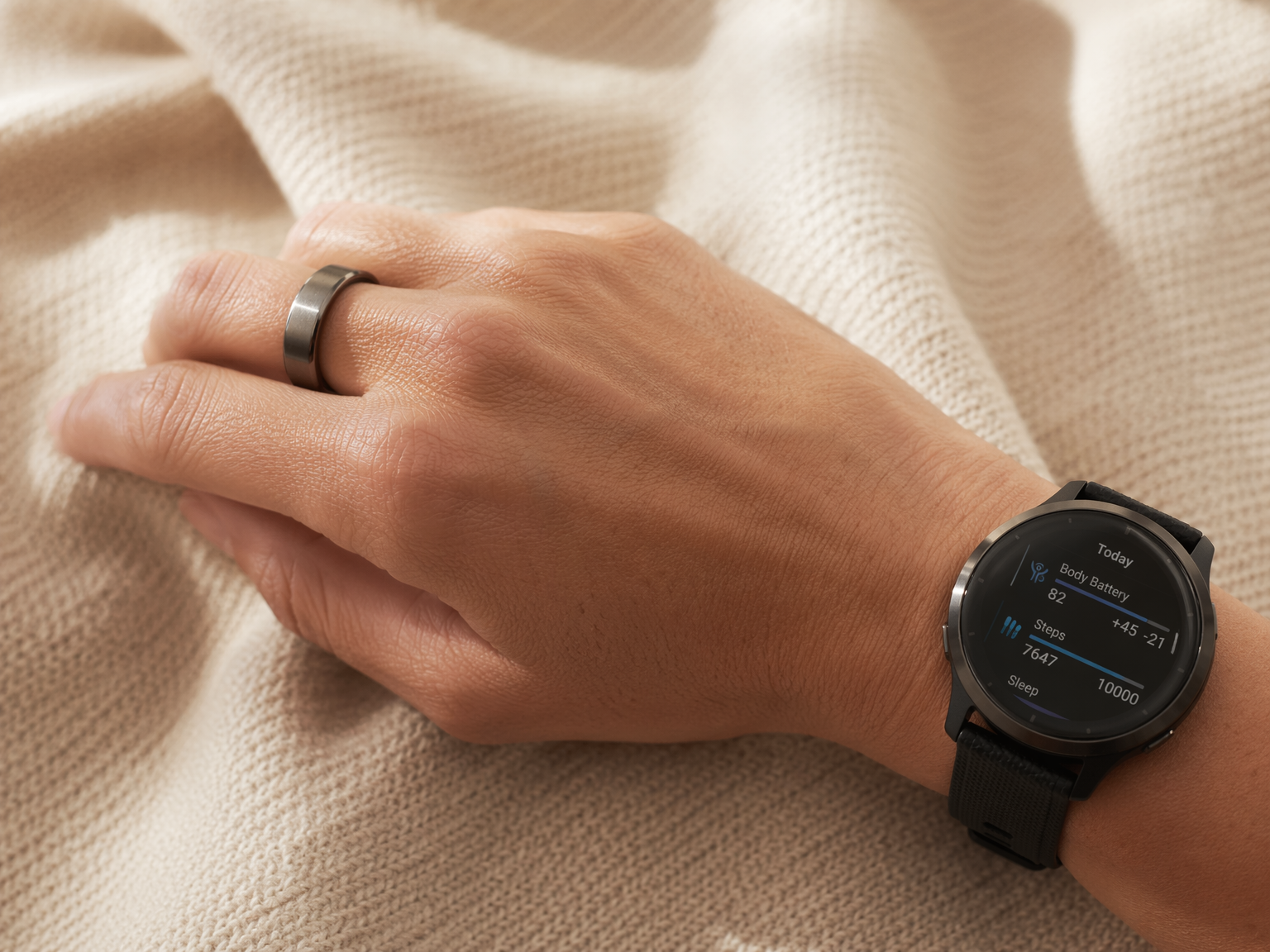
Some people wear both: Oura at night for sleep and HRV accuracy, Garmin during the day for GPS and workout metrics. It gives you the best of both worlds—but at a cost: ~$650+ upfront plus Oura’s subscription. Given that trend consistency makes a single Garmin or Oura sufficient for most users, dual‑wielding is for the tiny subset who want absolute accuracy in every domain and don’t mind wearing two devices (and charging both). Our ecosystem comparison article dives into the philosophy behind each platform if you want to pick one.
Verdict: Which Tracker Should You Buy Based on Your Recovery Priority?
| Device | Best For | HRV Accuracy | Sleep Staging Accuracy | Subscription | Battery Life |
|---|---|---|---|---|---|
| Oura Ring Gen4 | Recovery accuracy priority | CCC 0.99 | Best (non‑sig vs PSG) | $5.99/mo | 4–7 days |
| Whoop 5.0 | Strain‑to‑recovery coaching | CCC 0.94 | No peer data | $239/yr | 4–5 days |
| Garmin Vivoactive 6 | No‑subscription all‑in‑one | MAPE 10.52% | Limited evidence | None | 11 days |
| Apple Watch Series 11 | Full smartwatch + some recovery | <1% HR error | Poor (‑43 min deep sleep) | None (basics) | 18–36 hrs |
| Fitbit Charge 6 | Budget with readiness score | Not tested | Poor (+18 min light sleep) | $9.99/mo needed | 5 days |
If you want the most accurate sleep and HRV tracking, buy the Oura Ring. If you want a great recovery package without a monthly fee, buy a Garmin Vivoactive or Forerunner. If you want daily strain‑to‑recovery coaching and don’t mind a subscription, get the Whoop. For everyone else—smartwatch loyalists, budget buyers, or those who can’t stand wearing a ring—the trend consistency insight means even the cheaper devices will track your recovery direction. The real tiebreaker is form factor comfort for 24/7 wear and how much you’re willing to pay each year.
One final note: no consumer wearable tracks calories accurately. The energy expenditure MAPE was >30% for all brands in the 2022 systematic review. Don’t make diet decisions based on your tracker’s calorie burn. Focus on HRV, sleep, RHR, and temperature—that’s where the science backs up the investment.
This is general fitness education, not medical advice. For diagnosis or treatment of pain or injury, consult a qualified clinician.
Pick your next session
Browse all routines to find an appropriately-spaced next session.
Spot something off?
This content sits adjacent to health guidance — tell us if a citation or figure needs a correction.