
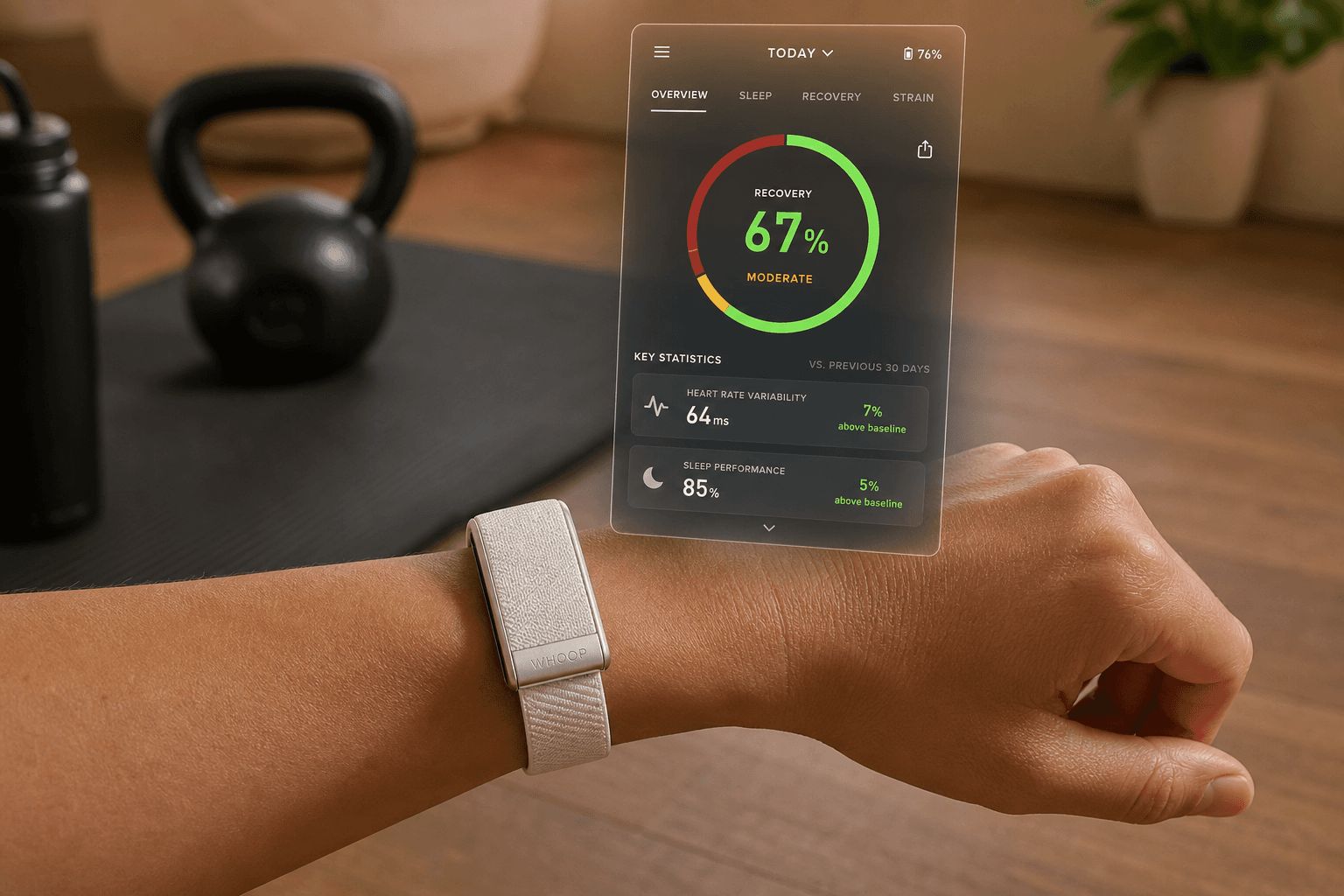
What the Recovery Score Actually Measures (And What It Doesn't)
The single most common misunderstanding among Whoop users is treating the Recovery score as a measure of how their muscles feel. It isn't. The score is a window into your autonomic nervous system (ANS) — specifically, the balance between your sympathetic (fight-or-flight) and parasympathetic (rest-and-digest) branches. When that balance tilts toward sympathetic dominance, your body is in a state of heightened physiological stress, and your Recovery score drops accordingly.
Whoop derives the score from three core metrics, each captured during specific sleep windows to minimize daytime confounders like caffeine, stress, and screen time:
- Heart Rate Variability (HRV): Measured during the last slow-wave sleep (SWS) cycle of the night. This is deliberate — slow-wave sleep is the period when external noise is lowest, producing a cleaner baseline than awake or light-sleep readings. HRV reflects how responsive your nervous system is; higher values generally indicate better recovery readiness.
- Resting Heart Rate (RHR): Weighted toward deep sleep periods. A lower RHR relative to your personal baseline signals that your cardiovascular system is recovering efficiently. An elevated RHR can indicate residual strain, illness onset, or insufficient sleep quality.
- Respiratory Rate: Your breaths-per-minute during sleep. While a smaller contributor to the overall score than HRV and RHR, an elevated respiratory rate can flag physiological stress that the other two metrics might not fully capture.
These three inputs are then modified by your sleep performance (how much you slept relative to your target) and your previous day's strain. A night of 5 hours of sleep will drag your score down even if your HRV looks good, because the system knows you haven't given your body enough time to complete the recovery cycles it needs.
What Each Color Zone Means Physiologically
Whoop translates the numerical Recovery score into a three-color traffic-light system. Each color corresponds to a distinct autonomic state, and understanding that state is the key to acting on the score correctly.
| Color Zone | Physiological State | What It Means for Training | Recommended Strain Target |
|---|---|---|---|
| Green (67%–100%) | Parasympathetic dominance — your nervous system is primed for high output. HRV is at or above your baseline, RHR is low, and sleep was sufficient. | Your body is ready to handle high-strain activities: heavy strength work, HIIT, long runs, or competitive sport. This is the day to push hard. | High strain (14–21 on Whoop's scale, depending on your baseline) |
| Yellow (34%–66%) | Mixed autonomic state — neither fully recovered nor under acute stress. HRV and RHR are within a moderate range, but not at optimal levels. | Proceed with intention. You can train, but avoid max-effort work. This is a good day for moderate steady-state cardio, technique-focused strength work, or a slightly shorter version of your planned session. | Moderate strain (10–14) |
| Red (0%–33%) | Sympathetic dominance — your nervous system is under elevated stress. HRV is below baseline, RHR is elevated, and sleep may have been insufficient or poor quality. | Your body needs recovery priority. This does not mean complete rest — it means reducing strain. Swap HIIT for Zone 2 cardio, shorten your run, or do a mobility session. | Low strain (under 10) |
The key insight here is that the color zones are relative to your personal baseline, not a universal standard. A green score for a new runner might be 68%, while an elite endurance athlete might not hit green unless they're above 85%. Whoop builds your baseline over the first two to three weeks of wear and continuously adjusts it as your fitness changes.
The Biggest Misuse: Why Red Doesn't Mean 'Skip the Workout'
This is the article's core behavioral thesis, and it's worth stating plainly: a red Recovery score is a signal to reduce your strain target, not a command to stay on the couch. The most common mistake home athletes make is treating red days as automatic rest days, which breaks training consistency and often leads to a pattern of feast-or-famine: push hard on green days, do nothing on red days, repeat.
Think of the Recovery score as a strain budget. On a green day, your budget is high — you can spend it on a heavy squat session or a 10-mile run. On a red day, your budget is low, but you still have money to spend. The question is how to spend it wisely.
- Swap HIIT for Zone 2 cardio: If your plan called for intervals, do 30–40 minutes of easy cycling, jogging, or incline walking instead. You still get the metabolic and recovery benefits of movement without the central nervous system demand.
- Shorten the session: A recovered cyclist member quoted in Whoop's own content describes this approach directly: on poor recovery days, they adjust by doing an 8-mile run instead of 12 miles. Same activity, lower dose.
- Drop the intensity, keep the volume: If you're following a strength program, reduce the working weight by 10–15% and focus on technique. You still get the movement practice and blood flow without taxing your ANS.
- Prioritize recovery activities: Use the day for mobility work, stretching, or a dedicated recovery session. These activities still register as strain on Whoop — typically in the low range — and contribute to your long-term training consistency.
This approach aligns with the 80/20 rule that many endurance athletes follow: roughly 80% of weekly training should be low-to-moderate intensity (Zone 2 or below), and only 20% should be high-strain work. If you're pushing hard on every green day and doing nothing on red days, you're likely exceeding that 20% threshold and accumulating unnecessary fatigue. The goal is to distribute strain intelligently across the week so that your high-strain days happen when your body is ready for them, and your low-strain days still move you forward.
Using the Journal Feature to Find Your Personal Recovery Drivers
One of Whoop's most underutilized features is the daily journal. Each morning, after you view your Recovery score, the app prompts you to log behaviors from the previous day: caffeine intake, alcohol consumption, sleep consistency, hydration, meditation, late-night eating, and more. Over time, the app correlates these behaviors with your Recovery scores and surfaces personalized insights about what helps or hurts your recovery.
The value here is that it replaces generic recovery advice ("get more sleep," "drink less coffee") with data specific to your physiology. You might discover that your HRV drops 15% on days when you have caffeine after 2 PM, but your partner sees no effect from the same habit. Or that a 30-minute evening walk consistently improves your sleep performance by 3–4%, while a 90-minute intense session before bed has the opposite effect.
- Be consistent: The journal is most useful when you log it daily, even on days when you think nothing notable happened. Whoop needs a critical mass of data points to detect meaningful correlations.
- Focus on modifiable behaviors: You can't control work stress or a sick child, but you can control sleep timing, evening screen use, and hydration. Prioritize journaling the factors you can actually change.
- Review the insights tab weekly: Whoop's algorithm needs time to surface reliable patterns. Checking the insights tab once a week is more productive than obsessing over day-to-day fluctuations.
The journal feature transforms Whoop from a passive data collector into an active coaching tool. Without it, you're just looking at a number. With it, you're running a continuous n-of-1 experiment on your own recovery.
Best Recovery Activities (According to Whoop Member Data)
Whoop periodically publishes aggregated member data showing which recovery activities are most commonly logged and which have the strongest correlation with next-day Recovery scores. According to their data, the five most popular activities are meditation, stretching, breathwork (labeled "increase relaxation" in the app), ice baths, and massage therapy.
But popularity doesn't equal effectiveness. When Whoop analyzed which activities had the highest positive impact on Recovery scores, two stood out:
| Recovery Activity | Impact on Next-Day Recovery Score | Notes |
|---|---|---|
| Meditation | Highest positive impact among all logged activities | Associated with decreased heart rate, improved HRV, and mood regulation. Consistent daily practice shows stronger effects than occasional use. |
| Massage therapy (close to bedtime) | ~1% positive impact | Timing matters: massage logged closer to bedtime showed roughly 1% positive impact vs. 0.6% when logged further from bedtime. |
| Massage therapy (further from bedtime) | ~0.6% positive impact | Still beneficial, but the proximity to sleep appears to amplify the recovery signal. |
| Stretching | Moderate positive impact | Commonly logged and broadly accessible. Best used as part of a consistent evening wind-down routine. |
| Ice baths | Moderate positive impact | Popular among athletes for reducing perceived soreness. Effects on HRV and RHR vary by individual. |
| Breathwork (increase relaxation) | Moderate positive impact | Low time commitment (5–10 minutes) and accessible to all fitness levels. Consistent practice appears to improve baseline HRV over weeks. |

Comments
Join the discussion with an anonymous comment.