
Why Your Home Workout Needs an Autoregulation System
If you train at home consistently, you've likely faced this dilemma: you wake up feeling flat, your legs are heavy from yesterday's squats, but your training plan says it's a HIIT day. Do you push through or take it easy? Guessing leads to two problems — either you grind through a session your body isn't ready for, increasing injury risk and digging a deeper recovery hole, or you bail on a day when you actually had more in the tank than you thought.
This is where autoregulation — adjusting training load based on your current physiological state rather than a fixed schedule — becomes a game-changer for home gym practitioners. Without a coach watching your bar speed or asking how you feel, you need an objective signal to guide daily decisions. Whoop's three core metrics — Recovery, Strain, and Sleep — provide exactly that. They give you a daily readiness score, a target for how much effort to expend, and the sleep data to understand why your readiness looks the way it does.
This article builds a complete weekly autoregulation framework around those metrics. You'll learn how to read your morning Recovery score, set a daily Strain Target, structure a fluid training week that adapts to your body, and use Whoop's Journal and Strength Trainer features to refine your approach over time. The goal is not to follow a rigid plan — it's to let your physiology write the plan each day.
The Strain-Recovery-Sleep Triad: How Whoop Measures Readiness
Before you can build a training week around Whoop, you need to understand what each metric actually represents and how they interact. The three metrics form a closed loop: sleep quality and quantity drive your recovery, your recovery score determines how much strain your body can handle, and the strain you accumulate affects your next night's sleep and subsequent recovery.
Recovery Score (0–100%)
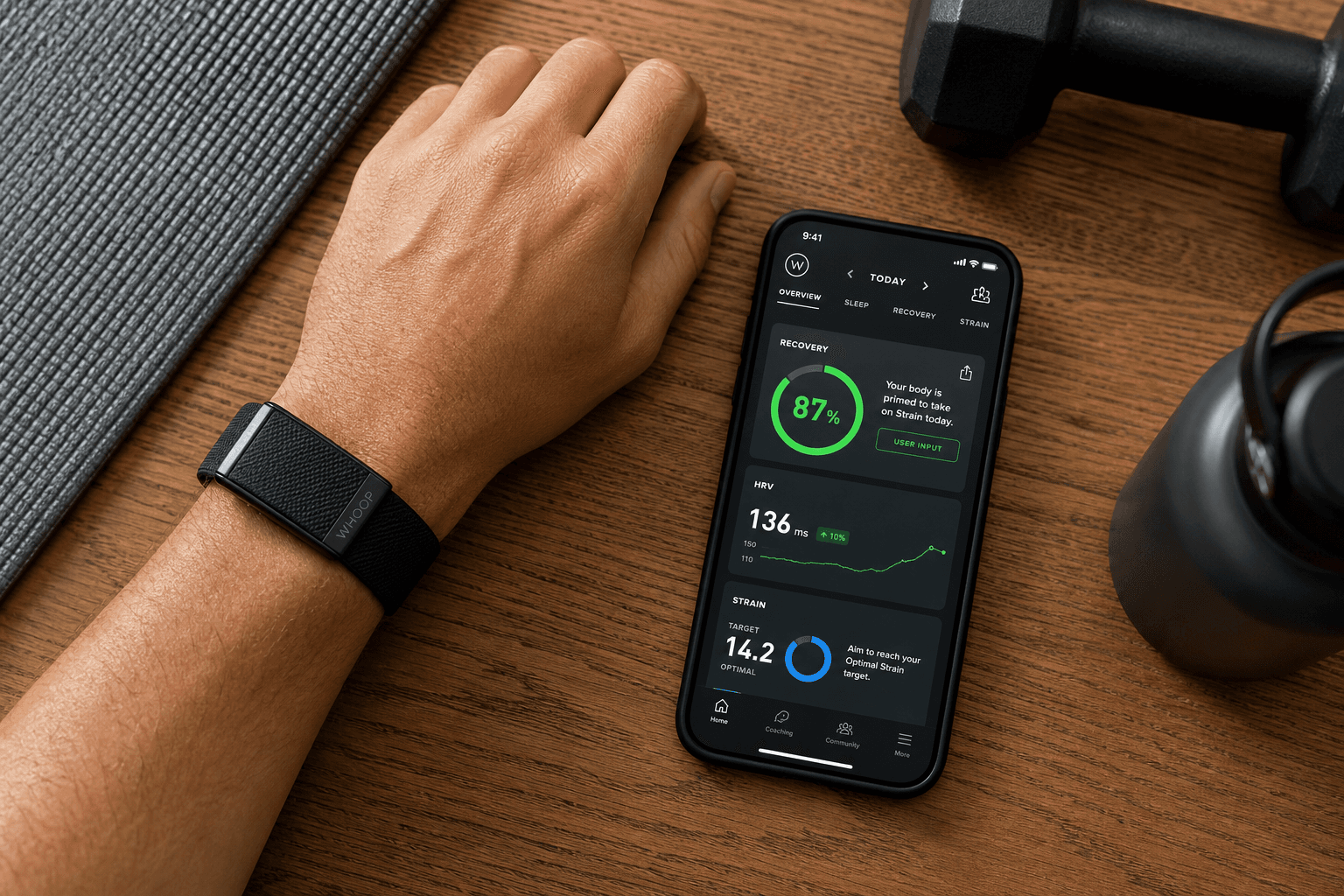
Your daily Recovery score is calculated from four overnight metrics: heart rate variability (HRV), resting heart rate (RHR), sleep performance, and respiratory rate. It is expressed as a percentage and color-coded into three zones:
- Green (67–100%): You are effectively recovered and ready for high-intensity training.
- Yellow (34–66%): You are somewhat recovered. Moderate, steady-state effort is appropriate.
- Red (1–33%): Your body is not recovered. Focus on rest and active recovery.
According to Whoop's company data, the average nightly recovery across all members is 58%. This means most people spend a fair amount of time in the Yellow zone — which is normal and expected. You don't need to be Green every day to train effectively.
Strain (0–21 Logarithmic Scale)
Strain measures the cardiovascular and muscular load your body experiences during the day. It uses a logarithmic scale, meaning each point increase represents a significantly larger effort. Whoop calculates Strain based on your personalized heart rate zones — as your fitness improves, the same activity will produce a lower Strain score because your cardiovascular system becomes more efficient.
Here are reference Strain values from Whoop's published data to help you calibrate your expectations:
| Activity | Average Strain Score |
|---|---|
| Average daily Strain (all members) | 11.0 |
| One hour of running | 12.0 |
| One hour of functional fitness | 10.1 |
| One hour of walking | 6.5 |
A critical detail for home gym users: Strain includes both cardiovascular load (heart rate duration and intensity) and muscular load from strength activities like weightlifting, functional fitness, and HIIT. Whoop's algorithm accounts for the fact that heavy squats stress your system differently than a steady run.
Sleep Performance
Sleep is the foundation of recovery. Whoop tracks sleep stages (light, deep, REM), sleep consistency, and disturbances. Your sleep performance score feeds directly into the next day's Recovery calculation. If you sleep poorly, your HRV and RHR will reflect it, and your Recovery score will drop accordingly.
How to Read Your Morning Recovery Score and Set a Daily Strain Target
The most practical daily habit you can build is a 30-second morning check-in: open the Whoop app, look at your Recovery score and color zone, and set a Strain Target for the day. This turns an abstract number into a concrete training boundary.
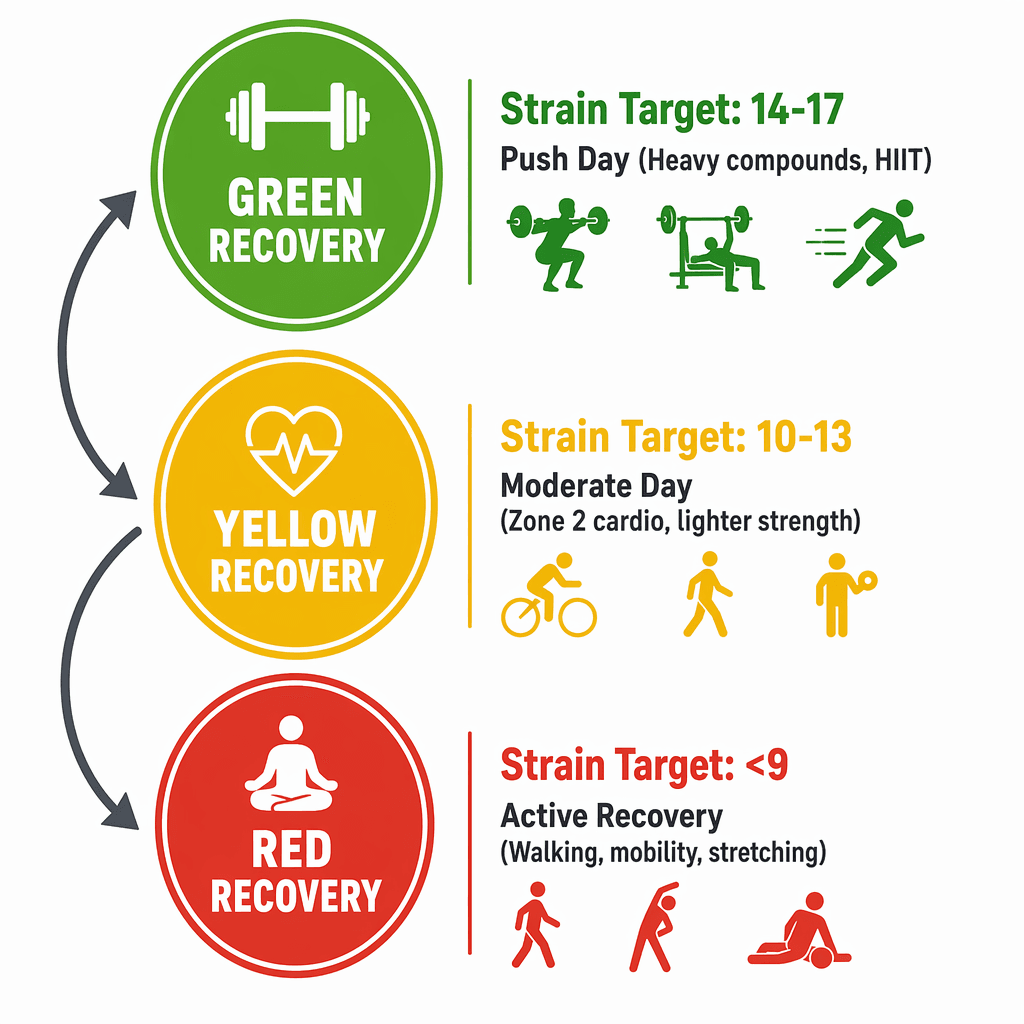
Based on Whoop's published Strain scale and scoring logic, here are recommended Strain Targets for each recovery zone:
| Recovery Zone | Strain Target Range | Recommended Training Focus |
|---|---|---|
| Green (67–100%) | 14–17 | Heavy compound lifts, HIIT, high-intensity intervals, max-effort work |
| Yellow (34–66%) | 10–13 | Zone 2 cardio, moderate strength work, technique-focused sessions |
| Red (1–33%) | <9 | Active recovery: walking, mobility, stretching, light yoga |
One of the most instructive data points from Whoop's Strain explainer is this: a workout that normally scores 9.5 Strain can register 10.5 on a low-recovery (Red) day because your cardiovascular system has to work harder to achieve the same output. This means that pushing through a Red day with your planned workout not only feels harder — it objectively places more strain on your body than it would on a Green day. That extra strain can further delay recovery, creating a downward spiral.
The practical takeaway: if you wake up Red, your job is not to see how close you can get to your normal Strain. Your job is to keep Strain below 9 and let your body catch up.
Sample Weekly Training Split Using Whoop Data
The most powerful shift you can make is moving from a fixed weekly schedule to a fluid one that adapts to your daily Recovery score. Below is a sample structure for an intermediate home gym practitioner training five days per week. The key difference from a traditional split: the day labels are not "Monday: Chest" and "Wednesday: Legs." They are "Green Day: Heavy Push" and "Yellow Day: Moderate Cardio." The actual calendar day depends on your Recovery score that morning.
| Day Type | Recovery Zone | Strain Target | Sample Workout |
|---|---|---|---|
| Push Day | Green (67–100%) | 14–17 | Heavy compound lifts (squat, bench, deadlift) or HIIT intervals |
| Moderate Day | Yellow (34–66%) | 10–13 | 30–45 min Zone 2 cardio (jog, bike, row) + accessory strength work |
| Active Recovery Day | Red (1–33%) | <9 | 20–30 min walk, full-body mobility flow, foam rolling, light stretching |
| Rest Day | Any | N/A | Complete rest from structured exercise; focus on sleep and hydration |
Here is how this might play out in a real week:
- Monday: You wake up Green. You do your heavy squat session (Strain 15.2).
- Tuesday: Yellow. You do 40 minutes of Zone 2 on the exercise bike plus pull-ups and rows (Strain 11.8).
- Wednesday: Red. You take a 25-minute walk, do a 15-minute mobility routine, and foam roll (Strain 6.2).
- Thursday: Green again. You hit a HIIT session with kettlebell swings and burpees (Strain 16.0).
- Friday: Yellow. You do a moderate upper body strength session (Strain 12.5).
- Saturday: Green. You do a heavy deadlift session (Strain 14.8).
- Sunday: Full rest day. No structured exercise.
Notice that the week still includes three strength sessions, two cardio sessions, one active recovery day, and one full rest day — but the order and intensity are dictated by your Recovery scores, not a calendar. Over a month, you will likely hit each type of session roughly the same number of times, but you will do them on days when your body is actually prepared.
Using the Journal to Correlate Habits with Recovery Outcomes
Whoop's Journal feature lets you log daily behaviors — sleep time, alcohol consumption, hydration, meditation, massage, late-night eating, and more — and then correlates those habits with your Recovery scores over time. After two to four weeks of consistent logging, the Journal analysis reveals which habits have the strongest positive and negative impact on your personal recovery.
This is where the data becomes truly personalized. General advice like "sleep more" or "drink less caffeine" is useful, but knowing that your recovery drops 4% when you eat within two hours of bedtime — while your training partner sees no effect — is actionable in a way generic tips are not.
Whoop's member data has identified several recovery activities with measurable impacts. For example, massage therapy logged closer to bedtime showed a 1% positive impact on recovery, while those logged further from bedtime showed a 0.6% impact. Other activities like meditation, stretching, breathwork, and ice baths also show overall positive effects, associated with decreasing heart rate, improving HRV, and boosting mood.
Strength Trainer: Quantifying Muscular Load in Home Workouts
One of Whoop's most underappreciated features for home gym users is Strength Trainer. This feature allows you to log your strength sessions by entering exercises, sets, reps, and weight. Whoop then uses velocity-based training principles — analyzing rep speed and weight — to calculate a muscular strain score for the session.
This is significant because no other mainstream wearable does this. Most devices estimate calorie burn and cardiovascular strain from heart rate data, but they ignore the specific muscular demands of strength training. Whoop's Strength Trainer fills that gap by accounting for the fact that a set of heavy deadlifts at 5 reps and a set of light dumbbell curls at 15 reps produce very different muscular loads, even if your heart rate is similar.
For home gym practitioners, this means you can track progressive overload more precisely. If you add 5 pounds to your squat and the rep speed stays the same, Strength Trainer will show that the muscular strain remained stable — confirming you handled the load increase well. If rep speed drops significantly, the muscular strain calculation will reflect that, and you'll know you're approaching a plateau or need a deload week.
- Log your sets in Strength Trainer immediately after each exercise for the most accurate rep speed data.
- Review the muscular strain score alongside your cardiovascular Strain to see how strength work contributes to your total daily load.
- Use the trend over weeks, not individual sessions, to assess whether your programming is driving progressive overload.
The 4 Rs of Recovery Mapped to Whoop Features
The 4 Rs framework — Rehydrate, Refuel, Repair, Rest — is a well-established model for structuring recovery. By mapping each R to a specific Whoop feature or metric, you can turn this framework into a daily checklist that your wearable helps you execute.
| Recovery Pillar | What It Means | Whoop Feature / Metric |
|---|---|---|
| Rehydrate | Restore fluid and electrolyte balance after training | Journal: log hydration to see its correlation with next-day Recovery |
| Refuel | Consume nutrients to replenish glycogen and support muscle repair | Journal: log meal timing and composition to identify patterns with sleep quality and HRV |
| Repair | Active recovery methods that support tissue healing and nervous system down-regulation | HRV and Recovery score trends; Journal: log massage, stretching, ice baths, and breathwork |
| Rest | Prioritize sleep quantity and quality for hormonal and cellular repair | Sleep performance score, sleep consistency tracking, and AI Coach recommendations |
This framework turns Whoop from a passive data dashboard into an active recovery system. Instead of just looking at your Recovery score and wondering what to do, you have a structured set of actions tied to specific features. Low HRV today? Check your Journal to see if you hydrated adequately yesterday. Poor sleep performance? Review your sleep consistency and late-night eating logs.
When Data and How-You-Feel Disagree: Balancing Objective Metrics with Subjective Feel
No autoregulation system is perfect, and there will be mornings when your Recovery score and your subjective feel are in clear disagreement. Learning to navigate these situations is what separates effective use of the data from blind obedience to a number.
Here are the two most common scenarios and how to handle them:
Green Score, Sore Legs
You wake up with a Green Recovery score but your legs feel like concrete from yesterday's squat session. Your cardiovascular and nervous systems are ready for high strain, but your muscles are still recovering from the mechanical stress of heavy lifting. In this case, the Green score is telling you your heart can handle a hard workout, but your muscles may not. The recommended approach: proceed with caution. You can do a high-intensity session that targets a different muscle group — for example, an upper body push day or HIIT on the bike — while giving your legs another day to recover. The Green score gives you permission to train hard, but you should direct that intensity away from the sore muscles.
Red Score, Feeling Fine
You wake up with a Red score but feel well-rested and energetic. This is the harder scenario because your subjective experience tells you one thing and the data tells you another. The evidence suggests you should trust the data and scale back. A Red score indicates that your autonomic nervous system is under stress — your HRV is low, your resting heart rate is elevated, or your sleep was insufficient — even if you don't feel it consciously. Pushing hard on a Red day can produce the elevated Strain effect (a workout that normally scores 9.5 might register 10.5), further delaying recovery. Start your warm-up and see how you feel after 10 minutes. If your heart rate spikes unusually fast or your perceived effort is higher than normal, honor the Red score and switch to active recovery.
Building a smarter home workout week with Whoop is not about chasing a perfect Green streak. It is about learning to read your body's signals — both the objective ones from the wearable and the subjective ones from how you feel — and using them to make better daily decisions. Over weeks and months, this approach leads to more consistent training, fewer missed sessions due to overtraining or burnout, and a deeper understanding of what your body needs to perform at its best.


Comments
Join the discussion with an anonymous comment.