
The Best Garmin Fitness Tracker for Your Home Gym: Models Ranked for Strength Training, HIIT, and Cardio
Looking for a Garmin tracker that works for indoor training and strength workouts? We rank the best models—Vivoactive 6, Venu 4, Forerunner 265, and more—by how they handle rep counting, rest timers, Body Battery, and wrist HR accuracy during lifts. Whether you're a beginner or a data-driven lifter, find the right Garmin for your home gym.
Most Garmin Reviews Are Written for Runners
You search for “best Garmin fitness tracker” and every list puts the Fenix 8 at the top. Multi-band GPS, trail maps, inReach satellite texting – a $1,000 adventure watch promoted as the pinnacle of wrist-based training. Then you set it up in your garage, start a deadlift set, and realize the rest timer is buried three taps deep. The rep counter misses every partial. The flashlight is neat, but you are six feet from a light switch.
I bought and returned three “running watches” before I figured out that most Garmin reviews are written for runners. Home fitness changes the buying equation completely. You need rep tracking that catches partials, a rest timer you can start without looking at the screen, and Body Battery that tells you whether yesterday’s squat session left you ready to train again. These features are not correlated with price. The Fenix has them, but so does the $300 Vivoactive 6 – and the Vivoactive 6 lacks the outdoor baggage you are paying for.
The counterintuitive truth: for home-gym-only use, the Fenix line is overkill. The Vivoactive 6 and Venu 4 serve this audience better at two different price points. Here is why.
Which Models Actually Work in a Garage Gym?
Garmin sells about a dozen current models. For a home gym, only four families really matter: Vivoactive, Venu, Forerunner, and Fenix. (Instinct 3 is a budget outdoor watch; skip it unless you need extreme battery for camping.) Here is how they stack up on the criteria that actually affect your workout:
| Model | Price | Rep Tracking & Rest Timer | Body Battery / HRV | Workout Animations | Wrist HR Accuracy (Strength) | Verdict for Home Gym |
|---|---|---|---|---|---|---|
| Vivoactive 6 | $300 | Full strength profile, one-tap rest timer | Yes | Yes | Elevate V4 – okay, drifts on heavy compounds | Best value |
| Venu 4 | $550 | Full strength profile, plus Live Activities on phone | Yes | Yes (plus Fitness Coach) | Elevate V5 – better, less drift | Premium pick |
| Forerunner 265 | ~$450 | Basic strength tracking, rest timer less integrated | Yes | No | Elevate V4 | Only if you run outside weekly |
| Forerunner 570/970 | ~$600–$750 | Rudimentary strength; 970 needs $170 chest strap for advanced metrics | Yes | No | Elevate V4/V5 | Overkill for indoor use |
| Fenix 8 | $800+ | Full strength, but HR tracking 'not flawless' – chest strap recommended | Yes | No | Comparable to Venu 4, but with outdoor features you pay for | Overkill |
| Instinct 3 | ~$400 | Basic activity tracking, no strength profile | Yes | No | Elevate V4 | Outdoor-focused; skip for gym |
Two things stand out. First, the Vivoactive 6 and Venu 4 are the only models in the entire lineup that include workout animations – short video clips showing proper form for each exercise. That alone makes them a better choice for anyone new to strength training. Second, the Fenix 8’s advantage (GPS accuracy, durability, inReach) is zero for a garage gym. Its wrist HR during exercise is not flawless, and you need a chest strap for reliable HR-based training anyway.
Don’t Let a Subscription Push You to a More Expensive Watch
Garmin’s new subscription ($6.99/month or $69.99/year) adds Live Activities and Active Intelligence features. After testing, WIRED concluded it’s “not worth it.” I agree. Core strength features – rep counting, rest timers, Body Battery – are free. Do not let a subscription push you toward a more expensive watch.
What I Learned After 60 Strength Sessions
I have logged about 40 strength sessions with the Vivoactive 6 and 20 with the Venu 4. Here is the honest, hands-on verdict.
- Rep counting: Works well for exercises with a clear start and end – dumbbell curls, triceps pushdowns, lat pulldowns. It misses partial reps, slow negatives, and form breaks at the top of a deadlift. I manually adjust about one set in five. Acceptable.
- Rest timer: The Vivoactive 6’s auto-rest is excellent. After you finish a set and press the set-counter, the timer starts. It beeps when rest is over. You do not touch the watch again. The Venu 4 adds the option to see and edit reps on your phone during rest via Live Activities – a nice bonus for detailed logging.
- Body Battery: A genuine tool for scheduling. After a heavy squat day, my Body Battery might charge to only 60 overnight. I know to take an easy day or a deload. The metric is based on HRV, stress, and sleep, and I find it tracks reliably. It does not measure real-time fatigue during a workout – it is a planning tool, not a spotter.
Overall, Garmin’s strength tracking is the best I have used on a wrist device. It is not perfect, but it is good enough to replace a paper logbook. The key limitation – wrist HR accuracy during high-intensity strength – is a hardware reality, not a Garmin flaw. Any wrist tracker doing the same job will have similar error.
Vivoactive 6: The $300 Watch That Gets It Right
The Vivoactive 6 is priced at $299.99 and gives you an AMOLED screen, 11-day battery, and a strength activity profile that actually works. Start a strength activity, tap the set counter, and the rest timer runs automatically. You do not need to look at the screen again until your next set.
Rep counting is decent but not perfect. It catches steady reps – curls, presses, rows – and only misses when you slow down on a partial or switch grips mid-set. That is the same limitation every wrist-based tracker has. For complex lifts like deadlifts or cleans, I manually edit the rep count afterward. It takes ten seconds.
The biggest surprise is the workout animation feature. The watch shows a short video silhouette of the exercise before you start a set. It sounds gimmicky, but when you are doing an unfamiliar movement – a single-leg press, a reverse-grip lat pulldown – it genuinely reduces the chance of wrong form. NBC News highlighted this as a differentiator, and my experience confirms it.
The trade-off: the Vivoactive 6 uses the Elevate V4 optical sensor, lacks multi-band GPS, and has no ECG. Indoors, none of that matters. The only real downside is wrist HR accuracy during heavy compounds. Studies show wrist trackers can be off by more than 30% for energy expenditure. If you need precise HR during squats, pair the watch with a chest strap. The Vivoactive 6 supports Bluetooth HR straps, and the whole setup still costs less than a Venu 4.
In February 2026, Garmin pushed a free update to the Vivoactive 6 that added Fitness Coach and sleep alignment features. That is a sign the watch is not abandoned after launch. Average Garmin replacement cycle is eight years – your $300 watch should stay relevant for many years.
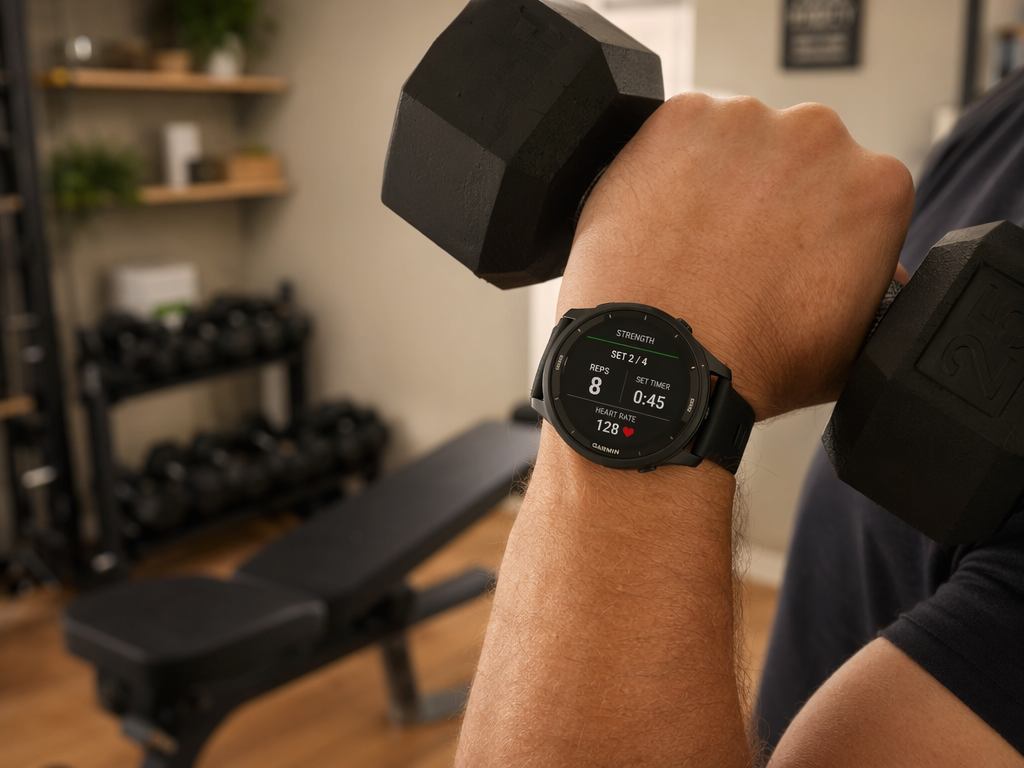
Venu 4: When You Want More Than the Baseline
The Venu 4 costs $549.99 and is the upgrade you buy when you want more than the baseline. Three concrete improvements matter for strength training: the Elevate V5 sensor, Garmin Fitness Coach, and the built-in flashlight.
The Elevate V5 HR sensor (compared to V4 on the Vivoactive) reduces wrist HR drift during heavy lifts. It is not perfect – no wrist sensor is – but my set-to-set comparisons show it is about 6–8 bpm closer to a chest strap reading on deadlifts. If you track HR zones for muscle endurance work, that matters.
Garmin Fitness Coach, added via the same February 2026 software update, gives you personalized strength plans. You input your goals, available equipment, and days per week, and the watch generates a progressive overload program with sets, reps, and rest times. It is not as deep as a dedicated app like JuggernautAI, but for $0 extra, it is a solid alternative to paying a separate subscription.
The flashlight is the feature you laugh at until you use it. In a dim garage or a basement corner, having a white light on your wrist to see equipment pin settings or a notebook is genuinely handy. The Vivoactive 6 does not have one.
The Venu 4 also adds multi-band GNSS and ECG – features still irrelevant indoors. You are paying for them, but the core strength benefits (better HR sensor, built-in coaching, flashlight) justify the $250 gap for lifters who want the best indoor experience.
Forerunner: Great for Runs, Not for the Gym
The Forerunner 265 is The Verge’s “platonic ideal for a running watch.” I agree. It is a fantastic running watch. But for strength training, it falls short.
The strength activity profile is basic: you can log sets and reps, but the rest timer is less integrated, and there are no workout animations. The interface is tailored to metrics like cadence and ground contact time, not rep tracking and Body Battery scheduling.
If you run outside three times a week and lift twice, the Forerunner 265 is a fine compromise. If you lift three times a week and run once, buy the Vivoactive 6 instead. The Forerunner 570 and 970 are even more running-centric. The 970 requires a $170 chest strap just to unlock Running Economy features. That is absurd for a home gym.
Fenix 8: Fantastic Outside, Lousy for Your Deadlift
The Fenix 8 is a fantastic outdoor watch. It is a lousy value for your deadlift session.
The argument for it usually goes: “It has every feature, and it’s rugged.” Let me dismantle that. Every feature you actually need – rep tracking, rest timer, Body Battery, HRV, workout animations – is on the Vivoactive 6 for $300. The features you pay extra for on the Fenix: multi-band GPS (useless indoors), microLED display (nice but unnecessary), inReach satellite texting ($8–$50/month subscription). The flashlight? Now on the Venu 4. The HR sensor? Comparable to the Venu 4’s Elevate V5 – and even Fenix 8 HR is “not flawless” and needs a chest strap for reliable training.
There is exactly one scenario where a Fenix makes sense for a home gym user: you do serious outdoor expeditions on weekends and want a single watch that works in both worlds. Even then, the Venu 4 handles outdoor hiking and running well enough. The Fenix only wins for multi-day hikes without charging and for satellite emergencies.
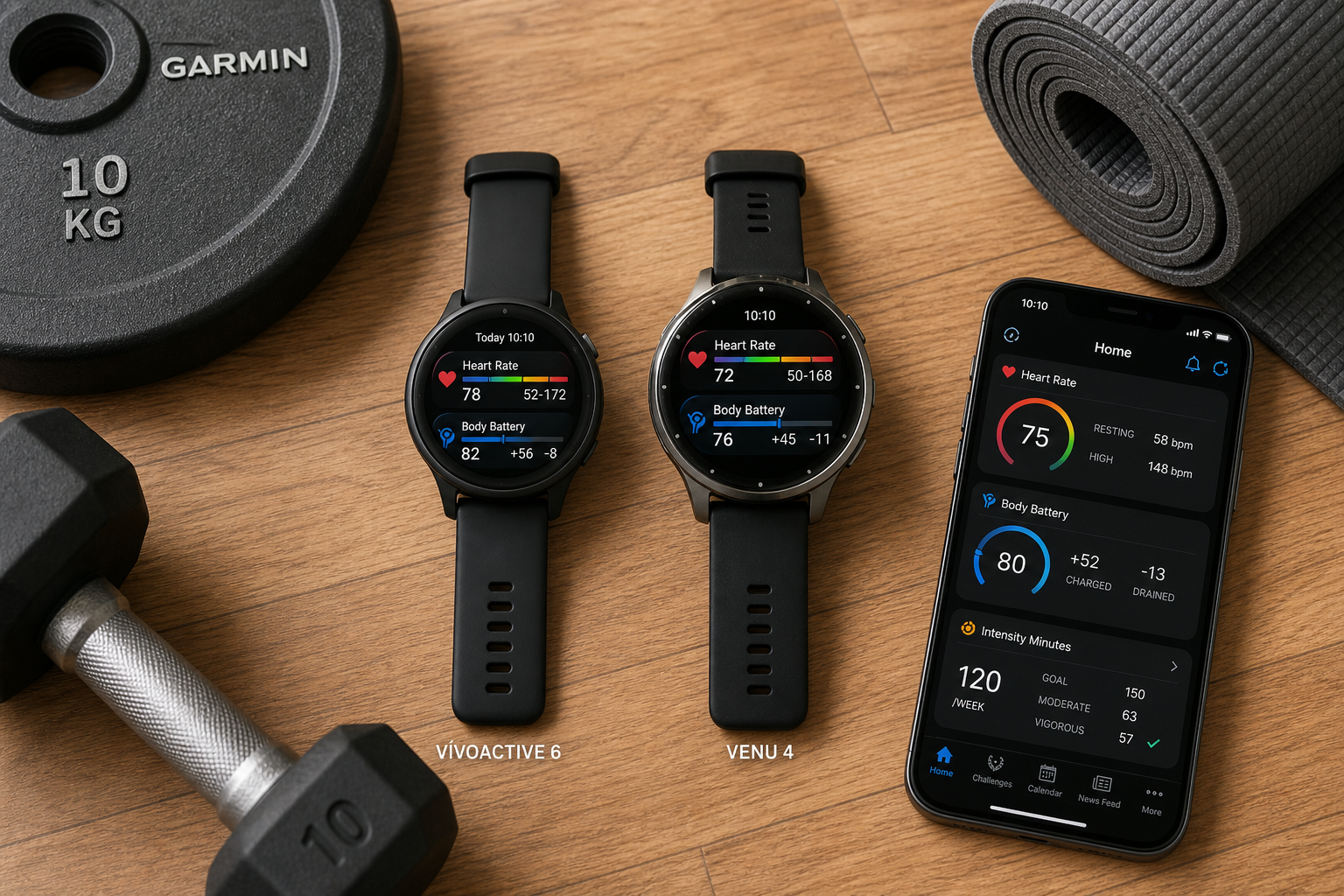
Buy This, Not That: The Final Call
Three profiles, three clear answers.
- Beginner or budget-conscious: Buy the Vivoactive 6. You get full strength tracking, workout animations, Body Battery, and eleven days of battery. No subscription needed. $300 well spent.
- Data-driven lifter who wants coaching and better accuracy: Buy the Venu 4. The Elevate V5 sensor, Garmin Fitness Coach, and flashlight justify the higher price. Pair with a chest strap if you want precise HR.
- Runner who lifts (not the other way around): Consider the Forerunner 265. But if your home gym is the primary training space, go Vivoactive 6.
Still deciding between a dedicated tracker and a smartwatch? Best Workout Tracker 2026: Fitness Band vs Smartwatch vs App for Every Training Style breaks down the full landscape.
Interested in recovery metrics beyond Body Battery? Best Fitness Trackers for Recovery in 2026: Ranked by Sleep, HRV, and Readiness Accuracy covers sleep, HRV, and readiness tracking across brands.
This result comes from one real apartment under the stated conditions — it is a strong signal, not a guarantee your space will measure identically.
Builds this evidence supports
No build currently links to this specific test. Browse all builds with a matching tag.
Spot something off?
If this result didn't match your own space, let us know — floor-damage and noise claims carry real deposit-risk consequences if we get them wrong.