
Garmin vs. Whoop vs. Oura: Which Fitness Tracker Ecosystem Is Right for Your Home Fitness Practice?
Garmin, Whoop, and Oura represent three fundamentally different approaches to fitness tracking. This comparison helps home fitness enthusiasts decide which ecosystem — real-time sports coach, passive recovery analyst, or sleep-first ring — best matches their training priorities, budget, and daily wear preferences.
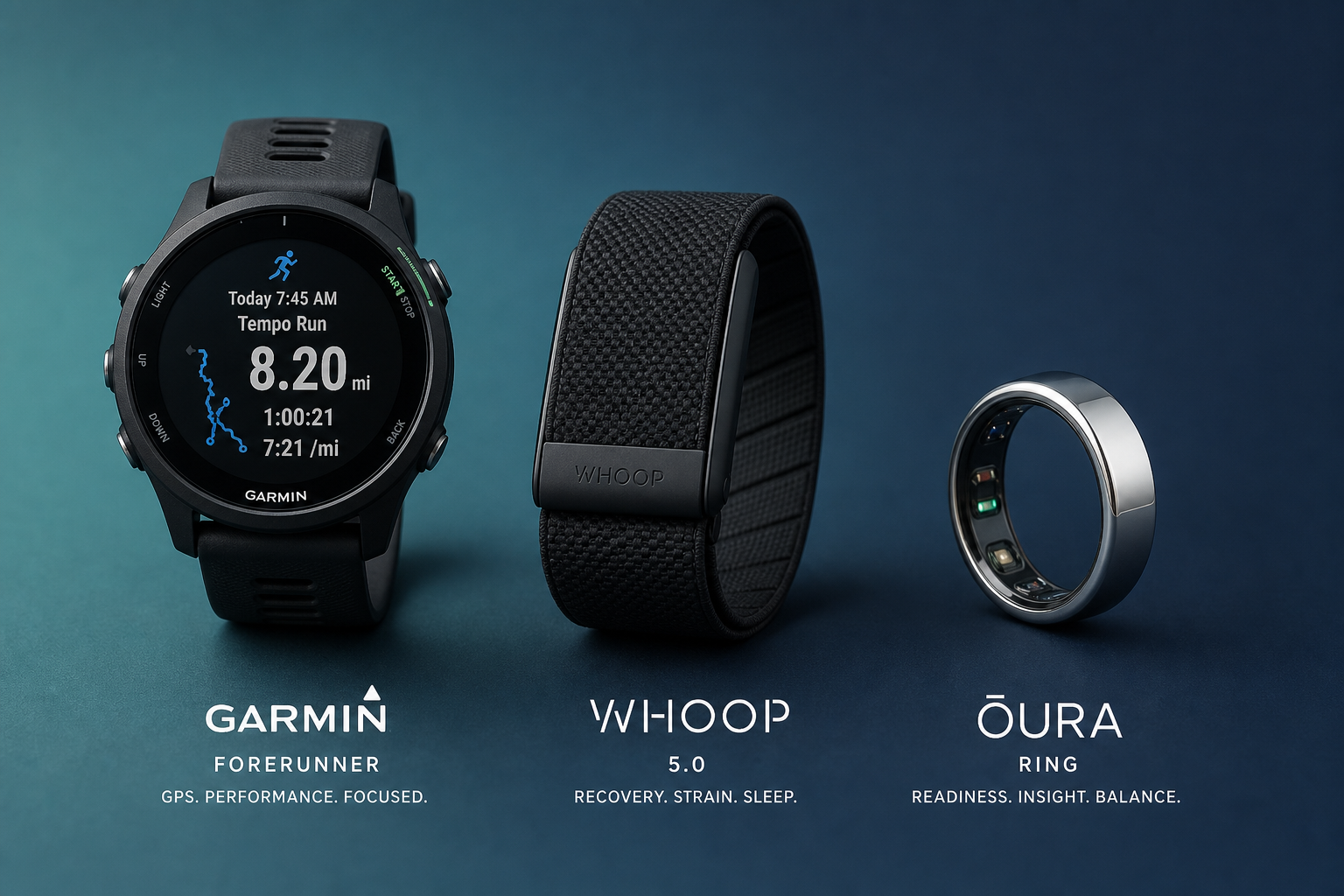
The Three Philosophies: Real-Time Coach vs. Passive Recovery Analyst vs. Sleep Specialist
Garmin, Whoop, and Oura are not just different brands competing for the same spot on your wrist or finger. They represent three fundamentally different design philosophies about what a fitness tracker should do and how it should fit into your life. Understanding these philosophies is the first step toward choosing the right ecosystem for your home fitness practice.
Garmin builds on-wrist real-time sports coaches. Its watches are designed to give you live metrics during a workout — pace, distance, heart rate, power output, and dozens of sport-specific data fields — without requiring a subscription to access the core functionality. You buy the hardware, and the essential software is included.
Whoop takes the opposite approach. It is a screenless passive recovery coach that deliberately removes the distraction of a display. You never glance at your wrist mid-run to check your pace. Instead, Whoop collects data continuously and surfaces a single daily Recovery score that tells you whether your body is ready for a hard effort or needs rest. The trade-off is that Whoop requires an ongoing subscription — you never truly own the device.
Oura is a sleep-first specialist in a compact ring form factor. Its primary focus is overnight recovery: sleep staging, heart rate variability (HRV), body temperature trends, and a daily Readiness score that tells you how well you have recovered. Workout tracking is deliberately minimal — Oura logs activity but does not coach you through it.
The right choice depends entirely on whether your priority is workout performance data, recovery optimization, or sleep quality insights. No single device excels at all three.
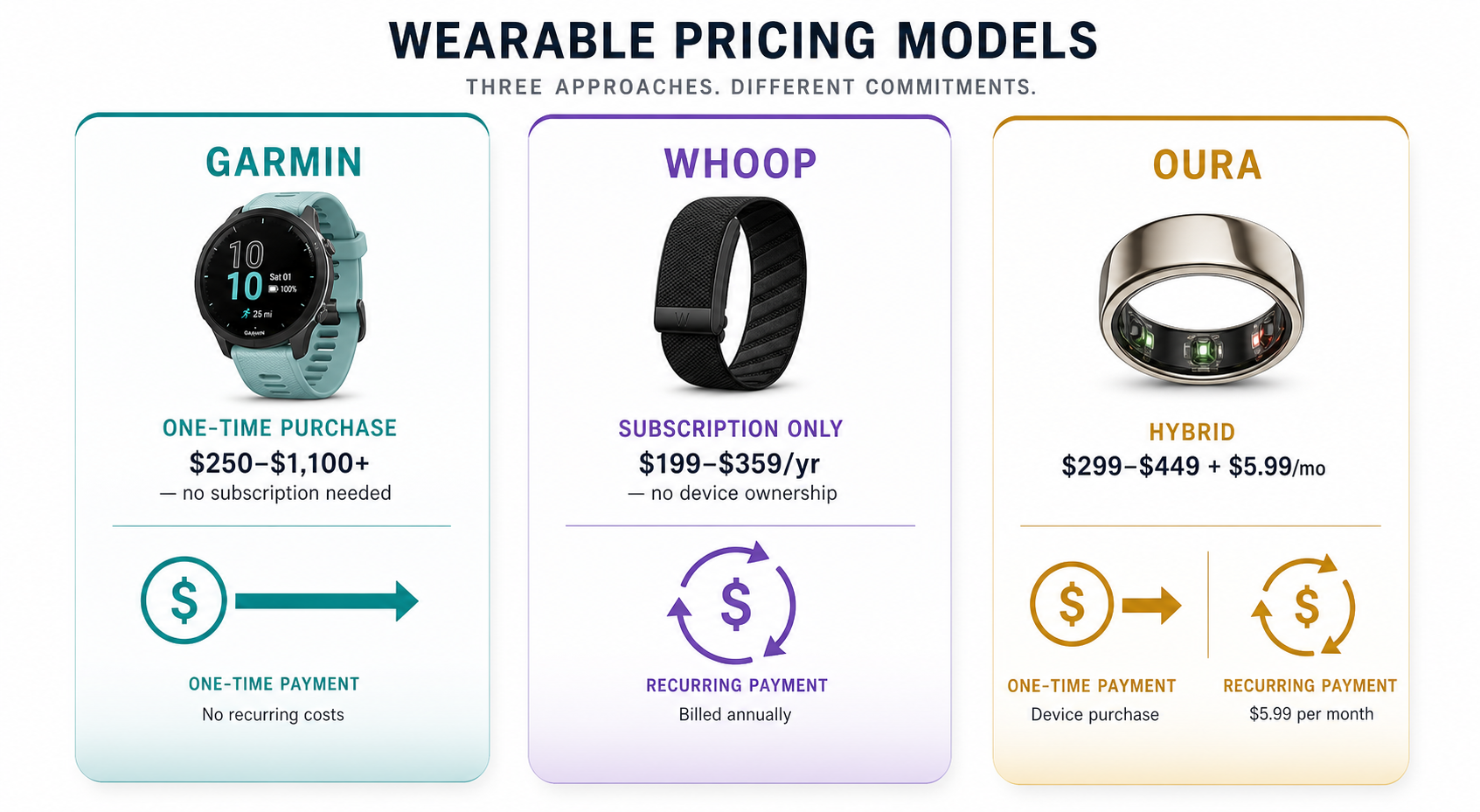
Cost Comparison: One-Time Purchase vs. Subscription Models
The total cost of ownership across these three ecosystems diverges sharply after the first year. Garmin is a one-time hardware purchase with free core software. Whoop is a subscription-only model where you never own the device. Oura sits in the middle: you buy the ring, then pay a monthly fee for the detailed analytics.
| Ecosystem | Hardware Cost | Subscription Cost | Year 1 Total | Year 3 Total |
|---|---|---|---|---|
| Garmin (Vivoactive 6) | $300 | $0 (core) or $70/yr (Connect+) | $300 | $300 |
| Garmin (Fenix 8) | $1,100+ | $0 (core) or $70/yr (Connect+) | $1,100+ | $1,100+ |
| Whoop (WHOOP One) | $0 | $199/yr | $199 | $597 |
| Whoop (WHOOP Life) | $0 | $359/yr | $359 | $1,077 |
| Oura Ring 4 | $299–$449 | $5.99/mo ($71.88/yr) | $371–$521 | $515–$665 |
Garmin's pricing spans a wide range. The Vivoactive 6 starts at around $300, the Venu 4 at $550, the Forerunner 970 at $750, and the Fenix 8 at $1,100 or more. All include free access to Garmin Connect, activity tracking, GPS, and basic sleep and health metrics. The optional Garmin Connect+ subscription adds advanced analytics but is not required to use the watch as a fitness tracker.
Whoop has no hardware purchase. You pay a subscription fee — $199/year for WHOOP One, $239/year for WHOOP Peak, or $359/year for WHOOP Life — and receive the latest band. If you cancel the subscription, the device stops working. This model works well for users who want the lowest upfront cost and plan to use the service long enough to justify the recurring fee.
Oura Ring 4 costs $299 to $449 depending on the finish and sizing kit, plus a $5.99/month membership that unlocks the detailed readiness, sleep, and HRV data that make the ring useful. Without the membership, the ring provides only basic activity and sleep scores.
For a deeper breakdown of how these costs compare across the broader wearable market, see our Fitness Tracker Hidden Costs: The Real Total Cost of Ownership in 2026 guide.
Activity Tracking: Where Garmin Dominates and Where Whoop and Oura Fall Short
If your primary use case is tracking structured workouts — runs, bike rides, strength sessions, HIIT classes, or any activity where you want real-time feedback — Garmin is the clear winner. Its multi-band GNSS (GPS, GLONASS, Galileo) provides gold-standard positioning accuracy, and its Elevate Gen 5 optical heart rate sensor has been validated to match chest strap readings during steady-state running.
Garmin offers over 100 activity profiles, each with sport-specific metrics. The Forerunner 970, for example, can track running economy, step speed loss, and vertical oscillation — metrics that previously required a separate foot pod or chest strap. However, unlocking some of these advanced metrics requires the Garmin HRM-600 chest strap, which costs an additional $170.
Whoop takes a fundamentally different approach. It auto-detects activities using your phone's GPS and accelerometer data, but it does not provide real-time metrics during the workout. You cannot glance at your wrist to see your current heart rate or pace. Instead, Whoop records the session and calculates a Strain score afterward, which feeds into your daily Recovery assessment. This works well for users who want to track overall load rather than optimize individual sessions, but it is less useful for structured training where real-time feedback matters.
Oura's activity tracking is even more minimal. The ring logs steps, active calories, and workout duration, but it is not designed to coach you through exercise. It is best thought of as a passive activity logger that complements your primary workout tracking device.
| Feature | Garmin | Whoop | Oura |
|---|---|---|---|
| Real-time GPS | Yes (multi-band GNSS) | Phone GPS only (post-activity) | No |
| Activity profiles | 100+ | Auto-detected (limited) | Basic logging only |
| Real-time heart rate | Yes (on-wrist display) | No (screenless) | No |
| Workout coaching | Yes (pace alerts, intervals, etc.) | No (Strain score post-activity) | No |
| Advanced running metrics | Yes (with HRM-600 strap) | No | No |
Sleep and Recovery: Whoop and Oura Lead, Garmin Catches Up
When it comes to sleep tracking and recovery analysis, Whoop and Oura are widely considered more accurate than Garmin's wrist-based approach. Both platforms were designed from the ground up for overnight monitoring, and their algorithms reflect that focus.
Whoop's core metric is the Recovery score, which combines HRV, resting heart rate, respiratory rate, and sleep quality into a single daily number that tells you whether your body is ready for a hard training day. Whoop also provides a Strain score that measures cardiovascular load, helping you balance effort and recovery over time.
Oura focuses even more narrowly on sleep. The ring tracks sleep stages (light, deep, REM), sleep latency, efficiency, and consistency, and combines these with nighttime HRV, body temperature, and respiratory rate to produce a Readiness score each morning. Oura's form factor — worn on the finger rather than the wrist — tends to produce more consistent sleep data because it is less likely to be disturbed by movement or positional changes during the night.
Garmin has improved its sleep and recovery tracking significantly with the Body Battery and Training Readiness features. Body Battery estimates your energy reserves throughout the day based on heart rate variability, stress, and activity. Training Readiness combines sleep quality, recovery time, HRV status, and acute load to tell you whether you are ready for a hard workout. However, a 2020 systematic review of Garmin activity trackers found that sleep time was consistently overestimated compared to diary measures. While newer sensors (Elevate Gen 4 and Gen 5) may perform better, updated systematic data have not been published.
For users who prioritize sleep and recovery data, Whoop and Oura remain the stronger choices. Garmin's Index Sleep Monitor armband ($170) can close the accuracy gap by using a dedicated sleep sensor worn on the upper arm, but this adds cost and complexity to the setup.
For a deeper dive into how these platforms compare on HRV and readiness scoring, see our guide: Which Smart Watch Actually Tracks Recovery Well? HRV, Readiness Scores, and Training Load Compared. For Oura-specific accuracy analysis, read How Oura Ring Tracks Recovery: Readiness Score, HRV Accuracy, and What the Science Says.
Design and Daily Wear: Form Factor Trade-Offs
The form factor you choose determines how the device fits into your daily life — and whether you will actually wear it consistently enough to get useful data.
- Oura Ring: The most discreet option. The ring is comfortable for 24/7 wear, including sleep, and does not interfere with other wristwear (watches, bracelets). Its small size means no screen, no notifications, and no distraction. The trade-off is limited interaction — you check the app for data rather than glancing at your finger.
- Whoop Band: Screenless and versatile. The band is lightweight and available in multiple fabric options, including a bicep band and various wristband styles. The lack of a screen makes it less intrusive during sleep and daily wear, but you lose the ability to check metrics at a glance. Whoop is designed to be worn 24/7 and is comfortable enough for most users to forget they are wearing it.
- Garmin Watches: The most feature-rich but also the bulkiest. Garmin watches range from the relatively slim Vivoactive 6 to the substantial Fenix 8, which is large enough to be noticeable under a dress shirt. The trade-off is that you get a full-color AMOLED display with maps, notifications, music controls, and real-time workout metrics. However, the bulk can make sleep tracking less comfortable, and some users find the larger models too heavy for overnight wear.
For a broader comparison of screenless trackers and how they fit into different use cases, see our Screenless Fitness Tracker Buyer's Guide 2026.
Battery Life: How Often Do You Need to Charge?
Battery life directly affects the user experience, especially for sleep tracking. A device that needs nightly charging will miss overnight data, which defeats the purpose of buying a sleep-focused tracker.
| Device | Battery Life | Charging Frequency | Sleep Tracking Impact |
|---|---|---|---|
| Garmin Vivoactive 6 | 11 days | Every 10–11 days | Minimal — charge during a shower or desk session |
| Garmin Venu 4 | 12 days | Every 11–12 days | Minimal |
| Garmin Forerunner 970 | ~7 days (varies with GPS use) | Every 5–7 days | Low — charge during a short window |
| Garmin Fenix 8 (solar) | Weeks (up to a month with solar) | Every 2–4 weeks | Very low |
| Whoop 5.0 | 4–5 days | Every 3–4 days | Moderate — charge during a low-activity window |
| Oura Ring 4 | 4–7 days | Every 4–6 days | Low — charge during a short window (e.g., shower) |
Garmin's advantage in battery life is significant. The Fenix 8 with solar charging can last weeks on a single charge, making it the best option for users who do not want to think about charging at all. Even the entry-level Vivoactive 6 lasts 11 days, which means you can charge it once every week and a half without disrupting sleep tracking.
Whoop and Oura both require charging every 4–7 days. This is manageable but means you need to plan charging windows carefully to avoid missing overnight data. Whoop's battery pack charges the device while you wear it, which helps, but the 4–5 day battery life is noticeably shorter than Garmin's.
The Dual-Wear Strategy: When Serious Athletes Wear Both Garmin and Whoop or Oura
Some athletes do not choose one ecosystem. They layer two devices — wearing a Garmin watch for workout tracking and a Whoop band or Oura ring for sleep and recovery monitoring. This approach is validated by Wareable's editorial team, which describes a Whoop 5.0 paired with a dedicated Garmin sports watch as "the ultimate setup for the serious athlete."
The logic is straightforward: Garmin handles what it does best (real-time GPS, structured workout metrics, on-wrist data during exercise), while Whoop or Oura handles what they do best (sleep staging, HRV analysis, readiness scoring, behavioral coaching). The two devices complement each other rather than competing.
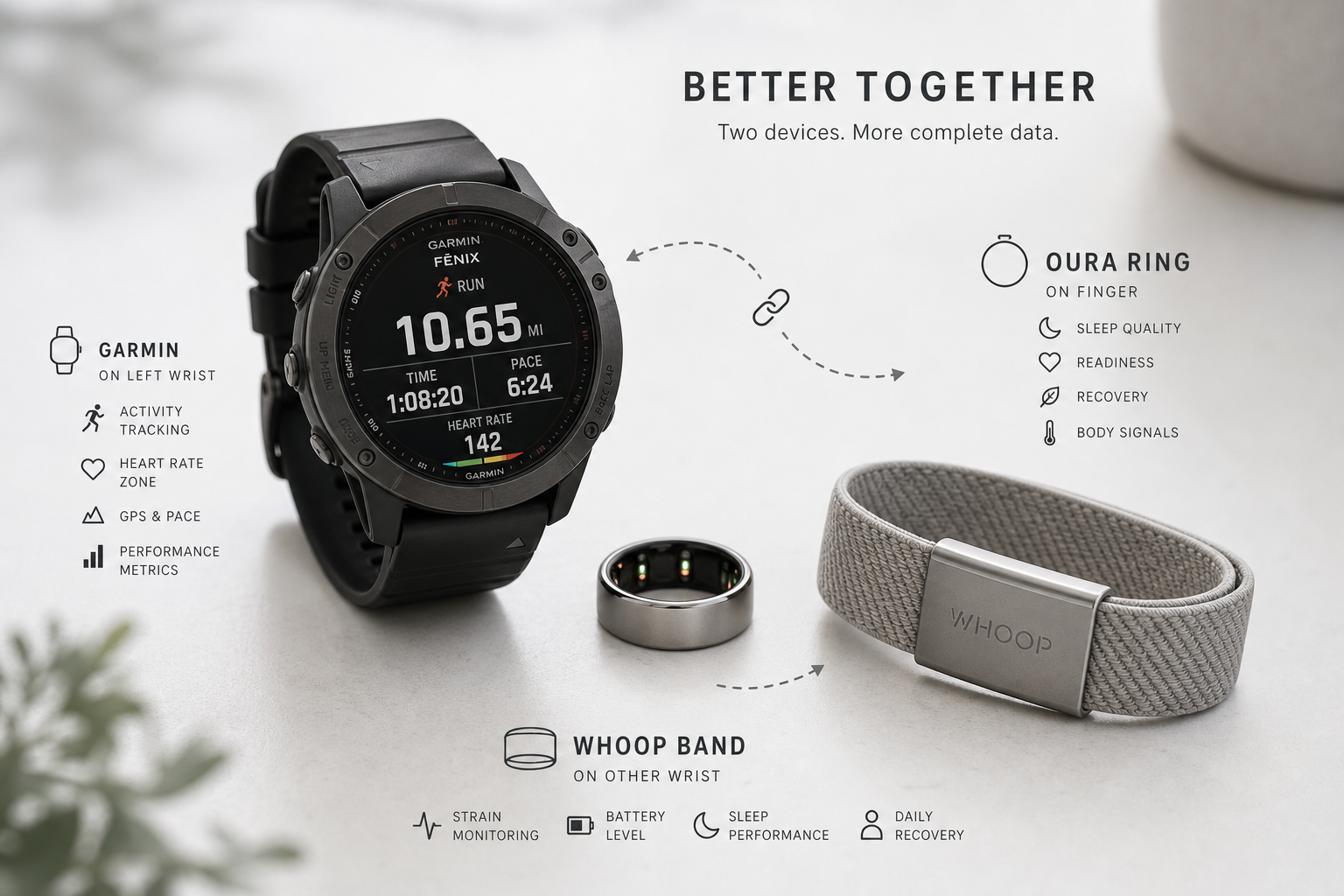
For most home fitness enthusiasts, a single device is sufficient. But if you find yourself wanting Garmin's workout metrics and Whoop's recovery insights, the dual-wear approach is a legitimate option — just be aware of the cost and complexity trade-offs.
Decision Framework: Which Ecosystem Fits Your Primary Goal?
The right ecosystem depends on your primary training goal. Use the table below to match your priority to the best option.
| Your Primary Goal | Best Choice | Why |
|---|---|---|
| Workout performance data (pace, distance, heart rate, intervals) | Garmin | Gold-standard GPS, 100+ activity profiles, real-time metrics on wrist, no subscription required for core features |
| Recovery optimization (HRV, strain management, readiness) | Whoop | Best-in-class Recovery and Strain framework, screenless design encourages 24/7 wear, behavioral coaching depth |
| Sleep quality insights (sleep stages, consistency, temperature trends) | Oura | Most accurate sleep staging in a compact, comfortable ring form factor; Readiness score combines sleep, HRV, and body temperature |
| Best of both worlds (workout tracking + recovery analysis) | Garmin + Whoop or Garmin + Oura (dual-wear) | Garmin handles workouts; Whoop or Oura handles sleep and recovery. High cost but best overall data quality |
For a deeper look at how Garmin's approach compares to the broader smartwatch category, see our Fitness Tracker vs. Smartwatch for Health Monitoring: A Decision Framework for Home Fitness Buyers.
This result comes from one real apartment under the stated conditions — it is a strong signal, not a guarantee your space will measure identically.
Builds this evidence supports
No build currently links to this specific test. Browse all builds with a matching tag.
Spot something off?
If this result didn't match your own space, let us know — floor-damage and noise claims carry real deposit-risk consequences if we get them wrong.