
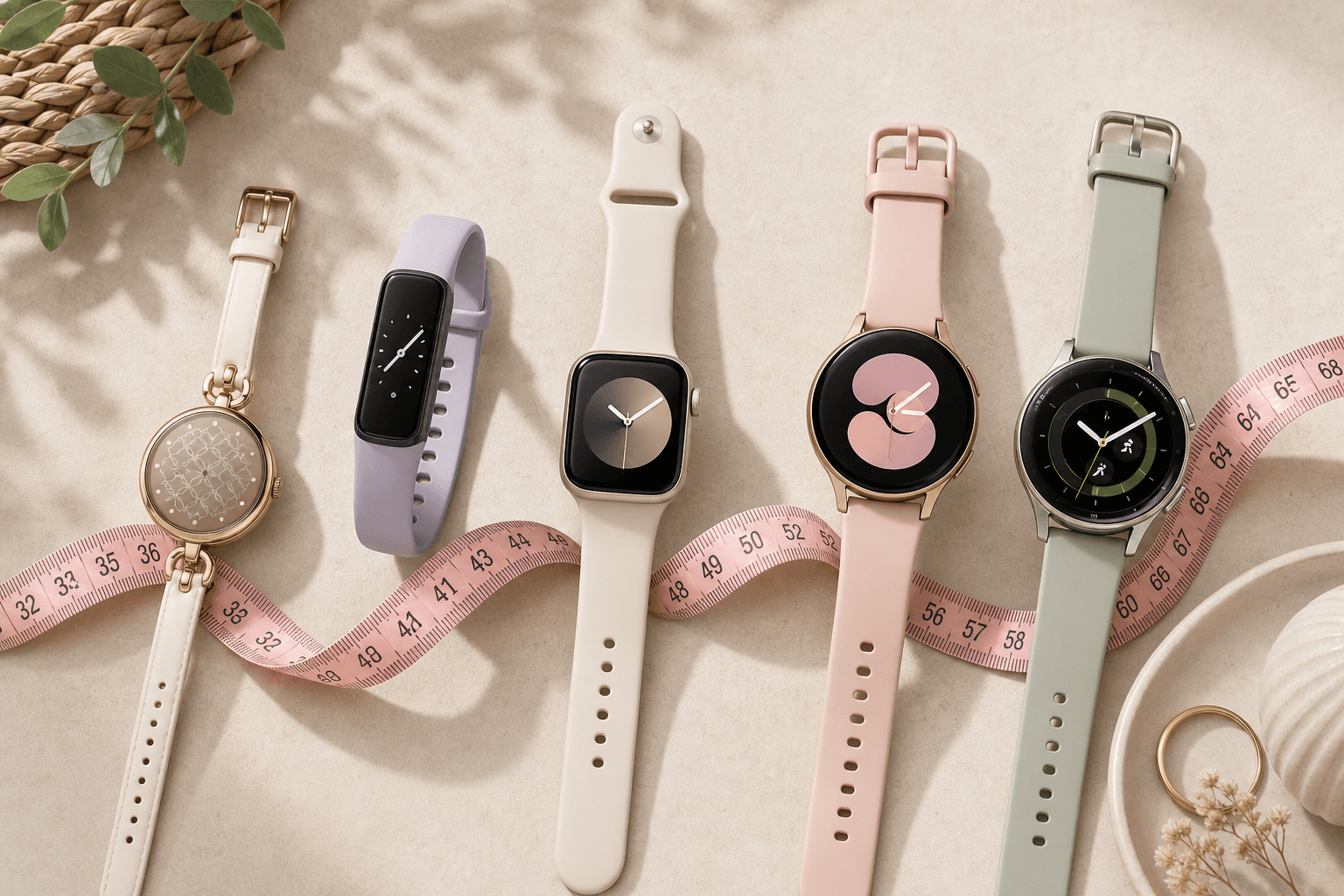
Why Most Fitness Trackers Don't Fit Women's Wrists
The wearable industry has a sizing problem. The average adult wrist circumference for women in the United States is 5.7–6.2 inches (14.6–15.7 cm), while the average for men is 6.5–7.2 inches. Yet the vast majority of fitness trackers and smartwatches are designed around the male average, with "small" bands that often start at 5.5 inches. That leaves a significant portion of women — particularly those with wrists under 5.5 inches — without a standard fit option straight out of the box.
This isn't a minor comfort issue. A tracker that doesn't fit properly can't do its job. Loose bands cause the optical sensor to lose consistent contact with the skin, degrading the accuracy of heart rate, SpO2, and HRV readings. A case that overhangs the wrist can dig into the forearm during movement or catch on clothing. And a device that's physically uncomfortable is one you'll eventually stop wearing.
Most buying guides treat wrist size as a footnote — a single line in a spec table buried under feature comparisons. This guide flips that priority. Instead of asking "Which tracker has the best features?" we start with a more fundamental question: Which trackers actually fit?
If you're also weighing use-case priorities like workout type or phone ecosystem, we have a separate guide that covers tested picks by workout type, wrist size, and feature priority. This article stays focused on one thing: finding a tracker that stays put and stays comfortable on a 5–6.5-inch wrist.
Band Size Comparison: Which Trackers Actually Fit Small Wrists?
The most reliable way to determine whether a tracker will fit is to check its band size range — specifically the minimum circumference the band can close to. Manufacturer-provided band sizes are the best starting point, though not all brands publish them clearly. Below is a comparison of the most popular fitness trackers and smartwatches, ranked by their smallest band setting.
| Model | Band Size Range (Smallest Setting) | Band Size Range (Largest Setting) | Source |
|---|---|---|---|
| Garmin Lily 2 | 4.3 in (10.9 cm) | 6.9 in (17.5 cm) | Garmin official specs |
| Apple Watch 41mm (Sport Loop) | 5.1 in (13.0 cm) | 6.3 in (16.0 cm) | Apple official specs |
| Fitbit Luxe (Small Band) | 5.3 in (13.5 cm) | 7.1 in (18.0 cm) | Fitbit official specs |
| Fitbit Inspire 3 (Small Band) | 5.5 in (14.0 cm) | 7.1 in (18.0 cm) | Fitbit official specs |
| Samsung Galaxy Watch 8 40mm (Small Band) | 5.5 in (14.0 cm) | 7.1 in (18.0 cm) | Samsung official specs |
| Fitbit Charge 6 (Small Band) | 5.5 in (14.0 cm) | 7.1 in (18.0 cm) | Fitbit official specs |
The Garmin Lily 2 stands out as the only mainstream tracker whose band accommodates wrists under 5 inches. Its 4.3-inch minimum is nearly a full inch smaller than the next closest option (Apple Watch 41mm with sport loop at 5.1 inches). For women with wrists in the 5–5.5 inch range, the choice narrows quickly: the Lily 2 and the Apple Watch 41mm with sport loop are the only devices that can guarantee a snug fit without modification.
For a side-by-side comparison tool that weighs fit alongside other factors like battery life, GPS, and subscription costs, check out our Best Fitness Tracker Decision-Matrix Guide 2026.
Case Diameter Matters: How Watch Size Affects Fit and Comfort
Band size tells you whether a tracker will close around your wrist. Case dimensions tell you whether it will sit flat and comfortable once it's on. A large case on a narrow wrist creates two problems: the case overhangs the wrist edges, causing pressure points and snagging, and the optical sensor may not maintain full contact with the skin, which degrades reading accuracy.
Case diameter is measured in millimeters across the watch face. For small wrists, anything above 42mm starts to look and feel oversized. Here's how the most petite-friendly models compare in physical dimensions.
| Model | Case Dimensions (mm) | Case Shape | Weight |
|---|---|---|---|
| Garmin Lily 2 | 35 x 15 | Rounded rectangle | ~24 g |
| Fitbit Luxe | 35 x 15 | Pill-shaped | ~26 g |
| Fitbit Inspire 3 | 37 x 16 | Pill-shaped | ~20 g |
| Apple Watch 41mm | 41 x 35 | Rectangular | ~32 g |
| Samsung Galaxy Watch 8 40mm | 40 x 40 | Round | ~30 g |
The Garmin Lily 2 and Fitbit Luxe share the same 35mm length and 15mm width, making them the smallest mainstream options. Their narrow profile means they sit flush on the wrist without overhang, even on wrists under 5.5 inches. The Samsung Galaxy Watch 8 in 40mm is notable because it is 11% thinner than the Galaxy Watch 7, according to Women's Health's hands-on review, which reduces the "bulging" effect that can occur when a thick case sits on a narrow wrist.
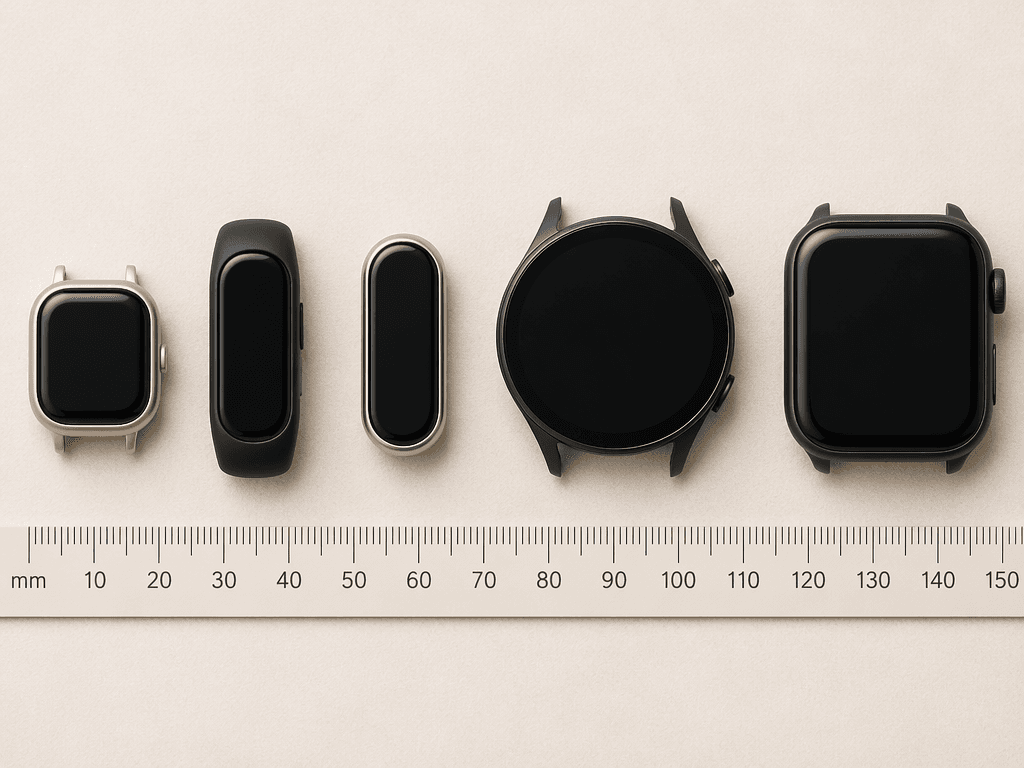
A common mistake is assuming that a smaller display means fewer features. The Garmin Lily 2 packs advanced energy monitoring, fertility tracking, and up to 5 days of battery life into its 35mm body. The Fitbit Luxe offers stress management, sleep tracking, and SpO2 monitoring in a similarly compact frame. You don't have to trade features for fit — you just have to choose models designed with smaller dimensions in mind.
Top Picks by Band Fit: From Smallest to Largest
The following recommendations are ranked by band fit — specifically, the minimum wrist circumference each device can accommodate. This is not a general "best for women" list. It is a fit-first hierarchy for women with 5–6.5-inch wrists.
1. Garmin Lily 2 — Best for the Smallest Wrists (4.3–6.9 in)
The Garmin Lily 2 is the only mainstream fitness tracker that fits wrists under 5 inches. Its 35mm x 15mm case is designed specifically for smaller female wrists, with a 14mm quick-release band that PCMag describes as "much slimmer than most smartwatch straps." The jewelry-inspired design means it looks more like a fashion accessory than a sports watch, which is a deliberate choice for women who wear their tracker all day.
- Band range: 4.3–6.9 inches
- Case: 35mm x 15mm
- Key features: Advanced energy monitoring, fertility tracking, heart rate, sleep tracking, SpO2
- Battery life: Up to 5 days
- Who it's for: Women with wrists under 5.5 inches who want a full-featured tracker in the smallest possible package
2. Apple Watch 41mm with Sport Loop — Best for Wrists 5.1–6.3 in
The Apple Watch 41mm with a sport loop band (the velcro-style fabric band) can accommodate wrists as small as 5.1 inches. This is a critical distinction: the standard sport band has fixed holes that may not provide a snug fit for smaller wrists, while the sport loop's continuous velcro adjustment allows for micro-adjustments. The 41mm case is significantly smaller than the 45mm and 49mm options, and at 32 grams it's light enough for all-day wear.
- Band range (sport loop): 5.1–6.3 inches
- Case: 41mm x 35mm
- Key features: ECG, blood oxygen, GPS, fall detection, S10 processor, always-on display
- Battery life: Nearly 2 days in testing (per PCMag and Wirecutter)
- Who it's for: iPhone users with wrists 5.1 inches and up who want smartwatch features alongside fitness tracking
3. Fitbit Luxe — Best Slim Profile for Wrists 5.3–7.1 in
The Fitbit Luxe's 35mm x 15mm tracker body is identical in length and width to the Garmin Lily 2, making it one of the most compact options available. Its small band starts at 5.3 inches, which covers most women with average-to-small wrists. The Luxe's AMOLED display and stainless steel finish give it a premium look that works for both workouts and daily wear.
- Band range (small): 5.3–7.1 inches
- Case: 35mm x 15mm
- Key features: Stress management, sleep tracking, SpO2, heart rate, activity tracking
- Battery life: Up to 5 days
- Who it's for: Women with wrists 5.3 inches and up who want a slim, stylish tracker without smartwatch features
4. Fitbit Inspire 3 — Best Budget Option for Wrists 5.5–7.1 in
At under $100, the Fitbit Inspire 3 is the most affordable option that still fits small wrists. Its small band starts at 5.5 inches, and the 37mm x 16mm case is slim enough to avoid overhang on most wrists. Wirecutter's testing found it had just 0.32% error in step count over a two-day period — the best step-count accuracy of any device they tested — and a battery life of up to 10 days (8.5 days in their testing).
- Band range (small): 5.5–7.1 inches
- Case: 37mm x 16mm
- Key features: Color AMOLED display, heart rate, sleep tracking, activity tracking, stress management
- Battery life: Up to 10 days (8.5 days in Wirecutter testing)
- Who it's for: Budget-conscious buyers with wrists 5.5 inches and up who want reliable basic tracking
5. Samsung Galaxy Watch 8 40mm — Best Android Option for Wrists 5.5–7.1 in
The Samsung Galaxy Watch 8 in 40mm is the best option for Android users with small wrists. Its 11% thinner profile compared to the Watch 7 (per Women's Health) reduces the bulk that made previous models uncomfortable on narrow wrists. The 40mm round case is 30 grams, and the small band starts at 5.5 inches. However, the same Women's Health review noted that even the small-medium band "still bulged outward" on a reviewer with a small frame, so this model is best suited for wrists at the higher end of the 5–6.5-inch range.
- Band range (small): 5.5–7.1 inches
- Case: 40mm round, 11% thinner than Watch 7
- Key features: FDA-authorized sleep apnea detection, ECG, body composition analysis, Wear OS
- Battery life: Up to 40 hours (estimated)
- Who it's for: Android users with wrists 5.5 inches and up who want a full smartwatch experience
After-Market Band Solutions: Making a Larger Tracker Fit Better
If you already own a tracker that's slightly too large, or if you want to buy a model whose band range is close to your wrist size but not quite there, after-market bands can sometimes bridge the gap. The key is understanding which band types offer the most adjustability.
- Velcro-style sport loops: These are the most adjustable option because they use continuous fabric rather than fixed holes. The Apple Watch sport loop, for example, accommodates wrists as small as 5.1 inches, while the standard sport band with holes may not close tightly enough for the same wrist.
- Third-party smaller bands: Many brands (including Nomad, Spigen, and various Etsy sellers) offer bands in smaller sizes for popular models like the Apple Watch and Samsung Galaxy Watch. Look for bands labeled "small" or "petite" that specify the minimum circumference.
- Band adapters: Some trackers with proprietary band connectors (like older Fitbit models) have third-party adapters that allow you to use standard 20mm or 22mm watch bands, opening up a much wider range of sizes.
Models to Avoid If You Have Small Wrists
Some excellent trackers simply aren't designed for small wrists. This isn't a judgment on their quality — it's a practical warning based on case dimensions and band minimums. If your wrist circumference is under 6.5 inches, the following models are likely to be too large for a comfortable, accurate fit.
- Apple Watch Ultra / Ultra 2: The 49mm titanium case is the largest Apple Watch option. It overhangs significantly on wrists under 6.5 inches, and the flat edges can dig into the forearm during wrist flexion.
- Garmin Forerunner 265 / 965 / 955: These running-focused watches have 45–47mm cases and band minimums around 5.5–5.7 inches. The large case size and 50+ gram weight make them top-heavy on narrow wrists.
- Garmin Venu 3 (45mm): The larger Venu 3 has a 45mm case. The Venu 3S (41mm) is a better option for small wrists, but its band minimum is still around 5.5 inches.
- Samsung Galaxy Watch 8 44mm / 46mm: These larger case sizes are designed for average-to-large wrists. The 40mm model is the only Galaxy Watch 8 size suitable for wrists under 6 inches.
- Most traditional smartwatches with 44–46mm cases: This includes many Wear OS watches from Fossil, Skagen, and Mobvoi, as well as the Google Pixel Watch 3 (45mm). Always check the case diameter before purchasing.
If you're drawn to a specific model on this list, consider whether an after-market band could improve the fit. But for most women with wrists under 6 inches, the comfort and accuracy trade-offs of an oversized case outweigh the feature benefits.
How to Measure Your Wrist Correctly for a Fitness Tracker
Getting an accurate wrist measurement is the single most important step before buying a tracker. Here's how to do it correctly.
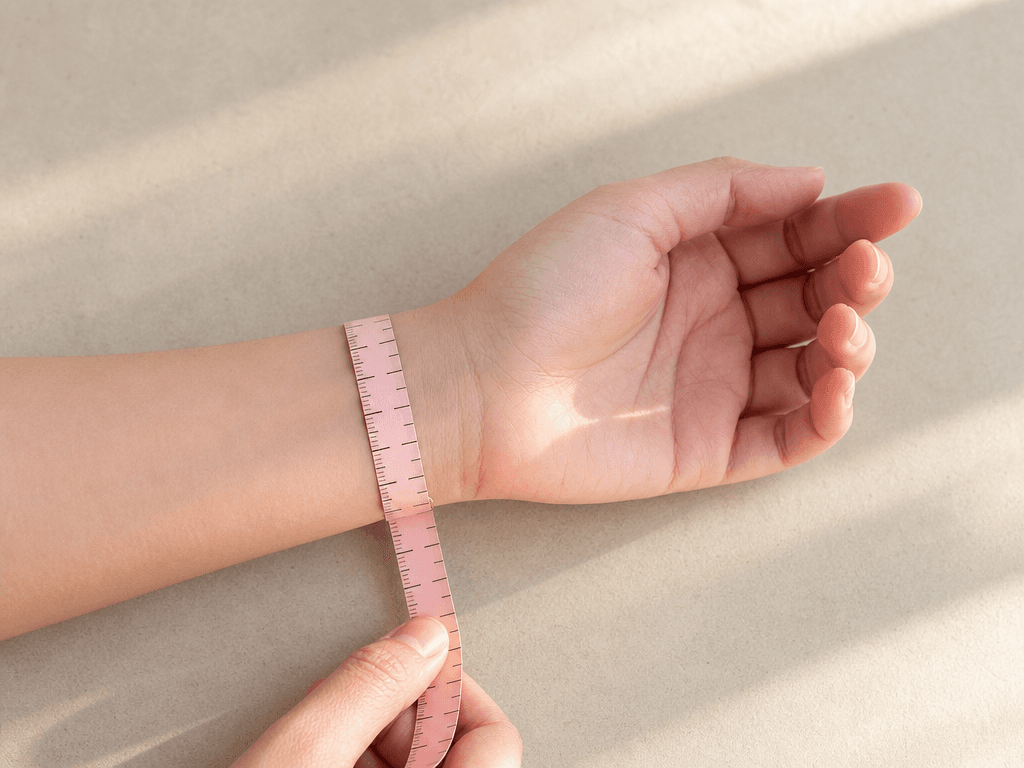
- Use a flexible measuring tape (the kind used for sewing). If you don't have one, use a strip of paper or string and then measure it against a ruler.
- Wrap the tape around the narrowest part of your wrist, which is just below the wrist bone (the ulnar styloid process). This is where a watch band naturally sits.
- Pull the tape snug but not tight. You should be able to slide one finger between the tape and your skin. A tracker needs to be secure enough to maintain sensor contact, but not so tight that it restricts circulation or leaves marks.
- Read the measurement where the tape overlaps. Write it down in both inches and centimeters, since some manufacturers list band sizes in one system or the other.
- Compare your measurement to the band size range of the tracker you're considering. Your wrist circumference should fall within the band's range, ideally with some room to spare on both ends.
If your wrist measures exactly at the minimum of a band's range, the tracker will fit but may be at the tightest setting. If it's close to the maximum, the band may not close securely. Aim for a model where your measurement falls in the middle third of the band's range for the most comfortable fit.
FAQ: Fit, Accuracy, and What to Do If Your Tracker Is Too Loose
Does a loose band affect heart rate accuracy?
Yes. Optical heart rate sensors work by shining light through the skin and measuring blood flow. If the sensor loses consistent contact with the skin — which happens when a band is too loose — the reading becomes noisy or drops out entirely. Multiple sources, including CNET and La Petite Poire, note that loose band fit is a commonly reported cause of degraded HR, SpO2, and HRV readings, especially during movement. For a detailed breakdown of how accuracy varies by metric and device, see our Fitness Tracker Accuracy for Women guide.
How can I tell if my tracker is too loose?
- The tracker slides more than half an inch up or down your wrist when you move your arm.
- You can fit two or more fingers between the band and your skin.
- The optical sensor leaves a visible gap or shows light bleeding through when you press the band.
- Heart rate readings show frequent dropouts or implausible spikes during steady-state exercise.
Will an after-market band solve accuracy problems?
Sometimes, but not always. A velcro-style sport loop can improve fit by providing more precise adjustment than a band with fixed holes. However, if the tracker's case is too large for your wrist, no band can fix the sensor alignment issue — the case itself may not sit flat against the skin. In that situation, the only reliable solution is to switch to a smaller tracker.
What if my wrist is between standard band sizes?
This is the most common fit problem. If your wrist measures 5.3 inches, for example, you're too small for bands that start at 5.5 inches but too large for the Garmin Lily 2's smallest setting. In this case, the Apple Watch 41mm with sport loop (minimum 5.1 inches) or the Fitbit Luxe (minimum 5.3 inches) are your best options. Both offer continuous or near-continuous adjustment that can accommodate in-between sizes.
Comments
Join the discussion with an anonymous comment.